


 Top Rated Course

We may not have the course you’re looking for. If you enquire or give us a call on +60 1800812339 and speak to our training experts, we may still be able to help with your training requirements.
ITIL® Version 5: All You Need to Know about the ITIL® (Version 5)
John Davies 08 June 2026ITIL Version 5 has been announced as the latest evolution of the ITSM framework, introducing modern guidance for value-driven service delivery globally. Explore what’s new, what remains unchanged. The update strengthens alignment between strategy and operations while supporting digital, AI-enabled, and sustainable practices.
Home
 Resources
IT Service Management
ITIL® Version 5: All You Need to Know about the ITIL® (Version 5)
Resources
IT Service Management
ITIL® Version 5: All You Need to Know about the ITIL® (Version 5)
Resources
IT Service Management
ITIL® Version 5: All You Need to Know about the ITIL® (Version 5)

Training Outcomes Within Your Budget!
We ensure quality, budget-alignment, and timely delivery by our expert instructors.
Table of Contents
The world of IT service management is moving faster than ever and standing still is no longer an option. For decades, ITIL® has helped organisations deliver reliable services across industries. With the arrival of ITIL® (Version 5), teams now gain a modern, practical framework connecting strategy to delivery, supporting digital transformation and measurable business outcomes.
This update reflects today’s reality where technology, AI and customer expectations change constantly. ITIL® (Version 5), equips professionals with clear guidance for responsible innovation, uniting product and service thinking to improve performance. In this blog, we'll explore what's new, why the update matters, the updated certifications and what stays the same. Let's dive in.
Table of Contents
1) What is New in ITIL® (Version 5)?
2) Why the Latest ITIL® Version was Required?
3) Certification Scheme of The ITIL® (Version 5)
4) What Stays the Same in ITIL® (Version 5)?
5) Conclusion
What is New in ITIL® (Version 5)?
ITIL® (Version 5) builds on its predecessors by introducing enhancements that directly tackle the demands of today's fast-paced, technology-centric world. These updates keep ITIL relevant and practical while reinforcing its globally recognised role in modern service management.
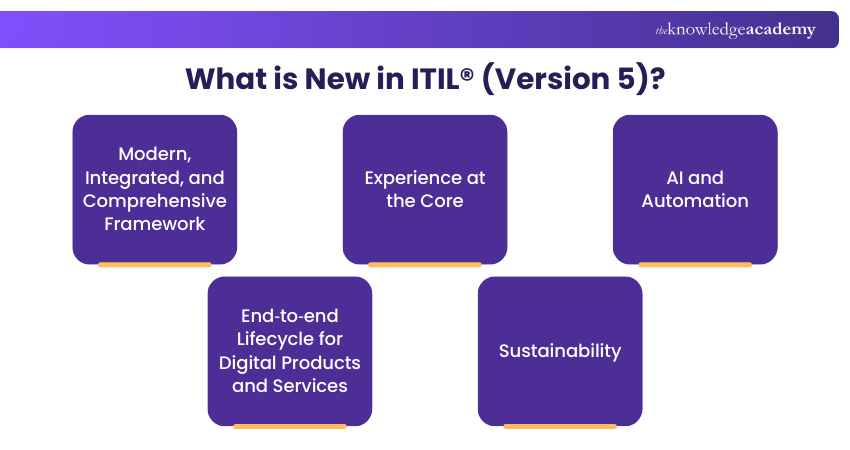
1) Modern, Integrated, and Comprehensive Framework
One of the standout features of ITIL® (Version 5) is its modern, integrated approach. Unlike other ITIL Versions that focused primarily on IT service management, this iteration expands to encompass digital product management. It provides a unified framework that integrates strategy, delivery, and operations, allowing organisations to manage both products and services seamlessly.
This comprehensive structure helps in creating a shared language and methodology for business and IT professionals, promoting collaboration and efficiency. The framework is designed to be adaptable, fitting into digital-first organisations where agility and integration are key to success.
2) Experience at the Core
A major shift in ITIL® (Version 5) is placing user experience at the heart of service management. Moving beyond traditional process-oriented approaches, the framework emphasises designing and managing services that are user-centred and outcome-driven.
This means focusing on creating value through enhanced experiences, clear roles, and responsibilities, all while committing to continual improvement. By prioritising experience, ITIL® (Version 5) helps organisations deliver services that not only meet but exceed user expectations, fostering loyalty and driving business growth.
3) AI and Automation
AI and automation are front and centre in ITIL® (Version 5), reflecting the transformative impact of these technologies on IT operations. The framework provides detailed guidance on adopting AI responsibly, including identifying drivers for implementation, assessing risks and opportunities, and establishing robust governance.
Automation is integrated to enable faster delivery of digital products and services, quicker responses to changes, and smarter decision-making in daily workflows. This AI-ready approach ensures that organisations can leverage these tools ethically and effectively, minimising risks while maximising benefits.
4) End-to-end Lifecycle for Digital Products and Services
ITIL® (Version 5) introduces a robust end-to-end lifecycle management for digital products and services. Through dedicated modules, it covers the entire journey from discovery and design to delivery, support, and ongoing improvement.
Such a holistic view ensures that products and services are developed and maintained with seamless integration, reducing silos and enhancing overall efficiency. By addressing the full lifecycle, the framework supports organisations in delivering high-quality, reliable digital solutions that align with business needs.
5) Sustainability
Sustainability is another key addition, woven into the fabric of ITIL® (Version 5). The framework promotes sustainable change management by aligning people, processes, and technology toward long-term goals. It encourages practices that support environmental and operational sustainability, such as efficient resource use and ethical AI adoption.
The shift in focus helps organisations build resilient systems that not only drive immediate value but also contribute to lasting improvements in the service value system. These innovations make ITIL® (Version 5) a vital tool for navigating the complexities of modern IT landscapes, offering clearer guidance on agile practices, value demonstration, and technological integration.
Why the Latest ITIL® Version was Required?
The transition to ITIL® (Version 5) wasn't arbitrary; it was driven by profound changes in the global business and technology environment since the release of ITIL® 4. Here's a closer look at the key factors that necessitated this update.
Digital Landscape
The digital landscape has transformed dramatically, with organisations now expected to deliver digital products and services at unprecedented speeds. Rapid response to market changes, integration of emerging technologies, and maintaining competitiveness in a digital-first world demanded a framework evolution. ITIL® (Version 5) addresses these by providing tools for faster, more effective digital delivery.
The AI Revolution
The explosion of AI technologies has revolutionised how businesses operate, from automation of routine tasks to advanced data-driven insights. However, this revolution brings challenges like ethical concerns, risk management, and governance. ITIL® (Version 5) was required to offer structured guidance on harnessing AI's potential while mitigating its downsides, ensuring responsible adoption across organisations.
Adaptability
In an era of constant disruption, adaptability is paramount. Work environments have shifted toward agile methodologies, remote collaboration, and hybrid models. The previous ITIL® version needed refinement to better support these changes, incorporating agile practices and flexible value presentations to help organisations stay nimble and responsive.
Greater Interconnection and Value Focus
Today's businesses thrive on interconnection between strategy and execution. ITIL® (Version 5) emphasises aligning business and technology through shared approaches, focusing on value creation and measurable outcomes. This interconnection ensures that IT initiatives directly support business goals, enhancing overall organisational performance.
Simpler and Clearer Qualification Scheme
The certification pathways in ITIL v3 and ITIL 4 were sometimes seen as complex and redundant. ITIL® (Version 5) introduces a streamlined scheme with nine core modules and one extension, reducing overlap and making it easier for professionals to progress. This clarity was essential to attract and retain talent in the field.
These drivers underscore why ITIL® (Version 5) was imperative, positioning it as a framework ready for the future.
ITIL® (Version 5) Certification Pathway
The certification scheme in ITIL® (Version 5) is more streamlined, consisting of nine core modules and one AI extension, leading to various designations. It promotes progressive learning, starting from foundational knowledge to mastery.
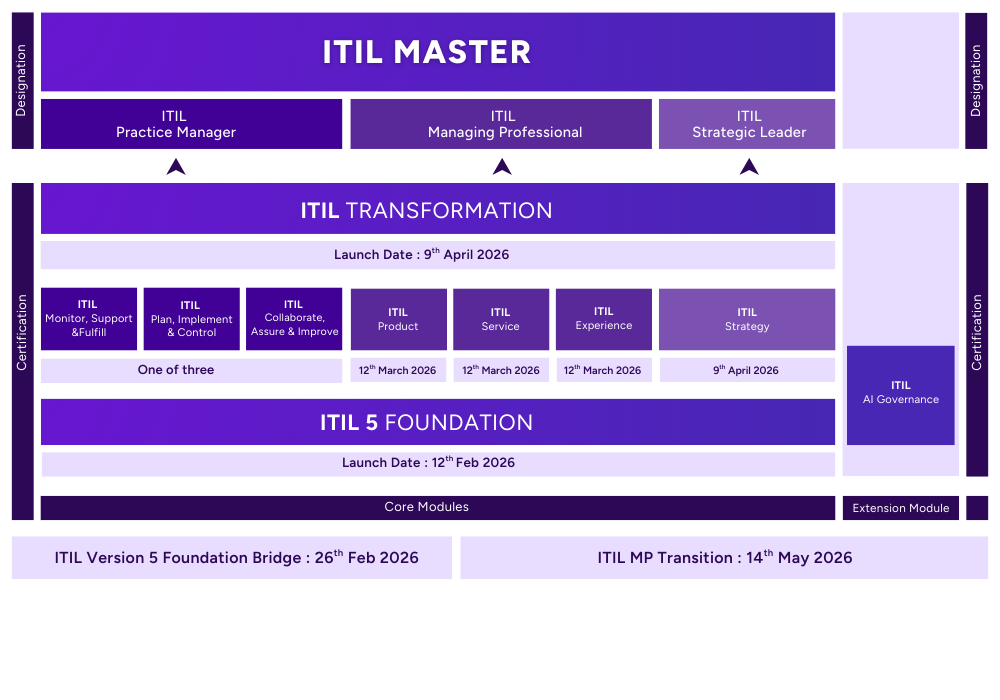
ITIL® Foundation
This entry-level certification introduces essential concepts, terminology, and value creation principles. It covers how value is generated for customers and organisations, defines roles and responsibilities, and highlights continual improvement. Ideal for beginners, it serves as the prerequisite for advanced paths.
ITIL® Practice Manager
Aimed at operational professionals, this designation builds skills in applying ITIL® practices daily. It requires ITIL® Foundation, ITIL® Transformation, and one of three specialised modules: Monitor, Support and Fulfil (MSF); Plan, Implement and Control (PIC); or Collaborate, Assure and Improve (CAI). Each module groups related practices for focused expertise.
ITIL® Managing Professional
For leaders in digital delivery, this focuses on service management, user experience, and improvement. It requires ITIL® Foundation, ITIL® Transformation, ITIL® Product and ITIL® Service (end-to-end lifecycle), and ITIL® Experience (user-centered design).
ITIL® Strategic Leader
Targeted at senior strategists, it covers digital strategy, governance, and investment. Requirements include ITIL® Foundation, ITIL® Transformation, and ITIL® Strategy (connecting vision to execution).
ITIL® Transformation
A core module required for all designations, it guides sustainable change by aligning people, processes, and technology. Completed once, it emphasises designing and managing improvements in the service value system.
ITIL® AI Governance
The ITIL® AI Governance extension module supports ethical AI implementation, and achieving ITIL® Master requires completing Practice Manager, Managing Professional, and Strategic Leader.
What Stays the Same in ITIL® (Version 5)?
Despite the updates, ITIL® (Version 5) preserves core elements from previous versions like ITIL v3 and 4. The foundational focus on best practices for value creation, roles, responsibilities, and continual improvement remains intact. Concepts like the service value system and governance principles continue to provide continuity, allowing experienced professionals to transition smoothly without relearning basics.
Conclusion
ITIL® (Version 5) represents a pivotal evolution in IT service and product management, tailored for an AI-infused, digital world. By integrating modern practices, emphasising experience and sustainability, and streamlining certifications, it empowers professionals to deliver exceptional value. Whether starting with Foundation or advancing to Master, this framework supports sustainable growth and innovation.
Frequently Asked Questions
What Happens After ITIL Version 5 Rollout?

ITIL® 4 and ITIL® (Version 5) will run in parallel for a minimum of 12 months, allowing candidates and organisations to complete in-flight learning journeys. There is no final retirement date for ITIL 4 yet, and a detailed coexistence and retirement plan will be released before any change takes place.
What if I Already Hold ITIL 4 Certification?
If you hold ITIL® 4 Foundation, you do not need to retake Foundation. ITIL (Version 5) is an evolution, not a replacement. Your ITIL 4 Foundation is fully recognised as a prerequisite for all advanced ITIL® (Version 5) qualifications. You can move directly into the new Version 5 learning paths and designations.
What if I Hold an ITIL v3 Certification?
If you hold ITIL v3 Foundation, it is recommended to complete ITIL (Version 5) Foundation training and passing the exam to transition. Version 5 introduces significant new content and updated practices compared to v3, so refreshed learning is considered essential to ensure you are fully prepared for modern, digital, and AI-enabled environments.
What are the Other Resources and Offers Provided by The Knowledge Academy?
The Knowledge Academy takes global learning to new heights, offering over 3,000+ online courses across 490+ locations in 190+ countries. This expansive reach ensures accessibility and convenience for learners worldwide.
Alongside our diverse Online Course Catalogue, encompassing 19 major categories, we go the extra mile by providing a plethora of free educational Online Resources like Blogs, eBooks, Interview Questions and Videos. Tailoring learning experiences further, professionals can unlock greater value through a wide range of special discounts, seasonal deals, and Exclusive Offers.
What is The Knowledge Pass, and How Does it Work?
The Knowledge Academy’s Knowledge Pass, a prepaid voucher, adds another layer of flexibility, allowing course bookings over a 12-month period. Join us on a journey where education knows no bounds.

John Davies


Cyber Security Governance & Assurance Specialist
John Davies is a cybersecurity expert specialising in governance, risk management, and compliance. With over 15 years in the field, he has led enterprise-wide security programmes across finance, healthcare and public sector organisations. His content provides practical guidance on building secure environments, managing risk and aligning with regulatory frameworks.

Upcoming IT Service Management Resources Batches & Dates
Date
 ITIL® 5 Foundation Certification
ITIL® 5 Foundation Certification
Mon 29th Jun 2026
ITIL® 5 Foundation Certification
Mon 6th Jul 2026
ITIL® 5 Foundation Certification
Mon 20th Jul 2026
ITIL® 5 Foundation Certification
Mon 10th Aug 2026
ITIL® 5 Foundation Certification
Mon 24th Aug 2026
ITIL® 5 Foundation Certification
Mon 7th Sep 2026
ITIL® 5 Foundation Certification
Mon 21st Sep 2026
ITIL® 5 Foundation Certification
Mon 5th Oct 2026
ITIL® 5 Foundation Certification
Mon 19th Oct 2026
ITIL® 5 Foundation Certification
Mon 9th Nov 2026
ITIL® 5 Foundation Certification
Mon 30th Nov 2026
ITIL® 5 Foundation Certification
Mon 21st Dec 2026

 If you wish to make any changes to your course, please


