


 Top Rated Course


We may not have the course you’re looking for. If you enquire or give us a call on +91-181-5047001 and speak to our training experts, we may still be able to help with your training requirements.
SQL Operators: A Complete Guide
The Knowledge Academy 02 March 2026SQL Operators, used in queries with clauses like SELECT and WHERE, perform arithmetic, comparison, and logical operations, helping manipulate and manage data. These operators help users filter, calculate, and manage data more efficiently, making them essential tools for building accurate and flexible SQL queries.

Training Outcomes Within Your Budget!
We ensure quality, budget-alignment, and timely delivery by our expert instructors.
Table of Contents

Ever run a query and think, “Well, that’s not what I asked for”? That’s where SQL Operators save the day. They help you fine-tune your questions so your database gives back exactly what you need whether it’s prices over 100, rows you want to skip, or a perfect match.
Think of them as your data-sorting sidekicks. In this blog, you’ll explore the types of SQL Operators, learn best practices, and see real-world examples that help you write cleaner, smarter queries with ease.
Table of Contents
1) Introduction to SQL Operators
2) Types of SQL Operators
3) Unary Operators
4) Assignment Operators
5) Real-world Examples
6) Can I use NOT with SQL Operators?
7) Can I use Multiple Operators in a Single SQL Query?
8) Conclusion
Introduction to SQL Operators
SQL Operators are fundamental components of Structured Query Language (SQL) that enable users to perform various operations on data within relational databases. These operators act as powerful tools for querying, filtering, and manipulating data. They encompass a wide range of functionalities, including arithmetic, comparison, logical, bitwise, and assignment operations.
SQL Operators are essential for writing accurate, efficient queries. They handle tasks like calculations, comparisons, condition checks, and NULL handling, making them vital for Data Analysis and management. A solid grasp of these operators is crucial when tackling SQL interview questions, as they’re key to solving real-world problems.

Types of SQL Operators
Operators in SQL refer to the diverse set of symbols and keywords used to perform various operations on data in relational databases. These are the types of SQL Operators:
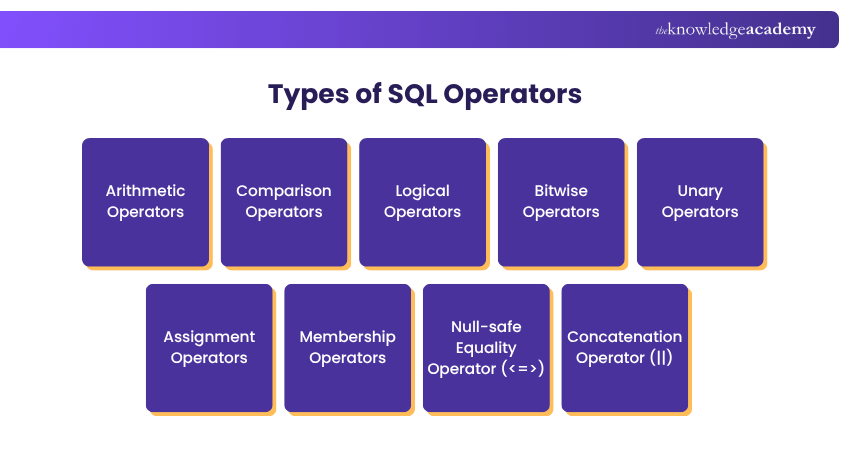
These operators include arithmetic, comparison, logical, bitwise, unary, assignment, membership, NULL-safe equality, and concatenation operators, each serving specific purposes in crafting efficient SQL queries.
Gain practical knowledge to write, query, and optimise SQL statements. Join our Introduction to SQL Course now!
Arithmetic Operators
Arithmetic operators help you do basic math with numbers in a database.
1) Addition (+): Adds two numbers together
2) Subtraction (-): Takes one number away from another
3) Multiplication (*): Multiplies of two numbers
4) Division (/): Divides one number by another
These operators are useful when you want to calculate totals, differences, averages, or other values directly in your SQL queries.
Comparison Operators
Comparison operators are used to check how two values relate to each other.
1) Equal (=): Checks if two values are the same.
2) Not Equal (!=): Checks if two values are different.
3) Greater Than (>): Checks if the first value is more than the second.
4) Less Than (<): Checks if the first value is less than the second.
5) Greater Than or Equal (>=): Checks if the first value is more than or equal to the second.
6) Less Than or Equal (<=): Checks if the first value is less than or equal to the second.
These operators help you filter data based on specific conditions in SQL queries.
Logical Operators
Logical operators help you combine conditions in SQL queries to make your searches more accurate.
1) AND: Returns true only if all conditions are true. It is used when multiple rules must be met.
2) OR: Returns true if at least one condition is true. It helps include more possible matches.
3) NOT: Reverses the result of a condition. It’s useful when you want to exclude certain results.
These operators make it easier to build flexible and powerful queries for finding exactly the data you need.
Bitwise Operators
Bitwise operators work at the bit level and perform actions in the binary form of numbers.
1) Bitwise AND (&): Compares two values bit by bit and returns 1 only if both bits are 1
2) Bitwise OR (|): Returns 1 if at least one of the corresponding bits is 1
3) Bitwise XOR (^): Returns 1 only if the bits are different
4) Bitwise NOT (~): Flips all the bits of the value
5) Left Shift (<<): Moves the bits of a number to the left, adding zeros at the end
6) Right Shift (>>): Moves the bits to the right, discarding bits on the right
These operators are mostly used in advanced SQL tasks involving low-level data processing.
Unary Operators
In SQL, unary operators are operators that work with a single operand, either before or after it. These operators perform specific actions on the operand and are commonly used for data manipulation and filtering. Here are some important unary Operators in SQL:
1) Unary Plus (+): The unary plus operator is used to indicate a positive value explicitly. For example, "+10" represents a positive number.
2) Unary Minus (-): The unary minus operator negates the value of the operand. For example, "-5" represents a negative number.
3) NOT Operator: The NOT operator is a logical unary operator that negates a Boolean expression. It converts true to false and false to true. For example, NOT(TRUE) is false, and NOT(FALSE) is true.
Unary operators are essential for performing calculations, changing the sign of numeric values, and logical negation in SQL queries. They provide flexibility and power in manipulating data and expressing conditions within a query.
Assignment Operators
Assignment operators assign values to variables.
1) Simple Assignment Operator (=): The simple assignment operator (=) assigns a value to a variable.
2) Add and Assign Operator (+=): The add and assign operator (+=) adds a value to the current value of a variable and assigns the result to the variable.
3) Subtract and Assign Operator (-=): The subtract and assign operator (-=) subtracts a value from the current value of a variable and assigns the result to the variable.
4) Multiply and Assign Operator (*=): The multiply and assign operator (*=) multiplies a variable by a value and assigns the result to the variable.
5) Divide and Assign Operator (/=): The divide and assign operator (/=) divides a variable by a value and assigns the result to the variable.
6) Modulus and Assign Operator (%=): The modulus and assign operator (%=) calculates the modulus of a variable and assigns the result to the variable.
Membership Operators
Membership Operators in SQL DATABASE are used to check if a value exists within a specified set of values. They allow for efficient data filtering and categorisation, making SQL queries more concise and effective.
1) IN Operator: The IN operator checks if a value matches any of the values in a provided list, array, or subquery.
2) NOT IN Operator: The NOT IN operator verifies if a value does not match any of the values in the specified list or subquery.
Membership Operators in SQL, like IN and NOT IN, check if a value exists within a set or subquery. They simplify queries, enhance readability, and are ideal for filtering data by specific criteria. Similar operators in R offer comparable functionality for efficient data handling.
Null-safe Equality Operator (<=>)
Null-safe Equality Operator in SQL DATABASE is used to safely compare values, even when one or both are NULL. It improves query accuracy by treating NULL values as comparable, unlike the standard equality operator.
1) Standard Equality Operator (=): Returns NULL when comparing a value with NULL, making results unpredictable when NULLs are involved.
2) Null-safe Equality Operator (<=>): Returns TRUE if both values are equal, including NULL <=> NULL ensuring safer and more consistent comparisons in SQL queries.
Acquire skills to write efficient queries and optimise database performance. Join our Advanced SQL Course now!
Concatenation Operator (||)
Concatenation Operator in SQL DATABASE is used to join text or string values from columns, literals, or variables into a single output. It enhances the readability and presentation of SQL query results, especially when combining data fields.

1) Sring Merging: The || operator combines values such as first name and last name into a full name, making the output more user-friendly.
2) Dynamic Text Construction: It allows appending static text to column data, which is useful for creating custom messages, labels, or formatted reports within SQL queries.
Real-world Examples
Practical examples of SQL Operators usage in real-world scenarios showcase the versatility and power of SQL in handling data effectively.
1) In a retail setting, arithmetic operators can be used to calculate the total cost of items in a shopping cart. The addition operator sums up the prices of selected products, while the multiplication operator calculates discounts or taxes, providing the final cost to the customer.
2) In a customer database, comparison operators come into play when filtering data based on specific criteria. For instance, the greater than operator can be employed to identify high-value customers who have made purchases above a certain threshold.
3) Logical operators find utility in Inventory Management. The AND operator can be used to filter products that are both in stock and fall under a specific category, streamlining inventory control processes.
4) In financial applications, SQL's assignment operators prove valuable. They can update the account balance by adding or subtracting funds based on deposits or withdrawals, respectively.
5) Membership operators are helpful when dealing with data categorisation. For instance, the IN operator can be used to extract sales data for products that belong to a specific product line or department.
These real-world examples of SQL Operators usage demonstrate the effectiveness of SQL in handling complex data manipulations, filtering, and analysis.
Can I use NOT with SQL Operators?
Yes, you can use NOT with SQL Operator to reverse their logic. For instance, NOT LIKE is used to find records that do not match a specific pattern. If LIKE '%abc%' matches values containing "abc", then NOT LIKE '%abc%' will return values that don’t contain "abc". This helps filter out unwanted patterns during searches.
Can I use Multiple Operators in a Single SQL Query?
Yes, you can use many operators like AND OR and NOT in one SQL query. For example, you can write a condition like WHERE age is more than 25 AND city is London. This will only show results that match both conditions. You can also use more than one AND or OR to add more filters.
Conclusion
Learning SQL Operators is a simple yet powerful way to improve your database skills. They help you write precise queries, filter data effectively, and get accurate results faster. Whether you're new to SQL or looking to sharpen your skills, understanding how these operators work will make your data tasks easier, smarter and more efficient.
Learn advanced techniques for optimising database performance. Join our PostgreSQL Administration Training now!
Frequently Asked Questions
What are the Four Basic Operations of SQL?

The four basic operations of SQL are SELECT, INSERT, UPDATE, and DELETE. These commands allow users to retrieve data, add new records, modify existing entries, and remove data from a database. Together, they form the foundation of database manipulation in SQL.
What are the Five Types of Commands in SQL?
Data Definition Language (DDL) commands, Data Manipulation Language (DML) commands, Data Control Language (DCL) commands, Transaction Control Language (TCL) commands and Data Query Language (DQL) commands.
What are the Other Resources and Offers Provided by The Knowledge Academy?
The Knowledge Academy takes global learning to new heights, offering over 3,000+ online courses across 490+ locations in 190+ countries. This expansive reach ensures accessibility and convenience for learners worldwide.
Alongside our diverse Online Course Catalogue, encompassing 17 major categories, we go the extra mile by providing a plethora of free educational Online Resources like Blogs, eBooks, Interview Questions and Videos. Tailoring learning experiences further, professionals can unlock greater value through a wide range of special discounts, seasonal deals, and Exclusive Offers.
. What are the Related Courses and Blogs Provided by The Knowledge Academy?
The Knowledge Academy’s Knowledge Pass, a prepaid voucher, adds another layer of flexibility, allowing course bookings over a 12-month period. Join us on a journey where education knows no bounds.
What are the Related Courses and Blogs Provided by The Knowledge Academy?
The Knowledge Academy offers various SQL Courses, including the Introduction to SQL Training, Advanced SQL Course, and PostgreSQL Administration Training. These courses cater to different skill levels, providing comprehensive insights into Operational Database.
Our Programming & DevOps Blogs cover a range of topics related to SQL Operators, offering valuable resources, best practices, and industry insights. Whether you are a beginner or looking to advance your Programming & DevOps skills, The Knowledge Academy's diverse courses and informative blogs have got you covered.

The Knowledge Academy


Global Training Provider
The Knowledge Academy is a world-leading provider of professional training courses, offering globally recognised qualifications across a wide range of subjects. With expert trainers, up-to-date course material, and flexible learning options, we aim to empower professionals and organisations to achieve their goals through continuous learning.


 If you wish to make any changes to your course, please


