


 Top Rated Course

We may not have the course you’re looking for. If you enquire or give us a call on + 800 908601 and speak to our training experts, we may still be able to help with your training requirements.
What is Commercial Law: Scope, Roles, and Business Impact
The Knowledge Academy 03 January 2026Commercial Law governs business and trade, covering contracts, finance, IP, and disputes, ensuring compliance, fair competition, and predictable transactions. Setting clear legal boundaries is useful for organisations since it helps them operate with confidence, reduce risks, and resolve disputes in a systematic way.

Training Outcomes Within Your Budget!
We ensure quality, budget-alignment, and timely delivery by our expert instructors.
Table of Contents

In the world of business, understanding What is Commercial Law is important for anyone involved in the process of buying, selling, or operating a company. It is the legal framework that governs business activities and commercial transactions, shaping how business interacts with customers, regulators, and employees. It is important to ensure that fairness, compliance, and trust are maintained in the marketplace.
As mentioned by the World Trade Organisation, world trade in goods and commercial services has reached an estimated £23.88 trillion in 2024. This level of economic exchange depends on clear legal duties and the seamless functioning of dispute mechanisms. In this blog, you will explore What is Commercial Law, its scope, roles, and more. Keep reading!
Table of Contents
1) What is Commercial Law?
2) Key Practice Areas Within Commercial Law
3) What is the Difference Between Corporate Law and Commercial Law?
4) What do Commercial Lawyers do?
5) Scope of Commercial Law
6) What Skills do you Need to be a Commercial Solicitor?
7) What is the Average Salary for Commercial Lawyers?
8) The Future of Commercial Law
9) Does Commercial Law Apply to Small Businesses?
10) Does Commercial Law Apply Cover International Trade?
11) Conclusion
What is Commercial Law?
Commercial Law, also called business law, regulates the rights, relationships, and behaviour of individuals, businesses, and organisations engaged in commerce, trade, and sales. This branch of Law governs interactions between corporations and individuals and enforces adherence to both national and international laws.
Commercial Law involves a range of legal practices that assist in the smooth functioning of businesses. It includes topics ranging from contracts and property law to intellectual property rights and company mergers.

Key Practice Areas Within Commercial Law
Commercial Law is a vast and dynamic field, encompassing a variety of specialised areas. Here are some key subfields that professionals in this domain often focus on:
1) Banking and Finance: Managing financial transactions and regulations.
2) Competition Law: Ensuring fair competition and addressing anti-competitive practices.
3) Construction Law: Overseeing legal aspects of construction projects.
4) Corporate Law: Governing the formation, operation, and dissolution of corporations.
5) Employment Law: Handling employer-employee relationships and workplace issues.
6) Energy Law: Regulating the production and use of energy resources.
7) Environmental Law: Protecting the environment through regulations and policies.
8) Intellectual Property Law: Safeguarding creations of the mind, like inventions and artistic works.
9) Litigation and Dispute Resolution: Resolving conflicts through legal proceedings or alternative methods.
10) Mergers and Acquisitions: Managing the consolidation of companies or assets.
11) Tax Law: Navigating the complexities of taxation.
12) Technology Law: Addressing legal issues in the tech industry.
Protect your business and employees with our comprehensive Employment Law Training – enhance your expertise now!
What is the Difference Between Corporate Law and Commercial Law?
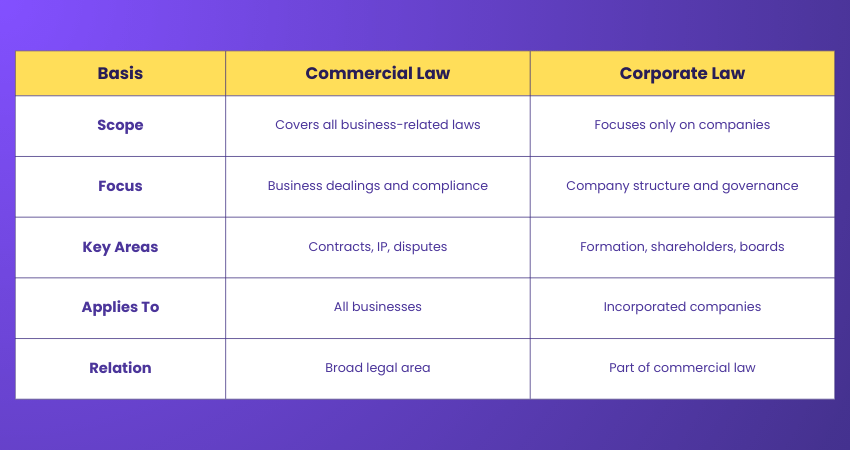
Commercial law is a broad area that covers all legal topics related to business. It includes topics such as contracts, employment law, intellectual property, and dispute resolution. It basically tells how businesses can deal safely with each other and follow the rules.
Corporate law focuses only on companies. Like how a company is formed, what will be its structure will be, what the role of shareholders is, and how board decisions are taken. So, in simple words, corporate law is a part of commercial law that deals only with company-related laws.
What do Commercial Lawyers do?
Commercial Lawyers advise businesses on legal matters that affect their daily operations and long-term strategy. Most of them work in industries such as Media, Technology, or Telecommunications. In large firms, they tend to specialise in specific fields, while in smaller firms, Commercial Lawyers have a broader scope, and their clients are businesses rather than individuals.
1) Commercial Solicitors
Commercial Solicitors advise and work with businesses, specialising in a specific area, such as Intellectual Property. Their work is transactional and centred on protecting the client’s business interests by identifying and managing legal risks. They draft, review, and negotiate contracts, commercial agreements, and standard legal wording for compliant business operations.
2) Commercial Barristers
Commercial Barristers are involved when disputes arise, and legal expertise is required in complex commercial matters. They focus on analysing legal issues, providing expert opinions, and representing businesses in court or arbitration. They work closely with Commercial Solicitors to utilise their documents, agreements, and risk assessments for building strong legal arguments for developing an effective dispute resolution.
Safeguard your business integrity with our Anti-Bribery Training Course – Register today!
Scope of Commercial Law
The scope of Commercial Law extends across the entire trading and legal lifecycle. It involves:
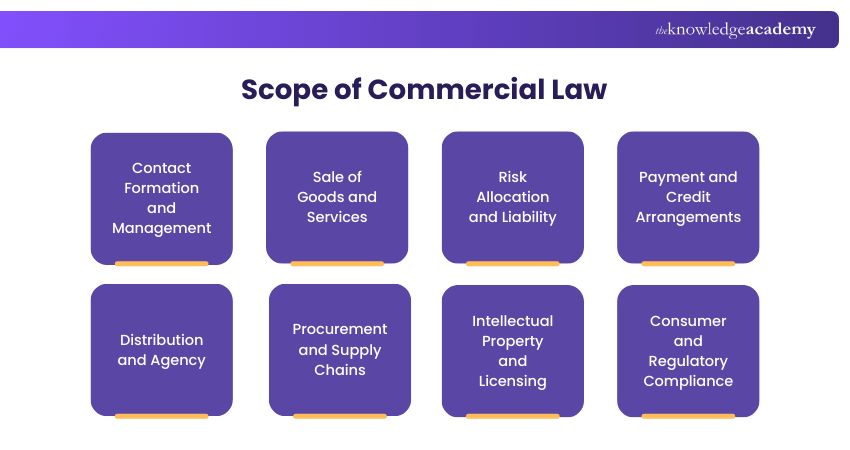
1) Contact Formation and Management: Governs offers, acceptance, terms and conditions, and contract performances.
2) Sale of Goods and Services: Regulates the selling, delivering, and payment receiving of business’s products and services.
3) Risk Allocation and Liability: Covers warranties, liability limits, and remedies when things go wrong.
4) Payment and Credit Arrangements: Manages invoicing, payment terms, title retention, and security.
5) Distribution and Agency: Defines the route to market through distribution, agency, and sales agreements.
6) Procurement and Supply Chains: Addresses supplier relationships, logistics, and transport obligations.
7) Intellectual Property and Licensing: Protects brands, content, and licensed commercial assets.
8) Consumer and Regulatory Compliance: Ensures marketing practices and business dealings comply with consumer protection laws.
What Skills do you Need to be a Commercial Law Solicitor?
If you want to become a commercial law solicitor, you need strong communication skills. You should know how to talk clearly with clients and listen carefully to what they say. It is also important to explain tough concepts of law in simple words so that the client understands clearly.
You should have the habit of solving problems. Sometimes you have to find the solution yourself, and sometimes you have to take help from seniors. Teamwork is also important, because you have to work with other lawyers. Along with this, paying attention to small details and completing the work on time are also the hallmarks of a good solicitor.
Stay compliant and excel with UAE Labour Law Training – empower your knowledge today!
What is the Average Salary for Commercial Lawyers?
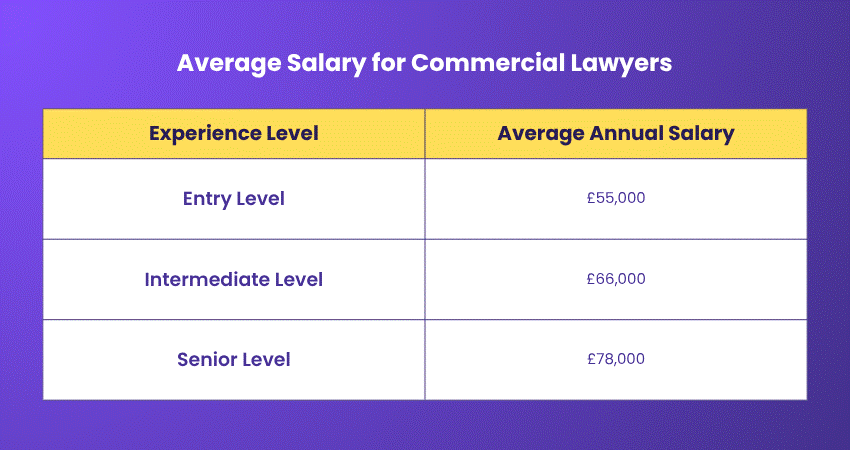
Salaries for Commercial Lawyers can vary significantly depending on location, industry, and experience level. Specialisations such as Corporate Law or Oil and Gas Law may offer premium compensation. Here is the breakdown of the average salary for Commercial Lawyers in the UK based on their experience level:
The Future of Commercial Law
The outlook for Commercial Law in the UK is very promising, with increasing demand for legal services in sectors like technology, finance, and data protection. As the UK economy continues to expand and diversify, businesses will need more legal support to navigate complex legal frameworks and ensure regulatory compliance.
1) Technological Advances: Innovations in technology are opening new avenues for Commercial Lawyers. The rise of e-commerce and digital platforms has driven an increase in cross-border transactions, highlighting the need for expertise in data protection and cybersecurity.
2) Post-Brexit Challenges: The UK's departure from the European Union has introduced new complexities for businesses operating internationally. This has heightened the need for legal advice on trade and regulatory compliance.
3) Growing Demand: Overall, the future of Commercial Law in the UK is bright, with increasing demand for legal services across various sectors. As the economy evolves and new challenges emerge, Commercial lawyers play a vital role in guiding businesses through legal frameworks, mitigating risks, and supporting them in achieving their goals.
Does Commercial Law Apply to Small Businesses?
Yes, Commercial Law applies to small businesses. It governs key business activities, such as contracts, sales, advertising, and dispute resolution to provide a clear legal framework. Understanding What is Commercial Law is beneficial for smaller businesses since it helps to avoid legal risks, protect their rights, and support sustainable growth in a compliant manner.
Does Commercial Law Cover International Trade?
Yes, Commercial Law covers international trade through a specialised area known as International Commercial Law. It covers cross-border business transactions between private parties. This framework relies on national laws and international treaties, such as the United Nations Convention on Contracts for the International Sale of Goods (CISG).
Its focus is on regulating international commercial contracts, managing legal risks, and resolving disputes, rather than governing trade relationships between states, which fall under public international trade law.
Conclusion
Understanding What is Commercial Law is valuable for businesses wanting to operate with confidence, reduce risk, and grow sustainably in a competitive market. From daily contracts and payments to complex international transactions, it provides a legal structure. This keeps business relationships fair, secure, and scalable. Organisations of any size can make informed decisions with it as well as build long-term trust with their team.
Build workplace law expertise and boost your employment law skills with Employment Law Courses – Join today!
Frequently Asked Questions
What Happens If a Business Breaches Commercial Law?

If a business breaches Commercial Law, it will face consequences, such as financial penalties or contract termination. Some serious consequences include fines, director disqualification, or imprisonment. Also, it leads to reputational damage, strains business relations, and compensation to affected parties.
Why Study Commercial Law?
Studying Commercial Law provides skills for handling business disputes, contracts, and trade regulations. It offers lucrative career opportunities in corporate sectors, enhances critical thinking, and helps navigate complex legal frameworks in global business, ensuring career versatility and growth.
What are the Other Resources and Offers Provided by The Knowledge Academy?
The Knowledge Academy takes global learning to new heights, offering over 3,000 online courses across 490+ locations in 190+ countries. This expansive reach ensures accessibility and convenience for learners worldwide.
Alongside our diverse Online Course Catalogue, encompassing 19 major categories, we go the extra mile by providing a plethora of free educational Online Resources like Blogs, eBooks, Interview Questions and Videos. Tailoring learning experiences further, professionals can unlock greater value through a wide range of special discounts, seasonal deals, and Exclusive Offers.
What is The Knowledge Pass, and How Does it Work?
The Knowledge Academy’s Knowledge Pass, a prepaid voucher, adds another layer of flexibility, allowing course bookings over a 12-month period. Join us on a journey where education knows no bounds.
What are Related Courses and Blogs Provided by The Knowledge Academy?
The Knowledge Academy offers various Employment Law Courses, including Commercial Law Training, Employment Law Training, and UAE Labour Law Training. These courses cater to different skill levels, providing comprehensive insights into Employment Law.
Our Human Resources Blogs cover a range of topics related to Employment Laws, offering valuable resources, best practices, and industry insights. Whether you are a beginner or looking to advance your Commercial Law skills, The Knowledge Academy's diverse courses and informative blogs have got you covered.

The Knowledge Academy


Global Training Provider
The Knowledge Academy is a world-leading provider of professional training courses, offering globally recognised qualifications across a wide range of subjects. With expert trainers, up-to-date course material, and flexible learning options, we aim to empower professionals and organisations to achieve their goals through continuous learning.

Upcoming HR Resources – Learn about Human Resources Batches & Dates
Date
 Commercial Law Training Course
Commercial Law Training Course
Fri 24th Apr 2026
Commercial Law Training Course
Fri 12th Jun 2026
Commercial Law Training Course
Fri 11th Sep 2026
Commercial Law Training Course
Fri 4th Dec 2026

 If you wish to make any changes to your course, please


