


 Top Rated Course

We may not have the course you’re looking for. If you enquire or give us a call on + 800 908601 and speak to our training experts, we may still be able to help with your training requirements.
CAP Theorem in Big Data: A Crucial Framework
Lily Turner 25 February 2026CAP Theorem in Big Data explains the trade-offs between Consistency, Availability, and Partition Tolerance in distributed systems. It states that it's impossible to achieve all three simultaneously. In this blog, we’ll explore how the CAP Theorem impacts the design of Big Data architectures and strategies to balance these constraints.

Training Outcomes Within Your Budget!
We ensure quality, budget-alignment, and timely delivery by our expert instructors.
Table of Contents
CAP Theorem in Big Data is a pivotal concept that underpins the architecture of distributed systems in the age of massive data sets and real-time processing. Conceived by Eric Brewer, the CAP Theorem presents a triad of critical properties, namely Consistency, Availability, and Partition Tolerance.
One property often must be prioritised at the expense of the others. This framework plays a significant role in guiding the design choices for systems dealing with vast and complex data, ensuring they strike the right balance between data accuracy, system responsiveness, and fault tolerance. In this blog, you will learn about how the CAP Theorem in Big Data plays an important role in distributed computing and database systems, significantly impacting the design and operation of Big Data systems.
Table of Contents
1) An Overview of Big Data
2) Understanding What is the CAP Theorem in Big Data
a) Consistency
b) Availability
c) Partition Tolerance
d) Big Data and CAP TheoreM
3) Looking at an Example of the CAP Theorem in Big Data
a) MongoDB
b) Cassandra
4) Conclusion
An overview of Big Data
Big Data represents the monumental volumes of data that inundate our digital world daily. This deluge encompasses structured and unstructured data, spanning text, images, videos, sensor readings, and more.
Now, what sets Big Data apart is its sheer size, the velocity at which it's generated, the variety of data types, and the valuable insights it can unlock. This data explosion has been fuelled by advancements in technology, the proliferation of internet-connected devices, and the digitisation of industries.
Harnessing Big Data provides organisations with the potential to make data-driven decisions, gain deeper customer insights, optimise operations, and foster innovation. Moreover, specialised tools and technologies, such as Hadoop, Spark, and Machine Learning algorithms, are employed to extract meaning from this data behemoth. Big Data Analytics enables predictive and prescriptive insights, revealing patterns and trends that were previously obscured.

Understanding What is the CAP Theorem in Big Data
The CAP Theorem, often referred to as Brewer's theorem after its creator, Eric Brewer, is a fundamental concept in the world of distributed systems, and its implications are especially pertinent in Big Data. It articulates the inherent trade-offs that distributed databases and systems must navigate among three key properties, which are:

1) Consistency
Consistency, the first element of the CAP Theorem, signifies that every read operation in a distributed system will return the most recent write or an error. In other words, all nodes within the system exhibit the same data value at any given time. Achieving strong consistency is crucial in applications where data accuracy is paramount, such as financial transactions or healthcare records.
2) Availability
The second property, Availability, indicates that every request, whether it's a read or write operation, receives a response, and that response is not an error. In essence, the system is always operational and responsive to client requests. High availability is essential for systems that cannot tolerate downtime, like e-commerce platforms or real-time analytics.
3) Partition Tolerance
Partition tolerance relates to the system's ability to function reliably despite network partitions or communication breakdowns. Network partitions can occur due to factors like hardware failures, congestion, or geographical distribution, leading to nodes being unable to communicate. A partition-tolerant system will continue to operate, ensuring nodes can communicate even under challenging network conditions.
The CAP theorem declares that, in a distributed system, you can't simultaneously achieve all three properties. Instead, you must prioritise two out of the three, and the choice of which two significantly impacts the system's behaviour:
a) CA or Consistency and Availability: Prioritising both Consistency and Availability means that the system maintains strong data consistency and high responsiveness but sacrifices Partition Tolerance. It can work well in stable network conditions, but it may become problematic during network partitions.
b) CP or Consistency and Partition Tolerance: Emphasising Consistency and Partition Tolerance ensures strong data consistency and the ability to withstand network partitions, but it might result in periods of unavailability during partition events.
c) AP or Availability and Partition Tolerance: Focusing on Availability and Partition Tolerance aims for high system availability and the ability to operate under network partitions. However, this might come at the cost of relaxing strong consistency, allowing for temporary data inconsistencies.
Predict market trends and demographics by signing up for our Big Data for Data Engineering Training now!
Big Data and CAP Theorem
In Big Data, distributed systems are prevalent, given the vast amounts of data that need to be processed, stored, and analysed. The CAP Theorem provides valuable guidance in making architectural decisions for these systems:
a) Data Consistency in Big Data: Big Data applications often prioritse eventual consistency over strong consistency. In scenarios like real-time analytics or recommendation engines, it's acceptable for data to temporarily be inconsistent across nodesas long as it converges to a consistent state over time. This approach improves system availability.
b) High Availability in Big Data: High availability is a paramount requirement for Big Data systems, as they often deal with massive workloads and must serve data without interruptions. Technologies like Hadoop and Spark typically adopt the AP model, focusing on availability and partition tolerance.
c) Partition Tolerance in Big Data: Big Data systems inherently require partition tolerance due to the large-scale distribution of data. Technologies like Apache Kafka, used for streaming data,focus on partition tolerance and fault tolerance.
Analyse large datasets critically by signing up for ourBig Data Analysis Course now!
Looking at an Example of the CAP Theorem in Big Data
Consider the example of an e-commerce application that combines real-time product availability with uninterrupted customer access, handling network disruptions seamlessly. It prioritises high availability and partition tolerance to ensure 24/7 shopping while sacrificing strict consistency for occasional, minor delays in updating product quantities during peak traffic, striking an effective balance.
Here are the various ways the e-commerce application demonstrates the CAP Theorem in Big Data:
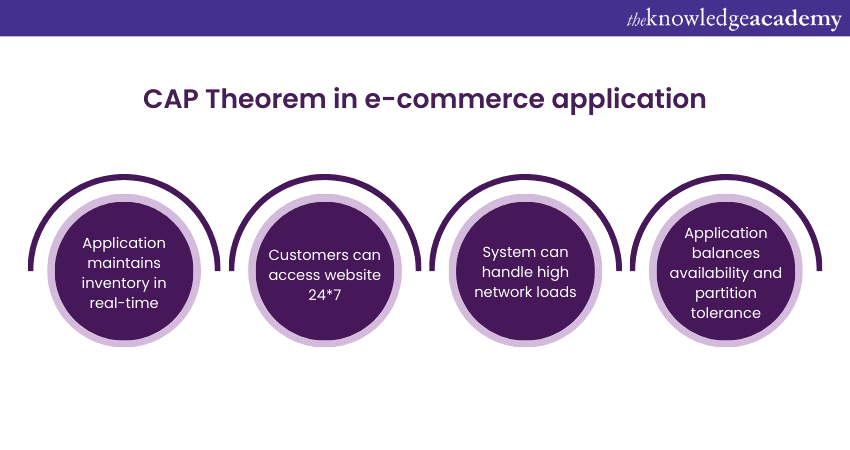
a) Consistency: The E-commerce application ensures that product inventory remains accurate in real-time, preventing overselling and maintaining order consistency.
b) Availability: Customers can access the website 24/7, browse products, and make purchases without encountering downtime or errors.
c) Partition Tolerance: The system handles high network loads during peak shopping seasons and occasional network disruptions without affecting users' ability to complete transactions. Data replication across multiple servers ensures data availability even if a server goes down temporarily.
d) Balancing act: The application strikes a balance by prioritising Availability and Partition Tolerance or AP to keep the platform accessible while sacrificing strong Consistency for some scenarios, such as momentarily displaying product quantities that may not be perfectly up-to-date during peak traffic.
Furthermore, MongoDB and Cassandra are two prominent NoSQL databases that exemplify the CAP Theorem's application in Big Data. Both databases address the need for scalable, distributed Data Management, but they do so with different priorities and architectural approaches
1) MongoDB
MongoDB, often associated with the AP or Availability and Partition Tolerance end of the CAP spectrum, is a widely used document-oriented NoSQL database. It prioritises high availability and fault tolerance, making it a valuable choice for various Big Data applications. Here are the key aspects demonstrated by MongoDB in Big Data:
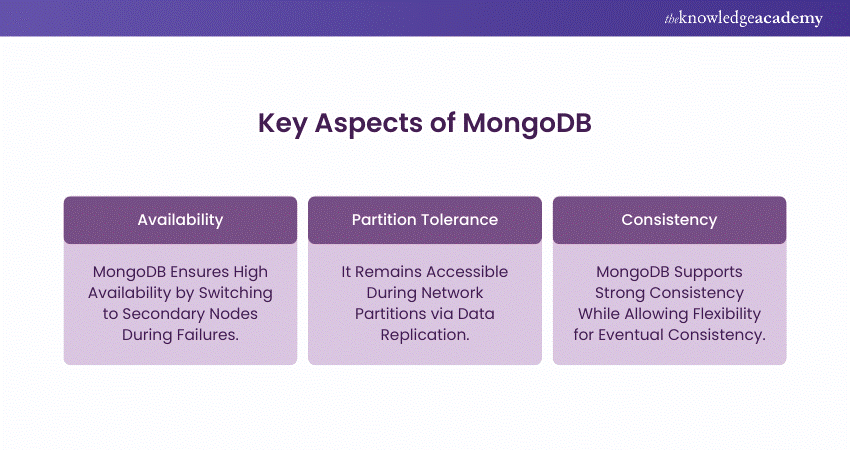
a) Availabilityservice interruptions.
b) Partition Tolerance: MongoDB excels in handling network partitions. Its partition tolerance is a result of data replication and automatic failover mechanisms. Even during network disruptions, the database remains accessible.
c) Consistency: While MongoDB provides strong consistency at the document level, it offers flexibility in terms of consistency. Developers can choose the level of consistency they need for specific queries, balancing it with availability and performance. This means that MongoDB can lean towards eventual consistency when required.
Learn the features of MongoDB by signing up for our MongoDB Developer Coursenow!
2) Cassandra
Cassandra, in contrast, aligns more with the AP side of the CAP theorem, focusing on Availability and Partition Tolerance. It is built to deliver high scalability and fault tolerance in distributed environments, making it an ideal choice for managing Big Data. When comparing it to other databases, understanding the differences in their design and functionality can help highlight their strengths. For instance, a Couchbase vs Cassandra comparison reveals unique aspects of how each handles data storage and retrieval in large-scale systems.
a) Availability: Cassandra focuses on maintaining a high level of availability, which is crucial in scenarios like e-commerce and social media platforms where downtime can have significant repercussions. It employs a peer-to-peer architecture and data replication to ensure that data remains accessible, even in the face of node failures.
b) Partition Tolerance: Partition tolerance is a core feature of Cassandra. Its decentralised design and support for data distribution across multiple nodes make it inherently resilient to network disruptions. Data can still be read and written to the database during partition events.
c) Consistency: Cassandra provides tunable consistency levels, allowing users to choose between different consistency models. It can offer strong consistency for critical operations while relaxing consistency for less crucial tasks, promoting high availability.
Dive deep into Big Data structures with the Big Data Architecture PDF!
Conclusion
While the CAP Theorem in Big Data provides a valuable framework for understanding the trade-offs in distributed systems, its simplicity and evolving nature necessitate a nuanced approach. Effective decision-making in the realm of Big Data requires careful consideration of the specific needs and complexities of each unique application.
Replicate data centres for low latency by signing up for our Apache Cassandra Training now!
Frequently Asked Questions
What is CAP Theorem for NoSQL?

CAP Theorem for NoSQL states a distributed system can achieve any of the two out of three: Consistency, Availability, and Partition Tolerance. The trade-offs are made as per the system’s needs.
Is DynamoDB a CAP Theorem?
DynamoDB prioritizes Availability and Partition Tolerance over Consistency, allowing for temporary inconsistencies to ensure the system remains available for users in the DynamoDB vs. MongoDB comparison.
What are the Other Resources and Offers Provided by The Knowledge Academy?
The Knowledge Academy takes global learning to new heights, offering over 3,000+ online courses across 490+ locations in 190+ countries. This expansive reach ensures accessibility and convenience for learners worldwide.
Alongside our diverse Online Course Catalogue, encompassing 17 major categories, we go the extra mile by providing a plethora of free educational Online Resources like Blogs, eBooks, Interview Questions and Videos. Tailoring learning experiences further, professionals can unlock greater value through a wide range of special discounts, seasonal deals, and Exclusive Offers.
What is The Knowledge Pass, and How Does it Work?
The Knowledge Academy’s Knowledge Pass, a prepaid voucher, adds another layer of flexibility, allowing course bookings over a 12-month period. Join us on a journey where education knows no bounds.
What are the Related Courses and Blogs Provided by The Knowledge Academy?
The Knowledge Academy offers various Big Data and Analytics Training, including the Big Data Analysis, Big Data and Hadoop Solutions Architect, and Big Data Architecture Training. These courses cater to different skill levels, providing comprehensive insights into into Big Data Processing.
Our Data, Analytics & AI Blogs cover a range of topics related to Big Data, offering valuable resources, best practices, and industry insights. Whether you are a beginner or looking to advance your Data Analytics skills, The Knowledge Academy's diverse courses and informative blogs have got you covered.

Lily Turner


Senior AI/ML Engineer and Data Science Author
Lily Turner is a data science professional with over 10 years of experience in artificial intelligence, machine learning, and big data analytics. Her work bridges academic research and industry innovation, with a focus on solving real-world problems using data-driven approaches. Lily’s content empowers aspiring data scientists to build practical, scalable models using the latest tools and techniques.
View Detail
Upcoming Data, Analytics & AI Resources Batches & Dates
Date
 Hadoop Big Data Certification
Hadoop Big Data Certification
Thu 9th Jul 2026
Hadoop Big Data Certification
Thu 8th Oct 2026

 If you wish to make any changes to your course, please


