


 Top Rated Course

We may not have the course you’re looking for. If you enquire or give us a call on +352 20 33 17 60 and speak to our training experts, we may still be able to help with your training requirements.
What is Data Accuracy? A Comprehensive Guide
Lily Turner 04 February 2026Data Accuracy refers to the correctness, reliability, and precision of data in representing real-world values based on data-driven insights. It ensures high-quality decision-making, reduces errors, and enhances operational efficiency. Understanding its importance, challenges, and best practices is crucial for businesses and organisations.

Training Outcomes Within Your Budget!
We ensure quality, budget-alignment, and timely delivery by our expert instructors.
Table of Contents

Would you trust a doctor who works with incorrect medical records? Or a bank that miscalculates your account balance? Inaccurate data often leads to financial losses, reputational damage, and operational chaos. That’s what happens when Data Accuracy is overlooked. Every business relies on data; be it for customer details, financial reports, or performance metrics. When that information is inaccurate, the consequences can be serious.
The good news? You can fix it. In this blog, we will explore the importance of Data Accuracy, its common inaccuracies, and proven techniques to maintain reliable data.
Table of Contents
1) What is Data Accuracy?
2) Why is Data Accuracy Important?
3) Data Inaccuracies Examples
4) How to Ensure Data Accuracy?
5) Common Data Accuracy Errors
6) Data Accuracy vs Data Integrity
7) Data Accuracy Best Practices
8) Data Accuracy Challenges
9) Conclusion
What is Data Accuracy?
Data Accuracy is the correctness of the information collected, used, and stored from the original or source information. It measures its closeness with the information, ensuring the data is closely aligned with the overall informational quality and credibility.
For example, if a company's database contains customer addresses, Data Accuracy ensures the information's correctness and relevancy, minimising any sort of shipping and communicational errors.
Why is Data Accuracy Important?
Data Accuracy is essential for organisations for several reasons. Those key reasons include:

1) Customer Satisfaction: Accurate data leads to a better understanding of customer needs, further improving service delivery and cultivating loyalty.
2) Brand Credibility: Data that is consistent and accurate helps maintain and enhance an organisation's reputation, further building steeper stakeholder trust.
3) Enhanced Decision-making: Accurate data ensures reliable and genuine informational-backed decisions. This reduces any sort of associated risks and provides better outcomes.
4) Operational Efficiency: With precise data, you can ensure more streamlined processes. This helps minimise minor to minor errors and streamline productivity.
5) Regulatory Compliance: Maintaining Data Accuracy is vital for government and industry regulations and also to prevent potential fines and legal issues.
Data Inaccuracies Examples
Data inaccuracies can impede an organisation's operations and Decision Making processes significantly. Common examples include:

1) Incomplete Data
This occurs when datasets do not contain essential information, leading to lower analysis and decision-making gaps. For instance, a customer database lacking email addresses for certain entries can disrupt communication and affect marketing campaigns.
2) Duplicated Data
Duplicate records arise when the same data is multiplied within a system, leading to higher confusion and inefficiencies. For example, an Inventory Management System’s product entry duplication can lead to inaccurate stock levels, causing overstocking or stockouts.
3) Outdated Data
Outdated data refers to older or non-relevant information, leading to potential misinformed decisions. For example, old customer contact details rely on can result in failed communication efforts.
4) Inaccurate Data Sources
Utilising unreliable or unverified data sources can introduce an organisation's dataset errors. For instance, information collection from unverified online forums or outdated Relational Databases can cause incorrect analyses and misguided strategies.
Secure your spot in our Predictive Analytics Course to master Predictive Modeling techniques!
How to Ensure Data Accuracy?
Data Accuracy is crucial for enhanced decision-making and operational efficiency. Some of the key strategies include:
1) Data Validation Techniques
Robust data validation implementation ensures the predefined data standards before processing or storage. This involves data type consistency checking, range constraints, and mandatory field completeness. For example, verifying that a date field contains a valid date within an acceptable range prevents future processing errors.
2) Data Cleansing Methods
Data cleansing, or data scrubbing, involves the inaccurate dataset records detection and correction. This process includes:
a) Parsing: Identifying and separating data elements to detect syntax errors.
b) Data Transformation: Standardising data to conform to required formats or structures.
c) Duplicate Elimination: Removing redundant records for data inflation and inconsistencies prevention.
c) Statistical Methods: Using statistical tools to identify anomalies or outliers that may indicate errors.
3) Accurate Data Integration & Transformation
During data integration, combining data from various sources into a unified view necessitates careful transformation for accuracy maintenance. Key practices include:
a) Data Mapping: Establishing precise source and target data elements correspondence to accurate data migration.
b) ETL Processes: Data Extracting, Transforming, and Loading (ETL) while applying validation and cleansing steps to uphold data integrity.
4) Data Governance & Management
Establishing a structured data governance and management framework is essential for highly sustainable and long-lasting Data Accuracy. This includes:
a) Master Data Management (MDM): Ensuring key data’s organisational uniformity and consistency.
b) Data Stewardship: Assigning roles responsible for data quality, compliance, and lifecycle management.
c) Standardised Procedures: Implementing consistent data entry, storage, and maintenance processes to minimise errors.
Common Data Accuracy Errors
Data Accuracy is crucial for effective decision-making and operational efficiency. However, several common errors can affect this. These include:
1) Human Mistakes
Certain error-prone manual data entries are there, considering typographical mistakes, omissions, or misinterpretations. For example, an incorrect postal code during a Marketing Campaign can lead to misdelivered packages. This causes wasted resources and higher customer dissatisfaction.
2) Integration Problems
Arising inconsistencies are there when consolidating multiple sources, data, formats, structures, or definitions. Without proper standardisation, these Data Discrepancies can lead to inaccurate data analyses and reporting.
3) No Validation
The absence of data validation processes allows erroneous or incomplete data to enter unchecked systems. Without proper mechanisms to verify Data Accuracy during entry or processing, the likelihood of inaccuracies increases, compromising decision-making.
4) System Failure
Technical issues (system crashes, hardware malfunctions, or software bugs) can result in corruption or critical data loss. These failures can lead to inaccurate and incomplete data, which further affects the reliability of the data-driven operation.
Deepen your understanding of data variability and uncertainty- Register for our Probability And Statistics For Data Science Training today!
Data Accuracy vs Data Integrity
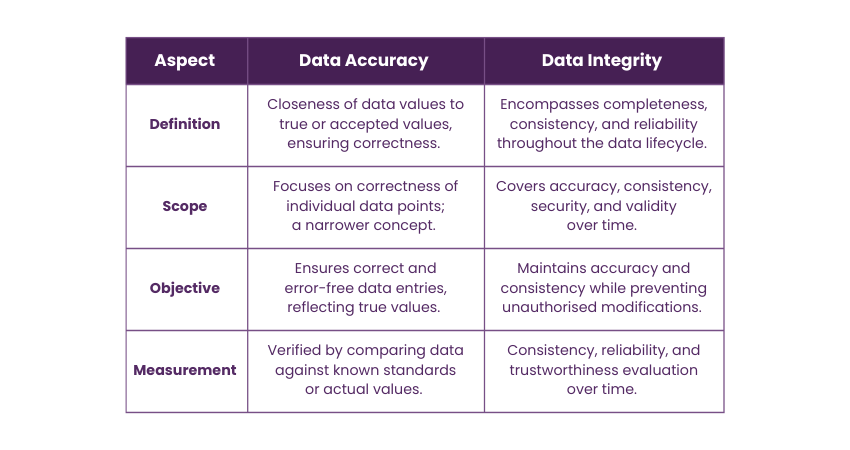
Understanding the differences in Data Accuracy vs data integrity is essential for effective data management. Here's a comparative breakdown based on key aspects:
1) Definition
a) Data Accuracy: Refers to the data values closeness to the true or accepted values. It indicates how correctly data represents real-world entities or events.
b) Data Integrity: Encompasses the overall completeness, consistency, and reliability of data throughout its lifecycle. It ensures the data is unaltered and trustworthy, from creation to deletion.
2) Scope
a) Data Accuracy: Focuses specifically on the correctness of individual data points. It's a narrower concept concerned solely with data precision.
b) Data Integrity: Encompasses a broader range of attributes, including accuracy, consistency, and security. It involves maintaining data validity and reliability over its entire lifecycle.
3) Objective
a) Data Accuracy: Aims to ensure the correctness and error-freeness of each data entry, reflecting its true value.
b) Data Integrity: Seeks to maintain and assure the Data Accuracy and consistency over its entire lifecycle, preventing unauthorised access or alterations.
4) Measurement
a) Data Accuracy: Assessed by comparing data entries against known standards or true values to determine their correctness.
b) Data Integrity: Evaluated through the consistency, reliability, and trustworthiness of data over time, ensuring it remains unaltered and intact.
Register today for our expert-led Data Science Courses - book your spot now!
Data Accuracy Best Practices
Data Accuracy is vital for organisations that are aiming to make informed decisions, maintain regulatory compliance, and streamline operational efficiency. Here are the best practices every organisation should implement to ensure the accuracy of the reliable data:
a) Establish Data Quality Standards: Define clear What is Data Collection, entry, and management guidelines to ensure organisational consistency and reliability.
b) Conduct Regular Data Audits: To maintain high data integrity, you must perform systematic dataset reviews for inaccuracies, rectification, identification, inconsistencies, or duplications.
c) Invest in Employee Training: Educate staff on the importance of data accuracy and provide the best data handling and management practices.
d) Implement Data Cleansing Tools: Utilise specialised error detection, entries removal, and data format standardisation software.
Data Accuracy Challenges
Ensuring Data Accuracy is crucial for organisations to make informed decisions and maintain operational efficiency. However, several challenges can impede Data Accuracy. These include:
1) Entry Errors
Inaccurate data entry, whether due to human mistakes or schematic errors, can lead to data inaccuracies. These inaccuracies may manifest as incorrect dataset’s values or inconsistencies.
2) Integration Challenges
Data that was accurate at its origin can become corrupted during data integration and transformation processes. This often occurs due to data transformation errors or difficulties in aligning and reconciling multiple source data.
3) Governance Hurdles
Poor data governance practices can jeopardise the entire dataset’s accuracy. Data handling inconsistencies across various teams, insufficient validation and verification processes, and inadequate documentation and lineage tracking contribute to data inaccuracies.
4) Technological Limitations
The dataset’s accuracy often correlates with its underlying architectural strength. Technological limitations, such as system glitches, data storage and retrieval issues, and insufficient data quality tools, can lead to Data Accuracy challenges.
Conclusion
Data Accuracy is the difference between smart decisions and costly mistakes. When your data is reliable, everything from strategy to customer experience will work better. But when it’s flawed, the risks are high. So, the real question is, are you making decisions with confidence or leaving them to chance?
Gain the skills to analyse, predict and drive real-world impact – sign up for our Data Science Courses now!
Frequently Asked Questions
What are the Criteria for Data Accuracy?

The main Data Accuracy criteria are completeness, consistency, timeliness, uniqueness, validity, and reliability. This ensures that the information accurately represents the original data source and its actual information.
What is the Weakness of Accuracy?
The main weakness of accuracy is inherent biases through data imbalances. In addition, there is a chance that accuracy may result in false positive or negative predictions.
What are the Other Resources and Offers Provided by The Knowledge Academy?
The Knowledge Academy takes global learning to new heights, offering over 3,000+ online courses across 490+ locations in 190+ countries. This expansive reach ensures accessibility and convenience for learners worldwide.
Alongside our diverse Online Course Catalogue, encompassing 19 major categories, we go the extra mile by providing a plethora of free educational Online Resources like Blogs, eBooks, Interview Questions and Videos. Tailoring learning experiences further, professionals can unlock greater value through a wide range of special discounts, seasonal deals, and Exclusive Offers.
What is The Knowledge Pass, and How Does it Work?
The Knowledge Academy’s Knowledge Pass, a prepaid voucher, adds another layer of flexibility, allowing course bookings over a 12-month period. Join us on a journey where education knows no bounds.
What are the Related Courses and Blogs Provided by The Knowledge Academy?
The Knowledge Academy offers various Data Science Courses, including the Pandas For Data Analysis Training, Predictive Analytics Course, and Probability And Statistics For Data Science Training. These courses cater to different skill levels, providing comprehensive insights into Data Reconciliation.
Our Data, Analytics & AI Blogs cover a range of topics related to Data Accuracy and Quality Management, offering valuable resources, best practices, and industry insights. Whether you are a beginner or looking to advance your Data Analytics skills, The Knowledge Academy's diverse courses and informative blogs have got you covered.

Lily Turner


Senior AI/ML Engineer and Data Science Author
Lily Turner is a data science professional with over 10 years of experience in artificial intelligence, machine learning, and big data analytics. Her work bridges academic research and industry innovation, with a focus on solving real-world problems using data-driven approaches. Lily’s content empowers aspiring data scientists to build practical, scalable models using the latest tools and techniques.
View Detail
Upcoming Data, Analytics & AI Resources Batches & Dates
Date
 Pandas for Data Analysis Training
Pandas for Data Analysis Training
Thu 9th Jul 2026
Pandas for Data Analysis Training
Thu 8th Oct 2026

 If you wish to make any changes to your course, please


