


 Top Rated Course

We may not have the course you’re looking for. If you enquire or give us a call on +352 20 33 17 60 and speak to our training experts, we may still be able to help with your training requirements.
Asset Classes: Types, Importance, and Investment Strategies
The Knowledge Academy 16 July 2026Asset Classes are investment categories like equities, bonds, cash, and real estate used to build diversified portfolios, plus alternatives like crypto. Understanding these categories helps investors diversify, manage risk, and meet financial goals, while the right mix and strategy can improve returns and support financial stability.

Training Outcomes Within Your Budget!
We ensure quality, budget-alignment, and timely delivery by our expert instructors.
Table of Contents

Making investment decisions can feel overwhelming, especially when faced with choices like stocks, bonds, or savings. Without a clear structure, it becomes difficult to know where to start or how to balance risk and return effectively. This is where Asset Classes play a key role, helping investors organise options and make informed financial decisions.
Understanding Asset Classes allows you to see how different investments behave and how they can work together in a portfolio. Whether you are saving for the short term or planning for long-term growth, using the right mix can help you build a stable financial future. In this blog, you will learn about what is an Asset Class, its types, importance, and more. Let’s begin!
Table of Contents
1) What is an Asset Class?
2) Why is Asset Class Important?
3) Types of Asset Classes
4) Factors That Define Asset Classes
5) Asset Allocation and Risk Tolerance
6) Asset Class and Investing Strategy
7) Which Asset Class has the Best Historical Returns?
8) Conclusion
What is an Asset Class?
All investment categories that demonstrate consistent financial characteristics alongside common market patterns together with equivalent returns and risks represent an Asset Class. The major asset categories consist of equities as well as fixed-income instruments with cash equivalents and commodities and Real Estate. These financial entities perform unique functions within portfolio management to achieve maximum growth by balancing risk exposure effectively.
When investing, people apply Asset Classes as tools to match their financial goals with their risk of tolerance. Results from investments in equity are higher but carry greater risks than earnings from fixed-income instruments. Inflation protection comes from commodities, while real estate generates passive revenue. Similarly, Fixed Asset Management ensures that tangible assets are optimally utilised for long-term growth. Investors can develop stable, resilient investment portfolios through the comprehension of how assets relate to one another.

Why is Asset Class Important?
The knowledge of distinct Asset Classes serves investors by offering different benefits:
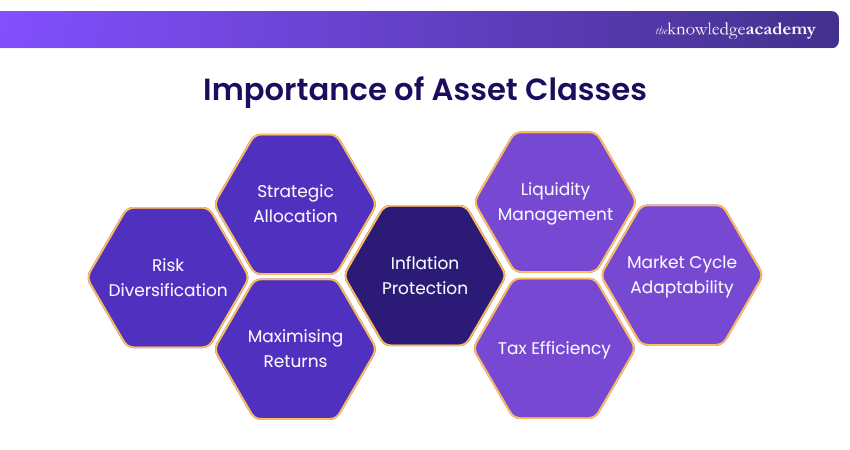
a) Risk Diversification: Distributing investments into various Asset Classes functions as risk mitigation by reducing portfolio loss threats.
b) Strategic Allocation: The strategic allocation framework assists investors in matching their portfolio investments to their time requirements, together with financial objectives and tolerance for risk exposure.
c) Maximising Returns: Long-term profitability improves when one builds a portfolio that uses several asset types in a diversified way.
d) Inflation Protection: Inflation protection through Investments occurs when commodities and real estate act as protective measures against inflation.
e) Liquidity Management: The deployment of assets between liquid and illiquid kinds serves to maintain ready access to cash at any time.
f) Tax Efficiency: Different types of investments provide tax benefits which help investors make the most of their returns after paying taxes.
g) Market Cycle Adaptability: Investors who use multiple Asset Classes can respond well to various market cycles because their portfolios are adaptable to different economic conditions.
Analyse, interpret, and drive financial growth with Accounting and Financial Statement Analysis Training – Sign up now!
Types of Asset Classes
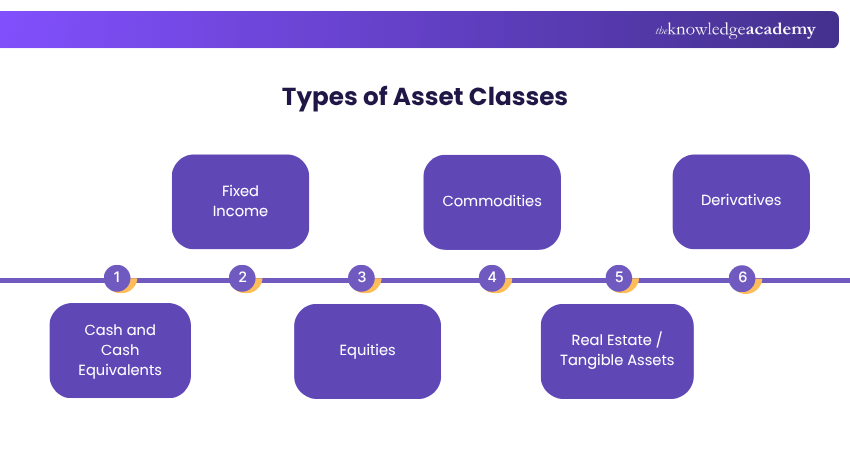
Asset Classes represent different categories of investments, each with unique characteristics, risk levels, and return potential. Understanding them helps investors build a diversified portfolio and choose investments that suit their financial goals. Let’s look at them below:
1) Cash and Cash Equivalents
Cash and cash equivalents are highly liquid investments that can be easily converted into cash. Generally, they are used for short-term needs, capital preservation, and maintaining flexibility during uncertain market conditions. They provide stability but typically offer lower returns compared to other Asset Classes.
For Example:
a) Treasury bills (T-bills)
b) Short-term government bonds
c) Savings accounts and money market funds
2) Fixed Income
Fixed-income securities involve lending money to governments or corporations in exchange for interest payments and repayment at maturity. These investments are known for providing stable and predictable returns with lower risk than equities. They play a key role in balancing risk and ensuring predictable returns in a portfolio.
For Example:
a) Government bonds
b) Corporate bonds
c) Certificates of deposit
d) Treasury inflation-protected securities (TIPS)
3) Equities
Equity, or stocks, represents ownership in a company. Investors earn returns through dividends and capital gains, making equity a key asset class for long-term growth. However, it comes with a higher risk compared to other Asset Classes. They are best suited for long-term investors seeking higher returns despite market fluctuations.
For Example:
a) Small cap (higher growth potential, higher risk)
b) Mid-cap (balanced risk and return)
c) Large cap (more stable, lower growth potential)
4) Commodities
Marketable commodities are physical assets like gold, oil, or agricultural products that are traded in commodity markets. They are used to protect against inflation and economic uncertainty, making them valuable for diversification. Usually, they are used to reduce overall portfolio risk during economic uncertainty.
For Example:
a) Gold and silver
b) Crude oil and natural gas
c) Agricultural products (wheat, corn, coffee)
d) Metals (copper, aluminium)
5) Real Estate / Tangible Assets
Real estate includes investments in physical property such as residential or commercial buildings. It can generate income through rent and may increase in value over time. Real estate helps diversify a portfolio and can act as a hedge against inflation. They are suitable for investors looking for long-term wealth creation and passive income.
For Example:
a) Residential properties (apartments, houses)
b) Commercial properties (offices, retail spaces)
c) Rental properties
d) Real Estate Investment Trusts (REITs)
6) Derivatives
Derivatives are financial instruments whose value depends on an underlying asset, such as stocks or commodities. They are mainly used for hedging risk or speculation and are considered high-risk investments suitable for experienced investors. Also, they require careful understanding as they involve higher complexity and risk.
For Example:
a) Options
b) Futures
c) Swaps
d) Forwards
Strengthen your financial governance skills with the Accounting and Finance Policies Course – Join now!
Factors That Define Asset Classes
Various characteristics determine how Asset Classes are defined according to the following factors:
a) Risk and Return Characteristics: Asset Classes display unique risk-return associations because each one comes with specific risk and reward features.
b) Market Dynamics: Economic conditions alongside interest rates and inflation rates produce affects on Asset Class performance levels.
c) Liquidity: This status differs between assets because stocks have higher liquidity, while real estate displays lower levels of liquidity.
d) Regulatory Framework: Different investment regulations apply to Asset Classes which restrict investors' choices through these rules.
e) Investment Horizon: The time period for investment choices ranges widely between assets which perform best in short-term gains and those that generate long-term growth potential.
f) Correlation with Other Assets: The movement of some assets differs from others, creating additional risk reduction opportunities.
Learn how to manage liquidity positions and capital adequacy planning with our Asset and Liability Management Training – Join now!
Benefits of Asset Classes
Here the following are the several advantages of Asset Class:

1) Diversification
Reducing risk becomes achievable through distributing investments across multiple asset categories. The performance of underperforming assets might be compensated by better-performing ones which results in portfolio stability.
2) Higher Returns
Long-term financial growth occurs when investors distribute their assets across multiple classes which enables them to secure high returns from profitable areas and protect their funds through less volatile assets.
3) Simplicity
The process of Asset Classification enables people to simplify their investment choices which allows them to both monitor their financial goals and modify their portfolios.
4) Liquidity Management
Asset Classes that include cash alongside equities present immediate cash accessibility, but real estate properties enforce extended waiting periods which allows investors to achieve desired levels of fund liquidity.
Asset Allocation and Risk Tolerance
Asset allocation and risk tolerance guide how investors choose and balance investments based on acceptable risk levels. The points below explain how risk tolerance influences asset allocation decisions.
Asset Allocation
1) Understanding Asset Classes: Knowing different Asset Classes helps recognise the nature and risk level of investments, from safer bonds to high-risk derivatives like futures or foreign exchange.
2) Risk varies by Asset Type: Different Asset Classes carry different levels of risk, so understanding this helps avoid taking on high risk unknowingly.
3) Role of Asset Allocation: Asset allocation spreads investments across assets to manage risk, with the level of diversification depending on individual choice.
Risk Tolerance
1) Risk-averse Investors: Investors with low risk tolerance usually prefer safer assets and may diversify within an asset class, such as holding large-cap, mid-cap, and small-cap shares or investing across sectors.
2) High Risk Tolerance Investors: Investors comfortable with risk may focus less on diversification and more on Asset Classes with higher potential returns.
3) Personal Decision: Risk tolerance is shaped by personal investment goals, financial situation, and willingness to accept risk and market volatility.
Asset Class and Investing Strategy
Developing a strong investing strategy requires understanding Asset Classes such as stocks, bonds, cash, and real estate, each with different risk levels, returns, and market behaviour. Asset allocation divides investments across these classes and plays a key role in long-term portfolio performance.
A well-diversified approach balances risk and reward based on an investor’s time horizon, risk tolerance, and financial goals. For example, younger investors may prefer stocks for growth, while retirees may choose bonds or cash for stability, helping reduce volatility and improve long-term outcomes.
Boost your career prospects in finance, banking, and corporate treasury roles. Join our Treasury Management Training now!
What are the Most Popular Asset Classes?
Investors often focus on a handful of core Asset Classes, each offering distinct advantages depending on market conditions and financial goals.
1) Equities (Stocks): Represent ownership in companies and typically offer strong long-term growth potential, though with higher volatility.
2) Fixed Income (Bonds): Provide steady interest payments and tend to be more conservative than equities, making them attractive to risk-averse investors.
3) Cash and Cash Equivalents: Include liquid investments like money market funds and T‑bills—offering minimal risk and high accessibility, but modest returns.
4) Real Estate: Tangible investments such as property or REITs that combine income potential with inflation protection and a low correlation to stocks and bonds.
5) Commodities and Alternatives: Encompass assets like gold, private equity, hedge funds, and even crypto; valued for their ability to diversify and reduce overall portfolio correlation.
Which Asset Class Has the Best Historical Returns?
Although stocks have historically produced the highest returns, the best strategy for long-term, balanced investing involves combining them with other Asset Classes.
1) Equities Lead in Long-Term Performance
Over time, equities (shares) have shown the highest historical returns compared to other major Asset Classes. Global stock markets have consistently outperformed bonds, real estate, and cash, making them a strong choice for long-term growth.
2) Best Asset Class for Beginners
Equities carry a higher risk even though they yield large returns. Finding the ideal asset class for novices that fits with their risk tolerance and financial objectives should be the main priority. It's usually safer to start with a combination of growth-oriented and low-risk assets.
3) Build a Diversified Portfolio
Creating a diversified portfolio, as opposed to depending on a single asset class, aids in risk management and lessens the effects of market volatility. An investment experience is more stable when stocks, bonds, and other assets are combined.
4) Investment Strategy for Balance and Growth
The investment strategy focuses on balancing growth and stability in a volatile market. It emphasises high-quality equities, resilient fixed income for risk control, and real assets like commodities to hedge inflation and geopolitical risks. Also, it is supported by diversification and active asset allocation.
Conclusion
Understanding Asset Classes is crucial for making smarter investment decisions and building a strong, diversified portfolio. Recognising how different classes behave and combining them strategically helps investors balance risk and return effectively. This helps to create a resilient investment approach that adapts to evolving market conditions and ensures financial stability.
Gain proficiency in budgeting and Financial Analysis with our Accounting Courses – Register today!
Frequently Asked Questions
What are the Criteria for Asset Classes?

Asset Classes require specific set of standards for their definition. The definition of Asset Classes depends on the risk profiles along with market actions and liquidity measures and regulatory structures and investment goals. Financial characteristics between Asset Classes must be similar and their reactions to economic events.
Why are Asset Classes Important in SIP Investments?
Asset Classes are important in Systematic Investment Plan (SIP) investments because they help balance risk and returns over time. Spreading SIP investments across different Asset Classes reduces market volatility and supports steady, goal-aligned growth.

The Knowledge Academy


Global Training Provider
The Knowledge Academy is a world-leading provider of professional training courses, offering globally recognised qualifications across a wide range of subjects. With expert trainers, up-to-date course material, and flexible learning options, we aim to empower professionals and organisations to achieve their goals through continuous learning.


 If you wish to make any changes to your course, please


