


 Top Rated Course

We may not have the course you’re looking for. If you enquire or give us a call on +800 312616 and speak to our training experts, we may still be able to help with your training requirements.
What is Synergy, and How to Build Team Synergy?
The Knowledge Academy 24 November 2025Synergy is the combined effect of two or more entities working together, producing greater results than their individual efforts and enhancing efficiency. It promotes teamwork, collaboration as well as unified growth. Thrive on the trends of collaboration, not only in social media but also through your equivalent establishments.

Training Outcomes Within Your Budget!
We ensure quality, budget-alignment, and timely delivery by our expert instructors.
Table of Contents

Have you noticed the recent trend in social media where influencers or celebrities would be collaborating with a brand? Ever wondered where such social media collaboration ideas emerged from? If not, I suggest you to read this blog to know where it originally began and how it was implemented with all compelling techniques!
Before getting into this blog, I hope you have been a team worker at least once in your lifetime. Are you wondering why teamwork has been focused out of the box? Indeed, it has a connection with What is Synergy and let’s know how they are interrelated.
Table of Contents
1) What is Synergy?
2) The Importance of Synergy
3) Different Types of Synergy
4) How to Build Team Synergy?
5) Requirements for Accomplishing Synergy
6) Real-world Examples of Synergy
7) Conclusion
What is Synergy?
Synergy wasn’t originally an English word. Yes, you read it right. It was derived from a Greek word, “Synergos,” which means “working together.” It was inspired by the ancient Greek philosophy, which stated that the whole result is greater and more valuable than the sum of its individual parts.
To put it in easy terms, Synergy is the interaction of two or more companies, brands, teams or any form of elements to produce more effective results. It aims to achieve increased and collaborated profits which are comparatively higher to individual efforts and work. For example, you can think of a song where different musical instruments are used to create soul warming music for it.

The Importance of Synergy
You are now introduced to what is a Synergy. When two or more effective people or companies come together, it gives birth to a new version of yourselves. You will be unified into a single team, working towards a shared goal. Apart from the shared goal, Synergy has several important aspects too. It includes:
1) Achieving greater and effective results
2) Improvising your missions and goals
3) Shared responsibilities and teamwork
4) Overcoming problems and threats with better solutions
Different Types of Synergy
The strategy of Synergy can be employed from your personal lives to professional lives. It is not bound to any particular part of life. Knowing the different types of Synergy will help you to understand wherever it has been used.

1) Interpersonal Synergy
Interpersonal Synergy refers to the unified work of multiple individuals with their skills and perspectives to achieve their goals.
Tip: Consider a movie where everyone from the crew has to put in their efforts for the unified goal of directing a movie.
2) Organisational Synergy
Organisational Synergy is limited within the organisation. It is like teams or different parts of the organisation working together for a shared goal or result.
Tip: For instance, you can think of the marketing team working together with the product delivery team to enhance sales.
Upskill your skillsets for the workplace by signing up for our Organisational Skills Training now!
3) Chemical Synergy
The definition for chemical Synergy is associated with Science. This is because in Science, two individual chemical components combine to form a new product or a chemical substance. The same applies in the context of business where people, teams or even two different companies join and work together.
Tip: A combination of sodium and chloride ions will produce edible salt. In the same way, combining teams to attain a new result would define chemical Synergy.
How to Build Team Synergy?
The basic criterion for Synergy is the tendency to collaborate with teams, or groups of people. That implies the importance of knowing how to build a team Synergy. Let's see some techniques that would help.

Establish a Clear Vision and Goals
1) Define a Shared Purpose: Ensure everyone understands the team’s mission and how their work contributes to it.
2) Set SMART Goals: Specific, Measurable, Achievable, Relevant, and Time-bound objectives align efforts and expectations.
Foster Open Communication
1) Encourage Transparency: Create a safe space for honest feedback and open dialogue.
2) Use the Right Tools: Leverage communication platforms (e.g., Slack, Microsoft Teams) to keep everyone connected.
Build Trust and Respect
1) Lead by Example: Demonstrate integrity, reliability, and respect.
2) Recognise Contributions: Celebrate individual and team achievements to build mutual appreciation.
Clarify Roles and Responsibilities
1) Avoid Overlap and Confusion: Clearly define each member’s role and how they contribute to the team’s success.
2) Promote Accountability: Ensure everyone takes ownership of their tasks.
Encourage Collaboration and Inclusivity
1) Promote Diverse Perspectives: Encourage input from all team members.
2) Use Team-building Activities: Regular exercises can strengthen relationships and improve cooperation.
Provide Opportunities for Growth
1) Offer Training and Development: Help team members build skills that benefit the team.
2) Encourage Mentorship: Pair experienced members with newer ones to foster learning and connection.
Continuously Reflect and Improve
1) Conduct Regular Retrospectives: Discuss what’s working and what needs improvement.
2) Adapt and Evolve: Be open to change and innovation based on team feedback.
Are you troubled with handling ethical dilemmas in the workplace? Join our Ethics in Workplace Training immediately to master it!
Requirements for Accomplishing Synergy
Collaborating as a group has certain requirements. Here is the list of requirements for a successful Synergy:
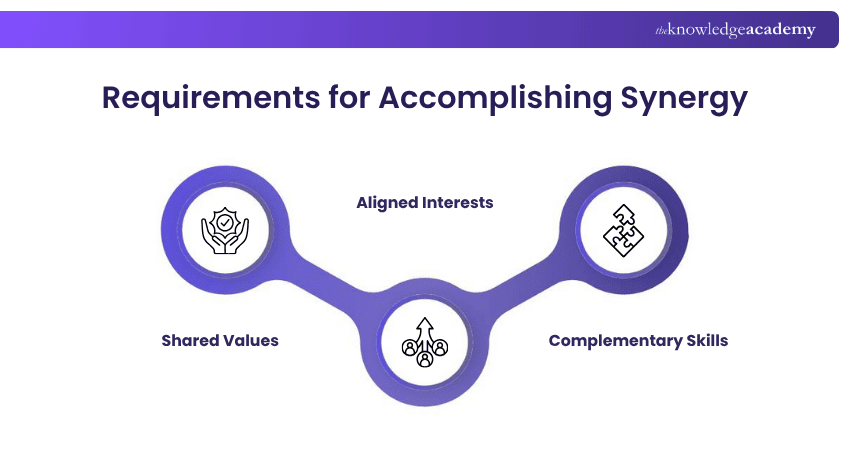
1) Shared Values
When companies with shared values align together, they are likely to establish themselves with easy collaboration, setup of goals and list of to do accomplishments.
2) Aligned Interests
Finding common interests between people and engaging with them is always valuable. It allows you to research further into your common interest, thereby producing more positive results.
3) Complementary Skills
Having complementary skills while in Synergy is an added advantage. It allows you to explore beyond the boundaries and try new things while aligning with your tasks.
Real-world Examples of Synergy
Real-world examples of Synergy come in various forms. If you notice your daily life, you’ll find that most of your actions are done with the help of others. Let's have a short gist of some real-world examples.
1) Business Mergers
Mergers are the combination of two companies or organisation to expect increased results. The merge that happened between Meta with Facebook and Instagram would describe business mergers.
2) Organisational Frameworks
Synergies are carried out by combining different products under the same market or specification. Such synergies are referred to as organisational synergies. The collaboration of Uber with Spotify was an unexpected but effective Synergy.
3) High-performing Teams
Synergy couldn’t be achieved if you’re not building up a team. No matter if the team is newly formed or aligned with existing members from different teams, it needs to be united to achieve the goals.
Conclusion
There goes a saying that you can’t clap with one hand. It requires both your hands to produce the clapping sound. Similarly, when you combine with potential Synergy, you will be more capable of achieving the top. The sky isn’t the limit to define what a synergistical work can accomplish. Hope this blog on What is Synergy will help you find your perfect Synergy and live the dream of your company!
Enhance building trust and integrity in business communications with our Business Ethics Course. Register today!
Frequently Asked Questions
What is the Purpose of Synergy?

The purpose of Synergy is to combine individual efforts to achieve a greater result than each could alone. In teams or systems, Synergy boosts productivity, creativity, and problem-solving by leveraging diverse strengths and collaboration.
What Are the Benefits of Synergy?
The benefits of Synergy include improved teamwork, increased efficiency, better problem-solving, and enhanced creativity. It helps combine diverse skills and ideas, leading to smarter decisions, stronger outcomes, and a more united, motivated group or organisation.
What are the Other Resources and Offers Provided by The Knowledge Academy?
The Knowledge Academy takes global learning to new heights, offering over 3,000 online courses across 490+ locations in 190+ countries. This expansive reach ensures accessibility and convenience for learners worldwide.
Alongside our diverse Online Course Catalogue, encompassing 19 major categories, we go the extra mile by providing a plethora of free educational Online Resources like News updates, Blogs, videos, webinars, and interview questions. Tailoring learning experiences further, professionals can maximise value with customisable Course Bundles of TKA.
What is The Knowledge Pass, and How Does it Work?
The Knowledge Academy’s Knowledge Pass, a prepaid voucher, adds another layer of flexibility, allowing course bookings over a 12-month period. Join us on a journey where education knows no bounds.
What are the Related Courses and Blogs Provided by The Knowledge Academy?
The Knowledge Academy offers various Employee Engagement Training, including Team and Management Ethics Training, Business Ethics Course, and Organisational Skills Course. These courses cater to different skill levels, providing comprehensive insights into Organisational Culture.
Our Human Resources Blogs cover a range of topics related to Synergy, offering valuable resources, best practices, and industry insights. Whether you are a beginner or looking to advance your Organisational skills, The Knowledge Academy's diverse courses and informative blogs have got you covered.

The Knowledge Academy


Global Training Provider
The Knowledge Academy is a world-leading provider of professional training courses, offering globally recognised qualifications across a wide range of subjects. With expert trainers, up-to-date course material, and flexible learning options, we aim to empower professionals and organisations to achieve their goals through continuous learning.

Upcoming HR Resources – Learn about Human Resources Batches & Dates
Date
 Team and Management Ethics Training
Team and Management Ethics Training
Fri 19th Jun 2026
Team and Management Ethics Training
Fri 2nd Oct 2026
Team and Management Ethics Training
Fri 18th Dec 2026

 If you wish to make any changes to your course, please


