


 Top Rated Course

We may not have the course you’re looking for. If you enquire or give us a call on +800 312616 and speak to our training experts, we may still be able to help with your training requirements.
ISO 9001 Internal Audit: Benefits, Methodology, and 5 Key Steps
The Knowledge Academy 28 February 2026An ISO 9001 internal audit is a formal, objective review of a company's quality management system (QMS) to ensure it complies with ISO 9001 standards. By uncovering risks and improvement opportunities early, it helps organisations in maintaining consistency, compliance, and customer confidence with continual improvement.

Training Outcomes Within Your Budget!
We ensure quality, budget-alignment, and timely delivery by our expert instructors.
Table of Contents
Ensuring consistent quality is not just a goal, it’s a commitment every organisation must uphold. An ISO 9001 Internal Audit plays a crucial role in this process by revealing how effectively your Quality Management System (QMS) operates in real-world conditions.
In this blog, we break down the purpose, benefits, and key steps of Internal Audit for ISO 9001, helping you understand how they strengthen compliance, boost performance, and drive continuous improvement across your organisation.
Table of contents
1) What is ISO 9001?
2) Understanding the ISO 9001 Internal Audit?
3) How to Conduct an Internal Audit in ISO 9001?
4) Understanding the ISO 9001 Audit Process
5) Benefits of Conducting ISO 9001 Internal Audit
6) What is the Internal Audit Methodology?
7) What are the Five Steps in ISO 9001 Internal Audit?
8) Conclusion
What is ISO 9001?
ISO 9001 is a global standard that specifies the requirements for an efficient Quality Management System (QMS). It guarantees an organisation will always sell and provide high-quality goods and services by using processes that are clear, dependable, and thoroughly monitored. Title: Achieving ISO 9001 Certification
Understanding the ISO 9001 Internal Audit?
An ISO 9001 internal audit is an organised, in-house review designed to assess whether your organisation’s processes management align with ISO 9001 standards. It checks process compliance, evaluates adherence to policies, identifies gaps or nonconformities, and uncovers opportunities for continual improvement.
Unlike an external audit carried out by a certification body, this assessment is performed by trained internal auditors or a qualified external consultant acting on your behalf.
How to Conduct an Internal Audit in ISO 9001?
Conducting an ISO 9001 Internal Audit involves a systematic process designed to evaluate the effectiveness of your organisation's Quality Management System (QMS). Here is a detailed guideline on how to carry out an Internal Audit based on ISO 9001 Quality Standards
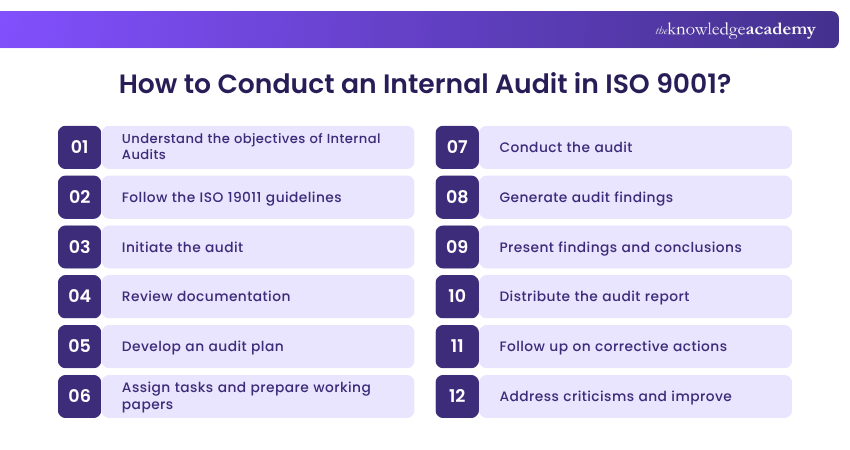
a) Understand the Objectives of Internal Audits: T The purpose of Internal Audits includes the assessment of process compliance to ISO 9001 Requirements, the review of the overall effectiveness in the application of the QMS, and the examination of organisational readiness towards external audits.
b) Follow the ISO 19011 Guidelines: ISO 19011 provides a framework for conducting effective Internal Audit, including principles, managing an audit program, conducting the audit, and auditing competencies. It's advisable to use ISO 19011 to plan your Internal Audit process.
c) Initiate the Audit: Firstly, establish the scope and purpose of your audit. Contact the process owner or department head to inform them about the upcoming audit.
d) Review Documentation: Consider the company's documentation, such as its quality manual, procedures, and records, where it ensures it is in accordance with ISO 9001 standards. It is to make sure that the ISO 9001 Documentation is comprehensive and up-to-date.
e) Develop an Audit Plan: Create an audit plan after analysing the document, the audit action plan must indicate what will be audited, the time frame, and manpower in the timeline.
f) Assign Tasks and Prepare Working Papers: Auditing assignments should be handed over to different auditors. Meanwhile, audit work papers should be prepared to help in the efficient audit process, especially for larger audits.
g) Conduct the Audit: Conduct the audit in accordance with the plan and process effectiveness and then check whether the prescribed QMS is in place. Use interviewees, observation and record inspection to collect the necessary facts.
h) Generate Audit Findings: Document the findings, define any discrepancies between norms, propose improvements where possible, and give credit for the best practices that were identified during the audit.
i) Present Findings and Conclusions: The closing meeting involves the sharing of the audit findings with the auditees to determine and discuss the major points that need clarification.
j) Distribute the Audit Report: Prepare and send a formal draft of the audit conclusions, findings and recommendations to concerned parties as contained in the audit report.
k) Follow up on Corrective Actions: Supervise that the implementation of corrective actions is in place to manage the observables which are non-conformant during the audit. The ISO 9001 audit should be followed up by checking if these measures were taken effectively.
l) Address Criticisms and Improve: Be aware of common criticisms of Internal Audits, such as perceived redundancy or the view of ISO 9001 Auditors as enforcers. Obtain input from the auditees to make changes in processes and demonstrate the value of Internal Audits.
Acquire in-depth knowledge of ISO 9001 and quality management standards with our ISO 9001 Lead Auditor Course – join today!
Understanding the ISO 9001 Audit Process
The audit process outlined in ISO 9001 will involve two important phases, namely Document Review and Process Review. Document Review examines the major QMS documents and ensures that they are congruent with the ISO rules whereas Process Review evaluates the effective business processes and whether with the QMS documents. Interviews, observations, and records are used by auditors to provide good implementation and process conformity.
Phases of ISO 9001 Audit:
1) Document Review
a) Dwelling on quality policy, scope and procedures revie
b) Carried out in the first audits
c) Does not include work instructions and forms
2) Audit Process Review
a) Assesses daily work and execution of working procedures
b) Requires interviews of staff, records of staff and observations of staff
c) Process approach used to make sure that it complies with documented procedures
d) Sample reviews a representative sample because of time constraints
e) Referral to training or documentation when there exists a gap
Benefits of Conducting ISO 9001 Internal Audit
Conducting an ISO 9001 Internal Audits offers numerous benefits for organisations striving to improve their Quality Management System (QMS). Incorporating ISO 9001 Training into the audit process further enhances these benefits by ensuring that all team members are well-versed in the standards and procedures. Here are some key advantages:
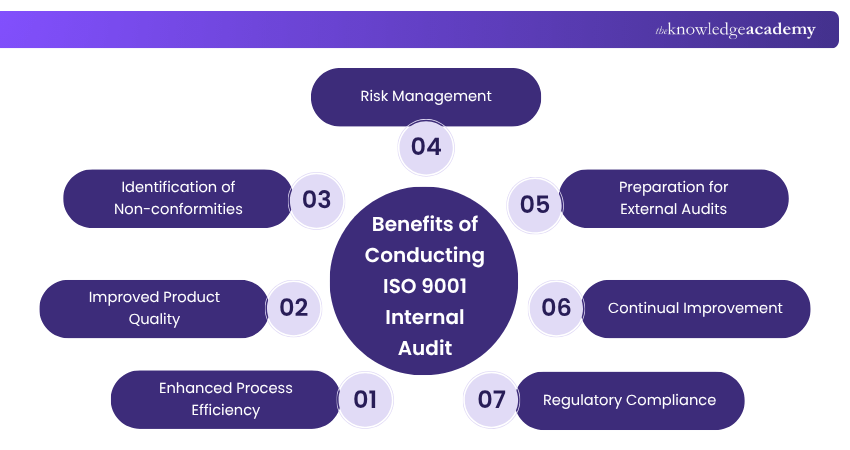
a) Enhanced Process Efficiency: The Internal Audit consistently probes into the entity processes, rectifying whatever areas of need and achieving the required efficiency. Thereby achieving the organisation's intended goals, such as increased productivity and improved resource management.
b) Improved Product Quality: Through the evaluation of product quality and service performance, Internal Audit processes provide the confidence that the products and services provided are in compliance with the customer expectations and quality and safety requirements, enabling the enhancement of product quality and boosting customer service and satisfaction.
c) Identification of Non-conformities: The first activity Internal Audits do is detect non-conformances in the QMS when they are minor. Initial recognition provides a chance for quick- corrective actions, resulting in fewer costs and errors.
d) Risk Management: The activity brings planning a step ahead through identification and execution of serious risks, aligning with the ISO 9001's emphasis on risk-based thinking approach. This leads to a boost in the capability to withstand the operational issues and effectively adapt to the emerging trends.
e) Preparation for External Audits: Internal Audit is conducted as a routine to prepare organisations for future conformity evaluation by solving potential nonconformities, which in turn reduces the likelihood of failure at the external evaluation stage.
f) Continual Improvement: Internal Audits are integral to the continual improvement cycle of Plan-Do-Check-Act (PDCA). It provides objective feedback on the QMS's performance, highlighting the opportunities for continuous improvement.
g) Regulatory Compliance: Routine audits are conducted to ensure that the QMS follows the ISO 9001 specifications and the license and regulatory laws to avoid legal problems and penalties associated with such matters
To learn more about internal audit, refer to our Internal Audit Sample Questions blog for comprehensive insights and practical guidance.
What is the Internal Audit Methodology?
The Internal Audit methodology sets forth the organised, progressive, stepwise procedure that the auditors have to follow when they carry out their evaluation of the internal systems of an organisation. It provides an understandable and reproducible framework that leads every audit from the stage of planning down to that of reporting. The use of a common method by the auditors guarantees the same level of correctness, openness, and speed in all audit operations.
Learn about the ISO 9001 standard to improve performance with our ISO 9001 Foundation Course – join today!
What are the Five Steps in ISO 9001 Internal Audit?
An internal ISO 9001 Internal Audit involves an organised process that is used to judge and enhance the quality management system of an organisation. It entails five main steps that would make compliance and note the gaps and facilitate improvement in a continuous manner.

There are 5 Key Processes to ISO 9001 Internal Auditing:
1) Audit Preparation- Chose which team will do the audit, scope the audit, and develop detailed audit planning.
2) Conducting the Audit- Collect evidence, evaluate compliance, and eliminate prejudicial investigations.
3) Audit Reporting- Write down the results, point out non-conformities and propose action plans.
4) Corrective Action- Formulate an action plan, carry out repairs, and confirm performance.
5) Follow-up Audit- Re-evaluate to determine whether it is effective and initiate sustained quality enhancement.
Conclusion
An ISO 9001 Internal Audit is not just a compliance checkpoint but rather a potential tool for enhancing an organisation's quality culture. Internal audits review processes foster growth over time, improve the company’s reputation with customers, and ensure that the quality management system is at its best. Start strengthening your quality management system today and move your organisation closer to consistent, reliable excellence.
Understand the importance of auditing techniques with our ISO 9001 Courses– join today!
Frequently Asked Questions
What happens if you fail the ISO 9001 audit?

If you fail an ISO 9001 Internal Audit, your organisation may not receive certification or have its existing certification suspended or revoked. You will need to address the identified non-conformities and undergo a follow-up audit to verify corrective actions.
How often should you do an Internal Audit for ISO 9001?
The timeframe for Internal Audit, as in the case of ISO 9001, may vary from organisation to organisation. However, these audits should be conducted annually. Some companies choose to get audited more frequently, depending on the complexity of their operating procedures.
What are the Other Resources and Offers Provided by The Knowledge Academy?
The Knowledge Academy takes global learning to new heights, offering over 3,000+ online courses across 490+ locations in 190+ countries. This expansive reach ensures accessibility and convenience for learners worldwide.
Alongside our diverse Online Course Catalogue, encompassing 17 major categories, we go the extra mile by providing a plethora of free educational Online Resources like Blogs, eBooks, Interview Questions and Videos. Tailoring learning experiences further, professionals can unlock greater value through a wide range of special discounts, seasonal deals, and Exclusive Offers.
What is the Knowledge Pass, and How Does it Work?
The Knowledge Academy’s Knowledge Pass, a prepaid voucher, adds another layer of flexibility, allowing course bookings over a 12-month period. Join us on a journey where education knows no bounds.
What are Related Courses and Blogs Provided by The Knowledge Academy?
The Knowledge Academy offers various ISO 9001 Certification Courses, including ISO 9001 Foundation Course, ISO 9001 Internal Auditor Course and ISO 9001 Lead Implementer Certification Course. These courses cater to different skill levels, providing comprehensive insights into Quality Management.
Our Business Improvement Blogs cover a range of topics offering valuable resources, best practices, and industry insights. Whether you are a beginner or looking to advance your Compliance skills, The Knowledge Academy's diverse courses and informative blogs have you covered.

The Knowledge Academy


Global Training Provider
The Knowledge Academy is a world-leading provider of professional training courses, offering globally recognised qualifications across a wide range of subjects. With expert trainers, up-to-date course material, and flexible learning options, we aim to empower professionals and organisations to achieve their goals through continuous learning.

Upcoming Business Improvement Resources Batches & Dates
Date
 ISO 9001 Lead Auditor Course
ISO 9001 Lead Auditor Course
Mon 6th Jul 2026
ISO 9001 Lead Auditor Course
Mon 3rd Aug 2026
ISO 9001 Lead Auditor Course
Mon 7th Sep 2026
ISO 9001 Lead Auditor Course
Mon 5th Oct 2026
ISO 9001 Lead Auditor Course
Mon 2nd Nov 2026
ISO 9001 Lead Auditor Course
Mon 23rd Nov 2026
ISO 9001 Lead Auditor Course
Mon 7th Dec 2026

 If you wish to make any changes to your course, please


