


 Top Rated Course

We may not have the course you’re looking for. If you enquire or give us a call on +800 312616 and speak to our training experts, we may still be able to help with your training requirements.
What is Direct Discrimination? Meaning, Types, and Examples
The Knowledge Academy 09 February 2026Direct Discrimination is treating someone unfairly due to a protected characteristic like race, gender, age, religion, or disability through a deliberate act. It’s a deliberate unequal treatment that disadvantages an individual or group compared to others. This is unlawful under equality laws, including the Equality Act 2010 in the UK.

Training Outcomes Within Your Budget!
We ensure quality, budget-alignment, and timely delivery by our expert instructors.
Table of Contents
Direct Discrimination is a clear form of unfair treatment. It occurs when someone is intentionally treated unfairly or unfavourably because of a specific characteristic, such as age, gender, or race. This unequal treatment is intentional and puts a particular individual or group at a disadvantage compared to others in a similar situation. Knowing What is Direct Discrimination is key to recognising such harmful behaviour in everyday life.
According to the UK government’s Civil Service People Survey, 2024, 7% of civil servants reported they had been discriminated against at work. This provides a view of the ongoing discrimination despite the presence of legal protections. In this blog, you will explore about What is Direct Discrimination, its types, importance, and more comprehensively. Keep reading to learn more!
Table of Contents
1) What is Direct Discrimination?
2) Different Types of Direct Discrimination
3) The Importance of Addressing Direct Discrimination
4) Examples of Direct Discrimination in Business
5) Direct vs Indirect Discrimination
6) How to Prevent Direct Discrimination in Your Organisation?
7) How to Identify Direct Discrimination?
8) Conclusion
What is Direct Discrimination?
Direct Discrimination happens when an individual or group is treated unfavourably because of specific characteristics, such as race, gender, age, or disability. It is a clear and intentional form of unfair treatment and is unlawful under legal protection acts. For example, joking about an employee’s religious beliefs without any action is discrimination against religion or belief.
Under the Equality Act 2010 in the UK, it is unlawful to discriminate against someone because of the following characteristics:
1) Age
2) Disability
3) Gender Reassignment
4) Marriage and Civil Partnership
5) Pregnancy and Maternity
6) Race
7) Religion or Belief
8) Sex
9) Sexual Orientation

Different Types of Direct Discrimination
Understanding What is Direct Discrimination is important to recognise its occurrence in different ways. Let’s look at the three main types of Direct Discrimination below.
1) Ordinary Direct Discrimination: This is the most common and clear type of Direct Discrimination. It happens when a person or group is treated unfavourably because of a protected characteristic, such as age, disability, race or gender.
2) Discrimination by Association: This occurs when a person is treated unfairly because they are connected to a person with a protected characteristic. This individual may not have those characteristics themselves, but the association leads to unfavourable treatment.
3) Discrimination by Perception: This happens when someone is treated unfavourably because others believe they have a protected characteristic, even if that belief is incorrect. Here, it is about the perception, not the reality, making this form of discrimination serious.
1) Example Based on Protected Characteristics
Direct Discrimination is when a person or group is treated unfairly or unfavourably because of a protected characteristic. For example, Jessica, a woman, applies for a job with a company that sells farm machinery but is rejected because the employer believes men are more skilled and credible. This decision is based on sex, not ability, making it a form of Direct Discrimination.
2) When Direct Discrimination Might be Allowed?
In certain situations, what is considered Direct Discrimination may be allowed if there is an objective justification. This means the employer must prove there is a genuine business reason for the decision. However, this exception applies only in specific and limited cases, mainly related to age and disability.
Strong values serve as the foundation for building strong teams. Learn how in our Ethics in Workplace Training – Sign up now!
The Importance of Addressing Direct Discrimination
You may be surprised to learn how important it is to address Direct Discrimination. In fact, it's a necessity in today's corporate ecosystem. Here are its key points listed below:
1) Encourages Fairness and Inclusivity: Promotes equal treatment for all, regardless of identity.
2) Ensures Access to Opportunities: Protects individuals from being unfairly denied jobs, education, or support.
3) Drives Personal and Professional Growth: Fosters an environment where everyone can thrive and advance.
4) Sparks Creativity and Innovation: Welcomes diverse ideas that lead to better solutions.
5) Boosts Workplace Culture and Productivity: Builds a respectful atmosphere that motivates employees.
6) Demonstrates Commitment to Diversity: Shows the organisation values inclusivity and equality.
7) Improves Employee Engagement and Retention: Encourages loyalty by making all employees feel valued.
8) Aligns with Social Justice and Organisational Success: Combines ethical responsibility with sustainable business goals.
Organisational integrity is not negotiable. Learn how to protect in our Anti-Bribery and Corruption Training- Sign up now!
Examples of Direct Discrimination in Business
Understanding What is Direct Discrimination needs recognising its occurrence in business settings. It happens when an employee or job applicant is treated unfavourably or unfairly based on a protected characteristic. It is an unlawful practice and can lead to serious legal and reputational consequences for organisations.
Examples:
1) An employee working in sales is assigned male at birth, later transitions to a woman. If the employer changes her role against her wishes, she no longer meets clients. This is a form of Direct Discrimination based on gender reassignment.
2) Providing senior and leadership positions only to male employees due to assumptions about women’s childcare responsibilities or pregnancy. This form of discrimination is based on sex, pregnancy, and maternity.
3) Carrying out criminal background checks only for applicants from a particular race, nationality or religion. Singling out specific groups in a clear way and treating them unfavourably is unlawful.
Direct vs Indirect Discrimination
Understanding What is Direct Discrimination requires to be aware of the differences between other forms of discrimination. Let’s look at the differences between Direct Discrimination and Indirect Discrimination:
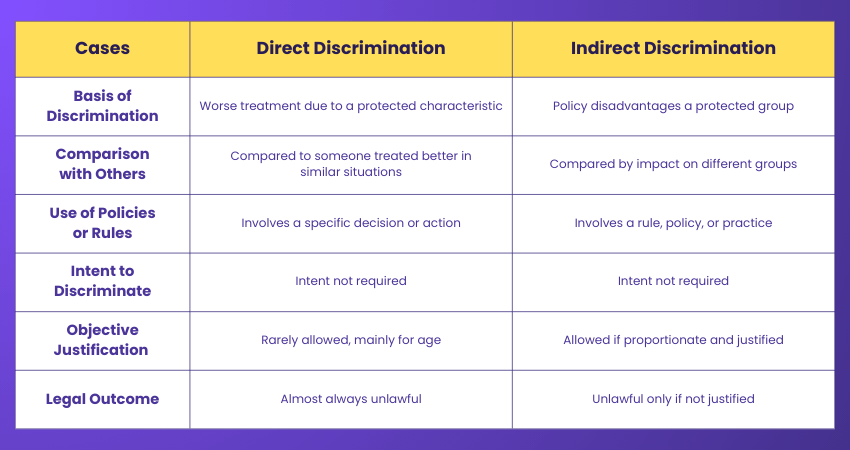
1) Basis of Discrimination: Direct Discrimination happens when a person or group is treated unfavourably due to a protected characteristic. The focus is mainly on the individual. Indirect Discrimination arises from neutral policies or practices that apply to everyone but put a group at a disadvantage. Here, the emphasis is on the impact rather than the intent.
2) Comparison with Others: Direct Discrimination compares between the person treated unfairly and another person in a similar situation. It might be about who was treated better, or who must have been treated unfavourably due to a characteristic. Indirect Discrimination comparison looks at assessing whether a policy places people at a disadvantage compared to others.
3) Use of Policies or Rules: Direct Discrimination involves a specific action affecting an individual, such as refusing a promotion or denying a service. In the case of Indirect Discrimination, it always involves a wider policy, rule, practice, or arrangement that applies broadly but results in unequal outcomes for certain groups.
4) Intent to Discriminate: Intent is not required for either type. In Direct Discrimination, it can occur if the unfavourable treatment was unintentional, if it is linked to a protected characteristic. In Indirect Discrimination, it does not depend on intent. Well-meaning policies can still be discriminatory if they unfairly put certain groups in a disadvantage.
5) Objective Justification: Objective Justification rarely applies to Direct Discrimination, including someone who shares the same protected characteristic as the person affected. In the case of Indirect Discrimination, objective justification is central. It is due to the policy that may be unlawful if its organisation can justify that there is a genuine reason, despite its discriminatory impact.
6) Legal Outcome: Direct Discrimination is unlawful and difficult to defend. This makes it a serious legal risk resulting in serious reputational and legal consequences. Indirect Discrimination is unlawful only when an organisation cannot demonstrate an objective justification. This allows for some scope of lawful defence where policies are necessary and genuine.
Make smarter and legally sound decisions with Commercial Law Training – Register today!
How to Prevent Direct Discrimination in Your Organisation?
To prevent Direct Discrimination in your organisation, you must implement the following pointers:

1) Establish Clear Anti-discrimination Policies: Develop robust Anti-discrimination policies that clearly define unacceptable behaviours and outline strict consequences of violation. Ensure these policies are effectively communicated to all employees and are enforced consistently.
2) Provide Diversity, Equity, and Inclusion (DEI) Training: Conduct periodic training sessions to educate the company's employees on diversity, equity, and inclusion. These programmes should focus on raising awareness, building empathy , and equipping employees with tools to foster an inclusive work environment.
3) Ensure Transparent Hiring and Promotion Practices: Adopt transparent hiring and promotion processes that are based on qualifications and merit instead of a biased approach or Nepotism. Avoid decisions influenced by personal identities, ensuring equal opportunities for all.
4) Conduct Regular Reviews of HR Processes: Periodically review your organisation's hiring and promotion practices to identify and address any biases. Use data-driven insights to make improvements and ensure fairness.
5) Encourage Open Communication: Foster an environment where employees feel safe discussing discrimination-related issues. Provide secure channels for reporting incidents without fear of retaliation and respond to reports promptly and effectively.
6) Build a Culture of Respect and Equality: Promote a workplace culture rooted in respect and equality. Make sure all employees feel valued and motivated to contribute to organisational success, enhancing morale and productivity.
How Do You Identify Direct Discrimination?
To identify Direct Discrimination, you can look for clear evidence of unfair treatment, such as being denied services, opportunities, or benefits that others receive under similar circumstances. For instance, if a job applicant is rejected solely because of their ethnicity or if a service is withheld due to a customer’s disability, these are examples of Direct Discrimination.
Conclusion
Understanding What is Direct Discrimination is essential for creating fair, respectful and legally compliant workplaces and communities. Recognising how Direct Discrimination works can help you identify unfair treatment, challenge harmful behaviour and take meaningful steps to prevent it. Clear awareness, consistent policies, and proactive responses reduce legal risk, and build an inclusive and equal workplace environment.
Navigate workplace law with confidence and stay compliant to reduce legal risk with our Employment Law Courses – Join today!
Frequently Asked Questions
What is an example of Direct Discrimination Case?

A qualified older employee is passed over for promotion solely due to their age, despite better performance than a younger colleague. This is a clear case of direct age discrimination in the workplace.
What is the Difference Between Direct and Indirect discrimination?
Direct discrimination involves treating someone unfairly due to a protected characteristic. Indirect discrimination occurs when a policy applies to everyone but disadvantages certain groups more, even if unintentional. Both are unlawful under the Equality Act 2010.
What are the Other Resources and Offers Provided by The Knowledge Academy?
The Knowledge Academy takes global learning to new heights, offering over 3,000+ online courses across 490+ locations in 190+ countries. This expansive reach ensures accessibility and convenience for learners worldwide.
Alongside our diverse Online Course Catalogue, encompassing 19 major categories, we go the extra mile by providing a plethora of free educational Online Resources like Blogs, eBooks, Interview Questions and Videos. Tailoring learning experiences further, professionals can unlock greater value through a wide range of special discounts, seasonal deals, and Exclusive Offers.
What is The Knowledge Pass, and How Does it Work?
The Knowledge Academy’s Knowledge Pass, a prepaid voucher, adds another layer of flexibility, allowing course bookings over a 12-month period. Join us on a journey where education knows no bounds.
What are the Related Courses and Blogs Provided by The Knowledge Academy?
The Knowledge Academy offers various Employment Law Courses, including Direct and Indirect Discrimination Training, Anti-Bribery Training Course, and Commercial Law Training. These courses cater to different skill levels, providing comprehensive insights into Employee Rights and Responsibilities.
Our HR Resources Blogs cover a range of topics related to Direct Discrimination, offering valuable resources, best practices, and industry insights. Whether you are a beginner or looking to advance your HR skills, The Knowledge Academy's diverse courses and informative blogs have got you covered.

The Knowledge Academy


Global Training Provider
The Knowledge Academy is a world-leading provider of professional training courses, offering globally recognised qualifications across a wide range of subjects. With expert trainers, up-to-date course material, and flexible learning options, we aim to empower professionals and organisations to achieve their goals through continuous learning.

Upcoming HR Resources – Learn about Human Resources Batches & Dates
Date
 Direct and Indirect Discrimination Training
Direct and Indirect Discrimination Training
Fri 3rd Jul 2026
Direct and Indirect Discrimination Training
Fri 2nd Oct 2026

 If you wish to make any changes to your course, please


