


 Top Rated Course

We may not have the course you’re looking for. If you enquire or give us a call on +800 312616 and speak to our training experts, we may still be able to help with your training requirements.
Risk vs. Issue: What Is the Difference?
Grace Mitchell 24 January 2026Have you ever wondered what sets a risk apart from an issue? Risk is a potential problem that may occur in the future, while issue is a current problem that needs immediate attention. This blog explores the Difference Between Risk and Issue, how to manage them effectively, and strategies for mitigating risks before they become issues.

Training Outcomes Within Your Budget!
We ensure quality, budget-alignment, and timely delivery by our expert instructors.
Table of Contents

Understanding the Difference Between Risk and Issue can transform how you manage projects. A risk is like a storm cloud on the horizon—it hasn’t happened yet, but you’re ready to adjust course if needed. It’s about anticipating and preparing for potential problems. An issue, however, is the sudden downpour already soaking your deck, requiring immediate action to steady the ship.
In this blog, we’ll dive into the key Difference Between Risk and Issue, offering real life examples. Whether you’re aiming to prevent future setbacks or resolve current challenges, this blog will help you sharpen your project management skills and lead with confidence.
Table of Contents
1) What is a Risk?
2) What is an Issue?
3) Risk vs Issue: What is the Difference?
4) Risk vs Issue: Examples in Project Management
5) Conclusion
What is a Risk?
A risk is an event or circumstance that may occur and would have a positive or negative impact on a project's objectives. In simple words, project risks and uncertainties are those events that have not occurred yet but could affect the timeline, cost, scope, or quality of the project. cost, scope, or quality of the project. With respect to this, proactive identification and risk management in project management becomes very much the art of reducing the negative or capitalising on positive opportunities.
Each project has its associated risks, but it isn't their mere presence that points to some form of failure; it's how such risks are dealt with. Effective risk management would involve an early identification of the potential risks, an assessment of their likelihood and potential impact, and the strategy in place toward mitigation or avoidance of these risks.
Types of Risks in Project Management
In project management, risks are potential events that could impact your project’s success. Understanding the different types of risks helps in identifying, assessing, and mitigating them effectively to keep your project on track.

1) Technical Risks: These are risks associated with technology, such as software bugs, malfunctioning hardware, or new technologies that are not performing as expected. Technical risk may lead to project delay or involve further resources to fix the problem.
2) External Risks: This risk is outside the control of the project team and could be due to market conditions, regulatory changes, natural hazards, or supply chain problems. Most external risks cannot be foreseen and avoided; one must have contingency plans for them.
3) Organisational Risks: Organisation-related risks emanate from within an organisation, whether due to limited resources, changed priorities in a project, or even internal politicking. These are factors that might change the time estimate and number of resources needed within a project. Organisational risks may further lead to a reduction in resource availability and negatively affect project schedules.
4) Project Management Risks: These are risks emanating from the processes related to the managing of the project itself, such as poor planning, ineffective communication, or failure to follow best practices. The common consequences of such risks include scope creep, budget overflows, and delays beyond schedule.
5) Financial Risks: These are the potential losses in finances that may result from factors such as budget cuts, funding changes, or unexpected costs. These risks can impact a project directly on the question of its viability and should be handled with caution through proper budgeting and monitoring of finances.
What is an Issue?
An issue is an actual problem that is happening now and is affecting the project. As opposed to risks, which may happen in the future, issues are current problems that actively need resolution. Issues may range from minor nuisances to large obstacles and will impede project progress if not resolved.
Issues often arise from unmitigated risks but sometimes emerge unexpectedly. Effective issue management, which includes maintaining an Issue Log, not only involves identifying issues as they develop but also requires a thorough understanding of their impact and implementing corrective actions. This ensures that further disruptions to the project are minimized.
Types of Issues in Project Management
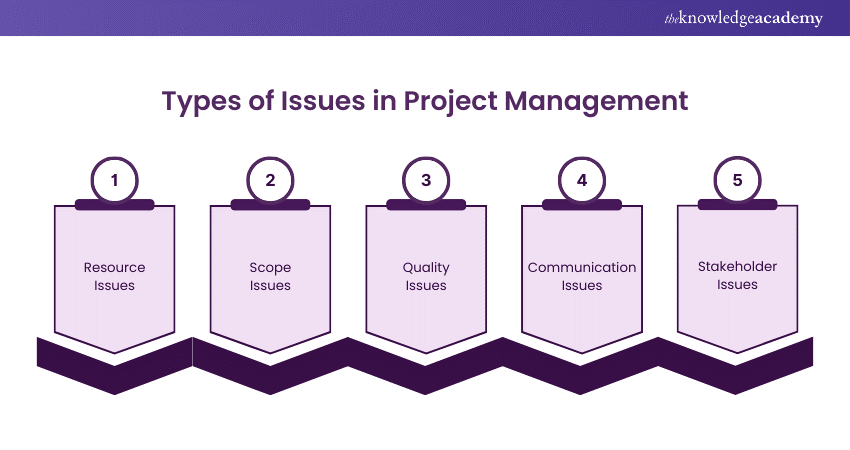
Issues are problems that arise during a project, requiring immediate attention and resolution. Recognising the various types of issues can help project managers respond quickly and effectively, minimising disruptions and ensuring project continuity.
1) Resource Issues: These mostly arise from shortages or conflicts with the project's resources, personnel, equipment, or materials. When the project is affected waiting period occurs, causing a reduction in the quality of the deliverables.
2) Scope Issues: These are the issues constituting major deviations from the originally agreed-upon scope. Most often, such instances result in extra work or scope creep. Scope issues more often translate into increased cost and the lengthening of the timelines of projects, thereby making it difficult to achieve the original goal or objective of the projects.
3) Quality Issues: These relate to the overall quality of the project's deliverables, such as defects, errors, or non-conformity to specifications. Quality issues will bring about rework, extra costs, and ill feelings from the stakeholders.
4) Communication Issues: Poor communication gives rise to misunderstandings and delays. It also leads to a situation where different individuals in the project have different ideas about the project. Communication issues often lead to confusion and inefficiencies within the project team.
5) Stakeholder Issues: conflicting stakeholder interests, lack of engagement by stakeholders, or resistance of stakeholders to change. Ensuring the level of project support, funding, and success of a project.
Master the art of project success. Get certified in Project Management with our Project Management Certification Course and turn your vision into reality - Register today!
Risk vs Issue: What is the Difference?
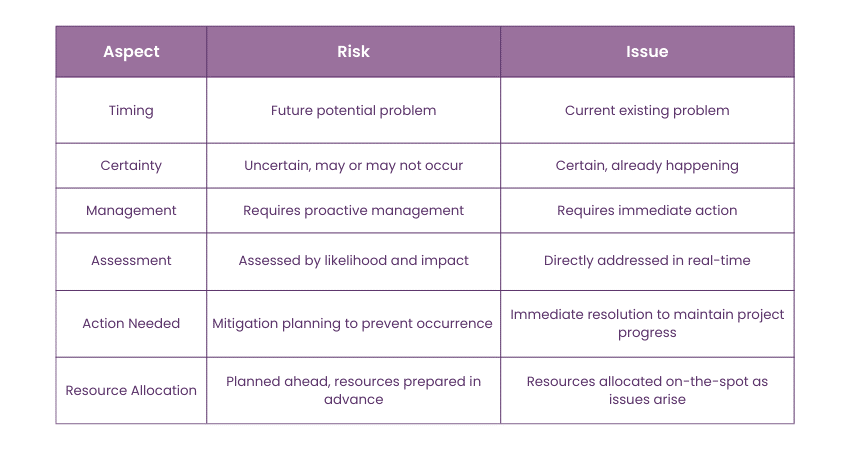
The main difference between a risk and an issue is with respect to timing and certainty. A risk is a potential problem that may occur sometime in the future, while an issue is an existing problem at present. While a risk refers to uncertainties that need proactive management, an issue is about certainties that require immediate action.
While risks can be assessed through the likelihood of the risk and its impact, facilitating the planning of mitigation, issues present in real time and are solved in real time. The major difference: risks are situations averted beforehand so that they do not come to pass, while issues need immediate attention to keep the project on course.
You should know the difference between risks and issues as the project manager to allocate resources most effectively. To prioritise what needs to be done in what order, to keep the project moving along, and to plan for and be prepared for things that could go wrong.
Risk vs Issue: Examples in Project Management
Real-world examples help illustrate the difference between risks and issues in project management. By examining these cases, we can better understand how risks can evolve into issues and the strategies used to manage both effectively.
Boeing's 787 Dreamliner: Risk Complexity Leading to Inevitable Issues
The Boeing 787 Dreamliner project has been a perfect example of how complex risks could lead to big issues. Throughout this project, Boeing has faced many kinds of risk-innovative materials, worldwide problems with supply, and ambitious timelines. Though these risks had been identified, the complexity and interdependencies were underestimated, which led to a row of issues related to delays, cost overruns, and technical problems with the aircraft.
The above case points to the need for adequate risk assessment and the realisation of how risk can quickly develop into significant problems if not handled properly. Boeing's case proves well that even if the risks are, or should be known, the impact could be much stronger than previously expected; hence, good practices should be developed to manage it.
Bank of America: When Risks Prove More Intense Issues Than You Imagined
The acquisition of Countrywide Financial by the Bank of America caused a huge stir. Initially, associated risks of acquisition were related to financial performance and market conditions. However, these risks just as fast grew into serious matters as the realisation of the financial crisis, costing the bank billions in losses, lawsuits, and the erosion of reputation.
This case goes to show how risks can become large problems, and especially when other conditions outside the control of the business enhance it further. It also brings forward the fact that continuous monitoring of risks should be applied, and one should be prepared for the worst, because even a well-assessed risk can turn into a critical issue under changed conditions.
Unleash your Inner Project Manager! Join our course Project Management for Non-Project Managers Course and transform your skills into project success.
Conclusion
In project management, distinguishing between risks and issues in project management is crucial for maintaining control and ensuring success. Risks are potential events that could disrupt your project if they occur, like bumps on the road ahead. Issues, on the other hand, are current obstacles that require immediate attention and resolution. By clearly identifying and managing both, you can better plan, prepare, and respond, keeping your projects on track and moving smoothly.
Ready to master PMO essentials? Join our Project Management Office Fundamentals Certification Course and become the project leader your team needs. Register now!
Frequently Asked Questions
How can Risk Mitigation Strategies be Developed?

Develop risk mitigation strategies by identifying potential risks early in the project, evaluating their likelihood and impact, and prioritising them based on severity. Create action plans that include steps to reduce, transfer, avoid, or accept risks, and continuously monitor and adjust these strategies as the project progresses.
How Should Issues Be Managed in a Project?
Issues should be managed by promptly identifying and documenting them, assessing their impact on the project, and assigning responsibility for resolution. Develop a clear action plan to address the issue, communicate with stakeholders, and monitor progress to ensure the issue is resolved efficiently.
What are the Other Resources and Offers Provided by The Knowledge Academy?
The Knowledge Academy takes global learning to new heights, offering over 3,000+ online courses across 490+ locations in 190+ countries. This expansive reach ensures accessibility and convenience for learners worldwide.
Alongside our diverse Online Course Catalogue, encompassing 19 major categories, we go the extra mile by providing a plethora of free educational Online Resources like Blogs, eBooks, Interview Questions and Videos. Tailoring learning experiences further, professionals can unlock greater value through a wide range of special discounts, seasonal deals, and Exclusive Offers.
What is The Knowledge Pass, and How Does it Work?
The Knowledge Academy’s Knowledge Pass, a prepaid voucher, adds another layer of flexibility, allowing course bookings over a 12-month period. Join us on a journey where education knows no bounds.
What are the Related Courses and Blogs Provided by The Knowledge Academy?
The Knowledge Academy offers various Project Management Courses, including the Project Management Certification Course, and the Project Management for Non-Project Managers Course. These courses cater to different skill levels, providing comprehensive insights into Top 12 Project Management Methodologies.
Our Project Management Blogs cover a range of topics related to Project Management, offering valuable resources, best practices, and industry insights. Whether you are a beginner or looking to advance your Project Management skills, The Knowledge Academy's diverse courses and informative blogs have got you covered.

Grace Mitchell


Senior Project Management Consultant and Author
Grace Mitchell is a highly experienced project management professional with over 15 years of expertise in leading large-scale projects across industries, including construction, IT, and finance. With qualifications in PRINCE2®, PMP®, AgilePM®, and MSP®, Grace specialises in delivering complex programmes with precision and clarity. Her writing is grounded in real-world application and focuses on helping learners build confidence in project delivery and stakeholder management.
View Detail
Upcoming Project Management Resources Batches & Dates
Date
 Project management Certification
Project management Certification
Fri 26th Jun 2026
Project management Certification
Fri 31st Jul 2026
Project management Certification
Fri 21st Aug 2026
Project management Certification
Fri 18th Sep 2026
Project management Certification
Fri 16th Oct 2026
Project management Certification
Fri 20th Nov 2026
Project management Certification
Fri 18th Dec 2026

 If you wish to make any changes to your course, please


