


 Top Rated Course

We may not have the course you’re looking for. If you enquire or give us a call on +44 1344 203 999 and speak to our training experts, we may still be able to help with your training requirements.
Equity Market Explained: Meaning, Types, Benefits and Examples
Olivia Taylor 16 July 2026The Equity Market connects buyers and sellers of shares, allowing individuals and institutions to invest in publicly listed and private companies. It helps businesses raise capital for growth and expansion. At the same time, it offers investors opportunities to build wealth and participate in a company’s performance.
Home
 Resources
Accounting and Finance
Equity Market Explained: Meaning, Types, Benefits and Examples
Resources
Accounting and Finance
Equity Market Explained: Meaning, Types, Benefits and Examples
Resources
Accounting and Finance
Equity Market Explained: Meaning, Types, Benefits and Examples

Training Outcomes Within Your Budget!
We ensure quality, budget-alignment, and timely delivery by our expert instructors.
Table of Contents
The Equity Market is a significant player in the modern world's financial system, linking investors eager for growth opportunities with companies. It leads to capital creation while also allowing one to be part of a business and get rewards. Let's look at its composition, its various roles, and its effects to provide a solid foundation for understanding the subsequent topics.
Table of Contents
1) What is an Equity Market?
2) How do Equity Markets Work?
3) Importance of Equity Markets
4)Types of Equity Market
5) Top Equity Markets
6) Benefits and Drawbacks of the Equity Market
7) What are the Timings of the Equity Market?
8) What Influences the Performance of Equity Markets?
9) Conclusion
What is an Equity Market?
The Equity Market, also known as the stock market, is a central hub where company shares are issued and traded. In the Equity Market platform, trades occur directly between parties, connecting buyers and sellers. It acts as a key indicator of economic status. The Equity Market bridges the gap between companies seeking capital with investors aiming to earn returns on their investments.
Key Takeaways:
1) It has an important role in the global financial market
2) It offers investors the opportunity to earn returns on their investments
3) It allows companies to raise capital for growth and expansion
4) Consists of the primary and secondary markets for investing and trading

How do Equity Markets Work?
Equity Markets function through buying and selling of shares issued by publicly listed companies. Here, investors purchase shares with the aim of earning future returns. The price of shares is determined by market forces, mainly supply and demand. These market forces are influenced by factors, such as company earnings and industry trends.
Below, a step-by-step process is provided for better clarity:
1) Placing an Order: A person (called an investor) tells a broker to buy or sell some company shares. They also say how many shares they want and the price.
2) Sending the Order: The broker sends this request to the stock exchange.
3) Finding a Match: The stock exchange looks for another person who wants to buy or sell the same shares at the same price.
4) Making the Trade: If both sides agree, the trade happens quickly.
5) Trade Confirmation: Both the buyer and the seller get a message to say the trade is done.
6) Payment and Shares: The buyer pays the money. The seller gives the shares.
7) Account Update: The shares go into the buyer’s Demat account. This is an online account that holds shares safely.
8) Settlement: This whole process is usually done by the next working day. This is called T+1.
Importance of Equity Markets
Let’s explore the importance of Equity Markets insightfully through three key elements:
1) Capital Raising
Here are some key points on capital raising:
1) It helps companies to raise capital for market entry, expansion and product development from the Capital Market.
2) Companies issue shares to the public and allow them to raise capital without debt.
3) It is also known as equity financing which enables businesses to grow while sharing investors' ownership.
2) Liquidity
Let's investigate some key functions:
1) These markets provide liquidity and allow investors to easily buy and sell shares.
2) Its high liquidity ensures a quick conversion of assets into cash that are crucial for investors.
3) It guarantees a constant presence of buyers and sellers.
4) This makes it easier to enter or exit positions and adjust portfolios.
3) Investment Options
Here are some key points:
1) It offers various Investment options, from large companies to emerging stocks.
2) A wide variety of Investment choices allows investors to build a varied portfolio.
3) The right investment makes the Equity Market essential for their strategy.
Attain knowledge of how subsidiary ledgers support a general ledger control account. Join our Cash Cycle Management Training now!
Types of Equity Market
Equity Markets are divided into two main categories, the primary and the secondary market. Both play different roles in the functioning of the stock market. These are the types of Equity Market:
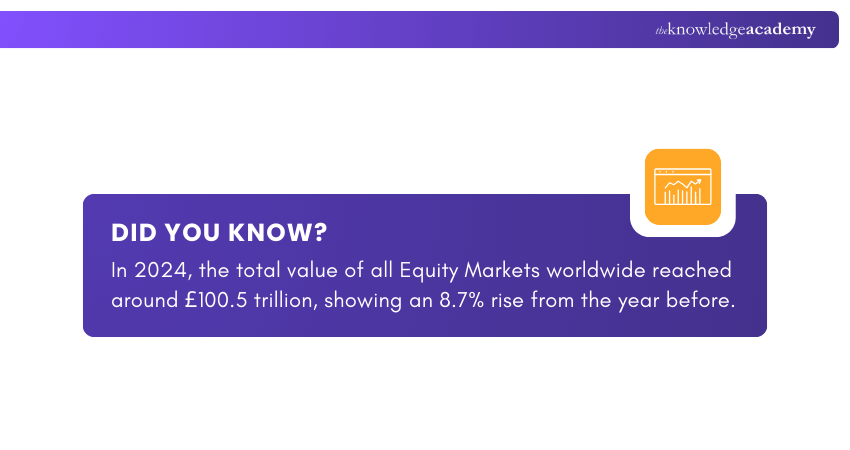
The equity market has two major parts which are determined by the manner in which the shares were originally issued and subsequently traded. Every one of these parts plays an important role at a particular stage during the investment life cycle.
1) Primary Market
The primary market is a place where fresh shares are sold to investors directly by issuing companies, mainly via IPOs, so that the companies can get more funds. It helps businesses raise capital for expansion, innovation, or debt repayment.
2) Secondary Market
Private investors via the secondary market can freely purchase and sell shares that are already in existence; thus, they gain liquidity, and the market gets a chance to discover the prices. This market operates through stock exchanges where buyers and sellers trade existing stocks at market-driven prices.
Understand costing techniques to optimise pricing and profit margins. Join our Inventory Accounting and Costing Course Join now!
Top Equity Markets
Equity Markets are places where people buy and sell company shares. These markets help companies get money and let people invest and earn more money. Below are some of the biggest Equity Markets in the world:
1) New York Stock Exchange (NYSE)
Located in New York City, the New York Stock Exchange was founded in 1792. This is the biggest stock market in the world. It started under a tree with 24 people. Now, many big companies like Johnson & Johnson, ExxonMobil, and Berkshire Hathaway are listed here. Long ago, people shouted to buy and sell shares. Today, most things happen on computers. Every day, the market starts with a bell sound.
2) Nasdaq
Nasdaq, based in New York Cit, was founded in 1971. It is the world’s first electronic stock market. It is home to many of the world’s leading technology giants, such as Apple, Microsoft, Amazon, and Google. Its primary focus on innovation and digital trading makes it a suitable platform for new and fast-growing tech companies looking to raise capital and expand globally.
3) Tokyo Stock Exchange (TSE)
Headquartered in Tokyo, Japan, the Tokyo Stock Exchange opened in 1878. This is the main stock market in Japan. It has big companies like Toyota, Sony, and Honda. It was once closed during World War II, but it opened again in 1949. The main market number here is called the Nikkei 225.
4) Shanghai Stock Exchange (SSE)
Situated in Shanghai, China, the Shanghai Stock Exchange was re-established in 1990. This is the biggest stock market in China. It started a long time ago but was closed for many years. It opened again in 1990. It has many large Chinese companies like ICBC and Sinopec. The main number here is the SSE Composite Index.
5) London Stock Exchange (LSE)
Based in London, UK, the London Stock Exchange was founded in 1801. This is one of the oldest stock markets in the world. In the past, people traded shares in coffee shops. Today, the market has companies from over 60 countries. Big names include HSBC, Shell, and Unilever.
6) Euronext Stock Exchange
With offices across Amsterdam, Paris, Brussels, and more, Euronext was formed in 2000. Euronext connects many European countries in one stock market. It works in countries like France, the Netherlands, and Portugal. It helps many European companies buy and sell shares easily.
7) Hong Kong Stock Exchange (HKEX)
Operating from Hong Kong, the Hong Kong Stock Exchange was founded in 1891. This market is a bridge between China and the world. It helps people outside China buy shares in Chinese companies. Over 2,600 companies are listed here, like Bank of China (HK) and China Unicom. Trading here now happens online.
Master cash flow control & learn smart risk strategies for financial stability with our Treasury Management Training Join now!
Benefits and Drawbacks of the Equity Market
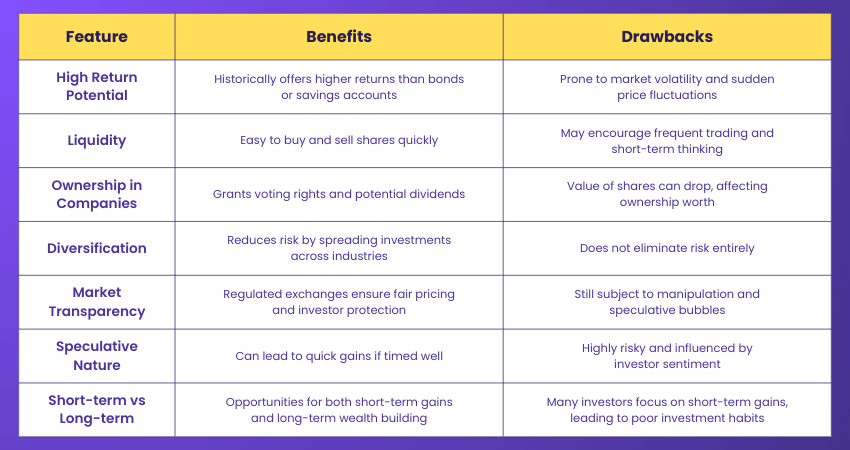
The Equity Market offers various benefits, such as high potential returns, liquidity, and the opportunity for diversification. Investors can own shares in companies, gaining dividends and voting rights. It will benefit from market transparency and regulation.
However, the Equity Market comes with risks, such as market volatility and the possibility of significant losses. The emotional nature of investing and short-term speculation can lead to poor decision-making.
What are the Timings of the Equity Market?
The Equity Market opens and closes at different times in each country. In the UK, the London Stock Exchange is open from 8:00 in the morning to 4:30 in the evening, Monday to Friday. In the USA, the New York Stock Exchange and Nasdaq are open from 9:30 in the morning to 4:00 in the evening (USA time). This is the same as 2:30 in the afternoon to 9:00 at night in the UK.
These are the main hours when most people buy and sell shares. But some people, like big investors, can also trade before or after these hours. Some apps or brokers also let normal people trade early in the morning or late at night.
What Influences the Performance of Equity Markets?
Economic factors like interest rates, inflation, and growth influence equity market performance, while company earnings and global events shape investor confidence. Investor buying and selling, driven by news and sentiment, determine share prices and overall market direction.
Conclusion
The Equity Market is an interplay of economic forces, corporate performances, and investor actions. Getting a grasp on these factors would entail making investment decisions that are more informed and with higher confidence. With this foundation in place, readers can apply these insights to evaluate opportunities and risks more effectively.
Gain proficiency in budgeting and financial analysis. with our Accounting Courses- Register now!
Frequently Asked Questions
What is the Difference Between Stock and Equity?

A stock is a share delivered by a corporation; on the other hand, equity is the ownership of that corporation. Stocks are the physical manifestation, whereas equity is the value of ownership it confers.
What is a Good Example of Equity Market?
A good example of an Equity Market in the UK is the London Stock Exchange (LSE), where companies like HSBC, Shell, and Unilever list their shares. It offers a transparent platform for investors to trade ownership stakes.

Olivia Taylor


Chartered Accountant and Financial Training Specialist
Olivia Taylor is a qualified chartered accountant with over a decade of experience in financial management, auditing and corporate reporting. Having worked with leading firms in both the public and private sectors, Olivia brings clarity to complex financial topics. Her writing focuses on helping professionals build confidence in key areas of accounting, compliance and financial planning.
View Detail

 If you wish to make any changes to your course, please


