


 Top Rated Course


We may not have the course you’re looking for. If you enquire or give us a call on +44 1344 203 999 and speak to our training experts, we may still be able to help with your training requirements.
How to Become a Python Developer and Build Programming Skills
The Knowledge Academy 06 May 2026Interested in How to Become a Python Developer? Learn the essential skills, tools, and steps to kickstart your Python Development career. This blog covers everything from basic concepts to advanced strategies, ensuring you have the knowledge needed to succeed in this dynamic field. Dive in to know more and succeed in this field!

Training Outcomes Within Your Budget!
We ensure quality, budget-alignment, and timely delivery by our expert instructors.
Table of Contents

Becoming a Python Developer is a rewarding journey that paves the way for numerous tech career opportunities. Additionally, according to BuiltWith currently, 115,261 live websites make use of Python. With such a high popularity, most top businesses are in need of skilled Python Developers. But wondering how do you start? What skills are essential to succeed in this field? This comprehensive blog on “How to Become a Python Developer” will answer these questions and more.
Whether you’re a curious beginner or an experienced coder, this blog will guide you through the essential concepts, powerful libraries, and practical strategies that will transform you into a Python pro. Let’s explore the steps and strategies on How to Become a Python Developer and become an expert in this domain.
Table of Contents
1) Who is a Python Developer?
2) What Does a Python Developer do?
3) Is it Hard to Become a Python Developer?
4) What Jobs Can You Get With Python?
5) Are Python Developers in Demand?
6) Steps to Become a Python Developer
7) Skills Required for Becoming a Python Developer
8) What Tools do Python Developers Use?
9) How Much Does a Python Developer Earn?
10) Conclusion
Who is a Python Developer?
A Python Developer specialises in programming with Python and creating Software Applications, websites, and digital solutions. They efficiently use Python libraries, frameworks, and tools to streamline development and solve complex problems. Working across industries like Web Development, Data Analysis, Machine Learning, and Artificial Intelligence (AI), they collaborate with teams to design, develop, test, and maintain Python-based applications, contributing to the growing Python ecosystem.
What Does a Python Developer do?
The job description of a Python Developer entails the following responsibilities:
a) Creating Software Applications and systems using the Python Programming Language.
b) Collaborating with cross-functional teams to understand project requirements and objectives.
c) Writing, testing, and debugging code to ensure software functionality and reliability.
d) Specialising in Web Development, Data Analysis, Machine Learning, or other Python-related domains.
e) Often working on back-end development, server scripting, and database management.
f) Optimising and maintaining existing codebases, enhancing software performance.
j) Continuously improving software security, scalability, and user experience.
Is it Hard to Become a Python Developer?
Becoming a Python Developer is not inherently problematic, but it requires dedication and consistent effort. Python is a crucial choice for beginners because of its simplicity and readability. However, mastering Python and becoming a proficient developer includes learning its various libraries, frameworks, and applications. This demands continuous learning and practice.
Additionally, proficiency in problem-solving and logical thinking is crucial for coding success. While Python offers a gentler learning curve compared to some other programming languages, aspiring developers must commit to ongoing growth to excel in this field.
What Jobs Can You Get With Python?
Python is a versatile Programming Language, and proficiency in it can result in top-notch job opportunities. Some common career paths for Python Developers include:

Python is a versatile programming language, and proficiency in it opens doors to a wide range of job opportunities. Some common career paths for Python developers include:
a) Software Developer: Software Developers create Software Applications, whether they are web applications, desktop software, or mobile apps.
b) Data Analyst/Scientist: Python is a staple tool in Data Analysis and manipulation, making it crucial for professionals working with data.
c) Machine Learning Engineer: Python is widely used in Machine Learning and Artificial Intelligence, and ML Engineers build and deploy predictive models.
d) Web Developer: Python is used in Web Development frameworks like Django and Flask, making it ideal for Web Development roles.
e) DevOps Engineer: Python is employed in automation and scripting, which is essential in the DevOps field for tasks like deployment and infrastructure management.
f) Game Developer: Python can be used for game development, particularly for scripting and building game logic.
g) Cybersecurity Analyst: Python is used in cybersecurity for tasks like penetration testing and building security tools.
h) Quantitative Analyst: Python is essential in finance for tasks like risk analysis and algorithmic trading.
Are Python Developers in Demand?
Python Developers are in huge demand due to their versatile skill set. Proficiency in Python is essential, but additional skills like Git, Django, Docker, Flask, AWS, CI/CD, CSS, DevOps, Agile, and API knowledge boost employability.
The active Python community provides extensive tools and resources, enhancing productivity. Despite high demand, there’s a shortage of skilled Python Developers, leading companies to offer premium compensation for those proficient in Python and related technologies.
Unlock the world of coding with our Python Programming Training – start your journey today!
Steps to Become a Python Developer
If you're interested in making a career as a Python Developer, here's a breakdown of the essential steps to How to Become a Python Developer:
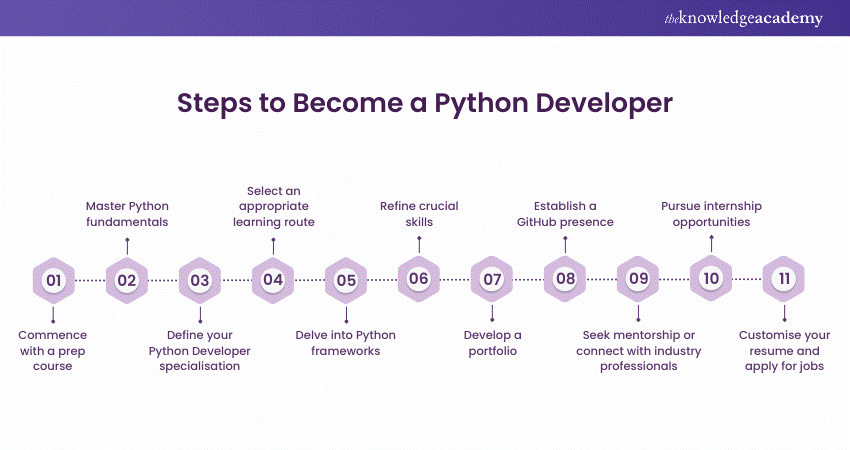
If you're interested in pursuing a career as a Python developer, here's a breakdown of the ten steps to How to Become a Python Developer:
a) Start with a preparatory course from an accredited institution to grasp the basic Features of Python and programming concepts, especially if you’re new to coding.
b) Dive into Python fundamentals like variables, data types, loops, and functions using online tutorials, documentation, and textbooks.
c) Decide on a specialisation such as Web Development, Data Science, Machine Learning, or Game Development based on your interests and career goals.
d) Select a learning route tailored to your specialisation. For Web Development, explore Django or Flask; for Data Science or Machine Learning, focus on libraries like NumPy, Pandas, TensorFlow, or Scikit-Learn.
e) Get familiar with frameworks relevant to your specialisation, like Django and Flask for Web Development or PyTorch for Machine Learning.
f) Enhance your skills with Git for version control, Docker for containerisation, Amazon Web Services (AWS) for cloud services, Continuous Integration/ Continuous Development (CI/CD), Cascading Style Sheets (CSS), DevOps, Agile methodologies, and API knowledge.
g) Build personal projects or contribute to open-source initiatives to create a portfolio showcasing your technical skills and problem-solving abilities.
h) Create a GitHub account, upload your projects, and engage with the coding community to boost your visibility and demonstrate your commitment.
i) Seek guidance from experienced Python Developers through networking or mentorship to gain valuable insights and advice.
j) Look for internships that align with your specialisation to gain real-world experience and potential job opportunities.
k) Tailor your resume to highlight your Python skills, projects, and internships. Apply for entry-level positions, showcasing your enthusiasm and adaptability during interviews.
Elevate your Web Development skills with our Python Django Training – join us today!
Skills Required for Becoming a Python Developer
To become a Python Developer, you need to have the following skills:
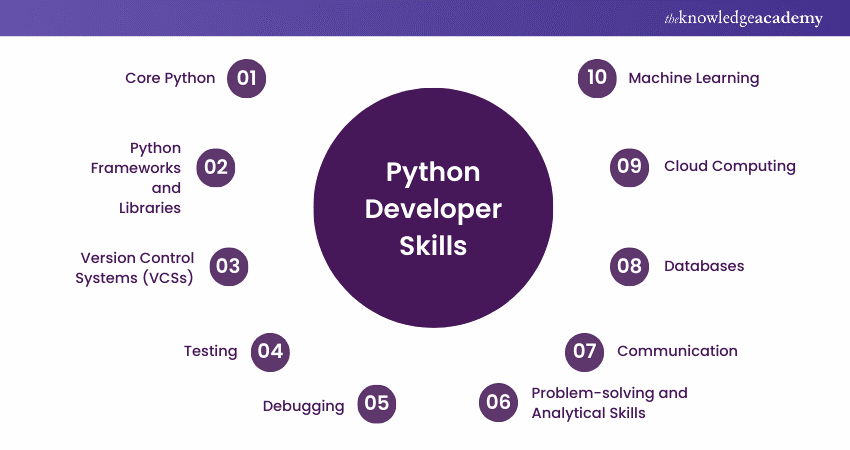
a) Core Python: Fundamentals like variables, data types, operators, control flow, functions, and OOP.
b) Frameworks and Libraries: Tools for web, data science, and Machine Learning, e.g., Django, Flask, NumPy, Pandas, and TensorFlow.
c) Version Control Systems (VCSs): Tools like Git for tracking code changes and collaboration.
d) Testing: Ensuring code functionality with frameworks like unit tests and pytests
e) Debugging: Identifying and fixing code errors, that are crucial for Python’s dynamic typing.
f) Problem-solving and Analytical Skills: Efficiently solving complex problems using logic and algorithms.
g) Communication: Effective verbal and written communication for collaboration and support.
h) Databases: Working with databases like MySQL and PostgreSQL, understanding SQL and design.
i) Cloud Computing: Using platforms like AWS and Azure, understanding cloud concepts and services.
j) Machine Learning: Basic knowledge of Machine Learning concepts and algorithms.
Unlock the future of Artificial Intelligence (AI) with our Python with Machine Learning Training – enlist yourself today!
What Tools Do Python Developers Use?
Python Developers employ a variety of tools to facilitate the development, testing, and deployment of Python applications. Some of the most frequently utilised Python development tools include:
a) Keras: It is a high-level and open-source neural network library written in Python. Keras is built on principles of user-friendliness, modularity, easy extensibility, and operation.
b) PyCharm IDE: This integrated development environment supports popular frameworks like Flask, Django, and Google App Engine. It offers features like intuitive auto-completion, PEP8 checks, and code quality improvements.
c) Pip Package: Python’s default package manager, Pip in Python, comes pre-installed. It logs your package management in a requirements file, aiding in cataloguing the same packages for different environments.
d) Python Anywhere: A highly reliable tool for Python Developers, Python Anywhere is a PaaS (Platform as a Service) that supports the entire Software Development Lifecycle (SDLC). It allows developers to run, develop, and host Python programs on the web.
e) Jupyter Notebook: This tool allows you to insert mathematical notations within markdown cells. It features a console-based approach for record authoring and a browser-based interface that integrates media, computations, mathematics, and text explanations.
Take your interview prep to the next level by focusing on key Software developer interview questions that will help you stand out from the competition.
How Much Does a Python Developer Earn?
The demand for Python Developers is extremely high, and their salaries reflect that. The salaries of Python Developers can be influenced by various factors, including:
a) Experience and Skill Level: More experienced Python Developers with an in-depth understanding of the language and related technologies often command higher salaries than entry-level developers.
b) Location: Salaries can change significantly based on the geographical location of the job. Major tech hubs like Silicon Valley, New York City, and London typically offer higher salaries to Python Developers due to the higher cost of living.
c) Company Size and Industry: Larger companies and those in industries such as finance and technology tend to offer more salaries compared to smaller firms or non-profit organisations.
d) Education and Certifications: Developers with advanced degrees or relevant certifications may receive higher salaries. Certifications like Python Institute certifications or AWS Certified Developer can boost earning potential.
e) Specialisation: Developers who specialise in a particular area, such as Web Development, Data Science, Machine Learning, or cybersecurity, often earn more due to the demand for specialised skills.
f) Programming Languages: Familiarity with other Programming Languages, especially those used in conjunction with Python, can impact salaries. For example, Python Developers who also know JavaScript or Structured Query Language (SQL) may command higher pay.
g) Remote vs. On-site Work: Remote developers may earn salaries that differ from on-site counterparts based on factors like location and company policies.
Familiarity with other Programming Languages, especially those used in conjunction with Python, can impact salaries. For example, Python Developers who also know JavaScript or Structured Query Language (SQL) may command higher pay.
1) Python Developer Entry-level Salary
Entry-level Python Developers can expect competitive salaries, which vary significantly depending on the region. Let’s explore them:
|
Regions |
Salary Per Year |
|
USA |
USD 43,2621 |
|
UK |
GBP 48,8504 |
|
UAE |
AED 180,0007 |
|
Canada |
CAD 42,05810 |
|
Australia |
AUD 120,000 |
|
India |
INR 150,000 |
|
Singapore |
SGD 90,000 |
Source: Glassdoor
2) Python Developer Mid-level Salary
The salaries for Mid-level Python Developers vary widely across different regions, reflecting the demand and cost of living in each area. Here’s a detailed breakdown:
|
Regions |
Salary Per Year |
|
USA |
USD 86,666 |
|
UK |
GBP 56,212 |
|
UAE |
AED 650,000 |
|
Canada |
CAD 64,8213 |
|
Australia |
AUD 105,0004 |
|
India |
INR 1,355,3056 |
|
Singapore |
SGD 6,7508 |
Source: Glassdoor
3) Python Developer Senior-level Salary
The following table provides an overview of Senior-level Python Developer salaries across different regions:
|
Regions |
Salary Per Year |
|
USA |
USD 116,0681 |
|
UK |
GBP 95,438 |
|
UAE |
AED 700,000 |
|
Canada |
CAD 80,3932 |
|
Australia |
AUD 180,0003 |
|
India |
INR 4,200,0004 |
|
Singapore |
SGD 9,2505 |
Source: Glassdoor
Conclusion
Mastering Python acts as a gateway for opportunities across various industries. Understanding "Lua vs Python" can further help you determine the right programming language for specific applications, especially when performance and flexibility are critical. By following this comprehensive blog on “How to Become a Python Developer,” you can gain the required knowledge and skills to excel in this dynamic field. Additionally, adhering to the Python Style Guide ensures that your code remains clean, readable, and maintainable, further enhancing your efficiency as a developer. To make your learning process smoother, download the Python Cheat Sheet for quick access to key commands and tips. Whether you're preparing for Django Interview Questions or diving into other aspects of Python development, this guide will help you build the foundation you need. Begin your journey today and unlock your potential as a proficient Python Developer!
Master the art of Data Science with our Python Data Science Training – get started now!
Frequently Asked Questions
What Projects Should I Work on to Build my Portfolio?

You can work on diverse projects that showcase your skills, such as Web Development, Data Analysis, app development, and Machine Learning. Highlight real-world problems you’ve solved and include collaborative projects to demonstrate teamwork and communication abilities.
What are the Other Resources and Offers Provided by The Knowledge Academy?
The Knowledge Academy takes global learning to new heights, offering over 3,000+ online courses across 490+ locations in 190+ countries. This expansive reach ensures accessibility and convenience for learners worldwide.
Alongside our diverse Online Course Catalogue, encompassing 17 major categories, we go the extra mile by providing a plethora of free educational Online Resources like Blogs, eBooks, Interview Questions and Videos. Tailoring learning experiences further, professionals can unlock greater value through a wide range of special discounts, seasonal deals, and Exclusive Offers.
What is The Knowledge Pass, and How Does it Work?
The Knowledge Academy’s Knowledge Pass, a prepaid voucher, adds another layer of flexibility, allowing course bookings over a 12-month period. Join us on a journey where education knows no bounds.
What are the Related Courses and Blogs Provided by The Knowledge Academy?
The Knowledge Academy offers various Programming Trainings, including the Python Course, R Programming Course, and Bootstrap Training. These courses cater to different skill levels, providing comprehensive insights into Computer Programmer Salary.
Our Programming & DevOps Blogs cover a range of topics related to Python Development, offering valuable resources, best practices, and industry insights. Whether you are a beginner or looking to advance your Programming & DevOps skills, The Knowledge Academy's diverse courses and informative blogs have got you covered.

The Knowledge Academy


Global Training Provider
The Knowledge Academy is a world-leading provider of professional training courses, offering globally recognised qualifications across a wide range of subjects. With expert trainers, up-to-date course material, and flexible learning options, we aim to empower professionals and organisations to achieve their goals through continuous learning.


 If you wish to make any changes to your course, please


