


 Top Rated Course


We may not have the course you’re looking for. If you enquire or give us a call on +44 1344 203999 and speak to our training experts, we may still be able to help with your training requirements.
Top 25 Photography Ideas to Inspire Your Creativity
The Knowledge Academy 03 March 2026Creative Photography Ideas focused on lighting, angles, colour and composition to help photographers capture meaningful and visually striking images. The right tools and practice can help anyone capture impressive and creative images. Ultimately, the best ideas come from personal exploration and creative vision.

Training Outcomes Within Your Budget!
We ensure quality, budget-alignment, and timely delivery by our expert instructors.
Table of Contents

Are you looking for fresh inspiration behind the lens? More than a visual documentation, Photography is about capturing stories, emotions and perspectives that ignite curiosity. Whether you’re a beginner searching for your next visual project or a pro craving new challenges, creative ideas can transform ordinary scenes into extraordinary art.
In this blog, we’ve curated 20 exciting Photography ideas to spark your imagination and help you see the world in a whole new light. Ready to explore? Let’s dive in!
Table of Contents
1) Top 25 Photography Ideas
a) Golden Hour Glory
b) Silhouette Serenity
c) Shadow Showcase
d) Nature's Narrative
e) Candid Charms
f) Street Photography
g) Go Macro
h) Foodie Frames
i) Architectural Angles
j) Add Emotion To Your Images
2) What are the Seven Basics of Photography?
3) What are the Four Pillars of Photography?
4) Conclusion
Top 25 Photography Ideas
From golden hour glory to underwater wonders, let us now explore the 25 best Photography Ideas to spark your creativity:
1) Golden Hour Glory
Golden hour is the time just after sunrise and before sunset. During this time, the world is covered in a soft, warm glow, transforming everyday scenes into surreal landscapes. This coveted light casts long shadows and enriches colours, lending photographs a dreamy, almost surreal quality. Beyond its aesthetic appeal, the Golden hour is cherished by Photographers for its versatility.
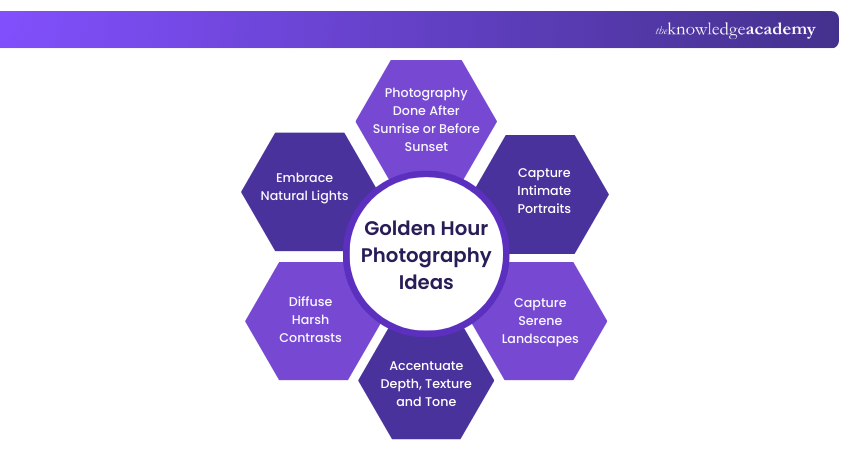
Whether capturing serene landscapes, intimate portraits, or bustling cityscapes, this magical time accentuates depth, texture, and tone. The diffused light minimises harsh contrasts, ensuring subjects are illuminated with gentle luminance. Embracing the Golden hour in Photography is about harnessing nature's most flattering light, revealing the extraordinary in the ordinary.

2) Silhouette Serenity
Silhouettes possess a blend of mystery and elegance in Photography. These darkened figures or shapes, set against a brighter backdrop, emphasises form and structure. This also strips away intricate details and brings forth raw emotion. The beauty of silhouettes lies in their simplicity.
Without facial expressions or colour distractions, they compel viewers to interpret emotions, stories, and contexts from minimal visual cues. Ideal settings often include sunrises or sunsets, where the contrast between light and dark is most dramatic. Through silhouette Photography, ordinary moments gain depth and ambiguity.
3) Shadow Showcase
Shadow Showcase evokes the idea of an exhibition that highlights the interplay between light and darkness. It can refer to various artistic expressions, from physical art pieces to metaphorical reflections. It often represents an art exhibit where artists use shadows as the central theme, employing techniques such as silhouette installations, light sculptures, or shadow puppetry.
The shifting tones, from deep blacks to soft greys, communicate emotions, tell stories, and captivate viewers through visual contrast. This style also suggests an introspective journey into hidden or often suppressed aspects of personality. Exploring these deeper layers can be an enlightening experience, revealing truths that lie within the subconscious.
4) Nature's Narrative
Nature's Narrative speaks of the timeless tales woven by the natural world, stories that transcend human lifetimes and civilisations. Each rustling leaf, cascading waterfall, and majestic mountain peak tells a tale of evolution, resilience, and beauty. The seasons narrate cycles of birth, growth, decline, and renewal.
Animals, with their migration patterns, mating dances, and survival instincts, add rich chapters to this story. The whispering winds carry legends of ancient trees, while the ever-expansive skies speak of mysteries beyond our grasp. To understand this style of Photography, you have to appreciate the interconnectedness of life.
5) Candid Charms
Candid shots capture the unposed, spontaneous moments that is filled with genuine emotion and authenticity. It seeks the raw, the real, and the unguarded. A child's infectious laughter, or a dancer lost in rhythm; these unscripted instances reveal profound truths about human experience.
Such photographs often resonate deeply because they unveil layers of genuine feeling, Bypassing the façades people often present, Candid Photography captures more than mere snapshots. Candid charms encapsulate the essence of a fleeting moment, preserving it in its purest, most unvarnished form, and reminding viewers of the beauty in life's simple, unfiltered instants.
Editing made easy, creativity made limitless! Sign up for our Lightroom Course now!
6) Street Photography
Street photography is an aesthetic photographic style capturing ordinary lives and unplanned events in the streets. It frequently means capturing people or objects as they spontaneously happen, unstaged and unposed, which discloses the nature and flow of the everyday scene.
Practically, street photography may be a mixture of becoming a part of a crowd and a busy street or surrounding and observing life there. Photographers are also allowed to capture spontaneous events or in some cases request the subjects to allow them to capture them engaged in their daily activities.
7) Go Macro
Go macro in photography means capturing close-up shots of small objects, details, or emotions often unnoticed by the naked eye. By bringing the camera very close, tiny subjects appear large and impactful. It transforms ordinary scenes into visually interesting stories with fresh perspective.
Interesting macro subjects include plants, insects, water drops, textures, and everyday items. These highlight shape, colour, and form in ways standard compositions cannot. Experimenting with macro also improves understanding of light, depth of field, and visual impact.
8) Foodie Frames
Food Photography is more than just snapping what's on the plate. It's about capturing the essence, flavours, and soul of culinary creations. Through careful composition, lighting, and styling, you can bring out the vibrant colours, tantalising textures, and mouthwatering allure of dishes.
Each frame is a sensory invitation, beckoning viewers to not only see but almost taste and smell the delicacies presented. Beyond mere representation, foodie frames tell stories of culture, tradition, and Innovation. From the steam rising off a bowl of soup to the glossy glaze on a dessert, this genre celebrates the art and passion behind every culinary masterpiece, turning meals into visual feasts.
9) Architectural Angles
Architectural Photography is an art of perspectives. It involves capturing edifices not just as static structures but as Storytelling monuments. Through thoughtful angles and compositions, Photographers spotlight the geometric patterns, historical nuances, and design intricacies of buildings, bridges, and urban landscapes.
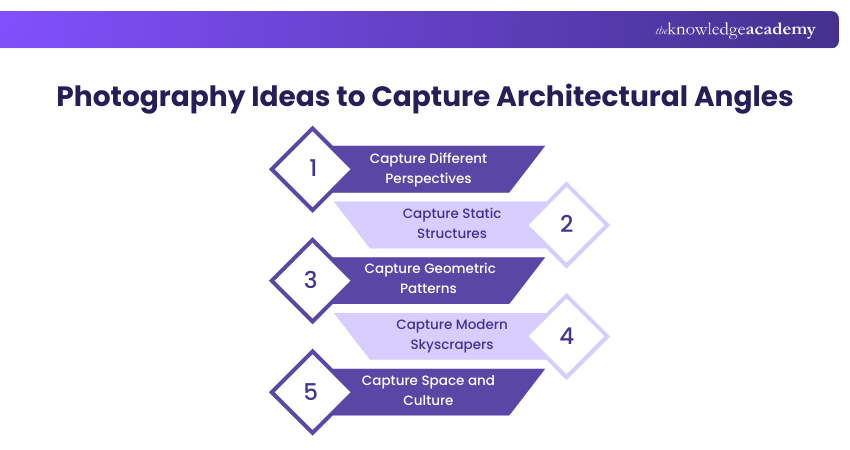
Architectural photography captures the curves of skyscrapers, intricate cathedral details, and urban symmetry through light, shadow, and form. Beyond documentation, it celebrates human creativity and design. Blending precision with aesthetics, it invites viewers to explore space, culture, and time through built environments.
10) Add Emotion to Your Images
When you add emotion to your photographs, you are looking to capture something that makes you feel something whether joy, surprise sorrow, curiosity or connection. Emotion also brings a sense of depth to your pictures and makes the pictures memorable since the viewers have an opportunity to identify with what they watch. It transforms photography into the art of storytelling by humans and not technical skills.
Finding expressive faces, meaningful interaction, or a story without words are some of the ways to seek emotion in your work. Lighting, composition, and timing will help to showcase what is important within the scene. Even banal subjects can be given a sense of strength when shot emotionally; if it is a candid laugh, a thoughtful stare, or the play of light and shadow, which creates an emotional state of mind.
11) Black and White Beauty
By removing colour, black and white Photography explores a world of contrasts, tones, and textures. This creates images that feel timeless in their simplicity and elegance. Without colour distractions, the true essence of the subject becomes more prominent, encouraging viewers to appreciate subtle details and deeper emotions.
This monochromatic style highlights the relationship between light and shadow, revealing natural drama in any scene. It works beautifully for intense portraits that uncover emotion and for landscapes that evoke a sense of nostalgia. Black and white Photography adds depth, character, and emotional richness to every image.
12) Monochromatic
Monochromatic photography is a type of photography that is based on the use of a single colour (or variation or shade of that colour) in an image to produce a distinctive and cohesive visual effect. This style makes the scene less complicated and only a matter of tonal differentiation, enhancing shapes, patterns, textures, and emotional appeal without being distracted by a complete colour palette.
The monochromatic style (shooting in black and white or selecting one prevailing color) will make you focus more on contrast, light, and composition. It has the ability to create certain moods, focus on details of the subject, and make generic scenes look more artistic and interesting.
Sign up for our Photoshop Course today and transform your Photography game!
13) Burst of Colour
A Burst of Colour in photography means the usage of bright colours in a shot that makes a powerful effect through bright colours and attracts the audience. This imaginative thought process invites you to colour as the main subject in your image - to isolate a colourful object on a neutral ground or simply take pictures of naturally colourful places such as the market, flowers, murals or fashion.
Through the focus on bright colors and contrasting shades, a burst-of-color style can transform banal scenes into lively and dynamic, as well as emotionally stimulating. This method makes you more sensitive to colour balance and contrast, and it will allow you to create a more expressive and memorable image.
14) Macro Magic
Macro Photography is similar to stepping into a hidden universe. It helps in revealing exquisite details often overlooked by the naked eye. This close-up technique magnifies minute subjects, transforming ordinary objects. Whether it is a dewdrop on a leaf, the intricate patterns of an insect's wing, or the mesmerising swirls in a flower petal.
It converts these into breathtaking works of art. The strength of Macro Photography lies in its ability to spotlight textures, colours, and patterns, offering a fresh perspective on the familiar. By emphasising such minutiae, macro magic not only showcases the wonders of the small but also underscores the vast beauty encapsulated within the tiniest of frames.
15) Different Perspectives
Different Perspectives in photography challenges you to get out of conventional shooting angles and to check out the other perspectives. Instead of shooting something at eye level, shoot directly overhead, directly at the ground, or at an unconventional angle. This change of attitude can change common scenes into new, interesting images by showing outlines and forms, lines, and interconnections that are not noticed.
Experimentation with point of view conditions your eye to the view beyond the superficial. To give an illustration, a overhead shot might show interesting details in a busy street, whereas a low angle shot might make a building more dramatic. When you choose to break up the picture in this manner, you not only create visual interest, but also make the viewers interact with the image differently.
16) Motion Mastery
Motion Photography captures the essence of movement. It involves turning dynamic scenes into still frames bursting with energy and life. Whether it's the graceful flutter of a bird's wings, the whirl of dancers in synchrony, or the rush of urban life in bustling streets, this style highlights the beauty of change and transition.
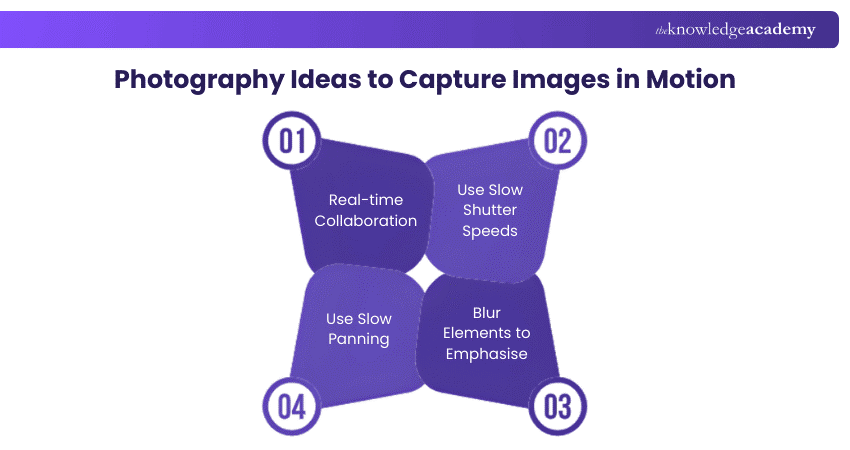
Utilising techniques like slow shutter speeds and panning, Photographers can either blur moving elements to emphasise speed or freeze action with crystal clarity. Beyond mere technique, mastering motion in Photography demands an intuitive understanding of timing and rhythm. It's about seizing the perfect moment, encapsulating the flow of life in all its kinetic splendour.
17) Long Exposure Elegance
Long exposure photography requires patience, as the shutter stays open for extended durations to capture movement over time. It weaves time into a visual story, recording light trails, silky waterfalls, and drifting clouds. This technique adds emotion and dynamism to otherwise still scenes. It transforms fleeting moments into expressive visual art.
Each streak or blur reflects the passage of time, turning motion into lasting imagery. The technique demands technical balance of ISO, aperture, and filters. When executed well, the results appear ethereal and dreamlike. From vibrant cityscapes to calm twilight shores, it captures motion within stillness beautifully.
18) Double Exposures
A creative technique of photography is double exposure, which involves the mixture of two types of photographs into one photograph in an attempt to have a dreamy and layered effect. Rather than portraying one subject, you merge two very different subjects together, like a portrait and a landscape, in one photograph so that you can see both things combined in that photograph.
This approach encourages experimentation with overlapping shapes, textures, and light, allowing you to tell complex visual stories or evoke mood and symbolism. Either in-camera (in case supported) or in post-processing, double exposure allows ordinary photographs to become expressive, artistic, and encourage the audience to think of relationships between seemingly unrelated subjects.
19) Astrophotography Awe
Astrophotography opens a window to the cosmos. Among the most stunning Photography Ideas, it involves capturing the vast and awe-inspiring tapestry of the night sky. From the luminescent arc of the Milky Way to the delicate dance of celestial bodies, this niche of Photography brings the universe's grandeur to our fingertips.
With long exposures and specialised equipment, Astro Photographers unveil stars, nebulae, and galaxies that elude the naked eye. Each image serves as a humbling reminder of our tiny existence within the cosmic expanse. The challenges of dark environments and Earth's rotation demand precision and patience. Yet, the results; a star-studded sky, a meteor's streak or a planet's glow are truly out-of-this-world, encapsulating the infinite wonders of the universe.
Turn your vision into a cinematic reality with our Filmmaking Course – Join now!
20) Aerial Art
Aerial Photography offers one of the most adventurous and visually rewarding perspectives. By capturing scenes from above, it presents landscapes, oceans, and cityscapes in dramatic and unexpected ways. With the rise of drones and advanced aerial cameras, Photographers can now explore angles that were once nearly impossible to access.
From the geometric patterns of farmland to the sweeping shapes of urban development, aerial views transform familiar scenes into abstract works of art. These images showcase both scale and fine detail, revealing how each subject fits into its wider environment. Aerial Photography turns ordinary locations into stunning visual narratives, making the world appear grander and more intricate from above.

21) Photograph an Event
Event photography is the process of capturing the most important moments, mood, interactions of an occasion that is special such as a wedding, festival, concert, sporting event or community event. This form of photography is based on real-time storytelling and capturing people in action, feelings in movement, and highlights to be remembered as they happen.
Event photography means recognising key moments, using available light, and adapting quickly to changing situations. It balances spontaneous captures with composed shots to record both what happened and how it felt. This approach sharpens technical skill and timing, helping you document dynamic scenes with confidence.
22) Landmarks
Taking photos of landmarks is a classic and engaging creative task focused on capturing famous architectural or natural sites in compelling ways. Whether it is a historic building, bridge, statue, or natural formation, the aim is to find fresh perspectives that make familiar places look new and exciting.
Lighting, angles, framing, and foreground elements can transform a simple landmark into a powerful visual statement. Shooting at different times such as sunrise, sunset, or night creates varied moods. This practice strengthens composition skills and helps you use context to tell stronger visual stories.
23) Photography Trips & Holidays
Photography holidays and trips help you step away from routine and fully immerse yourself in creative exploration. Travelling with a clear visual purpose, such as capturing landscapes, wildlife, architecture, or street scenes, encourages focused projects. Visiting inspiring places pushes you to experiment and observe light, composition, and detail more thoughtfully.
Unlike casual holiday snapshots, a photography focused trip allows you to slow down and truly connect with your surroundings. Whether self guided or part of a structured tour, it challenges you to adapt to new environments. The result is a stronger portfolio, improved skills, greater confidence, and a refreshed creative perspective.
24) Shoot Out of Focus
Shooting deliberately out of focus is a creative technique that embraces softness and blur to create mood, abstraction, and emotion. Instead of treating blur as a flaw, it becomes a tool for atmosphere and artistic expression, encouraging you to move beyond constant sharpness.
You can practise by shifting focus off-centre, using shallow depth of field, or experimenting with manual focus for dreamy effects. This approach invites viewers to interpret shapes and tones rather than details, pushing your visual limits creatively.
25) Fashion Photography
Fashion photography is a creative work, which aims at capturing style, mood, and personality using well-thought-out shoots. It extends beyond the clothes and emphasises the use of lighting, place, and posing as a combined storytelling.
To begin, collaborate with a model, select outfits that match your theme, and experiment with different settings and lighting styles. The project will improve your direction skills, develop your creativity, and allow you to create a portfolio that will be visually striking and coherent.
Refine your images into unforgettable visual masterworks with our Photo Retouching Training - Register now!
What are the Seven Basics of Photography?
There are seven basic elements in the art of Photography:
1) Line: This guides the viewer’s eye through the frame and creates direction or movement.
2) Shape: This defines the outline of objects and creates a strong visual structure.
3) Form: This adds a three-dimensional quality through light and shadow.
4) Texture:This shows surface details that make subjects feel tactile and real.
5) Colour: This creates mood, contrast, harmony and emotional impact.
6) Size: This highlights scale and proportion to emphasise importance or context.
7) Depth: This adds distance and layers, making the image feel more immersive.
What are the Four Pillars of Photography?
To capture remarkable photographs, Photographers must master these four essential pillars of the craft:
1) Composition: This refers to how elements are arranged within a frame. It involves framing, perspective and the placement of subjects to guide the viewer’s eye toward the intended focal point.
2) Lighting: This is a critical component that shapes the atmosphere and overall impact of a photograph. Be it natural or artificial, light can be manipulated to highlight subjects and create dramatic effects. Key factors include the direction and intensity of light.
3) Exposure: The amount of light reaching the camera sensor. It ensures that the image is neither overly bright nor too dark. Proper exposure preserves detail and maintains image quality.
4) Post-processing: This is the final stage where images are boosted using software tools. While capturing a great shot is vital, editing allows Photographers to refine their creative vision.
Conclusion
Creativity knows no bounds. Exploring the 25 Photography Ideas outlined in this blog will not only broaden your photographic career options but also enrich your artistic journey. Embrace these concepts and experiment with your vision. Let these ideas help you make every shot a testament to your ever-evolving creativity and passion for the craft.
Gain skills and knowledge in your chosen hobby with our Hobbies and Interest Courses – Join today!
Frequently Asked Questions
Where can I Find Photography Ideas?

Here are some effective ways to spark inspiration:
1) Try Photography challenges
2) Start themed Photography projects
3) Experiment with Conceptual Photography
4) Explore Fine Art portraits
5) Get creative with existing photos through editing
What Is the New Trend In Photography?
Current photography trends highlight authenticity, storytelling, and creative experimentation. Popular styles include candid lifestyle shots, cinematic edits, motion blur, drone imagery, and minimalist compositions. Many photographers now prefer natural light and raw aesthetics to create relatable and emotionally engaging visuals.
What are the Other Resources and Offers Provided by The Knowledge Academy?
The Knowledge Academy takes global learning to new heights, offering over 3,000+ online courses across 490+ locations in 190+ countries. This expansive reach ensures accessibility and convenience for learners worldwide.
Alongside our diverse Online Course Catalogue, encompassing 17 major categories, we go the extra mile by providing a plethora of free educational Online Resources like Blogs, eBooks, Interview Questions and Videos. Tailoring learning experiences further, professionals can unlock greater value through a wide range of special discounts, seasonal deals, and Exclusive Offers.
What is The Knowledge Pass, and How Does it Work?
The Knowledge Academy’s Knowledge Pass, a prepaid voucher, adds another layer of flexibility, allowing course bookings over a 12-month period. Join us on a journey where education knows no bounds.
What are the Related Courses and Blogs Provided by The Knowledge Academy?
The Knowledge Academy offers various Hobbies & Interest Courses, including the Photography Course, Mixing and Mastering Course and the Music Production Course. These courses cater to different skill levels, providing comprehensive insights into Photography.
Our Business Skills Blogs cover a range of topics related to Photography Ideas, offering valuable resources, best practices, and industry insights. Whether you are a beginner or looking to advance your Photography skills, The Knowledge Academy's diverse courses and informative blogs have got you covered.

The Knowledge Academy


Global Training Provider
The Knowledge Academy is a world-leading provider of professional training courses, offering globally recognised qualifications across a wide range of subjects. With expert trainers, up-to-date course material, and flexible learning options, we aim to empower professionals and organisations to achieve their goals through continuous learning.


 If you wish to make any changes to your course, please


