


 Top Rated Course

We may not have the course you’re looking for. If you enquire or give us a call on +44 1344 203999 and speak to our training experts, we may still be able to help with your training requirements.
Ecommerce Marketing: Everything You Need to Know
James Smith 07 February 2026Ecommerce Marketing involves effective strategies to boost online sales through channels like social media, SEO, and more. This blog covers essential tactics, from optimising product listings to leveraging Data Analytics, to help you master online selling. Acquire the tools to stand out in a crowded market and drive growth.

Training Outcomes Within Your Budget!
We ensure quality, budget-alignment, and timely delivery by our expert instructors.
Table of Contents

Are you struggling to capture the attention of online shoppers? Picture this: your brand effortlessly pops up in front of eager buyers just as they're ready to hit 'purchase.' That's the magic of Ecommerce Marketing - a blend of SEO, social media flair, captivating content, and more. With the right tactics, you’re not just playing in the ecommerce field - you own it.
Curious about how to make this happen? Whether you're new to ecommerce or aiming to grow, mastering Ecommerce Marketing is essential for achieving success. Ready to revolutionise your ecommerce journey? Let’s dive in and start crafting the success story your brand deserves!
Table of Contents
1) What is Ecommerce Marketing?
2) Importance of Ecommerce Marketing
3) Types of Ecommerce Marketing
4) Steps to Create an Ecommerce Marketing Plan
5) Ecommerce Marketing Ideas to Boost Sales
6) Conclusion
What is Ecommerce Marketing?
Ecommerce Marketing encompasses the strategies and tactics used to promote your online business and boost sales. It’s not only about attracting visitors to your website; it’s about converting those visitors into paying customers. This involves using SEO, Content Marketing, social media, and email marketing to enhance brand awareness and drive sales across various channels.
This type of marketing is unique because it requires a combination of Digital Marketing skills and an understanding of the ecommerce landscape. Unlike traditional retail marketing, Ecommerce Marketing must account for the entire customer journey, from the initial awareness of a product to the post-purchase experience.
Importance of Ecommerce Marketing
Ecommerce Marketing is not just a nice-to-have; it’s necessary for any online business aiming to thrive in a competitive marketplace. Here's why:

1) Increases Visibility: Ecommerce Marketing improves online presence. It makes it easier for potential customers to discover your products or services through search engines, social media, and other digital platforms.
2) Attracts Targeted Traffic: By using targeted marketing techniques, you attract specific audiences. These audiences are more likely to be interested in your offerings, leading to higher conversion rates and better sales outcomes.
3) Boosts Sales: Effective Ecommerce Marketing strategies drive more customers to your site. This increases the likelihood of purchases and significantly impacts your overall sales and revenue growth.
4) Builds Brand Recognition: Consistent and strategic marketing helps establish your brand in the marketplace. It makes your brand recognisable and trustworthy to customers, fostering loyalty and repeat business.
5) Engages Customers: Various channels like email, social media, and content marketing allow ongoing communication. This keeps customers engaged and encourages repeat purchases.
6) Provides Data-driven Insights: Ecommerce Marketing tools offer valuable analytics on customer behaviour, preferences, and Ecommerce Trends. This helps businesses make informed decisions and refine their marketing strategies for better results.
7) Enhances Customer Experience: By understanding customer needs and preferences, you can tailor the shopping experience. This makes it more enjoyable and seamless, improving satisfaction and encouraging repeat business.
8) Supports Competitive Advantage: Strategic marketing differentiates your business from competitors. It highlights unique selling points, helping you capture market share and stay ahead in a crowded ecommerce landscape.
9) Facilitates Global Reach: Ecommerce Marketing allows you to reach international markets easily. This expands your business opportunities and customer base beyond local or regional boundaries.
10) Ensures Long-term Growth: Continuous and evolving marketing efforts contribute to sustained business growth. They help you adapt to market changes, retain customers, and achieve long-term profitability.
Explore Shopify's features and build your online presence with expert guidance in our Introduction To Shopify – join now!
Types of Ecommerce Marketing
Here a some of the most effective types of Ecommerce Marketing:

1) Content Marketing
Content marketing primarily focuses on creating and sharing valuable content like blogs, videos, and infographics to attract, engage, and retain your target audience. It builds brand authority, drives traffic, and fosters customer loyalty.
2) Email Marketing
Email marketing involves sending targeted, personalised emails to your subscriber list to promote products, offer discounts, and build customer relationships. It’s an effective way to nurture leads and drive conversions.
3) Search Engine Optimisation (SEO)
SEO involves optimising your website and content to achieve higher rankings in search engine results. This enhances visibility and drives organic traffic to your site. This process includes keyword research, on-page optimisation, and creating high-quality backlinks.
4) Social Media Marketing
Social media marketing promotes your products or services through platforms like Facebook, Instagram, and Twitter. It engages with your audience, builds brand awareness, and drives traffic to your ecommerce site.
5) Affiliate Marketing
Affiliate marketing involves partnering with affiliates who promote your products on their platforms. They earn a small commission for each sale they generate, expanding your reach and boosting sales.
Elevate your ecommerce success by mastering product content creation with our expert-led Product Content For E-Commerce Training today!
6) Pay-Per-Click (PPC) Advertising
It is an advertising model where you pay for each click on your ad. These ads are generally displayed on search engines and social media platforms, attracting targeted traffic and delivering rapid results.
7) Influencer Marketing
Influencer marketing involves collaborating with influencers who have a large following to promote your products. This leverages their credibility to increase brand awareness and drive sales.
8) SMS Marketing
SMS marketing involves sending promotions, updates, and alerts directly to customers' mobile devices via text messages. It's a direct and efficient method to quickly engage your audience.
9) Retargeting
Retargeting focuses on users who have previously visited your website, showing them ads to encourage their return and complete a purchase. It's an effective strategy to recover lost sales.
10) Web Design and User Experience (UX)
Web design and UX focus on creating a visually appealing and user-friendly website. Good UX ensures easy navigation, faster load times, and a seamless shopping experience, improving customer satisfaction and conversion rates.
Learn to build, manage, and optimise your WooCommerce store with our comprehensive, hands-on WooCommerce Training – sign up now!
Steps to Create an Ecommerce Marketing Plan
Creating a comprehensive Ecommerce Marketing plan is essential for achieving your business goals. Let's explore the key steps to building an effective Ecommerce Marketing plan:
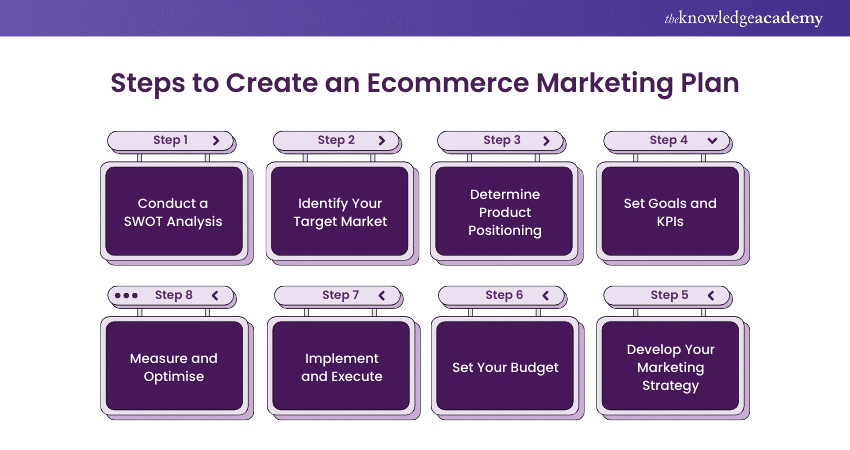
1) Conduct a SWOT Analysis
Strengths: Identify what your business excels at, such as unique products, strong brand reputation, or excellent customer service.
Weaknesses: Recognise areas where your business could improve, such as limited product range, high prices, or weak online presence.
Opportunities: Identify external factors that could highly benefit your business, such as emerging market trends, new technologies, or shifts in consumer behaviour.
Threats: Be aware of external challenges that could impact your business, such as new competitors, economic downturns, or changing regulations.
2) Identify Your Target Market
Customer Profiles: Define your ideal customers by considering their demographics (age, gender, income), psychographics (lifestyle, values), and behaviour (buying habits, preferences).
Market Segmentation: Segment your broader market into smaller groups based on shared characteristics. This helps optimise your marketing efforts to specific Market Segments, enhancing their effectiveness.
3) Determine Product Positioning
Unique Selling Proposition (USP): Clearly explain what sets your product or service apart and why your customers should choose it over competitors.
Competitive Analysis: Study your competitors deeply to understand their unique strengths and weaknesses. Use this information to position your product in a way that highlights its unique benefits and differentiates it from the competition.
4) Set Goals and KPIs
SMART Goals: Establish marketing goals that are Specific, Measurable, Achievable, Relevant, and Time-bound (SMART). For instance, “Increase your website traffic by 20% within the next six months.”
Key Performance Indicators (KPIs): Establish metrics to track your progress towards your goals. Common KPIs include website traffic, conversion rates, average order value, and customer acquisition cost.
5) Develop Your Marketing Strategy
SEO and Content Marketing: Optimise your website for search engines to boost visibility. Create valuable and insightful content, such as videos, blog posts, and infographics, to appeal and engage your audience.
Social Media Marketing: Leverage social media platforms and tools to connect with your audience, share content, and promote your products. Engage with followers through comments, messages, and interactive posts.
Email Marketing: Build and curate your email list by sending targeted campaigns. Use personalised emails to inform subscribers about new products, special offers, and company updates.
6) Set Your Budget
Allocate Resources: Determine how much you will spend on each marketing channel based on your goals and expected ROI. Consider costs for advertising, content creation, content creation tools, and personnel.
Monitor Spending: Keep track of your expenses to ensure you stay within budget. Adjust allocations as needed based on performance and changing priorities.
7) Implement and Execute
Action Plan: Create a detailed action plan outlining specific tasks, timelines, and responsibilities. Assign tasks to team members and set deadlines to ensure everything stays on track.
Tools and Platforms: Utilise marketing tools and platforms to streamline your efforts. Examples include email marketing software, social media management tools, and analytics platforms.
8) Measure and Optimise
Analyse Results: Consistently evaluate your KPIs and performance metrics to measure your marketing's effectiveness and success. Utilise tools such as social media insights, Google Analytics, and email marketing reports.
Adjust Strategies: Make data-driven adjustments to improve your marketing efforts. This could involve tweaking your SEO strategy, refining your social media content, or experimenting with different email campaigns.
Unlock the power of Magento – start your Magento Training today and transform your ecommerce skills!
Ecommerce Marketing Ideas to Boost Sales
Let's explore some practical ideas to boost your sales:
Sell on Marketplaces
Expanding your reach by selling on marketplaces like Amazon, eBay, or Etsy is an effective way to increase sales. These platforms have a massive customer base, which means more eyes on your products. Moreover, these marketplaces offer various tools and programs to help you optimise your listings, manage your inventory, and handle customer service.
Selling on multiple marketplaces, along with utilizing the WooCommerce Cheat Sheet, provides an additional revenue stream and reduces dependency on your website alone. Just be sure to maintain consistent branding and pricing across all platforms to avoid confusing your customers.
Upsell Your Products
Upselling is a powerful strategy to increase the average order value (AOV) on your ecommerce site. By offering customers a higher-end version of the product they’re viewing or additional complementary products, you can encourage them to spend more. For example, if a client is looking to buy a laptop, you can upsell them to a model with more features or suggest accessories like a laptop bag or external hard drive.
Successful upselling hinges on a thorough comprehension of your customers' needs and preferences. Use data to identify which products are often bought together or which higher-end products appeal to your target audience.
Reduce Cart Abandonment
Cart abandonment is a regular issue in ecommerce, but with the right strategies, you can significantly reduce it. Start by optimising the checkout process to make it as simple and transparent as possible. Offering multiple payment options, providing clear shipping information, and using trust badges can all help reassure clients and encourage them to complete their purchases.
Additionally, cart abandonment emails can be highly effective in recovering lost sales, especially when you start dropshipping. These automated emails remind customers of the items they left in their cart and often include incentives like free shipping or discount offers to entice them to complete the purchase.
Launch Text Message Campaigns
Text message marketing is a highly effective method to reach customers with time-sensitive offers and updates. With high open rates, SMS campaigns can drive immediate action, whether it’s a flash sale, an exclusive promotion, or a reminder about an upcoming event.
When crafting text message campaigns, keep your messages short, clear, and actionable. Ensure that clients have opted in to receive texts and provide an easy way to opt-out if they choose. Personalisation can also make your messages more engaging and effective.
Capture More Email Subscribers
Creating an email list is among the most valuable assets for any ecommerce business. Your email subscribers are already interested in your brand, making them more likely to convert into paying customers. To grow your email list, offer exclusive content in exchange for email sign-ups.
Pop-up forms, exit-intent offers, and gated content are all effective methods for capturing email subscribers. With a strong email list in place, you can segment your audience and customise your campaigns for distinct customer groups, thereby enhancing the chances of conversions.
Enhance Your Email Campaigns
Email marketing continues to be one of the most powerful strategies in Ecommerce Marketing. To maximise its potential, focus on creating personalised and targeted campaigns. Use customer data to categorise your email list based on behaviour, preferences, and purchase history. This allows you to send relevant posts that resonate with your audience.
Additionally, A/B testing various elements of your emails, such as:
a) Subject lines
b) Content
c) Calls to Action (CTAs)
This can help you optimise your marketing campaigns for better results. Regularly review the performance of your email campaigns and make data-driven adjustments to improve engagement and conversion rates.
Unlock the secrets to ecommerce success with our Ecommerce Strategy Course and elevate your digital business strategy today!
Conclusion
Ecommerce Marketing is the catalyst for turning your online store into a dynamic, thriving business. With a blend of SEO, social media expertise, and data-driven strategies, including insights from Magento vs Shopify, you can create a brand that not only attracts attention but also drives real growth. Ready to revolutionise your ecommerce success? The next step is yours!
Transform your career with cutting-edge Digital Marketing Courses that provide practical skills and real-world expertise!
Frequently Asked Questions
What is the Best Marketing for Ecommerce?

The best marketing for ecommerce combines SEO, social media, content marketing, and email campaigns. This integrated approach drives traffic, boosts visibility, engages customers, and ultimately increases sales and brand loyalty.
Which Platform is Best for Ecommerce Marketing?
The best platform for Ecommerce Marketing depends on your goals. Shopify, WooCommerce, and Magento are top choices due to their robust features, SEO capabilities, and integrations with marketing tools.
What are the Other Resources and Offers Provided by The Knowledge Academy?
The Knowledge Academy takes global learning to new heights, offering over 3,000+ online courses across 490+ locations in 190+ countries. This expansive reach ensures accessibility and convenience for learners worldwide.
Alongside our diverse Online Course Catalogue, encompassing 19 major categories, we go the extra mile by providing a plethora of free educational Online Resources like Blogs, eBooks, Interview Questions and Videos. Tailoring learning experiences further, professionals can unlock greater value through a wide range of special discounts, seasonal deals, and Exclusive Offers.
What is The Knowledge Pass, and How Does it Work?
The Knowledge Academy’s Knowledge Pass, a prepaid voucher, adds another layer of flexibility, allowing course bookings over a 12-month period. Join us on a journey where education knows no bounds.
What are the Related Courses and Blogs Provided by The Knowledge Academy?
The Knowledge Academy offers various Digital Marketing Courses, including Ecommerce Strategy Course, Certified Artificial Intelligence (AI) for Digital Marketing Training, Product Content for Ecommerce Training and Pinterest Marketing Course. These courses cater to different skill levels, providing comprehensive insights into Dropshipping Tips.
Our Digital Marketing Blogs cover a range of topics related to Ecommerce, offering valuable resources, best practices, and industry insights. Whether you are a beginner or looking to advance your Digital Marketing skills, The Knowledge Academy's diverse courses and informative blogs have got you covered.

James Smith


Digital Marketing Manager and Trainer
James Smith is a digital marketing professional with over a decade of experience in SEO, content strategy, paid media and analytics. He has supported both SMEs and global brands in transforming their digital presence. James’s writing and training are rooted in results-driven tactics and the latest marketing trends.
View Detail
Upcoming Digital Marketing Resources Batches & Dates
Date
 Ecommerce Strategy Course
Ecommerce Strategy Course
Fri 1st May 2026
Ecommerce Strategy Course
Fri 19th Jun 2026
Ecommerce Strategy Course
Fri 28th Aug 2026
Ecommerce Strategy Course
Fri 18th Dec 2026

 If you wish to make any changes to your course, please


