


 Top Rated Course

We may not have the course you’re looking for. If you enquire or give us a call on 01344 203999 and speak to our training experts, we may still be able to help with your training requirements.
What is Real-Time Data? Definition, Benefits and Use Cases
Lily Turner 05 May 2026Real Time Data describe to information that is processed immediately as it is collected, enabling businesses to make quick decisions. It has different use cases, including e-commerce, healthcare, and finance. By utilising data, businesses boost efficiency, improve customer experiences, and stay competitive in a changing market.

Training Outcomes Within Your Budget!
We ensure quality, budget-alignment, and timely delivery by our expert instructors.
Table of Contents
In this world where things change in the blink of an eye, Real Time Data is the superpower that lets businesses keep up and stay ahead. Imagine being able to modify your strategy or respond to customer requires quickly, all while your competitors are still reaching. That’s the magic of Real-time Data!
With Real Time Data, businesses can leap into action the moment an opportunity or challenge presents itself. It is like having a backstage pass to your business’s success making decisions in real-time, delighting customers and outsmarting competitors who are still living in the past.
Table of Contents
1) What is Real Time Data?
2) Importance of Real Time Data
3) How Real Time Data Works?
4) Real Time Data Processing
5) Real Time Data Use Cases
6) Real Time Data Benefits
7) Real Time Data Challenges
8) Best Practices for Analysing Real-time Data
9) Real Time vs Batch Processing: Key Differences
10) Conclusion
What is Real Time Data?
Real-time Data is information delivered instantly or with minimal delay, enabling quick business decisions. Unlike traditional data processing, it offers immediate insights crucial for industries like finance, healthcare, and logistics. This boosts responsiveness and operational efficiency.
It captures events as they happen, such as stock prices, traffic updates, or Social Media trends. These live updates help businesses stay agile, enhance customer experiences, and respond to changing conditions with precision.

Importance of Real Time Data
In today’s competitive environment, businesses cannot give to be left behind. Real-time Data allows organisations to reply quickly to opportunities and problems. This makes an important tool in many industries. Here is why Real-time Data is so important:
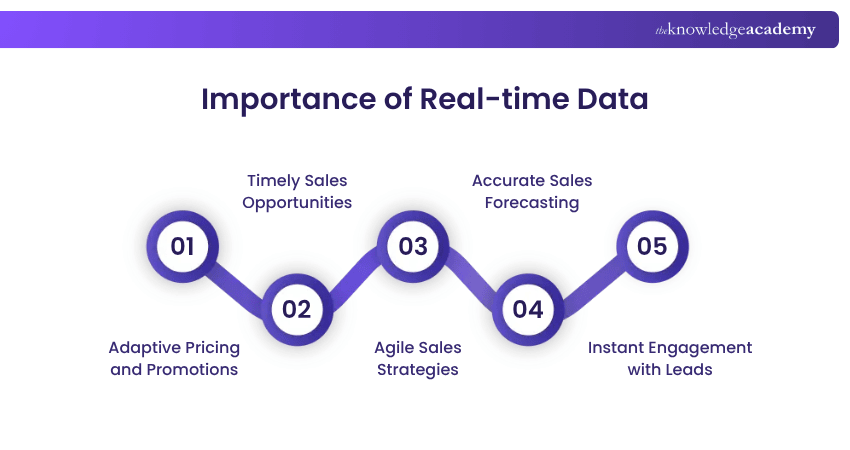
1) Adaptive Pricing and Promotions
1) Businesses can adjust prices instantly based on real-time customer demand
2) Promotions can be updated in response to competitor actions or market trends
3) This flexibility helps businesses capitalise on opportunities and boost sales quickly
2) Timely Sales Opportunities
1) Real-time tracking allows sales teams to spot potential sales opportunities as they happen.
2) Businesses can quickly act on customer interest to increase the likelihood of a sale.
3) Sales teams can also offer additional services based on current customer actions.
3) Agile Sales Strategies
1) Sales teams can adapt their approach based on Real-time Data.
2) Adjusting the sales pitch according to customer needs leads to higher chances of closing deals.
3) Live data enables more responsive and tailored interactions with customers.
4) Accurate Sales Forecasting
1) Real-time Data helps businesses predict future sales trends with better accuracy
2) Sales predictions are based on up-to-date customer options and market changes
3) Exact prediction helps businesses plan and distribute resources more efficiently
5) Instant Engagement with Leads
1) Real-time Data permits businesses to engage leads instantly after they show interest
2) Faster reply times increase the chances of transforming leads into customers
3) Interesting customers in real-time can make stronger relationships and trust
How Real Time Data Works?
Real-time Data is generated from various sources and needs fast processing to provide useful insights. Real-time Data processing (or data streaming) handles data as it’s collected, delivering immediate results. Unlike batch processing, which works in intervals, real-time processing offers quicker, more detailed insights, often with the help of Machine Learning.
The six key steps are:
1) Collection: Data is gathered from various sources like databases or devices
2) Preparation: Data is cleaned and organised for analysis
3) Input: Raw data is converted into machine-readable form
4) Processing: AI and machine learning algorithms process the data
5) Output: Results are delivered in readable formats (e.g., reports, charts).
6) Storage: Processed data is stored for future use or the next cycle
Become familiar with Bayesian statistics and hypothesis testing. Join our Probability And Statistics For Data Science Training – Today!
Real Time Data Processing
Real-time Data processing includes gathering, analysing, and acting on data immediately as it is generated. This system allows businesses to respond immediately to changes, like updating product suggestions or managing customer needs without delay.
The key steps include:
1) Data Collection: Data is collected consistently from sources like sensors or online platforms.
2) Processing: The data is quickly analysed using algorithms to give Real-time insights.
3) Action: The predictions are used to make immediate decisions or trigger actions, like adjusting prices or notifying customers.
Real Time Data Infrastructure
1) Real-time Data systems rely on strong infrastructure, including servers, networks, and software.
2) These systems are designed to handle large amounts of data as it comes in.
3) To access data in real-time, organisations need high-performance systems that can process data quickly with little delay.
Continuous Change Data Capture
1) Real-time Data is often captured using Continuous Change Data Capture (CDC).
2) CDC tracks changes in data sources as they happen, such as updates in inventory or customer information.
3) It ensures every update is captured and made available for analysis immediately.
Real Time Data Use Cases
Real-time Data has various applications across different industries. Here are some of the most common use cases:
1) Financial Services: In finance, Real-time Data is crucial for tracking stock prices, currency values, and market trends, helping traders make quick decisions and analysts identify patterns and risks.
2) E-commerce: Real-time Data helps online retailers track customer activity, inventory levels, and order statuses in real time. It allows businesses to personalise shopping experiences and recommend products based on customers’ browsing and purchasing behaviours.
3) Healthcare: Real-time Data plays a crucial role in monitoring patients’ vital signs and other medical data. Healthcare providers can respond to critical changes in patients’ conditions as soon as they occur, ensuring timely interventions.
4) Transportation and Logistics: Real-time Data is used for tracking vehicle locations, managing traffic flow, and improving delivery schedules. It helps companies reduce delivery times, optimise routes, and enhance customer satisfaction.
5) Customer Support: Real-time Data enables customer service teams to access up-to-the-minute information about customers, including past interactions, complaints, and issues. This allows agents to provide more personalised support and resolve issues faster.
Learn how to store pandas Data Frame objects in Apache Parquet format. Join our Pandas For Data Analysis Training – Now!
Real Time Data Benefits
Using Real-time Data provides businesses with many advantages. Let’s take a closer look at the key benefits:
1) Better Decisions
1) Real-time Data provides businesses with the most current, accurate information.
2) It helps eliminate uncertainty by allowing decisions to be based on live data rather than outdated information.
3) Access to Real-time Data leads to more informed and timely decision-making.
2) Operational Efficiency
1) Real-time Data automates data collection and analysis, reducing the need for manual work.
2) It helps businesses optimise workflows and cut down on delays.
3) This leads to increased operational efficiency and smoother business operations.
3) Customer Satisfaction
1) Real-time Data enables businesses to offer personalised recommendations instantly.
2) It helps address customer complaints and concerns in real-time.
3) By ensuring quick responses, Real-time Data helps improve overall customer satisfaction.
4) Market Advantage
1) Businesses using Real-time Data can quickly adapt to market changes.
2) It allows businesses to respond faster to customer preferences and emerging trends.
3) Real-time Data gives businesses a competitive edge, helping them stay ahead and capture more market share.
Real Time Data Challenges
While Real-time Data offers many benefits, it also comes with its own set of challenges. Businesses need to be aware of these challenges to ensure successful implementation:
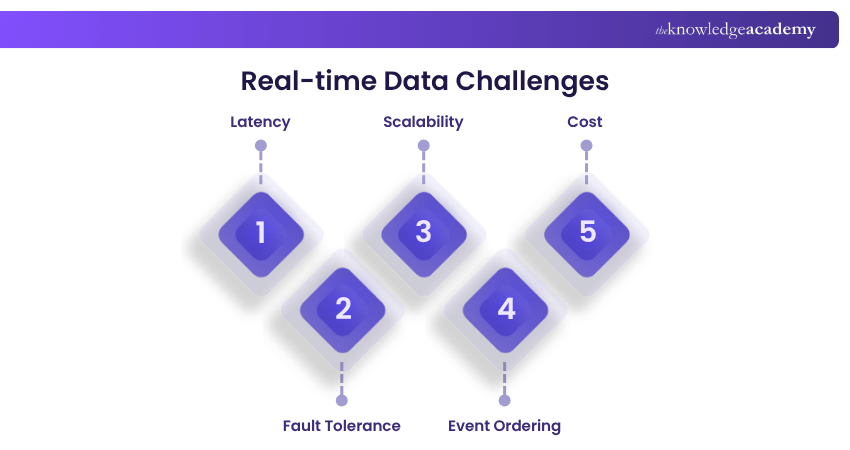
1) Latency
1) Latency refers to the delay between collecting, processing, and delivering data in real-time.
2) Even a small delay can lead to missed opportunities or poor decision-making.
3) Minimising latency is crucial to ensuring timely and accurate actions based on Real-time Data.
2) Fault Tolerance
1) Real-time data systems must be fault-tolerant, meaning they can handle failures without disrupting the data flow.
2) If a system fails to process data in real-time, it can significantly affect business operations.
3) Ensuring fault tolerance is essential for uninterrupted data processing and decision-making.
3) Scalability
1) As data volumes increase, businesses need scalable infrastructure to handle the growing load.
2) This may require upgrading hardware, improving network capacity, or investing in stronger software solutions.
3) Scalability ensures that real-time data systems can continue to perform efficiently as data needs grow.
4) Event Ordering
1) In some cases, the order of events is crucial to correctly understanding the data.
2) Ensuring accurate event sequencing is a challenge when multiple data sources are involved.
3) Proper event ordering is necessary to maintain the integrity and usefulness of Real-time Data.
5) Cost
1) Implementing a Real-time Data system can be costly, including expenses for hardware, software, and skilled personnel.
2) Despite the high initial cost, the long-term benefits of Real-time Data processing often outweigh the investment.
3) Businesses must carefully consider the costs of setup versus the ongoing advantages of faster, data-driven decision-making.
Learn predictive modelling techniques with our Predictive Analytics Course – Register now!
Best Practices for Analysing Real Time Data
To get the most out of Real-time Data, businesses need to follow best practices for analysis:
1) Data Quality: Ensure that the data being collected is accurate, consistent, and relevant. Poor data quality can lead to incorrect conclusions and misguided decisions.
2) Data Visualisation: Use data visualisation tools to present Real-time Data in an easily digestible format. This helps decision-makers quickly understand trends and make informed decisions.
3) Integration with Other Systems: Integrate Real-time Data with other business systems, such as Customer Relationship Management (CRM) and Enterprise Resource Planning (ERP) tools, to get a complete picture of business operations.
4) Automation: Automate as much of the data analysis process as possible to reduce the time and effort spent on manual analysis. Use machine learning algorithms to detect patterns and provide insights based on Real-time Data.
Real Time vs Batch Processing: Key Differences
While both Real-time Data and batch processing are used to collect and analyse data, there are key differences:

Conclusion
Real Time Data is modifying business operations, allowing quicker, data-driven decisions that improve efficiency, improve customer experiences and give a competitive side. While challenges continue, the benefits far exceed them. This is especially for businesses ready to initiate in the exact tools and infrastructure. This will help companies stay front in today’s rapidly evolving market.
Boost your career with Advanced Data Science certification. Join our Advanced Data Science Certification – Today!
Frequently Asked Questions
How is Real Time Data Collected?

Real Time Data is gathered from sources like IoT devices, web analytics, social media and connected systems. It always flows data for immediate processing and action.
What are the Requirements for a Real Time System?
A Real-time system requires great performance foundation, low latency, scalability, Real-time processing software, reliable storage, and fault indulgence to ensure quick, continuous data processing.
What are the Other Resources and Offers Provided by The Knowledge Academy?
The Knowledge Academy takes global learning to new heights, offering over 3,000+ online courses across 490+ locations in 190+ countries. This expansive reach ensures accessibility and convenience for learners worldwide.
Alongside our diverse Online Course Catalogue, encompassing 17 major categories, we go the extra mile by providing a plethora of free educational Online Resources like Blogs, eBooks, Interview Questions and Videos. Tailoring learning experiences further, professionals can unlock greater value through a wide range of special discounts, seasonal deals, and Exclusive Offers.
What is The Knowledge Pass, and How Does it Work?
The Knowledge Academy’s Knowledge Pass, a prepaid voucher, adds another layer of flexibility, allowing course bookings over a 12-month period. Join us on a journey where education knows no bounds.
What are the Related Courses and Blogs Provided by The Knowledge Academy?
The Knowledge Academy offers various Data Science Courses, including the Predictive Analytics Course, Pandas for Data Analysis Training, and the Probability and Statistics for Data Science Training. These courses cater to different skill levels, providing comprehensive insights into Difference Between Data and Information.
Our Data, Analytics & AI Blogs cover a range of topics related to Real Time Data, offering valuable resources, best practices, and industry insights. Whether you are a beginner or looking to advance your Data, Analytics & AI skills, The Knowledge Academy's diverse courses and informative blogs have got you covered.

Lily Turner


Senior AI/ML Engineer and Data Science Author
Lily Turner is a data science professional with over 10 years of experience in artificial intelligence, machine learning, and big data analytics. Her work bridges academic research and industry innovation, with a focus on solving real-world problems using data-driven approaches. Lily’s content empowers aspiring data scientists to build practical, scalable models using the latest tools and techniques.
View Detail
Upcoming Data, Analytics & AI Resources Batches & Dates
Date
 Predictive Analytics Course
Predictive Analytics Course
Thu 9th Jul 2026
Predictive Analytics Course
Thu 15th Oct 2026

 If you wish to make any changes to your course, please


