


 Top Rated Course


We may not have the course you’re looking for. If you enquire or give us a call on 01344 203999 and speak to our training experts, we may still be able to help with your training requirements.
What Are Python Tuples? A Beginner-Friendly Guide
Sienna Roberts 25 February 2026Python Tuples are immutable, ordered, and fixed-size data collections used to store multiple items in a single variable efficiently. Unlike lists, their values cannot be changed after creation, making them ideal for storing data. Tuples support indexing, slicing, and nesting, and are commonly used for data grouping and function returns.

Training Outcomes Within Your Budget!
We ensure quality, budget-alignment, and timely delivery by our expert instructors.
Table of Contents
Let’s be honest, when you’re just starting out with Python, terms like “tuple” sound more like a typo than something useful. But Python Tuples are actually one of the simplest and most underrated tools you’ll come across.
Imagine being able to group a few values together, like a name, a score, and a level in a game and knowing they’ll stay exactly how you left them. That’s what Python Tuples do. They don’t change, they don’t complain, and they help keep your code tidy. In this blog, we’re going to unpack Python Tuples in plain English, with examples that make sense and tips you’ll actually use. Ready to make coding a bit less confusing? Let’s get started.
Table of Contents
1) What are Tuples in Python?
2) Characteristics of Tuples in Python
3) Different Ways of Creating a Tuple
4) Tuple Operations in Python
5) Tuple Built-In Methods
6) Packing and Unpacking Tuples
7) Data Types of Python Tuples
8) When Should We Use Tuples?
9) Tuples VS Lists
10) How do you loop through a tuple in Python?
11) Conclusion
What are Tuples in Python?
Regarding Python, Tuples are a primary data structure that stores multiple information within a single variable. These Tuples belong to a category of built-in data types designed to manage data collection. While Python offers other collection types like lists, sets, and dictionaries, Tuples have distinct characteristics and use cases that set them apart. Similarly, in databases, a Tuple in DBMS represents a single row in a table, containing specific values for each attribute. Understanding Tuples in both programming and database contexts enhances data management and structuring efficiency.

Characteristics of Tuples in Python
Tuples are ordered, immutable sequences of elements. They can hold items of different data types including integers, strings, lists, and even other tuples. Because of their immutability, once a tuple is created, it cannot be altered. This makes them reliable for storing data that should not be changed accidentally.
Key traits include:
1) Immutable: No changes once defined.
2) Ordered: Maintains the order of elements.
3) Iterable: Can be looped through.
4) Hashable: Can be used as dictionary keys if they contain only immutable elements.
Different Ways of Creating a Tuple
Python offers several straightforward ways to create tuples, each useful in different contexts.
1) Using Round Brackets
The most common way to create a tuple is by enclosing items in round brackets.

2) Using Comma Separated
Interestingly, you can create a tuple simply by separating items with commas, even without parentheses.

3) Using Tuple Constructor
The “tuple()” constructor can turn other iterable types into tuples.

4) Creating an Empty Tuple
An empty tuple is as simple as it gets.

5) Single Element Tuple
Creating a single-element tuple requires a trailing comma.

Without the comma, Python interprets it as a string enclosed in parentheses.
6) Tuple Packing
Tuple packing allows multiple values to be assigned to a single variable.

Take a deep dive into the essence of Python and build your skills in various data types in Python. Register now for our Python Course.
Tuple Operations in Python
Tuples support several operations that help you manage data cleanly and concisely.
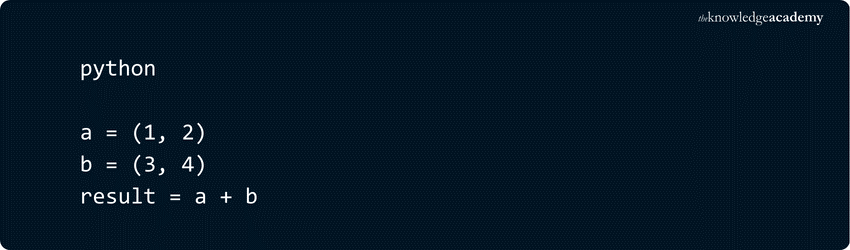
1) Concatenation of Python Tuples
Tuples can be combined using the “+” operator.
2) Repetition Python Tuples
The “*” operator repeats a tuple’s content.

3) Slicing Tuples in Python
Just like lists, tuples can be sliced.

4) Finding the Length of a Python Tuple
Use the “len()” function to count elements.

5) Membership Testing
You can check if an item exists using the “in” keyword.

6) Tuple Comparison
Tuples are compared lexicographically by their elements.

7) Nesting of Python Tuples
Tuples can contain other tuples or lists.

Tuple Built-In Methods
Tuples offer a couple of built-in methods.
1) Index
Returns the first occurrence index of an element.

2) Count
Counts how many times a value appears.

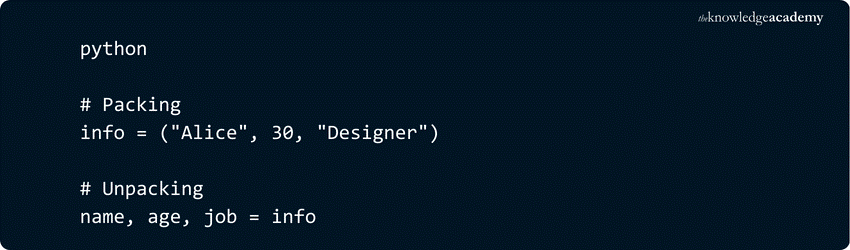
3) Packing and Unpacking Tuples
Tuple packing happens when multiple values are assigned to a variable. Unpacking extracts those values.
Data Types of Python Tuples
Unlike other programming languages, a Tuple in Python can hold elements of various types within the same Tuple. Here’s an explanation of Tuple items and the Python Data Types they can contain.

a) Homogeneous Tuple: Python Tuples are considered homogeneous when all their elements belong to the same data type. For example, you can create a Tuple that contains only integers, strings, floats, or any other specific data type, similar to how a Python Array can store elements of a single type efficiently.
b) Heterogeneous Tuple: Python also allows you to create Tuples that contain elements of different types. This type of Tuple is called heterogeneous Tuple.
c) Nested Tuples: A Tuple can also be within itself, meaning you can have Tuples within Tuples. Each inner Tuple can have its own data.
d) Immutable Characteristics: An important element of the Tuple is its immutability, regardless of the data contained within a Tuple. Once you create a Tuple and assign values to its elements, you cannot change those values or the size of the Tuple.
e) Accessing Tuple Elements: You can access individual Tuple elements using an index. In Python, indexing starts at 0.
f) Iterating Through Tuples: You can repeat the elements of a Tuple using loops like 'for' loops. This allows you to process the elements in the Tuples regardless of the datatypes.
One of the biggest advantages of Python Tuples is their ability to hold elements of any data type. This level of flexibility makes tuples incredibly useful for organising related but varied data into a single, manageable container.
For instance, you might use a tuple to represent a student’s record:

In this example, the tuple contains:
1) A string for the student’s name
2) An integer for their age
3) A list of their subjects
4) A dictionary for their grade
When Should We Use Tuples?
Tuples are not just a lighter alternative to lists. They serve specific purposes in Python.
1) Storing Fixed Data
Use tuples when the data should remain constant, such as geographic coordinates or configuration settings.

2) Using Tuples as Dictionary Keys
Tuples can act as dictionary keys if they contain only immutable elements.

3) Returning Multiple Values from Functions
Tuples are ideal for returning several values from a function.

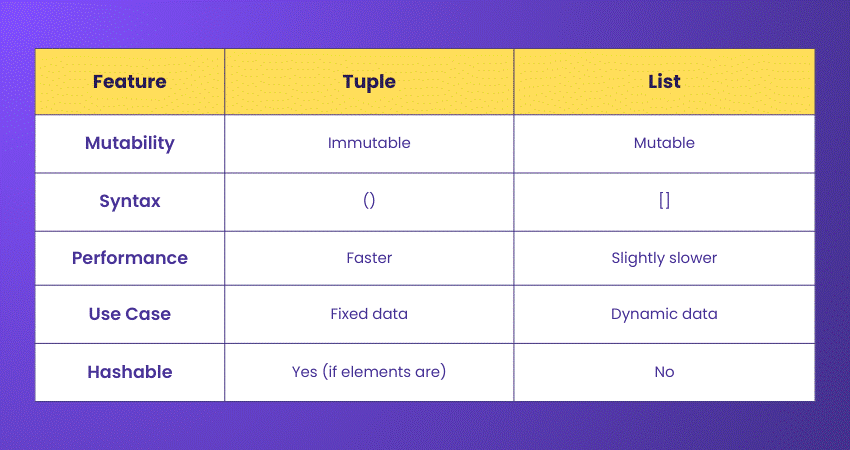
Tuples VS Lists
While both tuples and lists are sequence types, they differ in key areas.
How Do You Loop Through a Tuple in Python?
Looping through a tuple is just like looping through a list. You can use a “for” loop or “enumerate” if you need index tracking.

Looking to diversify your programming skills to the next level? Check out our PHP Course and enhance your knowledge.
Conclusion
Python Tuples are necessary for their immutability, order-preserving nature, versatility and performance characteristics. They are applied for different programming scenarios, like representing data structure, increasing code readability, offering data integrity, and simplifying the passing of flexible function parameters. Efficiently using Tuples is a valuable skill for any Python developer.
Attain in-depth knowledge of the Python framework for creating websites with our Python Django Training.
Frequently Asked Questions
Are Tuples Faster Than Lists in Python?

Yes, tuples are generally faster than lists in Python because they are immutable. Since their size and contents don’t change, Python can optimise memory and access speed. This makes tuples a better choice for fixed collections of data where performance matters.
Can a Tuple Contain Another Tuple in Python?
Absolutely! Tuples can contain any data type, including other tuples. This is known as nesting. Nested tuples are useful for creating complex, structured data, such as coordinates within coordinates or records that require multiple layers of grouping.
What are the Other Resources and Offers Provided by The Knowledge Academy?
The Knowledge Academy takes global learning to new heights, offering over 3,000+ online courses across 490+ locations in 190+ countries. This expansive reach ensures accessibility and convenience for learners worldwide.
Alongside our diverse Online Course Catalogue, encompassing 17 major categories, we go the extra mile by providing a plethora of free educational Online Resources like Blogs, eBooks, Interview Questions and Videos. Tailoring learning experiences further, professionals can unlock greater value through a wide range of special discounts, seasonal deals, and Exclusive Offers.
What is The Knowledge Pass, and How Does it Work?
The Knowledge Academy’s Knowledge Pass, a prepaid voucher, adds another layer of flexibility, allowing course bookings over a 12-month period. Join us on a journey where education knows no bounds.
What are the Related Courses and Blogs Provided by The Knowledge Academy?
The Knowledge Academy offers various Programming Training, including the Python Course, PHP Course and the Vue.js Framework Training. These courses cater to different skill levels, providing comprehensive insights into Python Enumerate.
Our Programming and DevOps cover a range of topics related to Python, offering valuable resources, best practices, and industry insights. Whether you are a beginner or looking to advance your Programming Skills, The Knowledge Academy's diverse courses and informative blogs have got you covered.

 If you wish to make any changes to your course, please


