


 Top Rated Course

We may not have the course you’re looking for. If you enquire or give us a call on + 1-866 272 8822 and speak to our training experts, we may still be able to help with your training requirements.
Verification and Validation in SoftwareTesting
Richard Harris 28 April 2026Verification and Validation in Software Testing are essential processes that ensure software products meet quality standards. Verification checks if the software adheres to specifications, while validation confirms if it meets user needs. This blog covers the significance of Verification and Validation in Software Testing.

Training Outcomes Within Your Budget!
We ensure quality, budget-alignment, and timely delivery by our expert instructors.
Table of Contents

Verification and Validation in Software Testing are crucial as they ensure that a software product meets its intended requirements and functions correctly. Verification focuses on assessing if the software has been built correctly, while Validation ensures that it meets user needs. Both processes are essential for delivering high-quality software.
According to Global Market Insights, Software Testing is expected to grow from $40 billion to $60 billion by the year 2027. Explore this blog to learn about the key distinctions between Verification and Validation in Software Testing, with examples.
Table of Contents
1) What is Verification Testing?
2) Advantages of Verification Testing
3) What is Validation Testing?
4) Advantages of Validation Testing
5) Differences between Verification and Validation in Software Testing
6) Conclusion
What is Verification Testing?
Verification is the process of evaluating whether the product satisfies certain conditions and is free of defects. It is a static testing process that ensures the correctness of the developed software.
Depending on the complexity and scope of a software application, the testing team employs various Verification methods. These include inspections, code reviews, technical reviews, and walkthroughs. The team may utilise mathematical models and calculations to predict software behaviour and verify code logic.
The IEEE-STD-610, a set of Software Engineering norms, describes Verification Testing as the test of a system to verify that it satisfies all its established conditions at a particular stage of its development.
Ready to take your Software Testing Skills to the next level? Explore our comprehensive Software Testing and Automation Training today!
Advantages of Verification Testing
Frequent Verification during the development process is crucial in reducing the number of bugs and defects that may arise in later stages. By verifying at each location, Developers and Product Managers can better understand the product's requirements for better development in the upcoming steps.
Even if all bugs cannot be resolved immediately, Verification helps QA estimate emerging issues and better prepare to tackle them when they appear. It ensures the software is closely aligned with customer and business requirements at every stage.
What is Validation Testing?
The Validation process typically occurs after the entire software development process is completed. Its main aim is to ensure that the final product delivered to the client meets their expectations. Unlike the development process, Validation only focuses on the result and does not involve the technical details of the internal processes.
Validation is crucial in determining whether the software team has developed the intended product. It is a one-time process initiated only after the team completes the Verification process. Software teams utilise several Validation methods, including White Box Testing (non-functional or structural/design testing) and Black Box Testing (functional testing), to ensure the software meets the desired specifications, similar to how CSSLP vs CISSP frameworks are employed to ensure security standards are met.
White Box Testing in Software Engineering is a software validation method that uses a predetermined set of inputs and data to verify the application's functionality. Testers compare the output values with the input values to ensure that the software produces the expected output, as defined by the requirements.
Sign up for our comprehensive Software Testing Courses and enhance your Software Testing skills.
Advantages of Validation Testing
There are various benefits of Validation Testing, including:
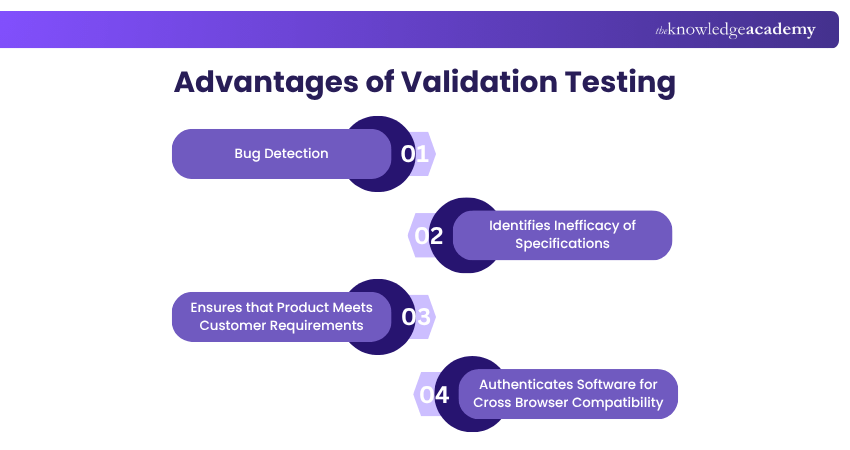
They ensure that all stakeholders' expectations are met. They allow software teams to take corrective action if there is any gap between the actual output and the anticipated outcome. They enhance the reliability of the final product.
Any bugs not detected during the Verification Testing will be identified during the Validation Tests. If the specifications were accurate and complete, any inadequacies would be exposed during Validation Testing. This may require teams to dedicate time and effort to rectify issues, but it will ultimately prevent a faulty product from being released to the market. Validation Testing ensures that the product meets customer demands and expectations in various conditions.
Learn Software Testing with our Software Testing Black Belt Course and upskill yourself in the domain of Software Development.
Differences between Verification and Validation in Software Testing
Key differences between Verification and Validation in Software Testing are as follows:
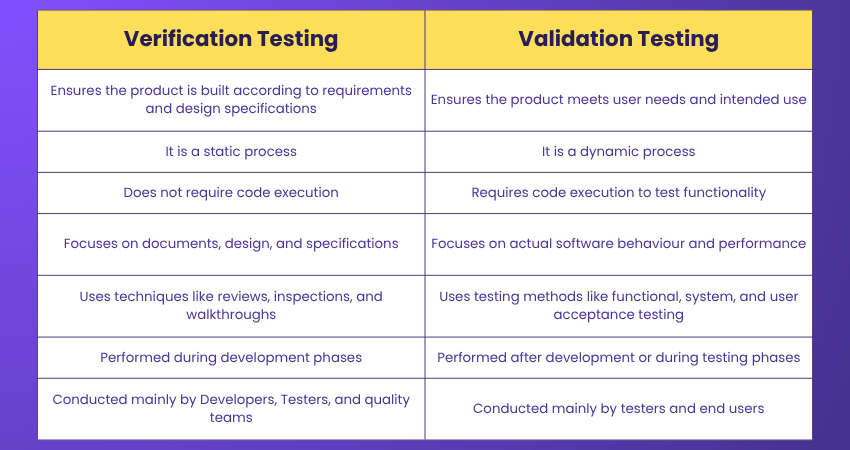
Verification and Validation are concepts used differently in various Project Management and Software Development methods. In Agile development methodology, Verification and Validation co-occur because the system is continuously refined based on end-user feedback. Verification and Validation form an essential part of Software Engineering.
A software team that fails to verify and validate its product rigorously may not meet stakeholders' expectations. These processes are crucial in reducing the likelihood of product failure and improving the reliability of the final software product.

Conclusion
To ensure the best final product, it is essential to implement the concepts of Verification and Validation in Software Testing meticulously. Proper understanding and usage of these testing techniques will help filter and neutralise bugs that can negatively affect user experience, leading to unfavourable feedback and reviews from customers and end-users.
Ready to take your Software Testing Skills to the next level? Explore our comprehensive Software Testing and Automation Training today!
Frequently Asked Questions
What is the Role of QA in Verification and Validation?

QA ensures processes and deliverables meet defined standards during development. It focuses on preventing defects through structured verification and confirming quality through validation.
What Tools are Used for Verification?
Verification tools include static code analysis tools, code review platforms, and automated testing frameworks. Common examples are SonarQube, JUnit, and Selenium for early defect detection.
What are the Other Resources and Offers Provided by The Knowledge Academy?
The Knowledge Academy takes global learning to new heights, offering over 3,000+ online courses across 490+ locations in 190+ countries. This expansive reach ensures accessibility and convenience for learners worldwide.
Alongside our diverse Online Course Catalogue, encompassing 17 major categories, we go the extra mile by providing a plethora of free educational Online Resources like Blogs, eBooks, Interview Questions and Videos. Tailoring learning experiences further, professionals can unlock greater value through a wide range of special discounts, seasonal deals, and Exclusive Offers.
What is The Knowledge Pass, and How Does it Work?
The Knowledge Academy’s Knowledge Pass, a prepaid voucher, adds another layer of flexibility, allowing course bookings over a 12-month period. Join us on a journey where education knows no bounds.
What are the Related Courses and Blogs Provided by The Knowledge Academy?
The Knowledge Academy offers various Software Testing Courses, including ISTQB Software Testing Foundation Course, ISTQB Certified Tester Advanced Level Test Management Course and the Certified Software Testing Professional (CSTP). These courses cater to different skill levels, providing comprehensive insights into Software Testing Job Roles.
Our Business Analysis Blogs cover a range of topics related to Software Testing concepts, offering valuable resources, best practices, and industry insights. Whether you are a beginner or looking to advance your Software Testing skills, The Knowledge Academy's diverse courses and informative blogs have got you covered.

Richard Harris


Senior Full Stack Developer and Technology Educator
Richard Harris is a highly experienced full-stack developer with deep expertise in both frontend and backend technologies. Over his 12-year career, he has built scalable web applications for startups, enterprises and government organisations. Richard’s writing combines technical depth with clear explanations, ideal for developers looking to grow in modern frameworks and tools.

Upcoming Business Analysis Resources Batches & Dates
Date
 Software Testing Automation Course
Software Testing Automation Course
Thu 10th Sep 2026
Software Testing Automation Course
Thu 12th Nov 2026

 If you wish to make any changes to your course, please


