


 Top Rated Course

We may not have the course you’re looking for. If you enquire or give us a call on + 1-866 272 8822 and speak to our training experts, we may still be able to help with your training requirements.
How to Become a MEAN Stack Developer: A Step-by-Step Guide
Richard Harris 21 March 2026This blog guides you on "How to Become a MEAN Stack Developer," a Web Developer who can use MongoDB, Express.js, AngularJS, and Node.js to create full-stack web applications. You will learn the steps and skills you need to master this popular and in-demand Web Development stack.

Training Outcomes Within Your Budget!
We ensure quality, budget-alignment, and timely delivery by our expert instructors.
Table of Contents
If you are interested in Web Development, you might have heard of the term MEAN Stack. MEAN stands for MongoDB, Express.js, AngularJS, and Node.js, four popular technologies used to create dynamic and interactive web applications. A MEAN Stack Developer can work with all these technologies and build full-stack web applications from scratch. In this blog, we will guide you through the steps on "How to Become a MEAN Stack Developer?" and the skills you need to master.
Table of Contents
1) Steps to Become a MEAN Stack Developer
a) Achieve your undergraduate degree
b) Engage in an internship experience
c) Join a master's program
d) Learn the fundamental programming language
e) Familiarise yourself with Web Development frameworks and third-party libraries
f) Understand backend languages and technologies
g) Understanding of databases
h) Understanding of basic design principles
i) Create your resume
j) Apply for jobs
2) MEAN Stack Developer skills
3) Conclusion
Steps to Become a MEAN Stack Developer
Here, we will outline the steps you must follow to become a MEAN Stack Developer.

1) Achieve your undergraduate degree
The first step to becoming a MEAN Stack Developer is to get a bachelor's degree in Computer Science, Software Engineering, or a related field. It will give you a solid foundation in programming, data structures, algorithms, and Web Development. You will also learn about programming languages, such as JavaScript, which are essential for MEAN Stack Development.
2) Engage in an internship experience
The next step is to gain some practical experience in Web Development by doing an internship or a part-time job. These roles often provide opportunities to work on MEAN Stack Projects and learn from experienced developers. This will help you apply your theoretical knowledge to real-world projects. You will also get exposure to different Web Development tools, frameworks, and best practices. You can look for internships or jobs that involve working with MEAN Stack technologies or similar ones, such as MERN stack (MongoDB, Express.js, React.js, and Node.js).
3) Join a master's program
If you want to advance your skills and knowledge further, you can consider joining in a master's program in Computer Science, Software Engineering, or Web Development. It will help deepen your understanding of technologies like MEAN Stack and other advanced topics, such as cloud computing, security, testing, and optimisation. You will also be able to work on more complex and challenging Web Development projects and research.
4) Learn the fundamental programming language
The core programming language for MEAN Stack Development is JavaScript, which is used for front-end and back-end development. JavaScript is a versatile and powerful language that can run on any platform and interact with any web browser. You need to master the basics of JavaScript, such as syntax, variables, data types, operators, control structures, functions, objects, arrays, and events. You also need to learn the modern features of JavaScript, such as ES6, ES7, and ES8, which introduce new syntax and functionalities, such as arrow functions, classes, promises, async/await, and modules.
5) Familiarise yourself with Web Development frameworks and third-party libraries
The next step is to learn how to use Web Development frameworks and third-party libraries that make Web Development easier and faster. These are the components of the MEAN Stack:
a) MongoDB: MongoDB is a NoSQL database that stores data in JSON-like documents. It is flexible, scalable, and easy to use. You must learn to create, read, update, and delete data using MongoDB and connect it to your Node.js server using a driver or an Object-Relational Mapping (ORM) tool, such as Mongoose. Understanding the Difference between MongoDB and MySQL is key, as MongoDB is NoSQL and MySQL is relational.
b) Express.js: Express.js is a web application framework that runs on Node.js. It provides a simple and elegant way to create web servers, handle HTTP requests and responses, and implement middleware and routing. You must learn to use Express.js to create RESTful Application Programming Interfaces (APIs) that communicate with your MongoDB database and serve your AngularJS front end.
c) AngularJS: AngularJS is a front-end framework that allows you to create dynamic and interactive web pages using HTML, CSS, and JavaScript. It follows the Model-View-Controller (MVC) pattern and uses directives, data binding, services, filters, and modules to organise your code and logic. You must learn to use AngularJS to create single-page applications that consume your Express.js APIs and display data from your MongoDB database.
d) Node.js: Node.js is a runtime environment that allows you to run JavaScript code outside the browser. It is fast, scalable, and event driven. You need to learn how to use Node.js to create web servers, handle asynchronous operations, and use modules, such as Node Package Manager (NPM), which helps you install and manage third-party libraries for your Web Development projects.
6) Understand backend languages and technologies
As a MEAN Stack Developer, you must also understand the backend languages and technologies that support your Web Development projects. These include:
a) HTML: HyperText Markup Language (HTML) is the standard language for creating web pages. It defines the structure and content of your web pages using tags and attributes.
b) CSS:Cascading Style Sheets (CSS) is the language that styles your web pages.
c) Bootstrap: Bootstrap is a popular CSS framework that provides a collection of ready-made components, such as buttons, forms, navigation bars, and grids.
d) JSON: JavaScript Object Notation (JSON) is a lightweight, human-readable data format commonly used to exchange data between web servers and clients.
7) Understanding of databases
Explore our detailed guide on MongoDB vs PostgreSQL to find the best fit for your project.
As a MEAN Stack Developer, you also need to understand databases, which are systems that store and organise data. You need to learn how to design, create, and manage databases using various tools and techniques, such as:
a) SQL: Structured Query Language (SQL) is a standard language for interacting with relational databases, such as MySQL, PostgreSQL, and Oracle
b) NoSQL: NoSQL (Not only SQL) is a term that refers to non-relational databases, such as MongoDB, CouchDB, and Redis. They store data in different formats, such as documents, key-value pairs, graphs, and columns.
Ready for a Mean Stack Interview Questions challenge? Sharpen your skills with the best questions to know!
8) Understanding of basic design principles
As a MEAN Stack Developer, you must also understand design principles and guidelines that help you create effective and appealing web pages. You need to learn how to apply design principles, such as:
a) Color: Color is an element that affects your web pages' mood, emotion, and perception.
b) Typography: Typography is the art and technique of arranging text on your web pages.
c) Layout: Layout is how you organise and arrange the elements on your web pages.
9) Create your resume
The next step is to create your resume, a document summarising your skills, qualifications, and achievements as a MEAN Stack Developer. You need to create a resume showcasing your Web Development projects, education and certifications, work experience and internships, and technical and soft skills. Using tools such as resume templates and builders, you must also make your resume concise, clear, and professional.
10) Apply for jobs
The final step is to apply for jobs as a MEAN Stack Developer. You must look for job opportunities matching your skills and interests using various platforms, such as job boards, social media, and networking events. You also need to prepare for the job application process, which may include writing a cover letter, submitting your resume and portfolio, taking online tests, and attending interviews. You must demonstrate your knowledge and skills as a MEAN Stack Developer and impress your potential employers with your passion and enthusiasm.
MEAN Stack Developer skills
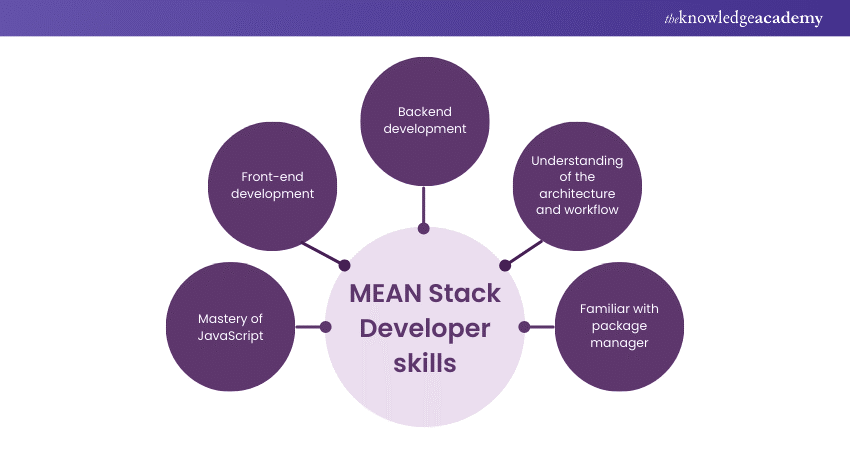
Here is the list of skills necessary for MEAN Stack Developer:
1) Mastery of JavaScript
As mentioned earlier, JavaScript is the core programming language for MEAN Stack Development. You need to master JavaScript's basics and advanced features, such as syntax, data types, operators, control structures, functions and many more.
2) Front-end development
Front-end development is creating your web applications' user interface and user experience. You need to master the skills and tools that allow you to create dynamic and interactive web pages using HTML, CSS, JavaScript, and AngularJS. You must learn to use AngularJS to create single-page applications that follow the MVC pattern and use directives, data binding, services, filters, and modules. You must also learn to use Bootstrap to create responsive and consistent web pages that adapt to different devices and screen sizes.
3) Backend development
Backend development is creating the server-side logic and functionality of your web applications. You need to master the skills and tools that allow you to create web servers, handle HTTP requests and responses, and communicate with databases using Node.js, Express.js, and MongoDB. You must learn to use Node.js to create web servers, handle asynchronous operations, and use modules such as npm. You must also learn how to use Express.js to create RESTful APIs that serve your AngularJS front-end and connect to your MongoDB database using a driver or an ORM tool, such as Mongoose.
4) Understanding of the architecture and workflow
As a MEAN Stack Developer, you also need to understand the architecture and workflow of your Web Development projects. Using best practices and conventions, you must learn to design, structure, and organise your code and files. You also need to learn how to use tools and techniques that help you manage and optimise your Web Development projects.
5) Familiar with the package manager
npm (Node Package Manager) is a tool that helps you install and manage third-party libraries for your Web Development projects. You need to be familiar with npm and how to install and update packages, such as AngularJS, Express.js, MongoDB, and Mongoose. You also need to be familiar with the package.json file, which is a file that contains information and dependencies of your Web Development projects.
Shape the digital future – Join our comprehensive App & Web Development Training to unleash your potential in crafting innovative and seamless user experiences!
Conclusion
In this blog, we have covered the steps on "How to Become a MEAN Stack Developer?" MEAN Stack Development is a rewarding and challenging career that requires you to master various technologies and tools, such as MongoDB, Express.js, AngularJS, Node.js, HTML, CSS, JavaScript, Bootstrap, JSON, SQL, NoSQL, Git, Testing, Deployment, and npm. The difference between MEAN Stack and Full Stack can be seen in the fact that Full Stack development often involves integrating technologies from multiple ecosystems, whereas MEAN Stack development focuses solely on the MongoDB-Express-Angular-Node combination.
Unlock the power of dynamic web applications – Become an AngularJS Developer and shape the digital landscape with cutting-edge front-end solutions!
Frequently Asked Questions
How do I become a MEAN Stack Developer?

The first step to becoming a MEAN Stack Developer is to get a bachelor's degree in Computer Science, Software Engineering, or a related field. It will give you a solid foundation in programming, data structures, algorithms, and Web Development. You will also learn about programming languages, such as JavaScript, which are essential for MEAN Stack Development.
Is there a current demand for the MEAN Stack?
Yes, there is a current demand for the MEAN Stack, as it is one of the industry's most popular and widely used Web Development stacks. The demand for MEAN Stack Developers is expected to grow as more and more companies and organisations adopt MEAN Stack technologies to create web applications that are fast, efficient, and scalable.
What are the other resources and offers provided by The Knowledge Academy?
The Knowledge Academy takes global learning to new heights, offering over 3,000 online courses across 490+ locations in 190+ countries. This expansive reach ensures accessibility and convenience for learners worldwide.
Alongside our diverse Online Course Catalogue, encompassing 17 major categories, we go the extra mile by providing a plethora of free educational Online Resources like Blogs, eBooks, Interview Questions and Videos. Tailoring learning experiences further, professionals can unlock greater value through a wide range of special discounts, seasonal deals, and Exclusive Offers.
What is Knowledge Pass, and how does it work?
The Knowledge Academy’s Knowledge Pass, a prepaid voucher, adds another layer of flexibility, allowing course bookings over a 12-month period. Join us on a journey where education knows no bounds.
What are related PRINCE2 courses and blogs provided by The Knowledge Academy?
The Knowledge Academy offers various App and Web Development Courses, including Introduction to HTML, WordPress Essentials and Website Design Course. These courses cater to different skill levels, providing comprehensive insights into Essential UI Developer Skills.
Our App and Web Development blogs cover a range of topics related to Web Development, offering valuable resources, best practices, and industry insights. Whether you are a beginner or looking to advance your App and Web Development skills, The Knowledge Academy's diverse courses and informative blogs have you covered.

Richard Harris


Senior Full Stack Developer and Technology Educator
Richard Harris is a highly experienced full-stack developer with deep expertise in both frontend and backend technologies. Over his 12-year career, he has built scalable web applications for startups, enterprises and government organisations. Richard’s writing combines technical depth with clear explanations, ideal for developers looking to grow in modern frameworks and tools.

Upcoming Programming & DevOps Resources Batches & Dates
Date
 MEAN Stack Web Development Training
MEAN Stack Web Development Training
Fri 26th Jun 2026
MEAN Stack Web Development Training
Fri 14th Aug 2026
MEAN Stack Web Development Training
Fri 18th Sep 2026

 If you wish to make any changes to your course, please


