AAT Level 3 Diploma in Accounting

accredited by

Our AAT course is accredited by AAT

Online Self-paced (8 hours)

Financial Accounting: Preparing Financial Statements Course Outline

Guided Learning Hours: 150

Module 1: Understand the Accounting Principles Underlying Final Accounts Preparation

  • Primary Users of Final Accounts
    • Primary Users of Final Accounts Existing and Potential Investors Lenders Other Creditors
    • How Final Accounts Are Used by the Primary Users
  • Framework of Accounting Underlying the Preparation of Final Accounts
    • Accounting Principles Accruals Going Concern Business Entity Materiality Consistency Prudence Money Measurement
  • Qualities of Useful Financial Information
    • Fundamental Qualitative Characteristics Relevance Representation Faithful Representation
    • Enhancing Qualitative Characteristics Comparability Verifiability Timeliness Understandability
    • Importance of Ensuring Financial Statements Are Free from Material Misstatement
    • Importance of Accountant’s Ethical Principles and Professional Scepticism When Preparing Financial Statements

Module 2: Understand the Principles of Advanced Double Entry Bookkeeping

  • Use of the Accounting Equation
    • Importance of the Accounting Equation for Keeping Records
    • Effect of Accounting Transactions
    • Calculate Elements of the Accounting Equation
  • Classification of Ledger Accounts
    • Classification of General Ledger Accounts Into
  • Purpose and Use of Books of Prime Entry and Ledger Accounting
    • Daybooks Sales Returns Purchases Purchase Returns Discounts Allowed Discounts Received Cash Book Journal
    • Information Recorded in Daybooks
    • Use of Daybooks to Update Ledger Accounts Including VAT
    • Ledgers and Their Interaction General Ledger Subsidiary Ledgers Receivables Payables
    • Control Accounts
    • Accounting Software Automates Transfer of Data into Control Accounts
    • Prepare Ledger Accounts Using Double Entry Principles
  • Carry Out Financial Period End Routines
    • Period End Accounts Balanced Differently by Classification Income Expense Asset Liability Capital
    • Accounting Software Automates Period End Routine
    • Verify Balances with Records and Reconciliations Inventory Bank Supplier Payables Receivables Asset Register
    • Transfer or Carry Balances in Ledger Accounts
    • Determine Validity of Transactions for Records

Module 3: Implement Procedures for the Acquisition and Disposal of Non-Current Assets

  • Importance of Prior Authority for Capital Expenditure
    • Why Authorisation Is Necessary
    • Who in an Organisation Gives Authority?
  • Importance of Classifying Expenditure into Capital or Revenue
    • IFRS Standards for Non-Current Assets IAS 16
    • Definitions of Cost Useful Life Residual Value Depreciable Amount Carrying Amount
    • Items Included in Cost of Non-Current Assets under IFRS
    • Revenue Expenditure Excluded from Non-Current Assets Value
    • Only Capitalise Expenditure Beyond Set Organisational Level
    • Effect of Capitalisation on Profit Loss and Financial Position
    • Categorise Items into Revenue Capital Expenditure
  • Record Acquisitions and Disposals of Non-Current Assets
    • Purpose and Content of Asset Register Verification Reconciliation with Ledger
    • Meaning of Disposals Account Balance
    • Part Exchange as Form of Funding
    • Non-Current Asset Registers May Be Software Based or Spreadsheet Based
    • Gains Losses on Disposal at Period End
    • Update Asset Register for Acquisitions Disposals
    • Record Acquisitions Disposals in General Ledger
    • Treat VAT per Organisation Registration

Module 4: Prepare and Record Depreciation Calculations

  • Calculate Depreciation
    • Depreciation as Accruals Principle
    • Allocation of Depreciable Amount over Useful Life
    • Software or Spreadsheets Automate Depreciation
    • Calculate Depreciation Using Straight Line Percentage Useful Life Residual Value or No Residual Value Full Year or Pro Rata
    • Calculate Depreciation Using Diminishing Balance Method
  • Record Depreciation
    • Record Depreciation in Asset Register and General Ledger with Journal Entries
    • Reconcile Asset Register with General Ledger Balances

Module 5: Record Period End Adjustments

  • Record Accruals and Prepayments of Income and Expenditure
    • Adjustments for Accruals Prepayments as Accruals Principle
    • Difference Between Amount Paid Received vs Recognised in Profit Loss
    • Impact of Adjustments Reversals on Ledger Accounts
    • Accrued Prepaid Balances Recognised as Assets Liabilities
    • Software Automates Recurring Accrual Prepayment Entries
    • Calculate Prepayment Accrual Amounts
    • Account for Accruals Prepayments via Journal General Ledger
    • Account for Reversal of Accruals Prepayments from Prior Period
  • Record Irrecoverable Debts and Allowances for Doubtful Receivables
    • Allowances for Doubtful Receivables as Accruals Principle
    • Differences Between Irrecoverable Debts Specific General Allowances
    • Write Off Recovery of Irrecoverable Debts
    • Calculate New Allowances and Adjust Existing Allowances
    • Record Debts Allowances in Journal
  • Record Inventory
    • Accounting for Inventory as Accruals Principle
    • Effect of Valuation Changes on Profit Loss
    • IFRS Standards for Inventory Valuation IAS 2
    • Inventory Valued at Lower of Cost and NRV per Item
    • Expenditure Types in Valuation
    • Software Automates Recording Tracking Valuation of Inventory
    • Determine Closing Inventory per Standards
    • Record Value of Closing Inventory in Journal
  • Considerations for Recording Period End Adjustments
    • When Making Period End Adjustments
    • Apply Professional Scepticism Integrity and Objectivity to Prevent Misleading and Inaccurate Information
    • Effects of Including Misleading or Inaccurate Period End Adjustments
    • Respond Appropriately to Period End Pressures

Module 6: Produce and Extend Trial Balance

  • Prepare an Initial Trial Balance
    • Certain Accounts Can Carry Either a Debit or Credit Balance
    • Importance of Producing Trial Balance to Check for Errors
    • Limitations of Trial Balance as Check for Errors
    • Accounting Software Completes Transfer of Data into Trial Balance
    • Transfer Balances from Ledger Accounts into Correct Debit or Credit Columns
    • Correct Errors Not Shown by Initial Trial Balance
    • Correct Errors Shown by Initial Trial Balance Using Suspense Account
  • Prepare an Adjusted Trial Balance
    • Accounting Software Automatically Recalculates Balances After Adjustments
    • Place Adjustments Correctly into Columns of Adjusted Trial Balance
  • Complete Extended Trial Balance
    • Importance of Fully Extended Trial Balance for Preparation of Financial Statements
    • Difference Between Entries in Extended Trial Balance for Sole Traders and Partnerships
    • Complete SPL and SFP Columns of Extended Trial Balance
    • Balance Off Extended Trial Balance by Calculating Profit or Loss Figure

Module 7: Produce Financial Statements for Sole Traders and Partnerships

  • Prepare Financial Statements for Sole Traders
    • Purpose of SPLs
    • Purpose of SFPs
    • How Financial Statements Are Linked to Accounting Equation
    • How SPL and SFP Are Related
    • Terminology: Sales Revenue Net Purchases Cost of Sales
    • Prepare SPLs
    • Prepare SFPs Using Net Assets Presentation
  • Opening and Closing Capital for Sole Traders
    • Reasons for Movements in Capital Balance During Period
    • Account for Drawings Capital Injections Profits or Losses
  • Produce SPL for Partnerships
    • Difference Between SPL for Partnership and Sole Trader is Appropriation Account
    • Purpose and Content of Partnership Appropriation Account
    • How SPL is Linked to Appropriation Account
    • Prepare Appropriation Account
    • Calculate Partner Share of Profit or Loss
    • Prepare Partnership SPL
  • Produce SFP for Partnerships
    • Difference Between SFP for Partnership and Sole Trader is Capital and Current Accounts
    • Difference Between Partner Current Accounts and Appropriation Account
    • Difference Between Partner Current Accounts and Capital Account
    • Account for Drawings
    • Prepare Partner Current Accounts
    • Prepare Partnership SFP Using Net Assets Presentation

Module 8: Interpret Financial Statements Using Profitability Ratios

  • Calculate Profitability Ratios
    • Relationship Between SPL and SFP Regarding Net Profit
    • Link Between Gross Profit Margin and Mark Up
    • Meaning of Profitability Ratios
    • Calculate Ratios: ROCE Gross Profit Margin Net Profit Margin Expense Revenue Percentage
  • Interpretation of Profitability Ratios
    • Why Calculating Ratios Can Aid Planning and Decision Making
    • Factors Causing Changes in Ratios and Differences Between Businesses
    • Whether Ratio is Better or Worse than Comparative Ratio
    • Importance of Professional Scepticism to Interpretation

Module 9: Prepare Accounting Records from Incomplete Information

  • Identify Missing Figures
    • Calculate Missing Figures Relating to Income Expenses Assets Liabilities and Capital
  • Mark Up and Margin
    • Difference Between Margin and Mark Up
    • Calculate Margin and Mark Up to Determine Missing Figures
    • Use Cost of Sales Calculations to Determine Missing Figures
  • Reasonableness of Figures when Information is Incomplete
    • Whether Given Figure is Reasonable
    • Why Actual and Calculated Balance Can Differ
    • Importance of Checking Information Produced by Accounting Software
    • Apply Professional Scepticism

Show moredown

Who Should Attend This Financial Accounting: Preparing Financial Statements Course?

This course is designed for individuals advancing their accounting skills as part of the AAT Level 3 Diploma in Accounting. It is particularly useful for those in roles such as:

  • Accountants
  • Finance Managers
  • Bookkeepers and Accounting Assistants
  • Business Owners and Entrepreneurs
  • Auditors and Compliance Officers
  • Graduates Pursuing Accounting Qualifications

Prerequisites of the Financial Accounting: Preparing Financial Statements Course

Delegates are recommended to have completed the AAT Level 2 Certificate in Accounting or hold equivalent knowledge of accounting principles. This foundation ensures readiness for the advanced concepts covered in this course.

Financial Accounting: Preparing Financial Statements Course Overview

The Financial Accounting: Preparing Financial Statements course equips learners with essential skills to produce accurate financial reports. It covers preparing income statements, balance sheets, and cash flow statements using advanced double-entry bookkeeping principles.

This 150-hour training provides practical knowledge of the full accounting cycle, including asset management, depreciation, adjustments, trial balance consolidation, and preparing financial statements. Learners also gain the ability to interpret reports and work with incomplete records.

Successful completion supports progression within the full AAT Level 3 Diploma in Accounting and paves the way for career growth in accounting and finance roles. It also strengthens practical expertise, giving learners the confidence to apply financial reporting skills in real-world scenarios.

Financial Accounting: Preparing Financial Statements Course Objectives

  • Understand the structure and purpose of financial statements
  • Apply accounting principles to prepare accurate reports
  • Ensure compliance with IFRS and GAAP standards
  • Analyse financial data to support business decisions
  • Communicate financial performance effectively

Show moredown

What’s Included in This Financial Accounting: Preparing Financial Statements Course

  • World-Class Training Sessions from Experienced Instructors
  • Course Completion Certificate
  • Digital delegate pack

Show moredown

accredited by

Our AAT course is accredited by AAT

Online Self-paced (8 hours)

Management Accounting Techniques Course Outline

Guided Learning Hours: 120

Module 1: Understand the Purpose and Use of Management Accounting Within Organisations

  • Internal Reporting Calculations
    • Purpose of Costing Budgeting and Internal Reporting
    • Importance of Providing Accurate Information to Management for Planning Control and Decision Making
    • Calculate Revenue Costs Contribution and Reported Profits for an Organisation
    • Calculate Segmented Revenue Costs Contribution and Reported Profits by Product
  • Differences Between Marginal and Absorption Costing
    • Difference Between Product and Period Costs
    • Differences Between Costing Techniques Marginal Costing Absorption Costing
    • Impact on Reported Performance of Marginal Versus Full Absorption Costing in Both Short Run and Long Run
    • Calculate Prime Cost Marginal Cost Full Absorption Cost

Module 2: Use Techniques Required for Dealing with Costs

  • Record and Calculate Materials Labour and Overhead Costs
    • Use Appropriate Data and Information from Both Manual Records and Software
  • Prepare Cost Accounting Journals
    • Principles of Cost Accounting Journal Entries
    • Prepare Cost Accounting Journals
  • Apply Inventory Control Methods
    • Calculate Inventory Control and Valuation Measures
    • Account for Inventories Using FIFO and AVCO Methods
    • Analyse Closing Inventory Balances
  • Cost Behaviours
    • Implications of Different Cost Behaviours for Cost Analysis Decision Making and Reporting
    • Use High Low Method to Separate Fixed and Variable Cost Elements of Semi Variable Costs
  • Differences Between Costing Systems
    • Account for Under or Over Recovered Overhead Costs in Accordance with Procedures
    • Make Under or Over Absorption Calculations
    • Interpret Significance of Under or Over Recoveries of Overhead Costs on Unit Costs and Total Profit
  • Differences Between Costing Systems
    • Appropriate Choice of Costing System for Different Business Sectors and Individual Organisations
    • Effect of Waste on Costing Inputs and Outputs
    • Record Cost Information Using Different Costing Systems

Module 3: Attribute Costs According to Organisational Requirements

  • Calculate and Attribute Overhead Costs Using Traditional Methods
    • Different Methods of Indirect Cost Recovery
    • Attribute Overhead Costs to Production and Service Cost Centres
  • Calculate Overhead Recovery Rates Using Traditional Methods
    • Calculate Overhead Recovery Rates in Accordance with Suitable Bases of Absorption
  • Calculate Overhead Recovery Rates Using Activity-Based Costing
    • Concept of Activity-Based Costing
    • Calculate Overhead Recovery Rates Using Appropriate Cost Drivers
  • Under or Over-Recovery of Overheads
    • Account for Under or Over-Recovered Overhead Costs in Accordance with Established Procedures

Module 4: Investigate Deviations from Budgets

  • Principles of Standard Prices Costs and Budgeting
    • Product Standard Price and Standard Cost
    • How Standard Prices and Costs Can Be Used to Develop Budgets
    • Different Types of Budget Fixed Flexed Rolling
    • How Operating Statements Are Used to Compare Budgeted Versus Actual Performance
    • Prepare Budgets for Multi Product Organisations Revenue Materials Labour Variable Overheads Fixed Overheads Non-Manufacturing Overheads
    • Flex Fixed Budgets for Actual Volume
  • Calculate Variances
    • Recognise Variances as Favourable or Adverse
    • Calculate Variances Using Flexed Budgets
    • Compare Flexed Budget Versus Actual Costs and Revenues to Calculate
  • Analyse and Investigate Variances
    • Determine Cause and Effects of Revenue and Cost Variances
    • Recognise Significant Variances for Investigation
    • Report on Remedial Action to Address Adverse Variances

Module 5: Use Spreadsheet Techniques to Provide Management Accounting Information

  • Organise Record and Format Data
    • Design Spreadsheets to Support
    • Ensure Data is Valid and Reliable
    • Format Data
  • Use Tools to Manipulate Analyse and Verify Data
    • Use Formulas and Functions
    • Use Tools to Support Analysis of Data
    • Edit and Update Data
    • Verify Accuracy of Data Using Formula Auditing Tools
  • Use Tools to Prepare Protect and Present Accounting Information
    • Protect Integrity of Data Validation Restrict Editing Protect Ranges of Cells
    • Enhance Visual Presentation of Data

Module 6: Use Management Accounting Techniques to Support Short Term Decision Making

  • Estimate and Use Short Term Future Revenue and Costs
    • Concept of Contribution Revenue Minus Variable Costs
    • Use Estimates of Relevant Future Revenue and Costs
    • Use CVP Analysis to Calculate
    • Interpret and Report on CVP Analysis
  • Examine the Effects of Changing Activity Levels
    • Effect of Changing Activity Levels on Unit Revenue Costs and Profits
    • Calculate Changes in Forecast Unit Revenue Costs and Profits

Module 7: Understand Principles of Cash Management

  • Principles of Cash Budgeting
    • Key Differences Between Cash and Profit
    • Principles of Forecasting Cash Receipts and Payments
    • Funding Methods Available for Acquisition of Non-Current Assets
    • Suitability of Each Funding Method for Acquisition of Non-Current Assets
    • Importance of Liquidity and Use of Resources Ratios
    • Working Capital Cycle
    • Produce Cash Budgets
    • Calculate Working Capital Using Resources Ratios:
  • Improving Cash Flow
    • Importance of Liquidity for Businesses’ Survival
    • Actions That Can Be Taken if Insufficient Liquidity
    • Methods of Improving Cash Flow
    • How Accounting Software and Use of Automation and Visualisation Can Aid Cash Flow Planning

Show moredown

Who Should Attend This Management Accounting Techniques Course?

This course is designed for individuals seeking to develop practical skills in cost control, budgeting, and financial decision-making as part of the AAT Level 3 Diploma in Accounting. It is particularly useful for those in roles such as:

  • Management Accountant
  • Finance Assistant
  • Budget Analyst
  • Cost Controller
  • Business Owner or Entrepreneur
  • Accounting Technician

Prerequisites of the Management Accounting Techniques Course

This Management Accounting Techniques Course is suited for learners who have completed the AAT Level 2 Certificate in Accounting or have an equivalent understanding of basic accounting principles.

Management Accounting Techniques Course Overview

The Management Accounting Techniques Course teaches learners essential skills in cost handling, budget variance analysis, and spreadsheet use to support business financial decisions. It introduces management accounting principles and techniques, helping learners understand how costs affect organisational performance.

This 120-hour training provides practical, hands-on experience with real-world examples. Delegates build confidence in producing management reports, analysing budgets, and applying cost management tools for improved business outcomes.

Completing this course prepares learners for progression within the AAT Level 3 Diploma in Accounting. It helps learners to contribute effectively to strategic planning and operational control.

Management Accounting Techniques Course Objectives

  • Understand the role of management accounting in business
  • Apply costing techniques to support financial decisions
  • Analyse budget variances and investigate causes
  • Use spreadsheets to present and interpret financial data
  • Support short-term decision-making with accurate cost analysis

Show moredown

What’s Included in This Management Accounting Techniques Course

  • World-Class Training Sessions from Experienced Instructors
  • Course Completion Certificate
  • Digital Delegate Pack

Show moredown

accredited by

Our AAT course is accredited by AAT

Online Self-paced (8 hours)

Tax Processes for Businesses Course Outline

Guided Learning Hours: 60

Module 1: Understand Legislation Requirements Relating To VAT

  • UK Tax Law Principles Relating To VAT
    • That HMRC Is the Relevant Tax Authority for VAT In UK
    • That VAT Is A Tax on Consumer Spending Charged on Taxable Supplies by Taxable Persons
    • Definitions
    • HMRC’s Rules About
    • HMRC’s Rights in Respect of Inspection of Records and Visits to Registered Businesses
  • VAT Registration and Deregistration Requirements
    • Registration and Deregistration Thresholds for Normal VAT Scheme and How to Apply Them
    • What Is Meant by Historic Turnover Method Historic Test and Future Turnover Method
    • Circumstances
  • Filing and Payment of VAT Returns
    • Timing and Frequency
    • Circumstances in Which Monthly Accounting May Be Beneficial to a Business
    • How Statutory Time Limits for Making Payment Differ Depending on Payment Method Used
    • That Compatible Software Must Be Used and Authorised for Submitting VAT Returns Under Making Tax Digital MTD
  • Special Schemes
    • Thresholds Qualification Criteria and Operation of Special VAT Schemes
    • Timing and Frequency
    • Circumstances for Voluntary and Compulsory Withdrawal from Special Schemes
  • Implications for Non-Compliance with VAT Regulations
    • Powers of HMRC To Penalise A Business That Has Failed to Register For VAT
    • Details of Penalty Regime Applicable to Non-Registration or Late Registration
    • How Penalty Regime Applies to Late Submission or Non-Submission of VAT Returns Excluding Changes in Filing Frequency
    • Powers of Assessment That HMRC Has in Respect of Failure to Submit VAT Returns
    • Details of Penalty and Interest Regime Applicable to Late or Non-Payment of VAT Due
    • Consequences of Failing To
    • Operational and Legal Consequences of Incorrect Recovery Of VAT

Module 2: Calculate VAT

  • Extracting Relevant Data from Accounting Records
    • Relevant Sources of VAT Information Needed by A Business
    • How to Identify Relevant Accounting Records That Cover Required Period of Each VAT Return
    • How to Identify and Extract Relevant Revenue Expenditure and VAT Figures from Accounting Records
    • How to Validate Data and Determine That Figures Extracted Have Come from Original and Verified Source Documents
    • Benefits of Accounting Software in Identifying Errors Eg Incorrect VAT Rate
  • VAT Invoices
    • Contents and Form of A VAT Invoice
    • How to Determine the Tax Point of An Invoice Both Basic and Actual When There Are
    • Significance of Correct Tax Point For
    • Time Limits for Issuing VAT Invoices
    • Rules Relating to Electronic Invoicing
  • VAT Calculations
    • Difference Between Inputs and Outputs and Between Input Tax and Output Tax
    • Automation of Calculations Through Use of Accounting Software
    • Rounding Rules on VAT Calculations
    • Rules for VAT When Prompt Payment Discounts PPD Are Offered to Customers
    • Different Implications of Exempt Supplies and Of Zero-Rated Supplies and The Effect on Recovery of Input Tax
    • How Partial Exemption Works the De Minimis Limit and How This Affects the Recovery of Input Tax
    • Identification of What Cannot Be Claimed as Input Tax
    • VAT Rules on Fuel Scale Charges How to Apply Them and Their Effect on VAT Payable or Reclaimable
    • How to Apply Bad Debt Relief When This Is Available and What Time Limits Apply
    • How to Account for Postponed Import VAT
    • Learners Need to Be Able To
    • Calculate VAT On
    • Calculate VAT When Given Net or Gross Amount of Supply
    • Calculate VAT Payable Repayable for A VAT Period from Information Such As
    • Calculate the Impact on VAT Of
    • Calculate VAT for International Trade

Module 3: Review and Verify VAT Returns

  • Adjust for Errors or Omissions in VAT Returns
    • If Previous Period Errors or Omissions Can Be Corrected by Amendments on Current VAT Returns
    • Thresholds and Deadlines Where Previous Period Errors or Omissions Must Be Declared
    • When Previous Period Errors or Omissions Must Be Separately Reported Rather Than Corrected on Current VAT Returns
    • When to Report Given Previous Period Errors or Omissions That Cannot Be Corrected on Current VAT Returns
    • Calculate and Process Appropriate Adjustments for Given Previous Errors
    • Recognise Impact That Adjustments for Previous Errors Will Have On VAT
  • Verify Information Contained Within VAT Returns
    • What Is Included in All Relevant Boxes of VAT Return Excluding Box 2 8 And 9
    • How Imports and Exports Are Treated on A VAT Return
    • Importance of Checking VAT Return Before Submission
    • How to Identify Reasons for Any Given Differences Between VAT Return and Accounting Records
    • Review VAT Returns from Accounting Information
    • Reconcile VAT Return to Accounting Records

Module 4: Understand Principles of Payroll

  • Employer Responsibilities of Payroll
    • That Payroll Is Operated by Businesses or Individuals Who Employ Staff
    • That HMRC Is the Relevant Tax Authority for Payroll
    • HMRC’s Powers to Require Businesses to Comply With
    • HMRC’s Rights in Respect of Inspection of Records and Visits
    • HMRC’s Rules About
    • Difference Between Gross Pay Taxable Pay Taxable Gross Pay and Net Pay
    • That Businesses Are Required to Make Statutory Deductions from Gross Pay
    • Businesses May Be Required to Make Non-Statutory Deductions from Gross Pay
    • When Businesses or Individuals Are Required to Register as An Employer
    • Employers Are Entitled to Deduct Statutory and Other Deductions from Employees’ Pay
    • Data Protection Principles Specifically Related to The Personal Data of Employees
    • Calculate the Following
    • Reconcile Gross Pay to Net Pay and Or Taxable Gross Pay
  • Operating Payroll
    • This Content of Forms Produced for Payroll
    • That Employers Must Produce and Distribute Forms to Employees Within Required Time Period
    • That Payroll Reports Must Be Submitted to HMRC By Employers Using Real Time Information RTI
    • Content of Full Payment Submissions FPS and Employer Payment Summary EPS Reports Submitted Under RTI
    • That Employers Must Report to HMRC Employee Payments and Employee Changes Within Required Timescale
    • Statutory Time Limits for Submitting Payroll Returns and Making Payment To HMRC
    • Consequences of Late Filing and Or Payment

Module 5: Report Information Within Organisation

  • Communicating Information on VAT and Payroll Related Matters
    • Who to Report Relevant Information To
    • When A Query Is Beyond Current Experience or Expertise and So Should Be Referred to A Line Manager
    • Significant Effect on Cash Flows and Cash Budgeting of Requirements to Make Payments on Time To HMRC
    • Communicate Appropriate Time Limits for Submitting Returns and Making Payments to Appropriate Persons
    • Communicate Effects of New Legislation to Appropriate Person
    • Provide Appropriate Information For VAT
    • Provide Appropriate Information for Payroll
  • Legislation Regulation Guidance and Codes of Practice
    • Where to Find Information Regarding Changes to VAT and Payroll Law and Practice
    • Importance of Seeking Authorisation Before Returns Are Submitted
    • Relevance of Data Protection Information Security and Confidentiality to VAT and Payroll Practice
    • Importance of Maintaining Up to Date and Relevant Knowledge
    • Importance of Ethical Behaviour in Relation to VAT and Payroll
    • Importance of Updating Accounting Software Regarding Changes to VAT and Payroll Legislation
    • Importance of Acting in Good Faith and Exercising Care When Dealing with HMRC According to AAT Code of Professional Ethics

Show moredown

Who Should Attend This Tax Processes for Businesses Course?

This course is designed for individuals seeking a recognised qualification in Tax Processes for Businesses as part of the AAT Level 3 Diploma in Accounting. It is particularly useful for those in roles such as:

  • Trainee Accountants and Tax Assistants
  • Business Managers
  • Finance Officers
  • Accounting and Finance Graduates
  • Entrepreneurs and Small Business Owners

Prerequisites of the Tax Processes for Businesses Course

To take the Tax Processes for Businesses Course, you need to complete the AAT Level 2 Certificate in Accounting.

Tax Processes for Businesses Course Overview

The Tax Processes for Businesses Course provides learners with a clear understanding of how tax systems operate within organisations. Businesses face a range of taxation requirements, from corporate tax to VAT and payroll-related obligations. A strong grasp of these processes is vital for compliance, accurate reporting, and strategic financial planning.

This course is particularly valuable for finance professionals, entrepreneurs, and graduates preparing for business or accounting qualifications. It equips delegates with the ability to apply tax rules, manage submissions, and handle records effectively while considering the implications of taxation on business decisions.

This 60-hour training by The Knowledge Academy covers payroll taxes, record-keeping, reporting deadlines, and the use of technology in managing compliance. Delegates will gain the skills to ensure accurate filings, reduce risks, and align tax strategies with organisational goals.

Tax Processes for Businesses Course Objectives

By the end of this training, delegates will be able:

  • To understand the core tax processes applicable to businesses
  • To develop knowledge of corporate tax, VAT, and payroll systems
  • To manage business tax reporting and compliance requirements
  • To evaluate the role of record-keeping in taxation processes
  • To apply tax rules in line with current legislation and standards
  • To strengthen practical skills in using tax processes for business efficiency

After completing this Tax Processes for Businesses Course, delegates will receive a certificate showcasing their expertise in business taxation.

Show moredown

What’s Included in This Tax Processes for Businesses Course?

  • World-Class Training Sessions from Experienced Instructors
  • Course Completion Certificate
  • Digital Delegate Pack

Show moredown

accredited by

Our AAT course is accredited by AAT

Online Self-paced (8 hours)

Business Awareness Course Outline

Guided Learning Hours: 70

Module 1: Understand Business Types, Structures and Governance, and the Legal Framework in Which They Operate

  • Types of Businesses
    • Standard Organisation Types and Their Key Characteristics
    • Impact of Business Type on the Organisation’s Governance
    • Types of Funding Used by Businesses
    • Common Features of Business Organisations
    • Differences Between Manufacturing and Service Businesses
  • Legal Framework for Companies and Partnerships
    • Key Elements of Companies Legislation
    • Key Elements of Unlimited Liability Partnerships
  • Business Stakeholders’ Interactions and Needs
    • Different Business Stakeholders
    • Stakeholders’ Objectives and Requirements from the Business
    • Stakeholders’ Contributions to and Impact on the Business
    • Relative Significance of Stakeholders to the Business
  • Organisational Structure and Governance
    • Organisational Structure
    • Importance of Governance in Different Organisation Types
    • Role of Operational, Managerial and Corporate/Strategic Levels within an Organisation
    • Role of the Finance Function in Contributing Towards the Operation of the Other Business Functions and the Organisation’s Plans and Decision Making
    • Concept of Risk and Risk Management

Module 2: Understand the Impact of the External and Internal Environment on Businesses, Their Performance and Decisions

  • Use of the PESTLE Model for Analysing the External Environment
    • Use of PESTLE to Analyse the Impact of the Business’s Macro Environment
    • Political Factors Affecting a Business
    • Economic Factors Affecting a Business
    • Social Factors Affecting a Business
    • Technological Factors Affecting a Business
    • Legal Factors Affecting a Business
    • Environmental Factors Affecting a Business
    • Identify PESTLE Factors Affecting a Business
    • Recognise the Impact of PESTLE Factors on the Business
  • Micro-Economic Environment
    • Concept of Supply and Demand
    • How Prices Are Determined by the Price Mechanism, Market Forces, and the Impact of Different Goods
    • Impact of Price Changes on Volumes, Revenues, Costs and Profitability
    • How the Levels of Competition in the Micro-Economic Environment are Influenced
  • Importance of Sustainability
    • Meaning of Sustainability
    • Three Aspects of Sustainable Performance
    • Importance of Sustainability in Accounting

Module 3: Understand How Businesses and Accountants Comply with Principles of Professional Ethics

  • Relevance of the Ethical Code for Professional Accountants
    • Principle of Integrity
    • Principle of Objectivity
    • Principle of Professional Behaviour
    • Principle of Professional Competence and Acting with Due Care
    • Identify Discrepancies That May be Found
    • Principle of Confidentiality
    • Professional Scepticism
    • Difference Between a Principles-Based Approach and a Rules-Based Approach
    • How Documented Organisational Policies Can Safeguard Against Threats and Ethical Conflicts
    • Types of Safeguard That May Be Applied
    • What an Accountant Should Do When a Threat Cannot Be Eliminated or Reduced to an Acceptable Level
    • Recognise Threats to Integrity in Financial Accounting
    • Recognise Threats to Objectivity
    • Recognise Professional Competence and Due Care Threats
    • Recognise Critical Areas Where Up-to-Date Technical Knowledge Is Essential and the Consequences of Not Maintaining CPD
    • Recognise When Confidential Information
    • Recognise Situations When Professional Scepticism Should Be Applied and the Action to Be Taken
    • Recognise Which Safeguards May Be Appropriate
  • Ethical Conflicts and Reporting Unethical Behaviour
    • How Ethical Conflicts Arise
    • How to Determine Whether Behaviour Is Ethical or Unethical
    • Key Organisational Values and Compliance with Regulations
    • Stages in Resolving Ethical Conflicts When Applying Fundamental Principles
    • What Happens When a Course of Action Is Unethical
    • Link Between Lack of Professional Competence and Due Care and Claims for Breach of Contract and Professional Negligence
    • Requirement for Professional Indemnity Insurance
    • When and How to Report Unethical Behaviour to Responsible Persons at Work
  • Money Laundering
    • Money Laundering Law and Regulations
    • Importance of Reporting Suspected Money Laundering in Accordance with Regulations

Module 4: Understand the Impact of New Technologies in Accounting and the Risks Associated with Data Security

  • Technology
    • Impact of Emerging and Developing Technologies on Accounting Systems
    • How Technological Developments Have Increased Outsourcing and Offshoring, Which Has Impacted Business Development
    • Effect of Automation and AI in Accounting Systems on the Role of the Accountant and the Finance Function
    • Key Features of Cloud Accounting
    • Benefits and Limitations of Cloud Accounting for an Organisation
    • Make Entries in the Cash Book
  • Data Protection, Information-Security and Cybersecurity
    • Principles of Data Protection
    • Impact of Data Protection Breaches on the Individual and Business
    • Importance of Maintaining Information Security
    • Importance of Cybersecurity to Address Cyber Risks
    • Risks to Data and Operations Posed by Cyberattacks

Module 5: Communicate Information to Stakeholders

  • Information Requirements in a Business Organisation
    • Attributes of Good Quality Information
    • Type, Purpose, and Characteristics of Information at Operational, Managerial, and Strategic Levels
    • Characteristics of Big Data
    • Benefits and Limitations of the Use of Big Data
    • Sources of Internal and External Big Data
    • Need to Apply Professional Scepticism in Relation to Big Data
    • Use of Data Analytics from External Sources
  • Visualising Information
    • Importance of Being Able to Visualise Information in Different Formats
    • Patterns or Significant Anomalies Within Data
    • Importance of Selecting Appropriate Data Visualisation for Communication
    • Accounting Software Uses Dashboards to Communicate with Non-Technical Stakeholders
    • Interpret Visual Information to Indicate Relationships and Trends
  • Communicating Information
    • Principles Used to Determine the Appropriate Method of Communication to Use Both Internally and Externally by the Business
    • Characteristics of Professional Communication

Show moredown

Who Should Attend this Business Awareness Course?

The Business Awareness Course is suitable for individuals seeking to build foundational knowledge of business concepts and practices. It is particularly suitable for those aiming for roles such as:

  • Business Graduates
  • Accounting Graduates
  • Aspiring Manager
  • Entrepreneur
  • Finance or Management Professional

Prerequisites of the Business Awareness Course

To take the Business Awareness Course, you need to complete the AAT Level 2 Certificate in Accounting.

Business Awareness Course Overview

The Business Awareness Course provides learners with essential knowledge of how organisations operate, compete, and achieve objectives in a dynamic environment. Developing business awareness is crucial for professionals who want to make informed decisions, recognise opportunities, and anticipate challenges in today’s competitive markets.

This course is particularly valuable for graduates, entrepreneurs, and professionals preparing for accounting or business qualifications. It equips delegates with an understanding of business structures, stakeholders, regulatory factors, markets, and the role of technology and globalisation.

This 70-hour training by The Knowledge Academy introduces key topics, including business objectives, organisational structures, market influences, economic frameworks, ethics, and the impact of external factors. Delegates will gain the skills to analyse business scenarios, apply commercial knowledge, and contribute to effective decision-making.

Business Awareness Course Objectives

By the end of this training, delegates will be able:

  • To understand the role of businesses in society and the economy
  • To explore organisational structures, governance, and stakeholder relationships
  • To analyse markets and external influences on business performance
  • To evaluate the impact of regulatory, economic, and technological factors
  • To develop commercial awareness for effective decision-making
  • To strengthen understanding of ethics, corporate responsibility, and globalisation

After completing this Business Awareness Course, delegates will receive a certificate showcasing their business knowledge. This recognition will support career progression in business, accounting, and management.

Show moredown

What’s Included in This Business Awareness Course?

  • World-Class Training Sessions from Experienced Instructors
  • Course Completion Certificate
  • Digital Delegate Pack

Show moredown

Not sure which course to choose?

Speak to a training expert for advice if you are unsure of what course is right for you. Give us a call on +44 20 4538 6376 or Enquire.

Benefits of the AAT Level 3 Diploma in Accounting

The AAT Level 3 Diploma in Accounting provides learners, delegates and professionals with stronger technical abilities, improved career prospects and the confidence to advance within the accounting and finance sector. Key benefits include:

  • Stronger business understanding: Learners build deeper awareness of how organisations operate and how financial information supports decision making across departments.
  • Improved knowledge of professional ethics: Delegates strengthen their understanding of ethical practices within accounting and finance, helping them apply responsible and compliant working standards.
  • Higher earning potential: Completing this level can lead to improved salary prospects, as employers value the advanced practical knowledge gained through AAT Level 3.
  • Eligibility for AAT Bookkeeper status (AATQB): Delegates become eligible to apply for AATQB status, allowing them to offer bookkeeping services independently as a recognised and trusted professional.
  • Practical accounting skills: Professionals develop hands on skills in financial statements, management accounting, taxation and the use of accounting software to support real business activities.
  • Progression to AAT Level 4: Learners are fully prepared to continue their studies and advance to the AAT Level 4 Diploma in Professional Accounting.
     

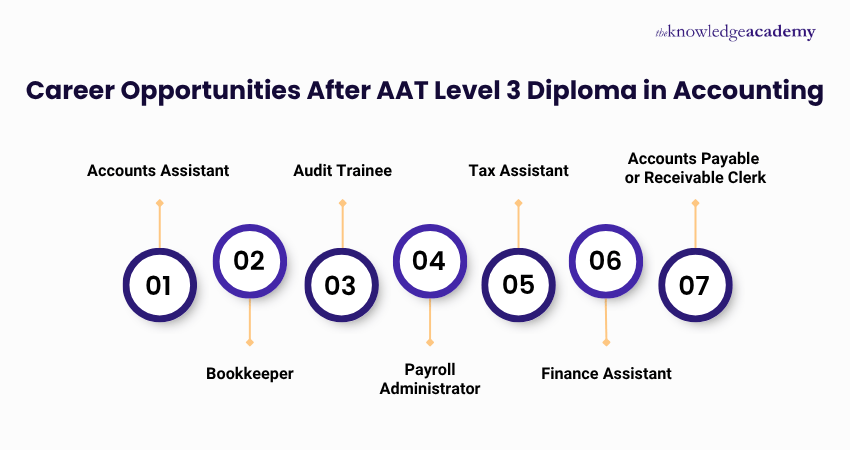
Career Opportunities After AAT Level 3 Diploma in Accounting

Completing the AAT Level 3 Diploma in Accounting prepares learners, delegates and professionals for skilled roles across accounting, finance and bookkeeping. Delegates can advance into positions such as:

Career Paths After AAT Level 3 Diploma in Accounting

  • Accounts Assistant: Support financial transactions, maintain ledgers, process invoices and assist with preparing management and financial reports.
  • Bookkeeper: Manage day to day bookkeeping tasks, complete reconciliations, prepare trial balances and support small business accounts.
  • Audit Trainee: Assist audit teams with documentation, testing procedures and financial checks while gaining experience in a professional audit environment.
  • Payroll Administrator: Handle payroll calculations, update employee records and ensure accurate and timely monthly payments.
  • Tax Assistant: Support basic tax computations, maintain compliance records and assist with tax preparation tasks.
  • Finance Assistant: Provide administrative and accounting support including reconciliations, data processing and financial reporting tasks.
  • Accounts Payable or Receivable Clerk: Process supplier invoices, manage customer payments, complete statement reconciliations and maintain accurate account records.
Show more blue-arrow

AAT Level 3 Diploma in Accounting FAQs

It is an advanced qualification that covers financial reporting, ethics, and management accounting, equipping learners with skills for mid-level accounting roles. 

The duration of these AAT Level 3 Diploma in Accounting Courses varies. Please visit our course pages for specific information.   

Yes. Delegates receive the official AAT Level 3 Diploma in Accounting upon successful completion.

It prepares learners for roles such as Accounts Manager, Finance Officer, or Assistant Accountant and supports progression to Level 4. At The Knowledge Academy, one of the best training providers, we help learners build advanced accounting capabilities for career growth.

Yes, The Knowledge Academy offers support via phone and email before, during, and after the course. As one of the trusted training providers, we ensure continuous support throughout your learning journey.

The prerequisites for the AAT Level 3 Diploma in Accounting are based on the course specifications and the target group of professionals it serves. Check the respective course page of the course that you are planning to take to know about its prerequisites. 

This course is ideal for individuals with basic accounting knowledge, those who have completed Level 2, or professionals looking to advance their accounting skills. At The Knowledge Academy, one of the trusted training providers, we support learners progressing to higher-level qualifications.

The course covers financial accounting, management accounting, business awareness, tax processes, and ethical practices in accounting. At The Knowledge Academy, one of the global training providers, we ensure content is aligned with current industry practices.

You will gain skills in financial reporting, budgeting, cost control, decision-making, and using accounting software to manage financial data effectively.

After completing this qualification, you can pursue roles such as Assistant Accountant, Accounts Supervisor, or Finance Officer. At The Knowledge Academy, one of the top training providers, we help learners prepare for these career opportunities.

In this course, delegates will have intensive training with our experienced instructors, a digital delegate pack consisting of important notes related to this course, and a certificate after course completion.

The Knowledge Academy stands out as a prestigious training provider known for its extensive course offerings, expert instructors, adaptable learning formats, and industry recognition. It's a dependable option for those seeking this certification.

The Knowledge Academy is one of the Leading global training provider for AAT Level 3 Diploma in Accounting.

The training fees for AAT Level 3 Diploma in Accounting in Jordan starts from £

Show more down

Why we're the go to training provider for you

icon

Best price in the industry

You won't find better value in the marketplace. If you do find a lower price, we will beat it.

icon

Trusted & Approved

Recognised by leading certification bodies, we deliver training you can trust.

icon

Many delivery methods

Flexible delivery methods are available depending on your learning style.

icon

High quality resources

Resources are included for a comprehensive learning experience.

barclays Logo
deloitte Logo
Thames Water Logo

"Really good course and well organised. Trainer was great with a sense of humour - his experience allowed a free flowing course, structured to help you gain as much information & relevant experience whilst helping prepare you for the exam"

Joshua Davies, Thames Water

santander logo
bmw Logo
Google Logo

Looking for more information on AAT Level 3 Diploma in Accounting

cross

Upgrade Your Skills. Save More Today.

superSale Unlock up to 40% off today!

WHO WILL BE FUNDING THE COURSE?

close

close

Thank you for your enquiry!

One of our training experts will be in touch shortly to go over your training requirements.

close

close

Press esc to close

close close

Back to course information

Thank you for your enquiry!

One of our training experts will be in touch shortly to go overy your training requirements.

close close

Thank you for your enquiry!

One of our training experts will be in touch shortly to go over your training requirements.