


 Top Rated Course

We may not have the course you’re looking for. If you enquire or give us a call on +39 800580270 and speak to our training experts, we may still be able to help with your training requirements.
What Is Cryptocurrency? Meaning, How It Works, and Examples
The Knowledge Academy 15 July 2026Cryptocurrency is digital money secured by cryptography on decentralised blockchains, enabling peer-to-peer transactions and secure wallet storage. It removes the need for central authorities and supports transparent transfers. Users can send value globally with greater speed, control, and flexibility than traditional payment systems.

Training Outcomes Within Your Budget!
We ensure quality, budget-alignment, and timely delivery by our expert instructors.
Table of Contents

Digital currency is reshaping people's perspectives on payments, possessions, and value in the digital world. Grasping What is Cryptocurrency gives a good reason for its worldwide fascination to develop that fast.
The instant transfers, new financial possibilities, and so on continue to be the main reason why crypto sparks curiosity and debate. Diving into What is Cryptocurrency is the starting point for revealing how it works, why it matters, and what the future holds.
Table of Contents
1) What is Cryptocurrency?
2) How Do Cryptocurrencies Work?
3) Types of Cryptocurrency
4) How to Buy Cryptocurrency?
5) How Can You Use Cryptocurrency?
6) How to Store Cryptocurrency?
7) Benefits of Cryptocurrencies
8) Risks of Cryptocurrencies
9) Common Cryptocurrency Terms
10) Is Crypto Real Money?
11) Cryptocurrency examples
12) Conclusion
What is Cryptocurrency?
Cryptocurrency is made up of digital coins that are secured by cryptographic techniques and used on decentralised computer networks. It provides a way for people to transfer and receive money without the involvement of banks or the state.
Cryptocurrency can be used for various purposes, such as payments, transfers, and investment, if stored in digital wallets. Its architecture facilitates quick and clear transactions over the whole network of the world.

How Do Cryptocurrencies Work?
Cryptocurrencies utilise the blockchain technology, which records all the transactions done in the network of computers. All transactions are verified cryptographically before they are put in a shared, non-tampered-with ledger.
Transactions are validated and then collected into blocks and stored forever in the blockchain. This method of decentralisation eradicates the necessity of middlemen and, at the same time, guarantees openness, safety, and reliability throughout the network.
What is Cryptocurrency Mining?
The practice of cryptocurrency mining comprises the activities of endorsing and documenting transactions over a blockchain network. Miners, in this case, are the ones using robust technological machines to carry out the difficult calculations that verify the transactions and integrate new blocks into the ledger.
As a token of appreciation for their efforts, miners get either the newly minted cryptocurrency or a portion of the transaction fees. The entire process serves the dual purpose of making the network safer and of conserving its non-centralised organisation at the same time.

Types of Cryptocurrency
There are different forms of cryptocurrencies, all of which have different uses and characteristics. Most famous among them is Bitcoin, which was launched for the purpose of peer-to-peer transactions as a digital currency.
Ethereum is for smart contracts; stablecoins for price stability; utility tokens for platform access; and governance tokens for voting rights are other types.
How to Buy Cryptocurrency?
If you are interested in investing in Cryptocurrency, understanding the safe and efficient methods for buying and managing digital currencies is crucial. The process typically unfolds in three distinct steps:
1) Selecting the Appropriate Platform:
First, you must choose the right place for your Crypto transactions. You have two basic variants:
a) Traditional Brokers: This service will provide a diversified set of financial assets, like Cryptocurrencies, stocks, bonds, and ETFs. For the most part, the platforms are known to have lower trading costs and could offer more restrictions on Cryptocurrency-specific features.
b) Cryptocurrency Exchanges: These have a strong focus on Cryptocurrencies and could offer a diversified set of coins, wallet storage solutions, options for interest-earning accounts or even other services. For the most part, they use an asset-based fee structure.
When assessing exchanges, consider the variety of Cryptocurrencies available, charge schemes, security measures, methods to store and withdraw your funds, and educational resources available.
2) Funding Your Account:
After you have selected an exchange, you must fund your account to start trading. Most exchanges permit you to fund using fiat currencies such as USD, GBP, or EUR with debit or credit cards-but it varies. Also take into consideration:
a) Credit Card Purchases: The use of credit cards to buy Crypto is a very risky procedure and should not be allowed in all the major exchanges. This proves to be risky due to the high volatility associated with Cryptocurrencies, which would often cost a hefty amount with the chances of getting into debt.
b) Other Payment Systems: Most platforms also offer ACH, and wire transfer. The methods available and the time taken to process deposits and withdrawal are not similar for each of the platforms. Also keep in mind the various fees applied such as deposit, withdrawal, and trading fees, which also vary dramatically depending both on the platform and the payment system used.
Dive into the tech behind Crypto, smart contracts, and decentralised apps with our Blockchain Training - Sign up now and take the route of innovation!
3) Making a Purchase:
Now you can use the web or mobile interface of your chosen broker or exchange to buy Cryptocurrency. Most of the time, it will make you choose 'buy,' then select the type of order, enter in the amount of Cryptocurrency you want to buy, and confirm the order. The same process is above for selling.
Other than direct buying, there are also other forms of investment into Cryptocurrencies:
a) Payment Services: The services available include those from platforms such as PayPal, Cash App, and Venmo. These enable individuals to buy, sell, and hold Cryptocurrencies.
b) Investment Vehicles: They can be Bitcoin trusts available through most brokerage accounts, Bitcoin ETFs, or mutual funds. For indirect exposure to the Crypto market, one could invest in Blockchain ETFs or Blockchain stocks, which track companies developing Blockchain Technology or using it in their operations.
Navigation of the Cryptocurrency market safely would require careful consideration of a trading platform, an understanding of the funding methods and their associated fees, as well as other conditions under which to buy or invest in Cryptocurrencies, be it directly or through other financial instruments.

How Can You Use Cryptocurrency?
Cryptocurrencies, such as Litecoin, Bitcoin, and Ethereum, have become popular means of purchasing goods and services and have also turned into alternative investment means aside from traditional stocks and bonds. Many investors are now looking to Buy Bitcoin as part of their investment strategies. Here’s how you can use Cryptocurrency:
1) Make Payments: You can spend Crypto on goods and services with online retailers, travel companies, and some physical stores.
2) Send Money Globally: Transfer funds across borders quickly and with low fees, making it useful for remittances.
3) Invest or Trade: You can hold it as “digital gold” for long-term value or trade for short-term gains.
4) Access Digital Apps: You can use certain coins to run decentralised apps (dApps), games or smart contracts.
5) Explore New Uses: You can engage with projects in decentralised finance (DeFi), supply chains, and digital art (NFTs).
Master the tools and trends behind financial disruption in our FinTech Course - Sign up now and become a FinTech trailblazer!
How to Store Cryptocurrency?
Once you buy it, you should store your Cryptocurrency safely to avoid hacks or thefts. Cryptocurrencies can be stored in wallets. The wallet, for one, can either be a physical appliance or online software which was designed to secure the private key of a user.
Some exchanges also allow consumers to store their assets on their own platform, though not all exchanges or brokers automatically include this service. There are several options in choosing a wallet provider; however, this basically falls under two major categories:
1) Hot Wallet Storage: These wallets utilise online software to secure the private keys to your assets. Hot wallets are very useful for accessing assets but relatively more exposed to online dangers.
2) Cold Wallet Storage: It uses offline electronic devices. It is generally known as a hardware wallet, and it stores private keys securely by means of offline electronic devices. Its security is significantly better because it operates with the internet off thus no hackers can hack them easily.
Benefits of Cryptocurrencies
Cryptocurrencies introduce a new idea of decentralised finance, or the removal of intermediaries like banks. In the system, the speed and security of transactions are enhanced because any individual can transfer funds directly to others and over borders. Here are a few benefits that’ll help you better understand What is Cryptocurrency:
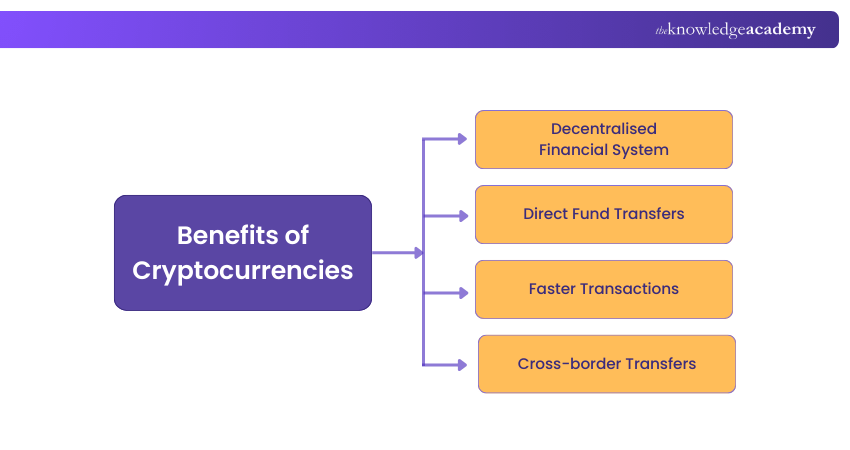
1) Decentralised Financial System: Cryptocurrencies introduce a new, decentralised approach to money, eliminating the need for centralised intermediaries like banks and financial institutions. This would mean that risks such as the most publicised point of failure of a single point of failure - that was the case of 2008, when the crash came on major investment banks.
2) Direct Fund Transfers: Cryptocurrencies allow for the direct transfer of funds between two parties without the trusted third party of a bank or credit card company. This can be facilitated through a public and private key as well as incentive mechanisms including but not limited to proof of work or proof of stake.
3) Faster Transactions: Cryptocurrency transactions do not entail the use of a third-party intermediary, and they can be faster than the transactions traditional money transfers involve. Such examples include flash loans in decentralised finance that can be executed without collateral and process settlement within a few seconds for trading purposes.
4) Cross-border Transfers: Cryptocurrencies Come in Handy in the Remittance Economy Intermediate currencies, such as Bitcoin, help speed cross-border money transfers. A fiat currency may be first transformed into Bitcoin (or another Cryptocurrency), sent across borders, and then transformed back into the destination fiat currency-all without third party facilitation.
Become an Ethereum Developer and unlock the power of decentralisation. Sign up for our Ethereum Developer Training now!
Risks of Cryptocurrencies
Due to the very significant losses from scams, hacks, bugs, and volatility, Cryptocurrencies have obtained a bad reputation for their instability as investments. Aside from the inherent market risks, which come with all speculative assets, there are several other Risks of Cryptocurrency which Investors should be aware:
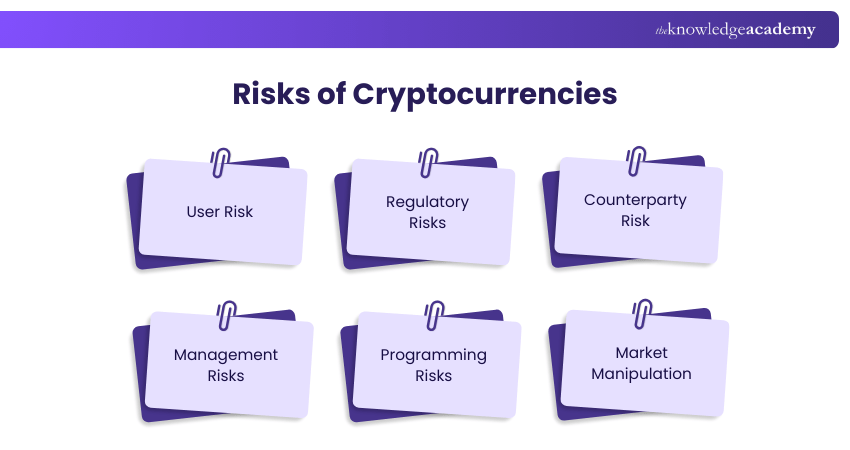
1) User Risk: Once Cryptocurrency is sent, unlike traditional finance, it cannot be reversed or cancelled. It's estimated that about one-fifth of all bitcoins are now inaccessible either due to lost passwords or incorrect sending addresses.
2) Regulatory Risks: As a rule, the regulatory status of Cryptocurrencies is far from certain in most regions; different governments are still considering how to handle their regulation-as securities, as currencies, or as both. A sudden regulatory crackdown might make the sale of Cryptocurrencies difficult or even plunge prices across the market.
3) Counterparty Risk: Most of the investors and traders keep their Cryptocurrency with exchanges or custodians. Any theft or misplacement by these third parties means the total loss of one's investment.
4) Management Risks: Without proper and clear regulations, there is limited protection against deceitful or unethical management. Many investors have been thrown off guard whereby they lost a large sum to teams of Managers that failed to deliver their promise.
5) Programming Risks: Many investments and lending platforms utilise automated smart contracts to manage user deposits. Investors in those platforms are generally taking on the risk that some sort of bug or exploit in the code would result in lost investment.
6) Market Manipulation: Another big issue in the Cryptocurrency space is market manipulation. Influential individuals, organisations, and exchanges sometimes act unethically.
Common Cryptocurrency Terms
The world of cryptocurrency has a special vocabulary, which includes terms in the basic glossary that reveal the workings of digital assets and networks. The ability to communicate the fundamentals opens up the way into the crypto world, not only through discussions but also through the individual’s own understanding.
a) Address: A separate, coin-specific identifier that is used for the receipt of cryptocurrency. It is safe to share publicly, and it is common practice to create a new one for every transaction.
b) Altcoin: The name that covers every cryptocurrency excluding Bitcoin. It embraces coins that are faster, more functional, or have more use cases.
c) Blockchain: A public and immutable digital ledger that keeps track of transactions in securely linked blocks and records them in a distributed manner. Its architecture makes it almost impossible to destroy the data that is stored in the past.
d) Cryptocurrency Exchange: An electronic marketplace where one can buy, sell, and trade cryptocurrencies. Exchanges are the intermediaries between the digital assets and fiat currencies.
e) Digital Assets: Cryptocurrencies and tokens that are the same as them, because of the encryption method they use to guarantee ownership and enable the transfer to be secure.
f) Digital Wallet: It is a device that helps you to keep the keys (both private and public) that are needed for the sending and receiving of cryptocurrency. There are software wallets and offline wallets, which are more secure.
g) Initial Coin Offering (ICO): It is a method of raising funds in which the new coins are sold to the public in order to fund the project. The investors get tokens that are redeemable on the platform.
h) Smart Contract: They are already mentioned as self-executing contracts written in code that will be activated once the conditions are satisfied. They have cut down the number of intermediaries and are widely adopted in the Ethereum networks.
Is Crypto Real Money?
Cryptocurrency is a digital asset traded using Blockchain technology. While it holds value and can be exchanged for goods or services, it lacks key attributes of fiat money, such as government backing and stability. Unlike traditional currencies, Crypto operates independently, making it more of a digital commodity than real money.
Cryptocurrency Examples
The circulation of cryptocurrencies are in thousands, with each one specifically designed to tackle a particular issue. The examples mentioned below give a glimpse of the largest and most impactful digital currencies that are in use today.
a) Bitcoin (BTC): The very first and the most famous cryptocurrency, allowing direct digital payments between users without the need for intermediaries.
b) Ethereum (ETH): A distributed ledger technology that allows the creation of dapps and smart contracts, besides the facilitation of the transfer of funds.
c) Litecoin (LTC): It was developed as a rapid counterpart to Bitcoin, granting even faster transaction verification times.
d) Ripple (XRP): A system made to allow immediate and affordable cross-border money transfers among banks and other financial organisations.
Conclusion
Cryptocurrency continues to reshape how people think about money, technology, and financial freedom. Understanding What is Cryptocurrency opens the door to exploring a fast-evolving digital world, so buckle up and enjoy the ride ahead.
Discover how Blockchain is transforming industries and gain the skills to lead the change. Sign up for our Blockchain Training now!
Frequently Asked Questions
Can Learning About Cryptocurrencies Help me Adapt to the Future of Finance and Technology?

Learning about Cryptocurrencies can surely help you adapt to the future of finance and technology. Cryptocurrencies, like Bitcoin and Ethereum, are becoming integral to the global financial markets. By understanding them, you will in fact gain important insight into Blockchain Technology, which underpins these currencies.
What are the Long-term Prospects and Growth Opportunities Within the Cryptocurrency Market?
The Cryptocurrency market's long-term outlook involves ongoing innovation, wider adoption, and deeper integration with mainstream financial systems. Growth opportunities lie in areas such as decentralised finance (DeFi), Blockchain applications, and global financial inclusion, driving market expansion and maturity.

The Knowledge Academy


Global Training Provider
The Knowledge Academy is a world-leading provider of professional training courses, offering globally recognised qualifications across a wide range of subjects. With expert trainers, up-to-date course material, and flexible learning options, we aim to empower professionals and organisations to achieve their goals through continuous learning.


 If you wish to make any changes to your course, please


