


 Top Rated Course

We may not have the course you’re looking for. If you enquire or give us a call on +39 800580270 and speak to our training experts, we may still be able to help with your training requirements.
What is a Data Lake? Use Cases, Benefits and Challenges
Lily Turner 24 November 2025A Data Lake is a centralised repository that stores large volumes of raw data in its native format, enabling flexible analysis and processing. Suitable for analytical purposes like Data Analytics, Business Intelligence, and Machine Learning. Get low-cost, scalable, real-time analytics of unstructured, semi-structured, and structured data.

Training Outcomes Within Your Budget!
We ensure quality, budget-alignment, and timely delivery by our expert instructors.
Table of Contents

Save your time! There is no need to convert all your unstructured and semi-structured raw data into a structured data format. You can now store all your data in their raw, unfiltered, and original formats without any changes to it. The advent of cloud storage has made the impossible possible. Would you like to know how? This blog brings the limelight to what is a Data Lake, focusing on its benefits and real-life usage. Let's dive into the blog to explore more about what Data Lake is!
Table of Contents
1) What is a Data Lake?
2) Why Use a Data Lake?
3) Common Data Lake Use Cases
4) Data Lake Architecture
5) Key Benefits of Data Lakes
6) Challenges of Using Data Lakes
7) Comparing Data Lakes, Data Warehouses, and Lakehouses
8) Conclusion
What is a Data Lake?
As a data storage architecture, Data Lake provides a centralised location to store any form of raw data. Unlike other data storage platforms, Data Lake holds the raw data in its original formats, like unstructured, semi-structured, and structured forms. They don’t require the data to be pre-structured or in a certain format as files or folders.
Data Lake uses a flat architecture for data storage, which means there are no regulations or specifications required before storing any data. You are free to store data in its own nature without any alterations. Often, these Data Lakes use cloud-based object storage systems. Object storage helps to store the data with metadata tags and unique identifiers to easily locate them when you need it for any analytical purposes.

Why Use a Data Lake?
Maintain your raw data as it is with Data Lake. There is no need to alter or change its format to something else to store it in your repository. It becomes your perfect choice when it does all its work with low-cost maintenance. Also, being an open format, Data Lake frees you from any proprietary locks. Even more, it is highly durable with its scalability and cloud object storage leverages. You can ingest your data from various sources in various formats with Data Lake.
Common Data Lake Use Cases
So far, you have come to know that Data Lake is used for raw data storage in its original form. Let's check what are the common situations in which you can implement Data Lake in your life or for your company or organisation.
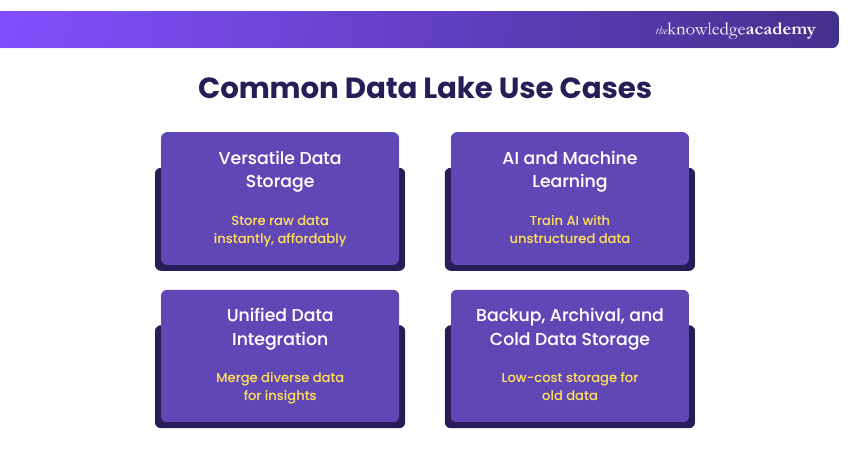
1) Versatile Data Storage
Consider the situation of a company where they deal with a lot of data every day. They need to store all those raw data in their repository as immediately as they can because they’ll be receiving numerous data, and they might not have enough time to check and convert all those data in a pre-structured format.
This is where Data Lake is found useful for them in storing all the data that they receive, no matter if they require it or not. Since Data Lakes are low-cost and scalable, you don’t have to worry about spending resources.
2) AI and Machine Learning
Data Lakes are efficient in the fields of data analytics, Artificial Intelligence (AI), and Machine Learning (ML). With piles of raw and unstructured data, Data Lakes helps to train generative AI applications and to build predictive models for analytics. Training gen AIs require a lot of unstructured data to check how well they are understanding and performing.
As for Machine Learning, these data are used for training and testing models. With those data, models can be trained to personalise the customer experience, optimise recommendations and certainly make some predictions.
3) Unified Data Integration
When there is uncountable data stored in your storage, you might integrate similar data to avoid confusion. Data Lake contributes its part to data integration, too. For that, Data Lake combines and harmonies the data from multiple sources. Those combined forms can be further used for any analytical research or decision-making purposes.
By storing data in a unique identifier format, it is easy to access and navigate the required data. When integrating, you can search for a particular set of data without searching the whole repository sections.
4) Backup, Archival, and Cold Data Storage
When you want to backup multiple data, you might not have an option like Data Lake. Because either you face issues with the storage limit or the high maintenance cost for the backups. What if those could be overcome with Data Lake? It offers a wide storage option under low-cost maintenance, and with that, you can store your past data.
With Data Lake, you can rest assured by backing up or storing past, old, cold or inactive data without much cost. Also, you can archive some data instead of backups if you want to. It acts as a data recovery option, too.
Upskill your expertise in cloud platforms by registering for our Cloud Computing Training soon!
Data Lake Architecture
The modern Data Lake is designed with cloud object storage techniques. The most widely used cloud object storage services are Google Cloud Storage, Microsoft Azure Blob Storage and Amazon Simple Storage Service (Amazon S3). When you are storing the data, it undergoes the following processes:
1) Data sources include structured, semi-structured and unstructured data.
2) Data ingestion brings the data into the Data Lake platform.
3) After that, data is stored and processed for various purposes like analysis and modelling
Processed data is ready for consumption, that is, for analysis and decision-making.
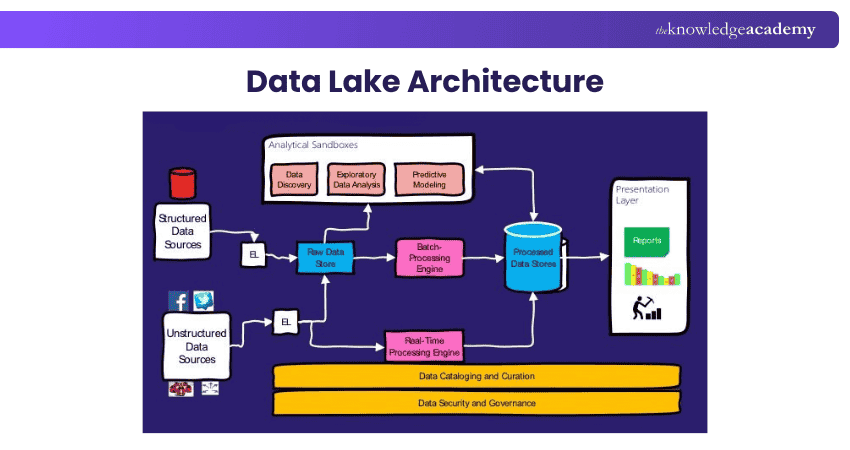
During data ingestion, the procedure of Extract, Load and Transform (ELT) is followed. This ensures that the data is in its original form unless it requires to be transformed.
Key Benefits of Data Lakes
Here are the key benefits of Data Lakes that you can find compelling:

1) Flexibility and Agility
1) Doesn't require a pre-planned structure of data; can be stored in any format
2) Supports real-time analytics with easy filtration of data
2) Real-time
1) Process, store and stream raw data in real time
2) Allows multi-functionality of storing and analytics all at the same time
3) Scalability
1) Capable of handling massive and growing data irrespective of its structure
2) Helps in comprehensive research and analytics with larger data volume
4) High-speed Processing
1) Directly access and use data for analysis instead of transforming it into a pattern
2) Get instant insights for your analytics from huge databases
5) Better Insights
1) Explore the hidden and unexpected insights from the data storage
2) Gives birth to new approaches and perspectives
6) Cost Savings
1) Comparatively low-cost maintenance with its open-source and cloud-based nature
2) Lesser or no cost with data transformation since it stores and uses raw data
Challenges of Using Data Lakes
Though there are a lot of benefits and user-convenient features available with Data Lake, it also has its own challenges. Let’s look at those challenges to see if they’re manageable:
1) Data Quality and Governance
Since Data Lake is all about uncountable data, sometimes, it will become a mess, turning into ‘data swamps.’ This eventually creates difficulty in maintaining the data quality. You can employ proper data governance and metadata management to avoid such scenarios.
2) Performance Optimisation
When there are loads of data, real-time analytics and query results might be affected. The data needs to be optimised for the strategies of queries and indexing to easily retrieve the data for any analytical performance.
3) System Reliability
Due to a lot of data storage, there are chances of it having duplicate, inconsistent, and corrupted data. This makes the data unreliable for people or analysts since it might lack accuracy in analytical results.
4) Limited Built-in Security Controls
Due to the nature of open-source data storage, Data Lakes is hard to maintain to be secured, and thereby, is vulnerable to any security breaches. It is essential to build actions like access controls and protection programmes against unauthorised activities.
Protect your data, storage and infrastructure with our Introduction to AWS Security – Sign up today!
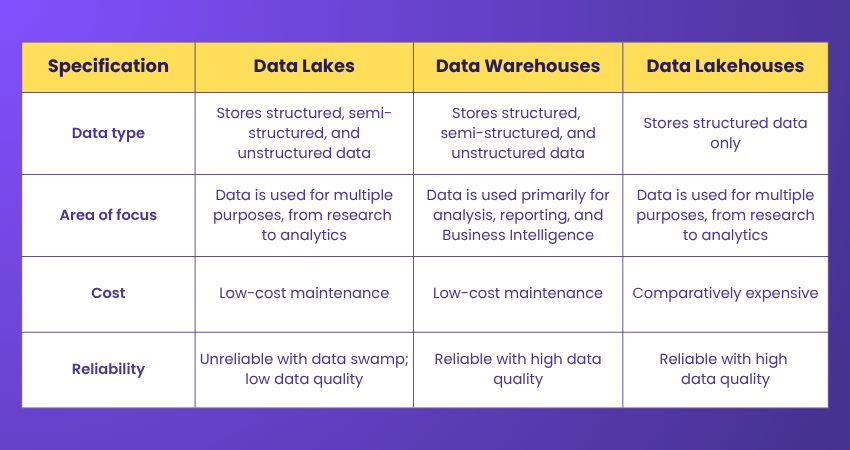
Comparing Data Lakes, Data Warehouses, and Lakehouses
Data Lakes, Data Warehouses, and Data Lakehouses are platforms that are used for data storage. Let's have a brief look at their similarities and differences with a comparison.
Conclusion
Data storage has never been this simple and easy before the practices of Data Lakes. Secure and protect your data with a single step of direct entry to the storage directory, eliminating any formatting or structuring. This blog, featuring what is a Data Lake, would have provided you with insights into its nature and how it is used and performed for various purposes. Safeguard all your data with Data Lakes without worrying about the cost of maintenance or storage capacity.
Elevate your data storage and retrieval process by joining our Data Warehousing Training on AWS today!
Frequently Asked Questions
Is Snowflake Just a Data Lake?

Snowflake is a cloud-based data storage system which could function as a Data Lake too. It provides storage of unstructured and semi-structured data along with structured data.
What is a Data Lake vs Database?
Database is primarily focused on storing structured data for further analysis. On the other hand, Data Lake is used to store structured, semi-structured, and unstructured data.
What are the Other Resources and Offers Provided by The Knowledge Academy?
The Knowledge Academy takes global learning to new heights, offering over 3,000 online courses across 490+ locations in 190+ countries. This expansive reach ensures accessibility and convenience for learners worldwide.
Alongside our diverse Online Course Catalogue, encompassing 19 major categories, we go the extra mile by providing a plethora of free educational Online Resources like News updates, Blogs, videos, webinars, and interview questions. Tailoring learning experiences further, professionals can maximise value with customisable Course Bundles of TKA.
What is The Knowledge Pass, and How Does it Work?
The Knowledge Academy’s Knowledge Pass, a prepaid voucher, adds another layer of flexibility, allowing course bookings over a 12-month period. Join us on a journey where education knows no bounds.
What are the Related Courses and Blogs Provided by The Knowledge Academy?
The Knowledge Academy offers various AWS Certification Training, including Building Data Lakes on AWS Training, Data Warehousing Training on AWS and Cloud Computing Training. These courses cater to different skill levels, providing comprehensive insights into What is Object Storage.
Our Cloud Computing Blogs cover a range of topics related to Data Lakes, offering valuable resources, best practices, and industry insights. Whether you are a beginner or looking to advance your Cloud Storage skills, The Knowledge Academy's diverse courses and informative blogs have got you covered.

Lily Turner


Senior AI/ML Engineer and Data Science Author
Lily Turner is a data science professional with over 10 years of experience in artificial intelligence, machine learning, and big data analytics. Her work bridges academic research and industry innovation, with a focus on solving real-world problems using data-driven approaches. Lily’s content empowers aspiring data scientists to build practical, scalable models using the latest tools and techniques.
View Detail
Upcoming Cloud Computing Resources Batches & Dates
Date
 Building Data Lakes on AWS Training
Building Data Lakes on AWS Training
Fri 19th Jun 2026
Building Data Lakes on AWS Training
Fri 4th Sep 2026
Building Data Lakes on AWS Training
Fri 4th Dec 2026

 If you wish to make any changes to your course, please


