


 Top Rated Course

We may not have the course you’re looking for. If you enquire or give us a call on +39 800580270 and speak to our training experts, we may still be able to help with your training requirements.
What is Agile Project Management: A Complete Beginner’s Guide
The Knowledge Academy 03 February 2026Agile Project Management is an iterative approach that delivers work in short cycles, enabling teams to adapt quickly, collaborate and respond to change. It improves visibility, speeds decisions, and reduces risk across projects. Teams deliver value faster while staying aligned with changing goals, priorities, and customer needs.

Training Outcomes Within Your Budget!
We ensure quality, budget-alignment, and timely delivery by our expert instructors.
Table of Contents
 Have you ever planned a project in detail, only to watch everything change overnight? New priorities appear, client expectations shift, and suddenly the original plan feels outdated. This is a common challenge for modern teams, and it is exactly where Agile Project Management stands out, helping teams stay flexible, focused, and in control even when change is constant.
In this blog, you will explore What is Agile Project Management, along with its history, core values and principles, and key advantages. You will also learn how Agile helps teams adapt quickly, collaborate effectively, and deliver real value, starting with the basics.
Table of Contents
1) What is Agile Project Management (APM)?
2) A Brief History of Agile Project Management
3) Agile Values and Principles
4) Different Agile Project Management Techniques
5) Advantages of Agile Project Management
6) Limitations of Agile Project Management
7) What are the Roles and Responsibilities of an Agile Project Manager?
8) What is the Difference Between Agile and Traditional Project Management?
9) Conclusion
What is Agile Project Management (APM)?
Agile Project Management (APM) is an iterative approach that delivers projects in continuous cycles instead of a fixed, linear process. It breaks work into small steps, helping teams adapt quickly, refine ideas, improve collaboration, and respond to change throughout the project lifecycle while delivering value at every stage.
In Agile Project Management, work is organised into short sprints, typically lasting between one and four weeks. Each sprint produces a usable outcome and enables rapid feedback. To fully understand what Agile Project Management is, it is important to see how cross-functional teams collaborate through daily stand-ups and structured frameworks such as Scrum, Kanban, and Extreme Programming (XP).
A Brief History of Agile Project Management
Agile Project Management emerged from early ideas of flexibility and continuous improvement in manufacturing and management. In the early 20th century, Frederick Taylor promoted process improvement through worker feedback, while Toyota’s lean manufacturing approach in the 1940s introduced just-in-time production and automation.
These principles were later adopted by software teams to enable iterative delivery, frequent feedback, and collaboration, helping teams adapt quickly and deliver value throughout the project lifecycle.
Agile Project Management Framework 1: Scrum
Scrum is one of the most widely used Agile frameworks by modern teams. It organises work into short, time-boxed sprints, usually lasting one to four weeks, where teams select tasks from a prioritised product backlog and commit to completing them within each sprint.
Scrum defines clear roles, including the Product Owner, Scrum Master, and Development Team. These roles establish accountability, support collaboration, and remove ambiguity. This structured approach helps teams stay focused, work efficiently, and deliver value consistently and quickly.
The Four Ceremonies of Scrum
1) Sprint Planning: The team identifies goals and selects tasks for the upcoming sprint.
2) Daily Stand-up: Team members share updates, discuss progress, and highlight challenges in a short daily meeting.
3) Sprint Review: The team presents completed work at the end of the sprint to gather feedback from stakeholders.
4) Sprint Retrospective: The team reflects on performance and identifies ways to improve future sprints.
The Scrum Board
The Scrum board is a visual tool that shows the progress of tasks during a sprint. It typically includes columns such as To Do, In Progress, and Done, allowing teams to monitor work easily and identify obstacles quickly.
Agile Project Management Framework 2: Kanban
Kanban is an Agile method that focuses on continuous flow rather than fixed iterations. Instead of working in sprints, tasks move steadily through different stages of completion. This approach helps teams remain flexible, respond quickly to changing priorities, and avoid overloading resources.
The Four Components of Kanban
1) Work Items: Individual tasks or user stories that need to be completed.
2) Workflow Stages: Visual columns representing each step of the process, such as To Do, In Progress, and Done.
3) Work in Progress (WIP) Limits: Restrictions on the number of tasks in each stage to reduce bottlenecks and improve efficiency.
4) Continuous Delivery: Tasks are released as soon as they are completed, ensuring steady value delivery.
The Kanban Board
The Kanban board visually represents tasks as cards moving across workflow stages. It provides clear visibility into progress, supports better organisation, and helps teams quickly identify inefficiencies or delays within the process.
Propel your Project Management career forward with our comprehensive Agile Project Management Foundation & Practitioner (AgilePM®) Course- Join now!
Agile Values and Principles
Let us explore the core values and principles that form the foundation of Agile Project Management and guide teams toward successful delivery.
4 Core Agile Values
These values from the Agile Manifesto highlight the mindset Agile teams should adopt to work efficiently and meet customer expectations.
1) Individuals and Interactions Over Processes and Tools:
People are at the heart of every successful project. Agile focuses on strong teamwork and communication rather than relying too much on tools or strict procedures.
2) Working Software Over Comprehensive Documentation:
The goal is to deliver usable results quickly. While documentation still matters, the priority is to create working solutions that add real value.
3) Customer Collaboration Over Contract Negotiation:
Agile encourages involving customers throughout the project. Their feedback helps guide the direction of the work and ensures the final product meets their needs.
4) Responding to Change Over Following a Plan:
Instead of sticking rigidly to one plan, Agile allows teams to adjust based on new information, changing requirements, or customer input. This leads to better results.
8 Key Principles of Agile Project Management
These practical principles from the DSDM framework provide guidance for running Agile projects with control, purpose, and effective delivery.
1) Focus on the Business Need: Every decision should support the project’s purpose and help deliver the value the business needs.
2) Deliver on Time: Timely delivery is crucial. Meeting deadlines is a key success factor in many Agile projects.
3) Collaborate: Great teamwork, clear roles, and shared ownership lead to better outcomes.
4) Never Compromise Quality: The level of quality must be agreed upon from the start. The team should work with that goal in mind throughout the project.
5) Build Incrementally from Firm Foundations: Take the time to understand the business problem and solution clearly before moving into detailed development. Build confidence through little, steady progress.
6) Develop Iteratively: Projects evolve over time. Working in short, repeatable cycles allows teams to learn, adapt, and respond to feedback effectively.
7) Communicate Continuously and Clearly: Clear communication avoids misunderstandings. Regular check-ins and open conversations help everyone stay on the same page.
8) Demonstrate Control: Keep the project transparent and manageable. Show progress clearly and ensure all work is aligned with the overall goals.
Gain hands-on experience refining backlogs and prioritising user requirements. Join our Agile User Stories Training now!
Different Agile Project Management Techniques
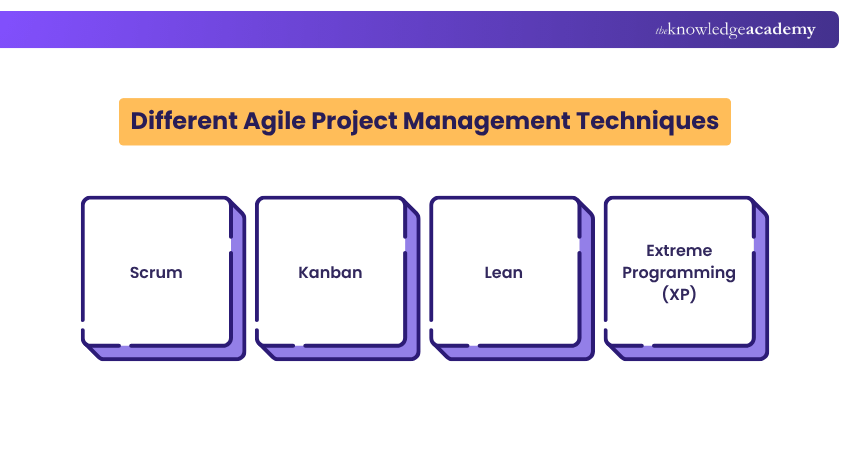
This PM methodology is not a one-size-fits-all approach. It encompasses various methodologies, each with its own set of practices and frameworks. These methodologies provide teams with guidelines and structures to effectively plan, execute, and deliver projects using Agile principles. Here are some popular Agile Project Management techniques:
Scrum
Scrum is one of the most widely adopted methodologies. It focuses on delivering value incrementally through short iterations called sprints. The Scrum framework consists of predefined roles, such as Scrum Master, Product Owner, and Development Team. It also involves specific ceremonies like Daily Stand-ups, Sprint Planning, Sprint Review, and Sprint Retrospective.
Kanban
Kanban is a visual Agile methodology that emphasises workflow visualisation and limiting Work In Progress (WIP). Kanban provides a visual representation of the project’s status using Kanban Boards, which represents the workflow, with tasks moving from one column to another as work progresses. Therefore, it promotes flexibility and encourages teams to focus on completing existing work before starting new tasks.
Lean
Lean manufacturing principles inspire this methodology and focus on eliminating waste and maximising customer value. Lean emphasises continuous improvement, just-in-time delivery, and value stream mapping.
It also encourages teams to identify and eliminate non-value-added activities, streamline processes, and improve efficiency. As a result, teams can deliver projects faster, minimise resource waste, and enhance overall outcomes.
Extreme Programming (XP)
Extreme Programming (XP) is another Agile Methodology emphasising close collaboration, continuous feedback, and high-quality Software Development practices. It incorporates practices such as test-driven development, pair programming, frequent releases, and continuous integration.
Further, XP fosters a strong customer focus, promotes team communication, and ensures the delivery of high-quality software products through rigorous testing and refactoring.
These are just a few examples of Agile Project Management. Each methodology has its strengths and suitability for different project scenarios. Choosing the right methodology based on the project’s characteristics, team dynamics, and organisational context is important.
Leap Agile excellence and accelerate your career growth. Join our Agile Training today!
Advantages of Agile Project Management
Agile Project Management approach offers several advantages, such as:
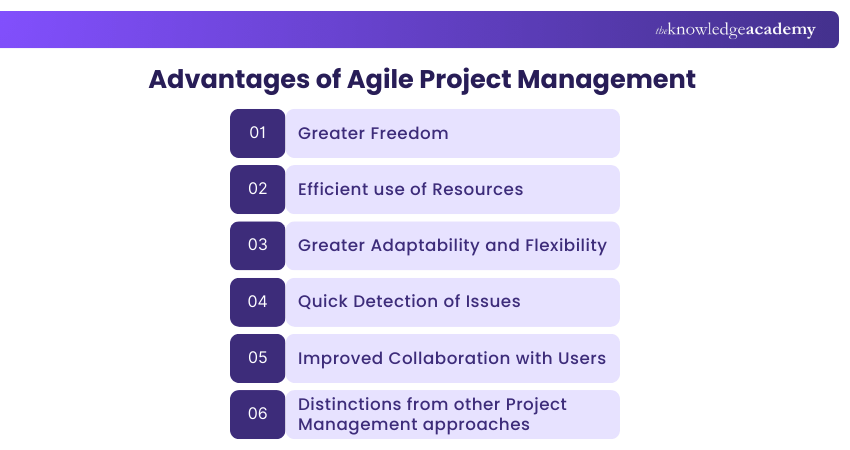
1) Greater Freedom: Agile Project Management allows designers to focus on their strengths when working on models.
2) Efficient use of Resources: This approach enables swift deployment with minimal waste, making the most of available resources.
3) Greater Adaptability and Flexibility: Developers can easily adjust to new requirements and make necessary changes.
4) Quick Detection of Issues: This allows for prompt resolution of problems and better management of projects.
5) Improved Collaboration with Users: Agile Project Management promotes collaboration, resulting in products that more effectively meet their needs.
6) Distinctions from other Project Management approaches: Unlike traditional methods like Waterfall, Agile Project Management doesn't require clearly defined goals and processes at the start of development, offering more flexibility. For teams looking to scale Agile practices, a Scaled Agile Framework Cheat Sheet can provide valuable insights.
Limitations of Agile Project Management
Agile Project Management has certain advantages. However, there are some potential drawbacks to consider, such as:
1) Inconsistent Results: As there are minimal predefined courses of action at the start of a project, it can sometimes go off track.
2) Difficulties in Measuring Progress: Off-track projects may lead to less predictable outcomes, making it harder to measure progress.
3) Time Constraints: Agile Management relies on making quick decisions. Therefore, it may only be suitable for organisations that take a short time to analyse issues.
4) Communication Challenges: Collaboration between teams or end-users must continuously create the best possible product. This can pose communication challenges.
Gain a clear understanding of core Agile principles and practices with our Agile Overview Training – Join now!
What are the Roles and Responsibilities of an Agile Project Manager?
Agile Project Manager’s roles and responsibilities include the following:
1) Assistance: The Agile Project Manager assists the team in achieving quality performance, holding teams accountable for their work, removing obstacles, and mentoring less experienced team members.
2) Defined Scope of Projects: The Agile Project Manager establishes the project’s schedule and scope while balancing this with timely and regular value deliveries and organising and leading working and project status meetings.
3) Delivery: The Agile Project Manager is responsible for providing outstanding business value projects to the users.
4) Extended Support: The Agile Project Manager supports the product owner in managing communications with stakeholders, managing customer expectations for deliverables, and implementing an effective project governance system.
5) Teamwork: The Agile Project Manager empowers the team through team-building techniques, ensuring each team member makes a meaningful contribution and is fully engaged in the project.
What is the Difference Between Agile and Traditional Project Management?
Agile and Traditional Project Management differ in flexibility, with Agile being iterative and traditional focusing on structured processes. Let us look at some differences between these management approaches:

Conclusion
Agile is no longer just a trend but a necessity for modern teams that want to stay flexible and competitive. Understanding What is Agile Project Management helps organisations deliver faster, adapt to change, and collaborate effectively. By adopting Agile practices, teams can achieve better outcomes and create lasting value.
Propel your Project Management career forward with our AgilePM® Foundation & Practitioner (AgilePM® V3) Course – Join now!
Frequently Asked Questions
What is Agile vs Waterfall?

Agile is an iterative, flexible approach where projects evolve through collaboration and ongoing feedback. A Waterfall is a linear model with fixed phases, where each stage must be completed before moving to the next. Agile adapts to change, while Waterfall follows a strict sequence.
What are the 5 Pillars of Scrum?
The 5 pillars of Scrum include commitment, courage, focus, openness, and respect. These values guide team behaviour, foster trust, and ensure effective collaboration. By embracing these principles, Scrum teams stay aligned, continuously improve, and deliver value throughout the project lifecycle.
What are the Other Resources and Offers Provided by The Knowledge Academy?
The Knowledge Academy takes global learning to new heights, offering over 3,000+ online courses across 490+ locations in 190+ countries. This expansive reach ensures accessibility and convenience for learners worldwide.
Alongside our diverse Online Course Catalogue, encompassing 19 major categories, we go the extra mile by providing a plethora of free educational Online Resources like Blogs, eBooks, Interview Questions and Videos. Tailoring learning experiences further, professionals can unlock greater value through a wide range of special discounts, seasonal deals, and Exclusive Offers.
What is The Knowledge Pass, and How Does it Work?
The Knowledge Academy’s Knowledge Pass, a prepaid voucher, adds another layer of flexibility, allowing course bookings over a 12-month period. Join us on a journey where education knows no bounds.
What are the Related Courses and Blogs Provided by The Knowledge Academy?
The Knowledge Academy offers various Agile Training, including the AgilePM® Foundation & Practitioner (AgilePM® v3) Training, SAFe® Agile Product Management Training, and the Agile for Teams Training. These courses cater to different skill levels, providing comprehensive insights into Agile Epic.
Our Project Management Blogs cover a range of topics related to Agile Project Management, offering valuable resources, best practices, and industry insights. Whether you are a beginner or looking to advance your Project Management skills, The Knowledge Academy's diverse courses and informative blogs have got you covered.

The Knowledge Academy


Global Training Provider
The Knowledge Academy is a world-leading provider of professional training courses, offering globally recognised qualifications across a wide range of subjects. With expert trainers, up-to-date course material, and flexible learning options, we aim to empower professionals and organisations to achieve their goals through continuous learning.

Upcoming Project Management Resources Batches & Dates
Date
 AgilePM® Foundation & Practitioner (AgilePM® v3)
AgilePM® Foundation & Practitioner (AgilePM® v3)
Mon 23rd Mar 2026
AgilePM® Foundation & Practitioner (AgilePM® v3)
Mon 30th Mar 2026
AgilePM® Foundation & Practitioner (AgilePM® v3)
Sat 4th Apr 2026, Sun 5th Apr 2026
AgilePM® Foundation & Practitioner (AgilePM® v3)
Tue 7th Apr 2026
AgilePM® Foundation & Practitioner (AgilePM® v3)
Mon 13th Apr 2026
AgilePM® Foundation & Practitioner (AgilePM® v3)
Mon 20th Apr 2026
AgilePM® Foundation & Practitioner (AgilePM® v3)
Mon 27th Apr 2026
AgilePM® Foundation & Practitioner (AgilePM® v3)
Tue 5th May 2026
AgilePM® Foundation & Practitioner (AgilePM® v3)
Mon 11th May 2026
AgilePM® Foundation & Practitioner (AgilePM® v3)
Mon 18th May 2026
AgilePM® Foundation & Practitioner (AgilePM® v3)
Tue 26th May 2026
AgilePM® Foundation & Practitioner (AgilePM® v3)
Mon 1st Jun 2026
AgilePM® Foundation & Practitioner (AgilePM® v3)
Mon 8th Jun 2026
AgilePM® Foundation & Practitioner (AgilePM® v3)
Sat 13th Jun 2026, Sun 14th Jun 2026
AgilePM® Foundation & Practitioner (AgilePM® v3)
Mon 15th Jun 2026
AgilePM® Foundation & Practitioner (AgilePM® v3)
Mon 22nd Jun 2026
AgilePM® Foundation & Practitioner (AgilePM® v3)
Mon 29th Jun 2026
AgilePM® Foundation & Practitioner (AgilePM® v3)
Mon 6th Jul 2026
AgilePM® Foundation & Practitioner (AgilePM® v3)
Mon 13th Jul 2026
AgilePM® Foundation & Practitioner (AgilePM® v3)
Mon 20th Jul 2026
AgilePM® Foundation & Practitioner (AgilePM® v3)
Mon 27th Jul 2026
AgilePM® Foundation & Practitioner (AgilePM® v3)
Mon 3rd Aug 2026
AgilePM® Foundation & Practitioner (AgilePM® v3)
Mon 10th Aug 2026
AgilePM® Foundation & Practitioner (AgilePM® v3)
Mon 17th Aug 2026
AgilePM® Foundation & Practitioner (AgilePM® v3)
Sat 22nd Aug 2026, Sun 23rd Aug 2026
AgilePM® Foundation & Practitioner (AgilePM® v3)
Mon 24th Aug 2026
AgilePM® Foundation & Practitioner (AgilePM® v3)
Tue 1st Sep 2026
AgilePM® Foundation & Practitioner (AgilePM® v3)
Mon 7th Sep 2026
AgilePM® Foundation & Practitioner (AgilePM® v3)
Mon 14th Sep 2026
AgilePM® Foundation & Practitioner (AgilePM® v3)
Mon 21st Sep 2026
AgilePM® Foundation & Practitioner (AgilePM® v3)
Mon 28th Sep 2026
AgilePM® Foundation & Practitioner (AgilePM® v3)
Mon 5th Oct 2026
AgilePM® Foundation & Practitioner (AgilePM® v3)
Sat 10th Oct 2026, Sun 11th Oct 2026
AgilePM® Foundation & Practitioner (AgilePM® v3)
Mon 12th Oct 2026
AgilePM® Foundation & Practitioner (AgilePM® v3)
Mon 19th Oct 2026
AgilePM® Foundation & Practitioner (AgilePM® v3)
Mon 26th Oct 2026
AgilePM® Foundation & Practitioner (AgilePM® v3)
Mon 2nd Nov 2026
AgilePM® Foundation & Practitioner (AgilePM® v3)
Mon 9th Nov 2026
AgilePM® Foundation & Practitioner (AgilePM® v3)
Mon 16th Nov 2026
AgilePM® Foundation & Practitioner (AgilePM® v3)
Mon 23rd Nov 2026
AgilePM® Foundation & Practitioner (AgilePM® v3)
Mon 30th Nov 2026
AgilePM® Foundation & Practitioner (AgilePM® v3)
Mon 7th Dec 2026
AgilePM® Foundation & Practitioner (AgilePM® v3)
Sat 12th Dec 2026, Sun 13th Dec 2026
AgilePM® Foundation & Practitioner (AgilePM® v3)
Mon 14th Dec 2026
AgilePM® Foundation & Practitioner (AgilePM® v3)
Mon 21st Dec 2026

 If you wish to make any changes to your course, please


