


 Top Rated Course

We may not have the course you’re looking for. If you enquire or give us a call on +44 1344 203999 and speak to our training experts, we may still be able to help with your training requirements.
What is Bookkeeping: A Beginner’s Complete Guide
Olivia Taylor 26 February 2026Bookkeeping is the systematic process of recording, organising, and maintaining a business’s daily financial transactions to ensure accurate financial records. It helps monitor cash flow, support financial reporting, and make informed and strategic decisions. Ultimately, it provides reliable data for budgeting and financial planning.

Training Outcomes Within Your Budget!
We ensure quality, budget-alignment, and timely delivery by our expert instructors.
Table of Contents
Have you ever wondered how companies keep their finances in perfect shape without losing track of a single transaction? Bookkeeping is the foundation that keeps every business financially organised and transparent. It is a vital practice that companies of all sizes and industries rely on to maintain stability, make smart decisions, follow tax laws, and analyse their financial health in detail.
Wondering how you can avoid costly mistakes, stay legally compliant, and clearly understand your business profits? Continue reading this blog to find out What is Bookkeeping, how it works, and why it remains essential for all businesses!
Table of Contents
1) What is Bookkeeping?
2) Why is Bookkeeping Important?
3) Types of Bookkeeping Methods
4) How Bookkeeping Works?
5) What Does a Bookkeeper do?
6) Why Choose Bookkeeping Software?
7) Bookkeeper vs Accountant: What’s the Difference?
8) Why Choose Bookkeeping Software?
9) Steps to Become a Bookkeeper
10) What Does a Bookkeeper do?
11) Bookkeeper vs Accountant: What's the Difference?
12) Conclusion
What is Bookkeeping?
Bookkeeping is the process of recording and organising the daily financial activities of a business. Its focus lies on maintaining an accurate general ledger, a record that shows every expense, payment, income, and transaction. In basic terms, Bookkeeping provides a clear picture of where finances come from and where they go. This helps businesses to keep their financial activities organised, accurate and healthy.
Beyond simple record-keeping, Bookkeeping plays a crucial role in supporting financial management and compliance. It ensures that financial data is accurate for preparing reports, filing taxes, and meeting legal requirements. It also helps monitor cash flow, evaluate performance, and support strong decision-making.

Why is Bookkeeping Important?
Bookkeeping is important because it provides a clear and accurate picture of a business’s financial position at any given time. Apart from that, it is required for so many reasons. Let's check why it is important for your business
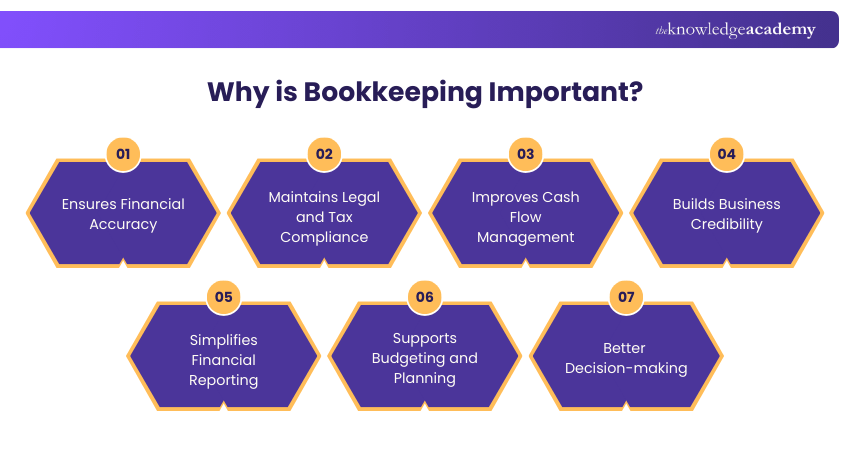
1) Ensures Financial Accuracy: Bookkeeping records every transaction regularly. This reduces mistakes and keeps financial information correct and updated. With accurate records, businesses always know their real financial position.
2) Maintains Legal and Tax Compliance: Proper Bookkeeping makes tax filing easier and more accurate. It helps businesses follow legal rules and avoid penalties. Having organised records also makes audits less stressful.
3) Improves Cash Flow Management: By tracking payments coming in and going out, businesses can manage their cash flow better. They can spot money shortages early and take action. This keeps the business financially stable.
4) Builds Business Credibility: Clear financial records build trust with investors, banks, and partners. When a business shows organised accounts, it appears more reliable and professional.
5) Simplifies Financial Reporting: With proper records, preparing financial reports becomes easier and faster. Businesses can quickly generate profit and loss statements and other reports when needed.
6) Supports Budgeting and Planning: Previous financial data helps businesses create realistic budgets. It allows them to plan expenses and investments more confidently.
7) Better Decision-making: When income and expenses are clearly tracked, business owners can make smarter decisions. They can see what is profitable and what needs improvement with better planning.
Types of Bookkeeping Methods
Bookkeeping can be done using different methods as per specific business needs and complexities. Let’s check those types of Bookkeeping methods:
1) Single-entry Bookkeeping
Single-entry Bookkeeping is a simple method. It is typically used by small businesses and sole proprietors. In this system, only one entry is made for each financial transaction, usually in a simple ledger or spreadsheet.
It records the basic information of your income and expenses. Moreover, it is easy to maintain with its Single-Entry System. The key features of Single-entry Bookkeeping include:
1) Records each transaction only once
2) Commonly tracks cash inflow and outflow
3) Often uses a basic cash book or spreadsheet
4) Doesn’t track assets or liabilities in detail
5) Suited for small businesses or sole traders
6) Focuses mainly on income and expenses
2) Double-entry Bookkeeping
Double-entry Bookkeeping is a more advanced and widely used method. It is the standard for most businesses, especially those with multiple transactions and complex financial structures. This method maintains a balance between assets, liabilities, equity, income, and expenses.
In the Double-entry Accounting system, every financial transaction is recorded twice as a debit (an increase in one account) and a credit (a decrease in another account). It ensures the accuracy and integrity of your financial records. Its key features include:
1) Tracks income, expenses, assets, and liabilities
2) Suitable for medium to large businesses
3) Helps detect errors through the trial balance
4) Provides a complete and accurate financial picture
5) Supports detailed financial reporting and analysis
6) Complies with Accounting standards and tax laws
Estimate the inventory for better Financial Management with our Inventory Accounting and Costing Course – Sign up now!
How Bookkeeping Works?
Bookkeeping is more than writing down numbers. It follows a clear process to keep everything accurate and organised. There are four common steps in the process of recording transactions. Here are those steps:
1) Recording Financial Transactions
The first step in bookkeeping is identifying and recording all financial transactions. These include sales, purchases, payments, receipts, salaries, and other daily business activities. Each transaction must be supported by proper documents such as invoices or receipts. Recording them promptly ensures that no financial detail is missed.
Example: If a retail shop sells goods worth £500 in cash, it must record the transaction immediately by increasing the cash account by £500 and recognising £500 as sales revenue.
1) Cash Account: Debited £500
2) Sales Account: Credited £500
2) Utilising the Journal
In general, a journal is a chronological record of all financial transactions. It consists of records of cash, credit, or other forms of payment. Each transaction is recorded in the journal with details such as date, description, accounts affected, and amounts. This chronological recording provides a complete transaction history.
Example: If your company is running a marketing project and hires a freelance designer for £700, you record:
1) Date: 5 August
2) Description: Payment to freelance designer for project banner
3) Account Debited: Marketing Expenses £700
4) Account Credited: Bank £700
3) Maintaining the Ledger
The ledger is a structured record of financial statements. It organises transactions by account, showing balances like cash, receivables, accounts payable, and expenses. Entries from the journal are posted here. Tools like Xero and QuickBooks integrate well with ledgers, though features and usability may vary based on business needs.
Example: A construction project buys bricks for £1,200. In the ledger, you can include:
1) Materials Expense: Debit £1,200
2) Bank: Credit £1,200
4) Creating a Trial Balance
A trial balance is a list of all accounts in the ledger with their balances. It checks if total debits and credits are equal and helps identify any discrepancies. If the trial balance does not balance like the debits do not equal the credits, it means there is an issue that must be fixed before creating final financial reports.
Example: A charity runs an event project. After recording all expenses and donations, the Bookkeeper prepares a trial balance. It shows:
1) Donations (Credit): £5,000
2) Event Expenses (Debit): £3,500
3) Supplies (Debit): £1,500
4) Debits = Credits (£5,000), so the trial balance is correct
Why Choose Bookkeeping Software?
Bookkeeping software is effective for businesses of all sizes. It replaces manual record-keeping with smarter, accurate and efficient systems. Some important reasons for adopting Bookkeeping software:
1) Cost-effective: Bookkeeping software automates repetitive tasks, helps to reduce cost of labour and maintains accuracy in financial records.
2) Focus on Running Business: By integrating automation, you can dedicate more time towards growing your business instead of fixating on paper and admin work.
3) Centralised Financial Records: All financial data is stored in a centralised place. This makes it simple to find receipts, track expenses, review income and prepare reports.
4) Real-time Financial Insights: Bookkeeping software's update figures in an instant. This gives an updated view of cash flow, expenses and profits. This makes room for faster data driven decision-making.
5) Collaboration: In cases, where you require to share financial data with team members or Accountants, Bookkeeping software makes it secure. This makes collaboration seamless and efficient.
Learn how Letters of Credit work with our Letters of Credit Training – Join soon!
What Does a Bookkeeper Do?
Bookkeepers have several tasks to handle. Now that you know what is Bookkeeping, here are some common tasks a Bookkeeper does:
1) Write down all the money that comes in and goes out
2) Use software, spreadsheets, or notebooks to keep records
3) Collect receipts, invoices, and bank statements
4) Make bills (invoices) and collect payments from customers
5) Keep track of all account balances (debits and credits)
6) Check that bank records and business records match
7) Make simple reports like income statements and balance sheets
8) Check records for mistakes and fix them
9) Handle employee payrolls, including hours and salaries
10) Help prepare tax returns and reports for the Accountant
Bookkeeper vs Accountant: What’s the Difference?
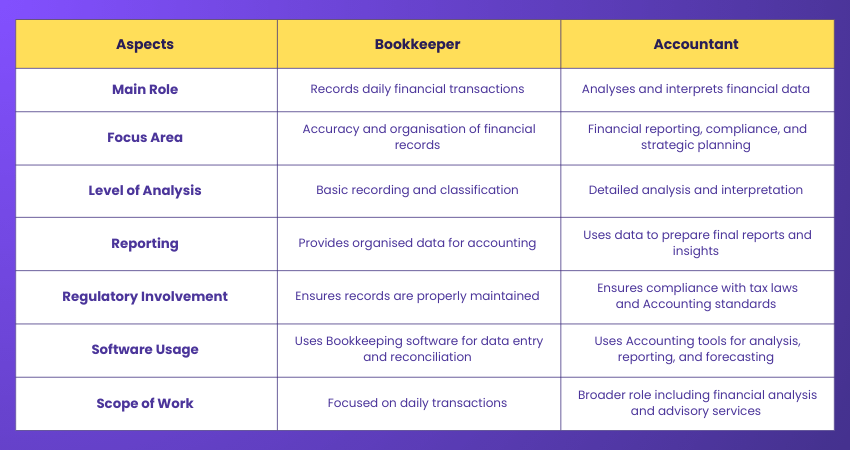
Although Bookkeepers and Accountants both work with financial data, their roles are different in scope and responsibility. A Bookkeeper focuses on recording and organising daily financial transactions, while an Accountant analyses, interprets, and reports on that financial information to support strategic decisions.
A Bookkeeper records daily financial transactions and ensures that the records are accurate and up to date. An Accountant uses this data to prepare financial statements, calculate taxes, ensure compliance, and provide strategic financial advice. In simple terms, Bookkeeping focuses on recording data, while Accounting focuses on analysing and interpreting it.
Here are the detailed differences between Bookkeeper and Accountant:
Why Choose Bookkeeping Software?
Bookkeeping software is effective for businesses of all sizes. It replaces manual record-keeping with smarter, accurate, and efficient systems. Some important reasons for adopting Bookkeeping software:
1) Cost-effective: Bookkeeping software automates repetitive tasks, helps to reduce the cost of labour and maintains accuracy in financial records.
2) Focus on Running Business: By integrating automation, you can dedicate more time towards growing your business instead of fixating on paper and admin work.
3) Centralised Financial Records: All financial data is stored in a centralised place. This makes it simple to find receipts, track expenses, review income, and prepare reports.
4) Real-time Financial Insights: Bookkeeping software's update figures in an instant. This gives an updated view of cash flow, expenses, and profits. This makes room for faster data driven decision-making.
5) Collaboration: In cases where you require to share financial data with team members or Accountants, Bookkeeping software makes it secure. This makes collaboration seamless and efficient.
Promote resilience in dynamic financial environments with our Asset and Liability Management Training – Register today!
Steps to Become a Bookkeeper
Becoming a Bookkeeper involves a combination of education, training, and practical experience. Here are the steps to pursue a career in Bookkeeping:
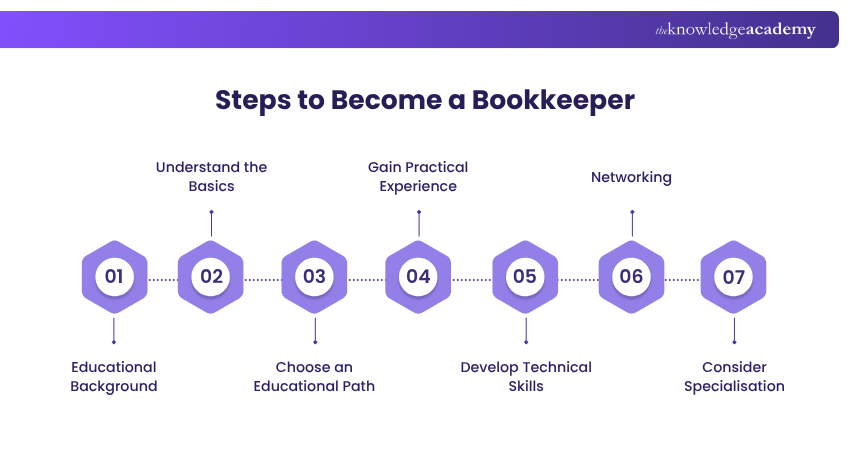
1) Educational Background: Start by completing your high school education, as it provides the foundation for further studies and skills needed in Bookkeeping. You can go for a High School Diploma.
2) Understand the Basics: Develop a strong understanding of basic arithmetic, mathematics, and numerical skills. Bookkeeping is heavily reliant on accuracy in calculations.
3) Choose an Educational Path: While a college degree is not always required, many Bookkeepers pursue relevant education to enhance their skills. You can go for an Associate Degree or Certifications in Accounting or Bookkeeping. Also, joining various online Bookkeeping courses can help you develop Bookkeeping skills.
4) Gain Practical Experience: Practical experience is crucial in Bookkeeping. Consider internships or part-time positions that allow you to apply your knowledge and get real-world experience. You can work for small businesses, Accounting firms, or as a freelance Bookkeeper.
5) Develop Technical Skills: Familiarise yourself with Bookkeeping Software and Accounting Tools. Proficiency in software like QuickBooks, Xero, or Sage can be an invaluable asset for your career.
6) Networking: Join professional organisations and networks related to Bookkeeping and Accounting. Building a professional network can lead to better job opportunities and industry insights.
7) Consider Specialisation: Bookkeeping can cover a broad range of industries and areas. You may choose to specialise in areas such as payroll, tax preparation, or Forensic Accounting, depending on your interests and career goals.
Estimate the inventory for better Financial Management with our Inventory Accounting and Costing Course – Sign up now!
What Does a Bookkeeper do?
Bookkeepers have several tasks to handle. Here are some common tasks a Bookkeeper does:
1) Write down all money that comes in and goes out
2) Use software, spreadsheets, or notebooks to keep records
3) Collect receipts, invoices, and bank statements
4) Make bills (invoices) and collect payments from customers
5) Keep track of all account balances (debits and credits)
6) Check that bank records and business records match
7) Make simple reports like income statements and balance sheets
8) Check records for mistakes and fix them
9) Handle employee payrolls, including hours and salaries
10) Help prepare tax returns and reports for the Accountant
Bookkeeper vs Accountant: What's the Difference?
People often confuse Bookkeepers with Accountants, but they play different roles. Here are the differences between those roles:
Conclusion
Bookkeeping lies at the core of every business’s financial health. It may appear simple, but it has a major impact on business growth, legal compliance tasks, and decision-making processes. If you are a freelancer, business owner or someone starting their finance career, knowing What is Bookkeeping is crucial for effective money management and sustaining long-term success.
Become an expert in auditing, tax preparation, and Financial Analysis with our Accounting Courses – Explore today!
Frequently Asked Questions
Do I Have to Keep Bookkeeping Records for My Business?

Yes, if you run a business, HMRC requires you to keep accurate Bookkeeping records, whether you're a sole trader, limited company, freelancer, or VAT-registered. These records help with tax returns, avoid fines, manage cash flow, track debts, and claim tax relief on allowable business expenses.
What is The Formula For Bookkeeping?
The formula for Bookkeeping is known as the Accounting equation. The basic formula is:
Assets = Liabilities + Equity
The above formula balances the balance sheet. Also, Bookkeeping links to the Income Statement through revenue and expenses. The expanded equation is:
Assets = Liabilities + (Capital + Revenue - Expenses)
What are the Other Resources and Offers Provided by The Knowledge Academy?
The Knowledge Academy takes global learning to new heights, offering over 3,000+ online courses across 490+ locations in 190+ countries. This expansive reach ensures accessibility and convenience for learners worldwide.
Alongside our diverse Online Course Catalogue, encompassing 19 major categories, we go the extra mile by providing a plethora of free educational Online Resources like Blogs, eBooks, Interview Questions and Videos. Tailoring learning experiences further, professionals can unlock greater value through a wide range of special discounts, seasonal deals, and Exclusive Offers.
What is The Knowledge Pass, and How Does it Work?
The Knowledge Academy’s Knowledge Pass, a prepaid voucher, adds another layer of flexibility, allowing course bookings over a 12-month period. Join us on a journey where education knows no bounds.
What are the Related Courses and Blogs Provided by The Knowledge Academy?
The Knowledge Academy offers various Accounting Courses, including Bookkeeping Course, Asset and Liability Management Training and Project Accounting Course. These courses cater to different skill levels, providing comprehensive insights into Outsourced Bookkeeping.
Our Accounting and Finance Blogs cover a range of topics related to Bookkeeping, offering valuable resources, best practices, and industry insights. Whether you are a beginner or looking to advance your Accounting skills, The Knowledge Academy's diverse courses and informative blogs have got you covered.

Olivia Taylor


Chartered Accountant and Financial Training Specialist
Olivia Taylor is a qualified chartered accountant with over a decade of experience in financial management, auditing and corporate reporting. Having worked with leading firms in both the public and private sectors, Olivia brings clarity to complex financial topics. Her writing focuses on helping professionals build confidence in key areas of accounting, compliance and financial planning.
View Detail
Upcoming Accounting and Finance Resources Batches & Dates
Date
 Financial Management Course
Financial Management Course
Fri 17th Jul 2026
Financial Management Course
Fri 16th Oct 2026

 If you wish to make any changes to your course, please


