


 Top Rated Course

We may not have the course you’re looking for. If you enquire or give us a call on +44 1344 203999 and speak to our training experts, we may still be able to help with your training requirements.
ITIL® Version 5 Certification Pathway: Levels & Roadmap
John Davies 10 February 2026The ITIL® Version 5 Certification Pathway, including levels, eligibility and career opportunities for modern digital and AI-driven IT roles. It explains how the framework supports modern digital and AI-driven IT roles. Also, it helps professionals progress confidently while delivering value, governance and transformation.

Training Outcomes Within Your Budget!
We ensure quality, budget-alignment, and timely delivery by our expert instructors.
Table of Contents
Are you wondering how IT Service Management is evolving in a world driven by digital products, automation, and AI? Struggling to understand what has changed and how it affects your career growth? The ITIL® Version 5 Certification Pathway is designed to answer these questions by redefining how organisations create value through modern digital services, experiences, and outcomes.
But which level should you start with, and how do the new pathways connect? More importantly, how does the ITIL® Version 5 Certification Pathway prepare you from traditional IT to product-driven, digital service roles? This blog breaks down the ITIL® Version 5 Certification levels, roadmap, and progression clearly, helping you choose the right path with confidence. Let’s get started!
Table of Contents
1) What is ITIL?
2) What is ITIL® Version 5?
3) Why Choose the ITIL® Version 5 Certification?
4) ITIL® Version 5 Certification Pathway
5) ITIL® Version 5 Eligibility Criteria
6) ITIL® Version 5 vs ITIL® 4
7) Career Opportunities After ITIL® Version 5
8) Conclusion
What is ITIL?
The ITIL, or Information Technology Infrastructure Library, is a complete guidance that assists companies in managing their IT services properly. ITIL is a unified approach to IT Service Management, offering a defined set of guidelines, best practices, and processes for aligning IT services with business needs and objectives.
The origin of ITIL dates back to the United Kingdom and the British government employed it to harmonise IT operations. On the other hand, ITIL developed a strong international recognition and acceptance over time.
ITIL's main aim is to coordinate IT services with the expectations of the business. It facilitates providing value to customers by establishing how to design, migrate, run, and improve IT processes. When comparing ITIL and PRINCE2, it's important to note that while both frameworks aim to improve processes within organisations, ITIL focuses on IT Service Management, whereas PRINCE2 is a project management methodology.
What is ITIL® Version 5?
ITIL® Version 5 is the latest evolution of the IT Infrastructure Library, designed to guide organisations in managing modern, digitally enabled products and services. It expands beyond traditional IT Service Management to provide a unified framework covering the full lifecycle of digital products and services, from strategy and design to delivery, optimisation, and continual improvement.
ITIL® Version 5 builds on the established foundations of ITIL® 4 while strengthening alignment with digital transformation, AI-driven automation, data-led decision-making, and adaptive ways of working. Rather than focusing solely on processes, it emphasises outcomes, collaboration, and value co-creation between service providers and consumers.
Why Choose the ITIL® Version 5 Certification?
Choosing ITIL® Version 5 helps professionals and organisations stay aligned with current and emerging service management practices. The framework reflects how services are designed, delivered, and improved in complex digital environments.
Key reasons to choose ITIL® Version 5 include:
1) Strong focus on business value and service outcomes
2) Better alignment with Agile, Lean, and DevOps practices
3) Practical guidance for digital and IT-enabled services
4) Improved support for continual improvement and governance
5) Globally recognised framework applicable across industries
ITIL® Version 5 Certification Pathway
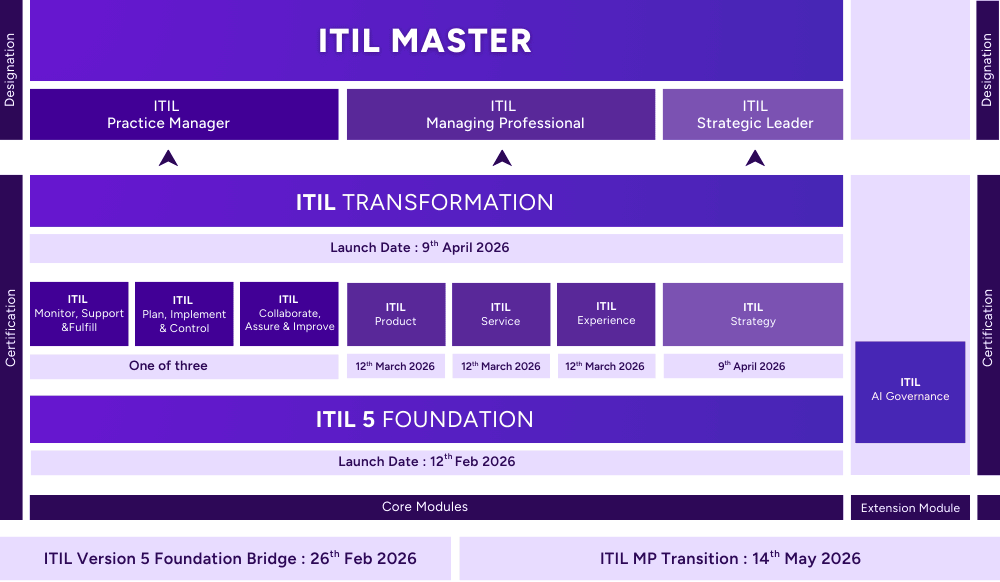
The ITIL® Version 5 Certification Pathway supports progressive learning, helping professionals grow from foundational skills to advanced strategic and transformational capabilities. To support a structured rollout, ITIL® Version 5 courses are being introduced in phases from early 2026.
ITIL® 5 Foundation
ITIL® 5 Foundation is the entry point to the Version 5 framework. It introduces the core concepts, terminology, and principles required to understand how modern digital products and services create value. The Foundation level is available from 12 February 2026 and provides the prerequisite knowledge for all higher ITIL® 5 pathways.
For professionals who already hold ITIL® 4 Foundation and want a focused overview of what has changed, an optional ITIL® 5 Foundation Bridge course is available from 26 February 2026. This bridge is optional and not required for progression.
Fast‑track your transition to ITIL® 5 and stay ahead in a rapidly evolving digital world by signing up for ITIL® Version 5 Foundation Bridge Training now.
ITIL® 5 Practice Manager
Under ITIL® Version 5, Practice Manager is a designation, not a standalone module set. It is achieved by:
1) Completing the existing ITIL® 4 Practice modules (which remain valid),
2) Completing the ITIL® 5 Transformation module
The combined ITIL® 4 practice modules are structured as follows:
1) ITIL® Monitor, Support, and Fulfil (MSF):
Covers Service Desk, Incident Management, Problem Management, Service Request Management, and Monitoring and Event Management practices.
2) ITIL® Plan, Implement, and Control (PIC):
Covers Change Enablement, Deployment Management, Release Management, Service Configuration Management, and IT Asset Management practices.
3) ITIL® Collaborate, Assure, and Improve (CAI):
Covers Relationship Management, Supplier Management, Service Level Management, Continual Improvement, and Information Security Management practices.
The ITIL® 5 Transformation module is scheduled to launch on 9 April 2026 and is a mandatory requirement for achieving the Practice Manager designation.
ITIL® 5 Managing Professional (MP)
The Managing Professional (MP) designation is intended for practitioners responsible for the end-to-end management of digital products and services. It focuses on applying ITIL principles across the service lifecycle, from creation and delivery to continual improvement.
The core Managing Professional modules are:
1) ITIL® Product: Focuses on managing digital products across their full lifecycle, ensuring product decisions align with customer needs, value streams, and business outcomes.
2) ITIL® Service: Covers the effective design, delivery, and operation of services, helping organisations maintain performance, reliability, and continual improvement.
3) ITIL® Experience: Emphasises designing and improving user, customer, and stakeholder experiences by managing service journeys, feedback, and satisfaction metrics.
These three modules are scheduled to launch on 12 March 2026 and together form the core knowledge base of the MP stream.
For professionals transitioning from earlier ITIL pathways, the Managing Professional (MP Transition) module is scheduled to launch on 14 May 2026, supporting continuity while aligning existing knowledge with the ITIL® Version 5 structure.
ITIL® 5 Strategic Leader (SL)
The Strategic Leader (SL) designation focuses on how IT and digital services support organisational strategy, governance, and long-term value creation. It is aimed at senior professionals involved in leadership, policy, and strategic decision-making.
The Strategic Leader pathway includes:
1) ITIL® Strategy: Focuses on aligning IT and digital services with organisational goals, covering governance, investment decisions, and long-term value creation.
2) ITIL® Transformation: Addresses leading organisational change by evolving operating models, embedding new ways of working, and enabling sustainable digital transformation.
Both modules are scheduled to launch on 9 April 2026, highlighting the close link between strategic intent and organisational change within ITIL® Version 5.
Master strategic decision‑making through the ITIL® 5 Strategy Certification – Join today!
ITIL® 5 Transformation
ITIL® 5 Transformation is a shared module across multiple designations and plays a central role in the Version 5 framework. It focuses on organisational change, digital evolution, and embedding new ways of working.
This module is scheduled to launch on 9 April 2026 and is used across:
1) Practice Manager
2) Managing Professional
3) Strategic Leader
It acts as a unifying element that connects operational execution with strategic direction.
ITIL® 5 AI Governance
ITIL® 5 introduces AI Governance as an extension module, reflecting the growing importance of responsible, ethical, and compliant use of artificial intelligence within digital services.
While this module has been formally announced as part of the ITIL® Version 5 scheme, official launch dates have not yet been confirmed. The module is expected to focus on governing AI-enabled services and is positioned as a specialist extension rather than a core requirement.
ITIL® 5 Master
ITIL® 5 Master represents the highest level of achievement within the framework. Rather than being a single exam, Master status is achieved by completing all three designations:
1) Practice Manager (PM)
2) Managing Professional (MP)
3) Strategic Leader (SL)
It demonstrates the ability to apply ITIL principles holistically across complex organisational environments and real-world scenarios.
ITIL® Version 5 Eligibility Criteria
Eligibility for ITIL® Version 5 Certifications depends on the level being pursued.
1) There are no prerequisites for ITIL® 5 Foundation, making it accessible to learners at all career stages.
2) Advanced ITIL® 5 modules typically require ITIL® 4 or ITIL® 5 Foundation, or valid ITIL® 4 designations for transition modules such as Managing Professional Transition.
3) Holders of ITIL® 3 and ITIL® 4 certifications have structured transition pathways to progress into ITIL® Version 5.
Empower your organisation’s future, learn to design and scale transformation with ITIL® 5 Transformation Certification – Register today!
ITIL® Version 5 vs ITIL® 4
Now, we’ll discuss the difference between ITIL Version 5 and ITIL® 4:
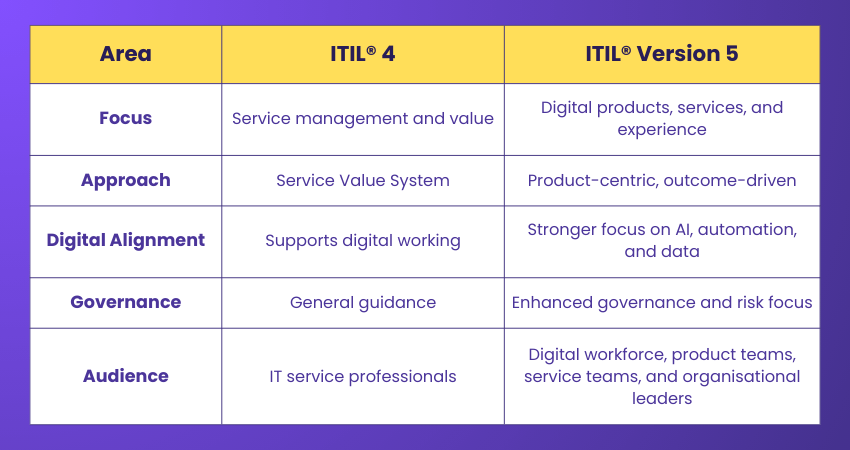
ITIL® Version 5 builds on the foundation of ITIL® 4 by responding to the growing demands of digital transformation. ITIL® 4 mainly focuses on service management and value creation through the Service Value System, helping organisations deliver consistent and reliable services.
In contrast, ITIL® Version 5 broadens this scope to include digital products, user experience, and clearly defined business outcomes. It moves away from a purely service-focused mindset toward a product-centric and outcome-driven approach.
Version 5 also places stronger emphasis on AI, automation, and data to support faster decisions and innovation. In addition, governance is more robust, with clearer guidance on risk and oversight. As a result, ITIL® Version 5 is relevant to IT professionals, digital teams, product owners, and organisational leaders.
Career Opportunities After ITIL® Version 5
By mastering modern digital product/service management and AI‑aligned practices, ITIL® 5 certified professionals can pursue roles such as:
1) Service Delivery Manager: Increased demand due to ITIL® 5’s focus on end-to-end service lifecycles, value streams, and customer experience.
2) IT Service Manager / IT Operations Lead: Strong alignment with continual improvement, automation-enabled operations, and data-informed service performance.
3) Digital Product Manager / Product Owner: ITIL® 5’s product-centric and outcome-driven approach aligns closely with Agile and digital product leadership roles.
4) AI Governance or Digital Governance Specialist: ITIL® 5 supports governance of AI-enabled services, helping professionals contribute to oversight, risk management, and responsible use of intelligent systems (typically alongside broader governance or risk roles).
5) Service Designer / Experience-focused Roles: Greater emphasis on service experience makes ITIL® 5 relevant to roles that design and improve user journeys and service interactions.
6) ITIL Consultant / Service Improvement Specialist: Organisations adopting ITIL® Version 5 require specialists who can guide transformation, optimise value streams, and align service management with business strategy.
Conclusion
The ITIL® Version 5 Certification Pathway provides a clear roadmap for managing digital products, services and experiences. By combining strong governance, product thinking and modern practices, it helps professionals remain relevant, support organisational transformation, and deliver measurable business value. As a result, it positions you not just to adapt to the digital era, but to thrive at the forefront of it.
Enhance service quality and customer satisfaction - register for ITIL® Certification today!
Frequently Asked Questions
How Often is the ITIL® Version 5 Framework Updated?

ITIL® Version 5 does not follow fixed annual updates. It evolves through periodic guidance updates, extensions, and new modules, reflecting changes in digital practices, governance needs, and emerging technologies, while maintaining a stable core framework for long-term organisational adoption.
Is ITIL® Version 5 Relevant for Cloud-native and SaaS Environments?
Yes. ITIL® Version 5 is designed for modern digital ecosystems, making it highly relevant for cloud‑native, SaaS, and platform‑based environments. Its product‑centric, AI‑ready, and experience‑driven guidance supports agile delivery, continuous improvement, and scalable service operations.
What are the Other Resources and Offers Provided by the Knowledge Academy?
The Knowledge Academy takes global learning to new heights, offering over 3,000+ online courses across 490+ locations in 190+ countries. This expansive reach ensures accessibility and convenience for learners worldwide.
Alongside our diverse Online Course Catalogue, encompassing 19 major categories, we go the extra mile by providing a plethora of free educational Online Resources like Blogs, eBooks, Interview Questions and Videos. Tailoring learning experiences further, professionals can unlock greater value through a wide range of special discounts, seasonal deals, and Exclusive Offers.
What is The Knowledge Pass and How Does it Work?
The Knowledge Academy’s Knowledge Pass, a prepaid voucher, adds another layer of flexibility, allowing course bookings over a 12-month period. Join us on a journey where education knows no bounds.
What are the Related Courses and Blogs Provided by The Knowledge Academy?
The Knowledge Academy offers various ITIL® Certification, including ITIL® Version 5 Foundation Certification, ITIL® 4 Foundation Certification Course and ITIL® 5 Transformation Certification. These courses cater to different skill levels, providing comprehensive insights into ITIL® Version 5.
Our IT Service Management Blogs cover a range of topics related to ITIL Version 5, offering valuable resources, best practices, and industry insights. Whether you are a beginner or looking to advance your IT Service Management skills, The Knowledge Academy's diverse courses and informative blogs have got you covered.

John Davies


Cyber Security Governance & Assurance Specialist
John Davies is a cybersecurity expert specialising in governance, risk management, and compliance. With over 15 years in the field, he has led enterprise-wide security programmes across finance, healthcare and public sector organisations. His content provides practical guidance on building secure environments, managing risk and aligning with regulatory frameworks.

Upcoming IT Service Management Resources Batches & Dates
Date
 ITIL® 5 Foundation Certification
ITIL® 5 Foundation Certification
Wed 18th Mar 2026
ITIL® 5 Foundation Certification
Mon 23rd Mar 2026
ITIL® 5 Foundation Certification
Wed 25th Mar 2026
ITIL® 5 Foundation Certification
Mon 30th Mar 2026
ITIL® 5 Foundation Certification
Wed 1st Apr 2026
ITIL® 5 Foundation Certification
Tue 7th Apr 2026
ITIL® 5 Foundation Certification
Wed 8th Apr 2026
ITIL® 5 Foundation Certification
Mon 13th Apr 2026
ITIL® 5 Foundation Certification
Wed 15th Apr 2026
ITIL® 5 Foundation Certification
Mon 20th Apr 2026
ITIL® 5 Foundation Certification
Wed 22nd Apr 2026
ITIL® 5 Foundation Certification
Mon 27th Apr 2026
ITIL® 5 Foundation Certification
Wed 29th Apr 2026
ITIL® 5 Foundation Certification
Tue 5th May 2026
ITIL® 5 Foundation Certification
Thu 7th May 2026
ITIL® 5 Foundation Certification
Mon 11th May 2026
ITIL® 5 Foundation Certification
Wed 13th May 2026
ITIL® 5 Foundation Certification
Mon 18th May 2026
ITIL® 5 Foundation Certification
Wed 20th May 2026
ITIL® 5 Foundation Certification
Tue 26th May 2026
ITIL® 5 Foundation Certification
Mon 1st Jun 2026
ITIL® 5 Foundation Certification
Wed 3rd Jun 2026
ITIL® 5 Foundation Certification
Mon 8th Jun 2026
ITIL® 5 Foundation Certification
Wed 10th Jun 2026
ITIL® 5 Foundation Certification
Mon 15th Jun 2026
ITIL® 5 Foundation Certification
Wed 17th Jun 2026
ITIL® 5 Foundation Certification
Mon 22nd Jun 2026
ITIL® 5 Foundation Certification
Wed 24th Jun 2026
ITIL® 5 Foundation Certification
Mon 29th Jun 2026
ITIL® 5 Foundation Certification
Wed 1st Jul 2026
ITIL® 5 Foundation Certification
Mon 6th Jul 2026
ITIL® 5 Foundation Certification
Wed 8th Jul 2026
ITIL® 5 Foundation Certification
Mon 13th Jul 2026
ITIL® 5 Foundation Certification
Wed 15th Jul 2026
ITIL® 5 Foundation Certification
Mon 20th Jul 2026
ITIL® 5 Foundation Certification
Wed 22nd Jul 2026
ITIL® 5 Foundation Certification
Mon 27th Jul 2026
ITIL® 5 Foundation Certification
Wed 29th Jul 2026
ITIL® 5 Foundation Certification
Mon 3rd Aug 2026
ITIL® 5 Foundation Certification
Wed 5th Aug 2026
ITIL® 5 Foundation Certification
Mon 10th Aug 2026
ITIL® 5 Foundation Certification
Wed 12th Aug 2026
ITIL® 5 Foundation Certification
Mon 17th Aug 2026
ITIL® 5 Foundation Certification
Wed 19th Aug 2026
ITIL® 5 Foundation Certification
Mon 24th Aug 2026
ITIL® 5 Foundation Certification
Wed 26th Aug 2026
ITIL® 5 Foundation Certification
Tue 1st Sep 2026
ITIL® 5 Foundation Certification
Mon 7th Sep 2026
ITIL® 5 Foundation Certification
Wed 9th Sep 2026
ITIL® 5 Foundation Certification
Mon 14th Sep 2026
ITIL® 5 Foundation Certification
Wed 16th Sep 2026
ITIL® 5 Foundation Certification
Mon 21st Sep 2026
ITIL® 5 Foundation Certification
Wed 23rd Sep 2026
ITIL® 5 Foundation Certification
Mon 28th Sep 2026
ITIL® 5 Foundation Certification
Wed 30th Sep 2026
ITIL® 5 Foundation Certification
Mon 5th Oct 2026
ITIL® 5 Foundation Certification
Wed 7th Oct 2026
ITIL® 5 Foundation Certification
Mon 12th Oct 2026
ITIL® 5 Foundation Certification
Wed 14th Oct 2026
ITIL® 5 Foundation Certification
Mon 19th Oct 2026
ITIL® 5 Foundation Certification
Wed 21st Oct 2026
ITIL® 5 Foundation Certification
Mon 26th Oct 2026
ITIL® 5 Foundation Certification
Wed 28th Oct 2026
ITIL® 5 Foundation Certification
Mon 2nd Nov 2026
ITIL® 5 Foundation Certification
Wed 4th Nov 2026
ITIL® 5 Foundation Certification
Mon 9th Nov 2026
ITIL® 5 Foundation Certification
Wed 11th Nov 2026
ITIL® 5 Foundation Certification
Mon 16th Nov 2026
ITIL® 5 Foundation Certification
Wed 18th Nov 2026
ITIL® 5 Foundation Certification
Mon 23rd Nov 2026
ITIL® 5 Foundation Certification
Wed 25th Nov 2026
ITIL® 5 Foundation Certification
Mon 30th Nov 2026
ITIL® 5 Foundation Certification
Wed 2nd Dec 2026
ITIL® 5 Foundation Certification
Mon 7th Dec 2026
ITIL® 5 Foundation Certification
Wed 9th Dec 2026
ITIL® 5 Foundation Certification
Sun 13th Dec 2026
ITIL® 5 Foundation Certification
Mon 14th Dec 2026
ITIL® 5 Foundation Certification
Mon 21st Dec 2026
ITIL® 5 Foundation Certification
Wed 23rd Dec 2026
ITIL® 5 Foundation Certification
Tue 29th Dec 2026

 If you wish to make any changes to your course, please


