


 Top Rated Course

We may not have the course you’re looking for. If you enquire or give us a call on +44 1344 203999 and speak to our training experts, we may still be able to help with your training requirements.
The ArchiMate Modelling Language vs UML: Key Differences
James Smith 11 May 2026Explore the key differences and advantages in our comprehensive comparison of the ArchiMate Modelling Language vs UML. Dive into the field of enterprise architecture modelling to understand how these two powerful tools cater to different needs. Learn to choose the right framework for your projects and maximise the potential of both.

Training Outcomes Within Your Budget!
We ensure quality, budget-alignment, and timely delivery by our expert instructors.
Table of Contents
Harmonising complex connections across entire organisations, linking strategy, business, and technology, requires a broad, strategic view. At the same time, it is equally important to focus on the detailed aspects of software development. Understanding the ArchiMate Modelling Language vs UML helps organisations navigate these two distinct yet complementary approaches.
Management teams create models to visualise how information flows between departments such as Sales, Support, and IT. This helps identify areas for improvement and supports better decision-making. UML and the ArchiMate provide structured approaches to managing these changes. In this blog, we explore how understanding the difference between the ArchiMate Modelling Language vs UML helps management choose the most suitable approach.
Table of Contents
1) What is the ArchiMate Modelling Language and UML?
2) Purpose and Usage
3) Conceptual Differences
4) Notations and Modelling Techniques
5) The ArchiMateNotations
6) UML Notations
7) Tool Support
8) Comparison Table
9) When to Use UML vs the ArchiMate Modelling Language?
10) Conclusion
What is the ArchiMate Modelling Language and UML?
To understand the difference between UML and the ArchiMate® modelling language 3, we first understand what makes them unique in detail.
1) The ArchiMate Modelling Language
The ArchiMate modelling language is an enterprise architecture modelling language. By incorporating the ArchiMate Diagrams, architects can visually represent and analyse the interactions between business, application, and technology layers. Its structure allows architects to visualise and analyse the relationships among different architectural domains, providing a coherent view of the enterprise structure.

2) UML (Unified Modelling Language)
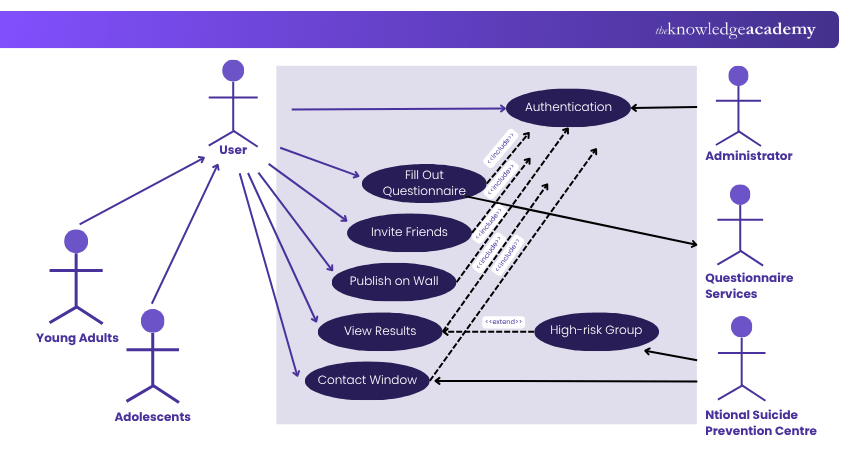
UML, created by the Object Management Group (OMG), is a standardised modelling language focused on software development. It contains various diagrams to specify, visualise, and document software systems' static structure and dynamic behaviour. UML benefits object-oriented design, allowing engineers and developers to communicate effectively about system design. The difference between Composition and Aggregation UML is an important concept in this communication, as it defines the ownership and lifecycle of objects. The Rapid UML Solution in ConceptDraw Solution Park offers a comprehensive library for crafting UML Use Case Diagrams. Elevate system design and communication with its user-friendly and professional tools.
Ready to master the holistic approach to enterprise architecture? Register for our ArchiMate® 3 Training Course Combined Level 1 and Level 2 today!
Purpose and Usage
The ArchiMate modelling language and UML are distinct modelling languages, with the former focusing on enterprise architecture and the latter on software development. Let us understand their specific use and purpose.
1) The ArchiMate Modelling Language
The purpose of the ArchiMate modelling language extends beyond mere modelling; it aims to bridge the gap between various business domains and IT. A coherent view of architectural models helps position an organisation's business strategy with IT strategy and operations. The ArchiMate Value Stream helps identify how value is created across business, application, and technology layers, improving efficiency in achieving strategic goals.
It is beneficial for stakeholders and decision-makers to understand and make changes at different levels of an enterprise. The ArchiMate modelling language offers a comprehensive approach that binds business, application, and technology layers, ensuring a holistic understanding of the organisation.
2) UML
UML, being more software-oriented, focuses on the design, visualisation, and implementation of software across different platforms. It offers extensive diagrams representing various system aspects, such as its structure, behaviour, and interactions.
UML allows developers, engineers, and system architects to collaborate and communicate more efficiently, ensuring the system's functionality aligns with its requirements. It is applicable across various stages of software development, from initial conceptualisation to detailed design and maintenance.
Learn the basics and build strong enterprise architecture foundations with the ArchiMate® 3 Training Course: Level 1 – Join now!
Conceptual Differences
The conceptual difference between UML and the ArchiMate modelling language can be traced to their foundational principles and objectives.
1) The ArchiMate Modelling Language
The design of the ArchiMate modelling language is rooted in a holistic approach to organisational structure. It encompasses technological and enterprise architecture, including business processes and strategies. It's crafted to facilitate the understanding, analysis, and visualisation of the alignment between business and IT, providing a high-level view that captures the organisation's entire ecosystem.
2) UML
UML, on the other hand, is engineered primarily for software development. It focuses on software systems' detailed design and modelling, employing object-oriented principles. Its structure emphasises the interactions, behaviours, and relationships among software components. Unlike the ArchiMate modelling language, which looks at the enterprise, UML zooms into the specifics of software architecture, addressing every aspect of software design and development.
Notations and Modelling Techniques
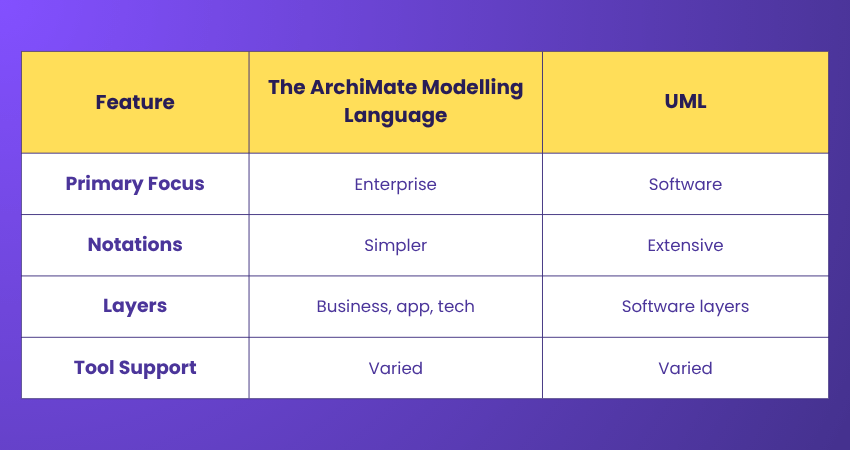
Notations and modelling techniques define the languages of UML and the ArchiMate modelling language. While the ArchiMate modelling language employs notations to represent complex organisational structures, UML uses specific symbols and diagrams to detail software design and interactions.
1) The ArchiMate Notations
The ArchiMate modelling language uses a more focused set of notations explicitly designed for enterprise architecture. These the ArchiMate Notations are organised into three main layers:
1) Business Layer Notation: Represents organisational elements such as business processes, roles, and functions.
2) Application Layer Notation: Focuses on applications and their interconnections.
3) Technology Layer Notation: Deals with the hardware and software that enable the application layer.
This segmentation helps provide clarity and alignment between different aspects of an enterprise.
UML Notations
UML offers an extensive and versatile set of notations catering to different aspects of software development:
1) Structure Diagrams: Like class and object diagrams, they depict the system's static structure.
2) Behaviour Diagrams: Such as use case and state machine diagrams describing the dynamic aspects of the system.
3) Interaction Diagrams: Like sequence diagrams, focusing on the flow and control of interactions within the system.
These notations provide a comprehensive and detailed representation of a software system's functionality and structure.
Elevate your enterprise architecture capabilities with the ArchiMate® 3 Training Course: Level 2 – Sign up now!
Tool Support
Various tools support both the ArchiMate modelling language and UML, depending on the specific requirements of a project.
1) The ArchiMate Modelling Language
For the ArchiMate modelling language, several specialised tools exist, like Bizz Design, Archi, and Sparx Systems, specifically designed to leverage the unique features of enterprise architecture modelling.
2) UML
UML enjoys support from various software development tools, including IBM Rational Rose, Microsoft Visio, and StarUML. These tools cater to the intricate demands of software modelling, offering diverse functionalities for different stages of development.
Comparison Table
When to use UML vs the ArchiMate Modelling Language?
The choice between the ArchiMate modelling language and UML depends mainly on the nature and objectives of the project.
Use the ArchiMate modelling language when:
1) Enterprise Overview Needed: If you require a holistic view of the entire organisation's structure, including alignment between business strategies and IT operations, the ArchiMate modelling language is the ideal choice.
2) Strategic Planning: For executives and stakeholders involved in organisational planning and decision-making, the ArchiMate modelling language provides essential insights into how different domains interconnect.
Use UML when:
1) Software Development Focus: UML is more suitable for software-centric projects, where detailed modelling of software components is necessary.
2) Object-oriented Design: If the project relies heavily on object-oriented principles, UML offers a comprehensive set of tools and notations for capturing these aspects.
3) Collaboration Between Developers: UML helps communicate complex software designs among developers, testers, and other team members, ensuring alignment in understanding and implementation.
Conclusion
The answer to the ArchiMate Modelling Language vs UML depends on the needs of your project. If you focus on aligning IT and business strategies, the ArchiMate modelling language may be the right choice. If your goal is detailed software modelling, UML could be more suitable. In understanding the ArchiMate modelling language and UML, it is essential to consider your project's context and specific requirements to make the most informed decision.
Turn complex systems into clear visual models and design smarter architectures with the ArchiMate® Training now!
Frequently Asked Questions
Can I use the ArchiMate Modelling Language and UML Together?

Yes, the ArchiMate modelling language and UML can be used together. The ArchiMate modelling language provides a high-level view of business, application, and technology layers, while UML offers detailed system design. You can link business capabilities in both use cases or map application components to UML classes or packages.
What is the Main Advantage of the ArchiMate Modelling Language?
The main advantage of the ArchiMate modelling language is its ability to connect business, application, and technology domains in a unified view. This integrated approach helps organisations understand relationships, improve communication, and make better decisions by providing clear insights across the entire enterprise architecture.
What are the Other Resources and Offers Provided by The Knowledge Academy?
The Knowledge Academy takes global learning to new heights, offering over 3,000+ online courses across 490+ locations in 190+ countries. This expansive reach ensures accessibility and convenience for learners worldwide.
Alongside our diverse Online Course Catalogue, encompassing 17 major categories, we go the extra mile by providing a plethora of free educational Online Resources like Blogs, eBooks, Interview Questions and Videos. Tailoring learning experiences further, professionals can unlock greater value through a wide range of special discounts, seasonal deals, and Exclusive Offers.
What is The Knowledge Pass, and How Does it Work?
The Knowledge Academy’s Knowledge Pass, a prepaid voucher, adds another layer of flexibility, allowing course bookings over a 12-month period. Join us on a journey where education knows no bounds.
What are the Related Courses and Blogs Provided by The Knowledge Academy?
The Knowledge Academy offers various the ArchiMate Training, including the ArchiMate 3 Training Course, the ArchiMate 3 Training Course: Level 1, and the ArchiMate 3 Training Course: Level 2. These courses cater to different skill levels, providing comprehensive insights into the ArchiMate Framework.
Our Business Improvement Blogs cover a range of topics related to the ArchiMate Modelling Language vs UML, offering valuable resources, best practices, and industry insights. Whether you are a beginner or looking to advance your enterprise architecture and modelling skills, The Knowledge Academy's diverse courses and informative blogs have got you covered.

James Smith


Digital Marketing Manager and Trainer
James Smith is a digital marketing professional with over a decade of experience in SEO, content strategy, paid media and analytics. He has supported both SMEs and global brands in transforming their digital presence. James’s writing and training are rooted in results-driven tactics and the latest marketing trends.
View Detail
Upcoming Programming & DevOps Resources Batches & Dates
Date
 ArchiMate® 3 Training Course
ArchiMate® 3 Training Course
Wed 5th Aug 2026
ArchiMate® 3 Training Course
Wed 4th Nov 2026

 If you wish to make any changes to your course, please


