


 Top Rated Course

We may not have the course you’re looking for. If you enquire or give us a call on +44 1344 203 999 and speak to our training experts, we may still be able to help with your training requirements.
What is the ArchiMate® Modelling Language and How Does it Work?
James Smith 20 August 2026The ArchiMate® Modelling Language helps Enterprise Architects describe, visualise and analyse relationships across an enterprise. Explore its purpose, concepts, core layers, benefits and practical applications.

Training Outcomes Within Your Budget!
We ensure quality, budget-alignment, and timely delivery by our expert instructors.
Table of Contents

Key Takeaways
1. The ArchiMate® Modelling Language provides a common visual language for describing Enterprise Architecture.2. Its elements, relationships, layers and viewpoints help represent different aspects of an enterprise.3. The three core layers are Business, Application and Technology, with additional concepts extending the language.4. The ArchiMate® Modelling Language can help stakeholders understand dependencies, communicate architecture and assess potential changes.An organisation can have business processes, applications, data and technology working together across hundreds of systems. But how can you clearly show how all these pieces connect?
A document can describe them, but a well-structured architecture model can make those relationships much easier to see, discuss and analyse. This is where the ArchiMate® Modelling Language comes in. Let’s explore how the ArchiMate® Modelling Language connects different parts of an enterprise.
What is the ArchiMate® Modelling Language?
The ArchiMate® Modelling Language is an open and independent language for Enterprise Architecture. It helps Enterprise Architects describe, analyse and visualise relationships across different areas of an enterprise.
It represents business processes, organisational structures, applications and technology infrastructure using common concepts, relationships and notation. Different modelling tools can then be used to create and manage the ArchiMate® Modelling Language.

How Does the ArchiMate® Modelling Language Work?
The ArchiMate® Modelling Language works by representing architectural elements and connecting them through defined relationships. Architects can then create different views of the model depending on the stakeholder concern being addressed.
A typical modelling approach involves the following steps:
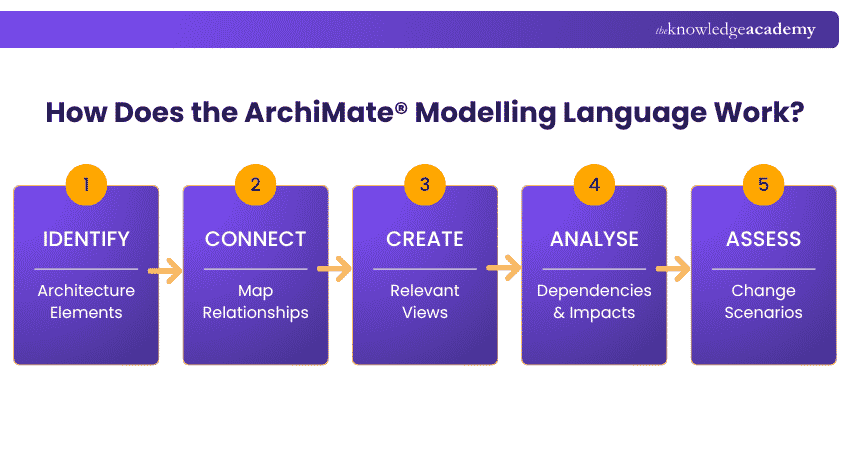
1) Create an Architecture Model
Identify the relevant parts of the enterprise and represent them using appropriate the ArchiMate® Modelling Language elements. These may include business processes, applications, services or technology components. This creates a structured representation of the architectural area being examined.
2) Map Relationships
Select the elements and relationships that are relevant to a particular stakeholder concern or architectural question. This creates a focused view without requiring stakeholders to interpret the entire architecture model. Different views can therefore present the same architecture to different audiences.
Trainer's Pro Tip:
When mapping relationships, focus on showing how one element supports or affects another. This makes dependencies clearer and helps stakeholders understand how changes in one area may impact others.
3) Create Relevant Views
Use the model to examine relationships, dependencies, gaps and potential areas of concern within the architecture. This can help architects understand how different components interact and where changes may have an impact. The resulting insights can support architectural analysis and decision-making.
4) Analyse the Architecture
Use the model to examine relationships, dependencies, gaps and potential areas of concern within the architecture. This can help architects understand how different components interact and where changes may have an impact. The resulting insights can support architectural analysis and decision-making.
5) Model Change Scenarios
Architects can represent alternative situations and examine their potential consequences before changes are implemented. This helps stakeholders understand how a proposed change could affect connected parts of the enterprise. For example, replacing an application can be assessed against the business processes and technology that depend on it.
Advance your knowledge and apply advanced modelling concepts to complex Enterprise Architecture scenarios with the ArchiMate® 3 Training Course: Level 1- Register now!
Core Layers of the ArchiMate® Modelling Language
The ArchiMate® Modelling Language framework has three core layers: Business, Application and Technology. These provide a structured way to represent how an organisation operates, how applications support it and how technology supports those applications.
1) Business Layer
The Business Layer represents organisational elements such as business actors, roles, processes, functions, services and products. It helps describe how the organisation operates and delivers value.
2) Application Layer
The Application Layer represents applications and application-related elements that support business activities. It can show how applications interact and how application services support business processes.
3) Technology Layer
The Technology Layer represents the technology infrastructure and services that support applications. It can include elements such as devices, system software, communication networks and technology services.
4) Beyond the Core Layers
The ArchiMate® Modelling Language framework extends beyond these three core layers. The specification also includes areas such as Motivation, Strategy, Physical, and Implementation and Migration, allowing architects to represent strategic drivers, capabilities, physical resources and change-related concepts.
Test Your Understanding
A business process depends on an application, which runs on supporting technology. Which of the ArchiMate® Modelling Language layers would help represent this relationship?
A. Business → Application → TechnologyB. Technology → Business → ApplicationC. Application → Business → Technology
Benefits of Using the ArchiMate® Modelling Language
By providing a standardised language for Enterprise Architecture, the ArchiMate® Modelling Language can make complex architectural information easier to represent and communicate. It can also help architects analyse relationships and dependencies across different areas of an enterprise.
Key benefits are:
• Clearer Communication: Provides a shared visual language for architectural discussions.
• Better Business-technology Alignment: Shows relationships between business needs and supporting technology.
• Improved Analysis: Makes dependencies and relationships easier to examine.
• Informed Decisions: Supports the evaluation of architectural options and scenarios.
• Greater Consistency: Provides standardised concepts and notation for modelling.
• Change Planning: Helps identify potential impacts when architecture changes.
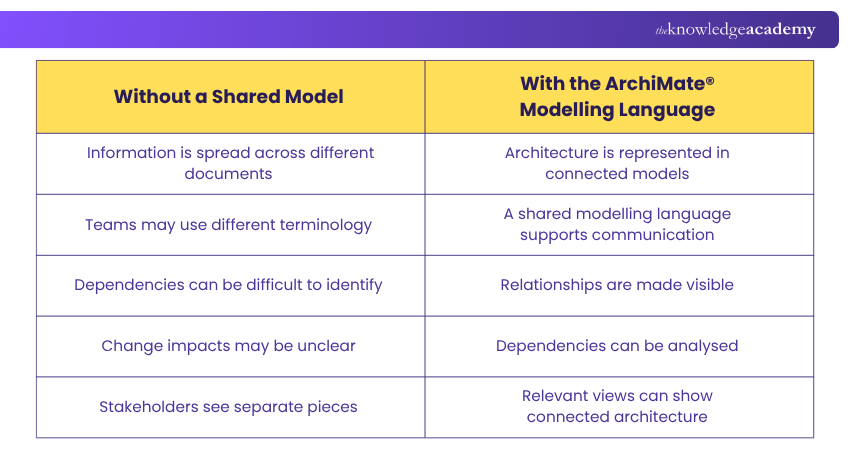
The difference is not simply visual. A structured model can help turn disconnected architectural information into something stakeholders can discuss and analyse.
Where Is the ArchiMate® Modelling Language Used?
The ArchiMate® Modelling Language can be used wherever organisations need to represent and communicate relationships across Enterprise Architecture. The Open Group describes its use for areas including business processes, organisational structures, information flows, IT systems and technical infrastructure.
1) Enterprise Architecture
Architects can model business, application and technology components to understand how different areas of an enterprise connect. This provides a structured view of the current architecture and can help identify relationships between different architectural elements.
2) Business and IT Alignment
Models can show how business processes and services are supported by applications and underlying technology. This helps business and IT teams develop a shared understanding of how technology contributes to organisational objectives.
3) Digital Transformation
Organisations can use architecture models to represent current and future states during transformation initiatives. By mapping dependencies and relationships, architects can communicate how proposed changes may affect different areas of the enterprise.
4) Change and Impact Analysis
When an organisation considers replacing an application, changing a business process or introducing new technology, the ArchiMate® Modelling Language can help identify connected elements and potential impacts. This allows architects to examine dependencies before implementing significant changes.
5) Architecture Communication
Different stakeholders require different levels of architectural information. The ArchiMate® Modelling Language viewpoints allow architects to present relevant elements and relationships for a specific audience, making complex architecture easier to understand without showing the entire model.
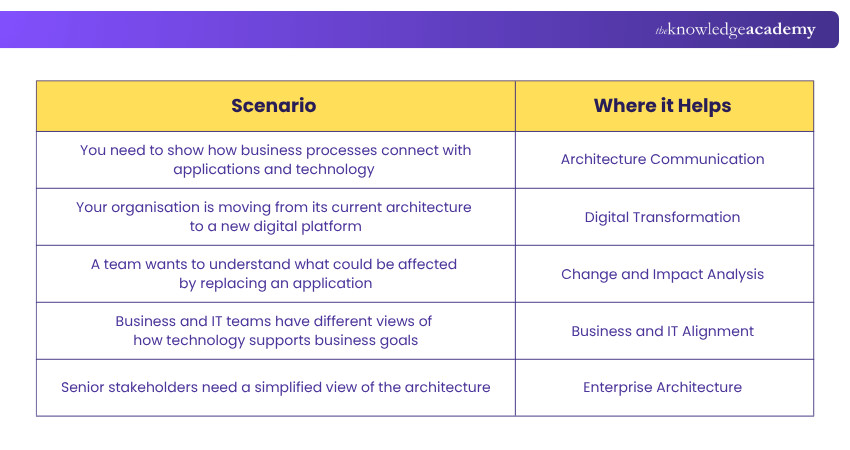
Now, see if you can cross over each scenario to the ArchiMate® Modelling Language use case that fits it best.
Conclusion
Understanding What is the ArchiMate® Modelling Language helps clarify its role in Enterprise Architecture. It provides a common way to visualise relationships across business, application and technology domains, supporting clearer communication, analysis and informed architectural decisions.
Learn to use the ArchiMate® Modelling Language to visualise, analyse and communicate Enterprise Architecture with the ArchiMate® Training- Join now!
Frequently Asked Questions
Is the ArchiMate® Modelling Language a framework or a modelling language?

The ArchiMate® Modelling Language is a modelling language for Enterprise Architecture. The ArchiMate® Modelling Language Specification defines its concepts, relationships and notation, while the framework organises these concepts into layers and other dimensions for architectural modelling.
What is the latest version of the ArchiMate® Modelling Language Specification?
The latest published version is ArchiMate® 3.2, released in October 2022. The Open Group's current ArchiMate® 3 certification programme covers the 3.2 release of the specification.
How does the ArchiMate® Modelling Language complement the TOGAF® Standard?
The TOGAF Standard provides methods and guidance for developing and governing Enterprise Architecture, while the ArchiMate® Modelling Language provides a visual language for representing that architecture. They can therefore be used together while serving different purposes.
Who uses the ArchiMate® Modelling Language?
It is particularly relevant to Enterprise Architects and professionals involved in architecture modelling and communication. Other business and technology stakeholders can also use the ArchiMate® Modelling Language views to understand architectural information relevant to their concerns.

James Smith


Digital Marketing Manager and Trainer
James Smith is a digital marketing professional with over a decade of experience in SEO, content strategy, paid media and analytics. He has supported both SMEs and global brands in transforming their digital presence. James’s writing and training are rooted in results-driven tactics and the latest marketing trends.
View Detail

 If you wish to make any changes to your course, please


