


 Top Rated Course


We may not have the course you’re looking for. If you enquire or give us a call on +353 12338944 and speak to our training experts, we may still be able to help with your training requirements.
What is C++ Programming and how to use it?
Richard Harris 21 April 2026C++ is a powerful general-purpose programming language used for system software, game development, and high-performance applications. It supports both procedural and object-oriented programming, offering flexibility and control over system resources. C++ excels in performance, making it ideal for software engineering and embedded systems.

Training Outcomes Within Your Budget!
We ensure quality, budget-alignment, and timely delivery by our expert instructors.
Table of Contents
Ever been captivated by the stunning realism of a high-end video game or amazed by the speed of lightning-fast trading systems? Behind these powerful experiences lies the brilliance of C++ - a programming language that powers some of the most sophisticated technologies around us. But What is C++ exactly? It’s a powerful, versatile programming language that blends raw speed with flexibility, enabling developers to build everything from complex software tools to immersive gaming experiences.
If you're eager to learn What is C++ is and how it works, this blog explores its history, features, advantages, and real-world applications. Buckle up you’re about to discover the language that drives the future!
Table of Contents
1) What is C++ Programming?
2) History of C++
3) How to Learn C++?
4) Examples of C++ Tools
5) Advantages of C++
6) Disadvantages of C++
7) Applications of C++
8) Conclusion
What is C++ Programming?
C++ supports both low-level and high-level programming, making it ideal for system development, software, and game engines. It provides efficient memory control and high performance, essential for operating systems, embedded systems, and high-frequency trading. Game engines like Unreal Engine use C++ for real-time graphics and physics simulations.
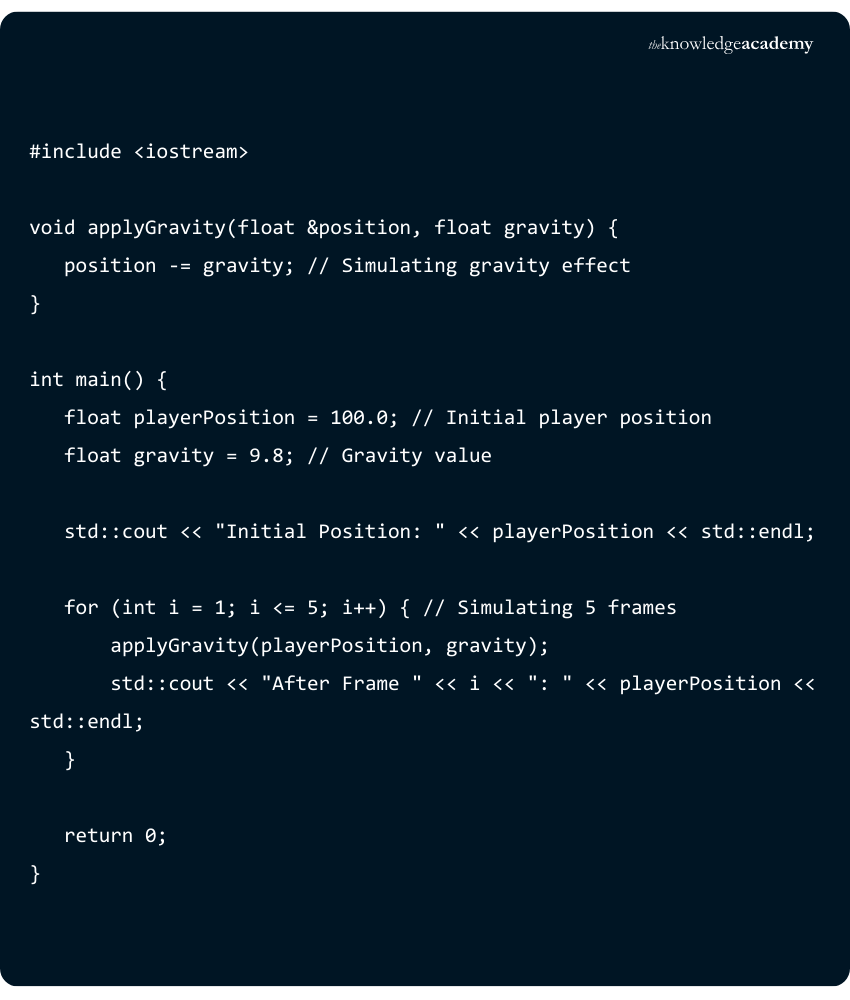
Here’s a simple C++ program demonstrating basic physics simulation in a game-like environment:
Output:

Explanation:
a) This program simulates gravity affecting a player's position over time.
b) Each frame updates the position, similar to real-time physics calculations in game engines.
c) Game Development frameworks like Unreal Engine use similar logic but with advanced rendering and physics engines.

History of C++
The development of C++ began in 1979 by Bjarne Stroustrup at Bell Labs. Stroustrup aimed to create a language that combined the efficiency and flexibility of C with the object-oriented features of Simula. Initially called "C with Classes," the language introduced classes, derived classes, strong typing, and other enhancements.
In 1983, it was renamed C++, symbolising the evolutionary nature of the changes from C. Over the years, C++ has undergone several standardisations, with significant versions including C++98, C++03, C++11, C++14, C++17, C++20, and the latest, C++23, each introducing new features and improvements.
Acquire proficiency in implementing the components of the C language. Join our C Programming Course now!
How to Learn C++?
Want to get started with C++? Here’s a simple roadmap:
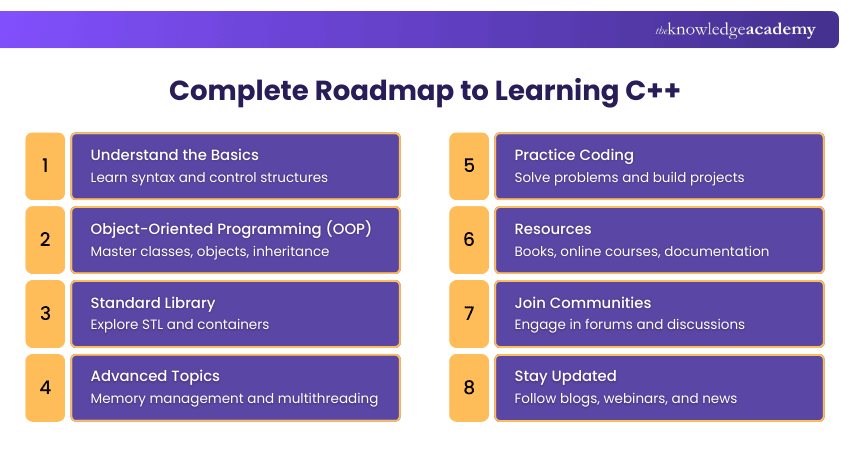
1) Understand the Basics
a) Learn the syntax and basic concepts like variables, data types, operators, and control structures (if-else, loops).
b) Familiarise yourself with functions, arrays, and pointers.
2) Object-Oriented Programming (OOP)
a) Study the principles of OOP: classes, objects, inheritance, polymorphism, and encapsulation.
b) Practice creating and using classes and objects.
3) Standard Library
a) Explore the C++ Standard Library, including the Standard Template Library (STL) which provides useful data structures and algorithms.
b) Learn about containers (vector, list, map), iterators, and algorithms.
4) Advanced Topics
a) Dive into advanced topics like memory management, smart pointers, and multithreading.
b) Understand templates and generic programming.
5) Practice Coding
a) Solve problems on coding platforms like LeetCode, HackerRank, or Codeforces.
b) Work on small projects to apply what you've learned.
6) Resources
a) Books: "C++ Primer" by Lippman, Lajoie, and Moo; "Effective Modern C++" by Scott Meyers.
b) Online Courses: Platforms like The Knowledge Academy provide in-depth C++ training programmes.
c) Documentation: Refer to the official C++ documentation and resources like cppreference.com.
7) Join Communities
a) Participate in forums like Stack Overflow, Reddit's r/cpp, and C++ communities on Discord.
b) Engage with other learners and experienced developers to share knowledge and get help.
8) Stay Updated
a) Follow C++ blogs, YouTube channels, and attend webinars or conferences to keep up with the latest developments in the language.
Examples of C++ Tools
Here are some examples of tools commonly used in C++ development:
IDEs
a) Visual Studio: A powerful IDE from Microsoft with extensive features for C++ development.
b) CLion: A cross-platform IDE from JetBrains, known for its smart code analysis and refactoring tools.
c) Code: Blocks: An open-source, cross-platform IDE that is highly customisable.
d) Eclipse CDT: An IDE with a robust set of tools for C++ development, part of the Eclipse ecosystem.
Build Systems
a) CMake: A widely-used build system that generates platform-specific build files.
b) GNU Make: A classic build automation tool that uses Makefiles to manage project builds.
c) Bazel: A build system from Google that supports large-scale projects with complex dependencies.
d) Ninja: A small, fast build system focused on speed and efficiency.
Testing Frameworks
a) Google Test (gTest): A popular framework for writing C++ unit tests, known for its simplicity and flexibility.
b) Catch2: A modern, header-only testing framework that is easy to integrate and use.
c) Boost.Test: Part of the Boost libraries, offering a wide range of testing tools and features.
d) CppUnit: A C++ port of the JUnit framework, providing a familiar structure for unit testing.
Profiling Tools
a) gprof: The GNU profiler, useful for analysing program performance.
b) Valgrind: A suite of tools for debugging and profiling, including memory leak detection.
c) Intel VTune Profiler: A performance analysis tool that provides detailed insights into CPU and GPU usage.
d) Visual Studio Profiler: Integrated profiling tools within Visual Studio for performance and memory analysis.
Documentation Tools
a) Doxygen: A widely-used tool for generating documentation from annotated C++ source code.
b) Sphinx: Originally for Python, but also supports C++ with extensions like Breathe.
c) Doxide: A modern documentation generator for C++, producing HTML documentation using Markdown.
d) hdoc: A documentation tool that uses LLVM/Clang for parsing and generates clean, static HTML.
Package Managers
a) vcpkg: A cross-platform package manager from Microsoft, simplifying library management.
b) Conan: A flexible package manager for C and C++ that supports multiple platforms and build systems.
c) Spack: A package manager designed for high-performance computing environments.
d) Hunter: A CMake-based package manager that simplifies dependency management.
Learn about all the primary concepts of Embedded C programming. Join our Introduction to Embedded C Programming Course today!
Advantages of C++
Here are the advantages of C++:
Performance
a) High Efficiency: C++ is known for its high performance and efficiency, making it ideal for system/software development, game development, and real-time applications.
b) Low-level Manipulation: It allows for low-level memory manipulation, giving developers fine-grained control over system resources.
Object-Oriented Programming
a) Modularity: Supports object-oriented programming (OOP) principles like encapsulation, inheritance, and polymorphism, which help in organising and managing complex codebases.
b) Reusability: Promotes code reusability through classes and objects, reducing redundancy and improving maintainability.
Standard Template Library (STL)
a) Rich Library: The STL provides a collection of pre-written classes and functions for data structures (like vectors, lists, and maps) and algorithms (like sorting and searching), which can save development time and effort.
Machine Independence
a) Portability: C++ code can be compiled on various platforms without modification, making it highly portable and versatile for cross-platform development.
Large Community
a) Support and Resources: A large and active community means abundant resources, libraries, and frameworks are available, making it easier to find help and improve skills.
Disadvantages of C++
The following are the disadvantages of C++:
Steep Learning Curve
a) Complexity: C++ has a steep learning curve due to its complex syntax and extensive feature set, which can be challenging for beginners.
Verbose Syntax
a) Lengthy Code: The syntax can be verbose and require more lines of code compared to some other high-level languages, which can make the code harder to read and maintain.
Error-Prone
a) Manual Memory Management: Requires manual memory management, which can lead to errors like memory leaks and segmentation faults if not handled properly.
b) Undefined Behaviour: Language allows for undefined behavior, which can result in unpredictable program behavior and hard-to-debug issues.
Applications of C++
C++ is a versatile and high-performance programming language, widely used in various industries. Here are some of the most common and important applications of C++:
Software Engineering
a) Enterprise Applications: C++ is widely used in developing large-scale enterprise applications due to its performance and reliability.
b) Database Management Systems: Many database systems, like MySQL and MongoDB, are developed using C++.
Operating System (OS) Development
a) Kernel Development: C++ is used in developing operating system kernels and drivers, providing the necessary performance and low-level access.
b) System Utilities: Various system utilities and tools are built using C++.
Graphical User Interfaces (GUIs)
a) Desktop Applications: C++ is used to create GUI applications with frameworks like Qt and wxWidgets.
b) Cross-platform GUIs: These frameworks allow for the development of cross-platform GUI applications.
Virtual Reality (VR)
a) VR Engines: C++ is used in developing VR engines and applications due to its high performance and real-time capabilities.
b) Simulation Software: VR simulations for training and education are often built using C++.
Blockchain Technology
a) Cryptocurrency Development: Many blockchain platforms and cryptocurrencies, like Bitcoin, are implemented in C++.
b) Smart Contracts: C++ is used to develop smart contracts and blockchain-based applications.
Game Development
a) Game Engines: Popular game engines like Unreal Engine are developed using C++.
b) High-performance Games: C++ is preferred for developing high-performance games due to its efficiency and control over hardware resources.
Conclusion
C++ is a powerful and versatile programming language, widely used in system development, gaming, finance, and real-time applications. Its speed, efficiency, and scalability make it a top choice for developers. Understanding What is C++ can open doors to exciting opportunities in the ever-evolving world of technology.
Understand memory management to enhance code performance with our C++ Programming (C Plus Plus) Course – Register now!
Frequently Asked Questions
What are the Big Three Rule in C++?

The Big Three in C++ refers to the destructor, copy constructor, and copy assignment operator. If a class requires any of these, it likely needs all three to manage dynamic memory and prevent memory leaks or unintended object copying.
What are the Basic Rules to Write a C++ Program?
A C++ program must include a main() function, follow proper syntax, use semicolon (;) to end statements, and include necessary header files (#include
What are the Other Resources and Offers Provided by The Knowledge Academy?
The Knowledge Academy takes global learning to new heights, offering over 3,000+ online courses across 490+ locations in 190+ countries. This expansive reach ensures accessibility and convenience for learners worldwide.
Alongside our diverse Online Course Catalogue, encompassing 17 major categories, we go the extra mile by providing a plethora of free educational Online Resources like Blogs, eBooks, Interview Questions and Videos. Tailoring learning experiences further, professionals can unlock greater value through a wide range of special discounts, seasonal deals, and Exclusive Offers.
What is The Knowledge Pass, and How Does it Work?
The Knowledge Academy’s Knowledge Pass, a prepaid voucher, adds another layer of flexibility, allowing course bookings over a 12-month period. Join us on a journey where education knows no bounds.
What are the Related Courses and Blogs Provided by The Knowledge Academy?
The Knowledge Academy offers various C Programming Courses, including the C Programming, C++ Programming (C Plus Plus), and the Introduction of Embedded C Programming. These courses cater to different skill levels, providing comprehensive insights into Pointers in C.
Our Programming & DevOps Blogs cover a range of topics related to C Programming, offering valuable resources, best practices, and industry insights. Whether you are a beginner or looking to advance your Programming & DevOps skills, The Knowledge Academy's diverse courses and informative blogs have got you covered.

Richard Harris


Senior Full Stack Developer and Technology Educator
Richard Harris is a highly experienced full-stack developer with deep expertise in both frontend and backend technologies. Over his 12-year career, he has built scalable web applications for startups, enterprises and government organisations. Richard’s writing combines technical depth with clear explanations, ideal for developers looking to grow in modern frameworks and tools.


 If you wish to make any changes to your course, please


