




We may not have the course you’re looking for. If you enquire or give us a call on +44 1344 203 999 and speak to our training experts, we may still be able to help with your training requirements.
What is Simulation: Types, Features and Benefits
ByThe Knowledge AcademyLast updated on: 03 October 2026
Simulation is a technique used to create a model of a process or system that helps you analyse its behaviour under various conditions without actual implementation. Learning What is Simulation involves understanding its application in fields like Engineering, Healthcare and Finance to predict outcomes and improve decision-making.
The Gist
1. Simulation creates a model of a real or proposed system to study how it behaves under different conditions.2. Common types include Discrete Event, Dynamic, Process, Agent-based, and Hybrid Simulation.3. Simulations use models, inputs, assumptions, and algorithms to test scenarios and analyse possible outcomes.4. They are widely used in fields such as Engineering, Healthcare, Finance, Aviation, Manufacturing, and Urban Planning.5. Simulation can reduce the cost, risk, and disruption associated with real-world testing while supporting better decision-making.
What if you could tweak the real world without any real-world consequences? What if you could test ground-breaking ideas without any unexpected harmful tangible effects? That's the power that the science of Simulation brings to engineers, businesses and researchers. From training pilots in flight simulators and optimising production lines to modelling market trends, Simulation brings complex systems to life in a virtual environment.
This blog explores What is Simulation in detail, outlining the types of Simulation, their standout features, and the amazing benefits they offer across industries. So read on and learn how it provides a risk-free way to experiment and innovate!
What is Simulation?
A Simulation is a model that imitates the operation or behaviour of an existing or proposed real-world system over time. This can include day-to-day activities of a bank, running an assembly line, Decision-Making, or assigning staff in a hospital or call centre. Simulations are often used for training, analysis, or experimentation to observe potential outcomes without the risks associated with real-life scenarios.
Here are some key features of a Simulation:
1) Realistic experience
2) Visual and interactivity
3) Use of models and algorithms
4) Elements of randomness based on real-world systems
5) Dynamic and static Simulations
You can learn more about these features below

Key Features of Simulation
Here are some key features commonly associated with Simulation:
1) Visual and Interactive: A Simulation may use visual or interactive representations to help users observe system behaviour and test different scenarios.
2) Time-Efficient: A Simulation runs faster than real life. It enables the Simulation of days, weeks, or years in seconds for quick assessment of long-term impacts.
3) 'What If' Scenarios: Simulation can help you test multiple configurations under identical conditions, helping identify the most effective approach.
4) Realistic Representation: Simulation incorporates variability to reflect real-world fluctuations, improving accuracy in process analysis.
Quick Insight
Simulation helps test ideas, processes, and system behaviour without always needing to experiment directly in the real world.
Types of Simulations
Simulation can take several forms depending on the system being modelled. Common approaches include Discrete Event Simulation, Dynamic Simulation, Process Simulation, Agent-based Simulation, and hybrid methods. Let's explore them in detail below
Discrete Event Simulation
a) Discrete Event Simulation (DES) models system operations as a sequence of discrete events over time.
b) Each event represents a change in the system’s state, progressing the Simulation step by step.
c) It enables detailed analysis of complex systems and their behaviour over time.
d) This type of Simulation is widely applied in manufacturing, Logistics, telecommunications, and healthcare for process optimisation and improved decision-making.
Dynamic Simulation
a) Dynamic Simulation imitates system operations as they evolve over time.
b) It’s used in machine kinematics, virtual prototyping, economics, and environmental science to model behaviour and analyse performance.
c) It helps predict outcomes by testing different scenarios and inputs.
d) It enables understanding of complex system interactions and supports informed decision-making.
Process Simulation
a) Process Simulation creates a model-based digital representation of chemical, physical, biological, and technical processes.
b) It relies on chemical and physical properties, reactions, and mathematical models to determine process characteristics.
c) It enables the testing of different scenarios without real-world risks.
d) It’s widely applied in industries like Manufacturing, Logistics, and chemical processing for informed decision-making.
Agent-based Simulation
a) Agent-based Simulation models the actions and interactions of individual entities, known as agents, within a system.
b) Each agent follows defined rules and can respond to changes in its environment.
c) It is useful for studying complex systems where individual behaviours influence overall outcomes.
d) Common applications include economics, traffic modelling, epidemiology, social systems, and supply chains.
Hybrid Simulation
a) Hybrid Simulation combines two or more Simulation approaches within a single model.
b) It can integrate methods such as Discrete Event Simulation, Agent-based Simulation, and Dynamic Simulation.
c) This approach is useful when a system contains different types of processes that cannot be represented effectively by one method alone.
d) It is commonly used in healthcare, manufacturing, logistics, and other complex operational environments.
How Simulation Works
Here’s an overview of how Simulations typically work:
1) Model Creation: The first step is to create a mathematical or computational model that represents the key characteristics and behaviours of the system being studied. This model is based on real-world Data, theories, and assumptions.
2) Input Data: The model requires input data, which can include initial conditions, parameters, and variables that define the state of the system. For example, input data might include temperature, humidity, and wind speed in a weather Simulation.
3) Running the Simulation: The Simulation is run through algorithms and equations. This process involves calculating how the system evolves over time or under different scenarios. Computers often perform these calculations due to their speed and accuracy.
4) Output Data: The Simulation generates output data, including predictions, visualisations, and statistical analyses. This data helps researchers and decision-makers understand how the system behaves and what outcomes are likely under various conditions.
5) Validation and Verification: Verification checks whether the Simulation model has been implemented correctly, while validation assesses whether it represents the real-world system accurately enough for its intended purpose.
6) Analysis and Interpretation: The last step is to analyse and interpret the results. This can involve identifying trends, testing hypotheses, and making informed decisions based on the Simulation data.
Simulation Snapshot
Model → Input Data → Run Simulation → Analyse Output → Improve Decisions
Processes That can be Simulated
Many systems and processes can be simulated if their behaviour can be represented using appropriate mathematical, logical, or computational models. Simulations are particularly useful for processes that involve change over time, variability, and randomness.
For instance, in a large department store, it is impossible to predict the exact time a customer will arrive, what they will purchase, or how long their transaction will take. Effectively modelling such complex and dynamic systems through other methods is not feasible.
Simulation in 3 Moves
Build it → Test it → Learn from it
Create the model, run different scenarios, and use the results to understand possible outcomes.
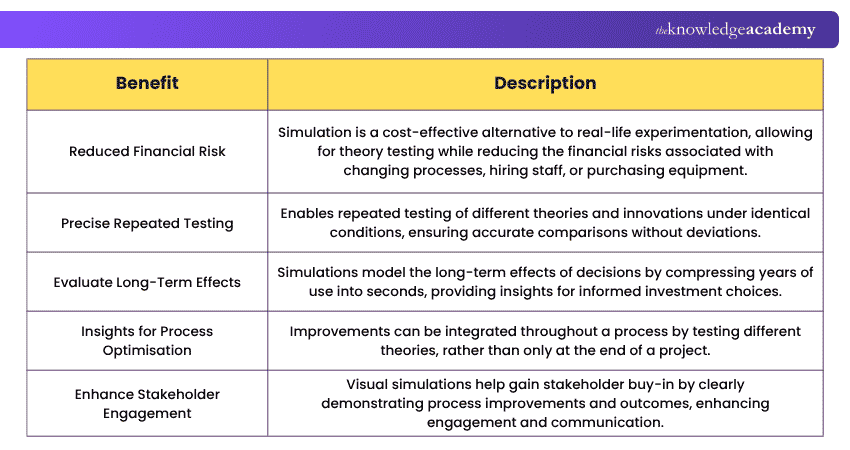
Benefits of Simulation
Simulation can offer substantial benefits, from day-to-day decisions to future business strategies. These advantages are summarised in the table below:
Examples of Simulation
These prominent examples will illustrate how the concept of Simulation is revolutionising diverse industries and make them future-ready
Automotive
Simulation helps a real vehicle to be replicated in a virtual environment. This makes the driver feel as if they are sitting in a real car. Numerous scenarios can be mimicked to give the driver a fully immersive experience.
These types of simulators really useful for training both new and experienced drivers by offering a route for teaching driving skills that can reduce maintenance and fuel costs. Moreover, it ensures the safety of the drivers themselves.
Engineering Systems
Engineering systems, including its operations and functions of equipment, processes and procedures, can be effectively imitated through Simulation. Engineering Simulations blend computer-assisted Simulation and mathematical models to design or improve existing processes.
Ergonomic
You can analyse working environments and virtual products by incorporating an anthropometric virtual representation of a human. This is also known as a Digital Human Model (DHM). DHMs can imitate the capabilities and performance of humans in simulated environments and boast applications ranging from assembly lines and disaster management to waste collection and video gaming.
Flight Simulations
Flight simulators provide a safe environment for training new pilots. It allows for a thorough assessment without any risk to the pilot, instructor, or aircraft. They also help in testing instrument failures and other potential issues under controlled conditions.
Additionally, simulators help pilots repeatedly practise identical scenarios, such as landing approaches, under diverse conditions. This helps reduce operational costs and fuel consumption compared to real flight time.
Biomechanics Studies
Biomechanics can employ Simulation to create models of anatomical structures. This has huge applications in designing medical treatments and devices. Biomechanics Simulation can help you study performances of the human body, simulate surgical procedures, and analyse joint loads. Another exciting example is neuromechanical Simulation. It unites biomechanics with neural network Simulation to test hypotheses in a virtual environment.
Urban and City Planning
You can design new cities and urban environments using Simulation. You can also test how existing urban regions can evolve due to policy decisions including traffic flow and city infrastructure.
Digital Lifecycle Management
Simulations can help you with product design. This allows for digital prototyping and testing to develop better performing products with a shorter time-to-market. You can also evaluate the lifecycle of the finished product.
Disaster Response Planning
Disaster preparedness is of utmost importance across nations.
As such, Simulations can replicate such emergency situations, including training and designing responses to events such as:
a) Natural disasters
b) Office hazards
c) Pandemics
d) Terrorist attacks
The responses can be monitored through the Simulation, spotlighting potential problems and areas where more training may be needed for responders.
Economics and Finance
Fields such as Finance and Economics benefit greatly from Simulations. A mathematical model of the economy can be tested using historical data which serves as a proxy for the actual economy. This can be used for the following:
a) Assess inflation
b) Assess unemployment
c) Evaluate balance of trade and budgets
d) Replicate the stock exchange
e) Test financial models
Banks also employ Simulations to imitate payment and securities settlement systems.
Marine Vessel Simulations
Simulation is not limited to flight Simulation, as you can simulate working in a ship or submarine. Simulators can include those that mimic the following:
a) Bridge
b) Engine rooms
c) Cargo handling bays
d) Communications
e) Remotely operated vehicles
These are widely used in training the Navy.
Master the concept of Digital Twin and gain insight into its amazing applications in our Digital Twin Course – Register now!

The Knowledge Academy develops accessible learning content across Project Management, IT, Cybersecurity, Data Science, Business Analysis, HR, Accounting and Finance, Leadership and Health and Safety. Its resources combine subject research with clear explanations to help professionals build practical knowledge across a wide range of disciplines.
View Detail

 If you wish to make any changes to your course, please


