


 Top Rated Course

We may not have the course you’re looking for. If you enquire or give us a call on +44 1344 203999 and speak to our training experts, we may still be able to help with your training requirements.
What is the Transport Layer? Key Responsibilities and Protocols
Lily Turner 22 April 2026The Transport Layer is the fourth layer of the OSI model, responsible for managing an efficient data flow between the hosts and end systems. It ensures smooth transmission by handling segmentation, flow control, error detection, and retransmission, delivering reliable, ordered, and error-checked data for seamless end-to-end communication.
Home
 Resources
IT Infrastructure & Networking
What is the Transport Layer? Key Responsibilities and Protocols
Resources
IT Infrastructure & Networking
What is the Transport Layer? Key Responsibilities and Protocols
Resources
IT Infrastructure & Networking
What is the Transport Layer? Key Responsibilities and Protocols

Training Outcomes Within Your Budget!
We ensure quality, budget-alignment, and timely delivery by our expert instructors.
Table of Contents
While browsing through your favourite online store or surfing over your favourite blogs, you must have come across a browser lock indicator in the URL section; if so? You are observing the Transport Layer at work. It is the technology that is responsible for keeping your online interactions secure by coding the exchanged data between the browser and your website server.
In this blog, we will be discussing how the Transport Layer works, its key responsibilities and protocols. Read ahead to learn more!
Table of Contents
1) What is the Transport Layer?
2) How the Transport Layer Works?
3) Responsibilities of a Transport Layer
4) Protocols of a Transport Layer
5) Transport Layer in TCP/IP Model
6) Conclusion
What is the Transport Layer?
In the Open Systems Interconnection (OSI) model of networking, the Transport Layer is the fourth layer. It ensures reliable communication by breaking data into segments, managing error detection, retransmission, and controlling the flow of data. Its primary task is to ensure the data is travelling smoothly between the two communication systems.
Transport Layer protocols include Transmission Control Protocol (TCP), which provides reliable, connection-oriented communication, and User Datagram Protocol (UDP), which offers faster, connectionless communication.
How the Transport Layer Works?
The Transport Layer acts like a careful organiser, making sure data is broken into manageable pieces and arrives in the right order. It provides reliability and control so that communication between systems runs smoothly.
1) Segmentation: Breaks large data into smaller chunks called segments.
2) Reassembly: Puts the received segments back together at the destination.
3) Sequencing: Numbers each segment so they can be re-ordered if they arrive out of sequence.
4) Error Checking: Detects and requests retransmission of corrupted or missing data.
5) Flow Control: Prevents one system from overwhelming another by adjusting the data rate.
Together, these processes ensure that what is sent from one device is accurately and efficiently reconstructed at the other end.
Responsibilities of a Transport Layer
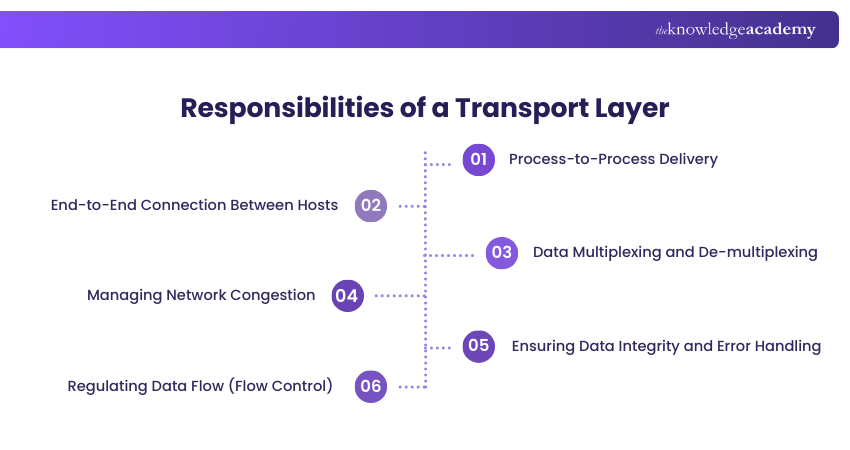
In this section, we will be exploring the various responsibilities of the Transport Layer:
1) Process-to-Process Delivery
It ensures that data sent by one application reaches the correct application. Each application is assigned a port number, and by combining segments with these port numbers, the Transport Layer directs data to the right destination application.
2) End-to-End Connection Between Hosts
Besides transferring data, the Transport Layer establishes a logical end-to-end connection between applications running on different hosts. This ensures that communication from source to destination remains reliable and consistent.
3) Data Multiplexing and De-multiplexing
For multiple applications to use the network at the same time, the Transport Layer multiplexes data streams into a single flow for transmission, and at the receiver’s end, it de-multiplexes the data back to the correct applications.
4) Managing Network Congestion
Congestion occurs when multiple sources on a network are sending data simultaneously, leading to slowdowns or packet loss. The Transport Layer applies open-loop mechanisms to prevent congestion and closed-loop mechanisms to detect and reduce it, ensuring efficient communication.
5) Ensuring Data Integrity and Error Handling
During transmission, the Transport Layer uses error-detection codes such as checksums. These mechanisms help identify corrupted data, request retransmission if necessary, and ensure that only accurate information is delivered to the user.
6) Regulating Data Flow (Flow Control)
The Transport Layer uses flow control mechanisms to prevent overwhelming the receiver with excessive data. Techniques such as the sliding window protocol regulate transmission rates, ensuring smooth and loss-free communication.
Gain knowledge of how to install, configure and troubleshoot Domain Name Service (DNS) by registering in our Ubuntu Linux Server Administration Training now.
Protocols of a Transport Layer
The Transport Layer functions with a set of protocols regarding how data is sent, received and organised. Generally, the two common Transport Layer protocols are:

1) User Datagram Protocol (UDP)
UDP is a connectionless protocol that is deemed to be unreliable since it does not utilise acknowledgement or guarantee delivery. Even though it is unreliable, it ensures efficiency, making it better suited for real time applications such as video conferencing and video calls.
2) Transmission Control Protocol (TCP)
On the other hand, TCP is a connection-oriented protocol, establishing a direct end-to-end connection between the application and its users. Unlike its counterpart, it is highly, reliable ensuring the delivery and retransmission of lost packets. Such reliability makes it suitable for web browsing, e-mail, etc.
3) Quick UDP Internet Connections (QUIC) Protocol
QUIC is a relatively new protocol designed to combine the reliability of TCP with the efficiency of UDP. Other Transport Layer protocols include Fibre Channel Protocol (FCP), Reliable Data Protocol (RDP) and Stream Control Transmission Protocol (SCTP). All these various protocols are designed for a particular task, depending upon the application.
Understand the OSI and TCP/IP models with our CompTIA Network+ Training - Register now!
Transport Layer in TCP/IP Model
The OSI model is a conceptual reference framework that explains how communication between systems can be structured. In contrast, the TCP/IP model is a practical framework widely implemented in modern computer networks and the Internet.
In the TCP/IP model, the Transport Layer acts as an intermediary between the Internet Layer and the Application Layer. Its main objective is to ensure reliable and orderly transmission of data across the network.
Conclusion
The Transport Layer is an essential component of both the OSI and TCP/IP models. It links applications with the underlying network, ensuring data is delivered reliably, efficiently, and securely. In fulfilling this role, it manages segmentation, error detection, and flow control, which enable smooth end-to-end communication and provide the stability users expect from the Internet.
Learn essential IT skills with our IT Support and Solution Training - Join now!
Frequently Asked Questions
What is the Main Purpose of Transport Layer?

The main purpose of the Transport Layer is to provide an efficient and reliable end-to-end communication between applications running on different systems. It ensures that data over the network is safeguarded, transferred accurately, and managed with flow control, handling errors and multiplexing for a fluid experience.
What is TCP and UDP in the Transport Layer?
TCP and UDP are the two main protocols in the Transport Layer. TCP is connection-oriented ensuring reliability, on-time delivery and error-proof data. Whereas UDP is connectionless, which is faster but does not guarantee timely or reliable delivery. Both are important and suited to support different applications.
What are the Other Resources and Offers Provided by The Knowledge Academy?
The Knowledge Academy takes global learning to new heights, offering over 3,000+ online courses across 490+ locations in 190+ countries. This expansive reach ensures accessibility and convenience for learners worldwide.
Alongside our diverse Online Course Catalogue, encompassing 17 major categories, we go the extra mile by providing a plethora of free educational Online Resources like Blogs, eBooks, Interview Questions and Videos. Tailoring learning experiences further, professionals can unlock greater value through a wide range of special discounts, seasonal deals, and Exclusive Offers.
What is The Knowledge Pass, and How Does it Work?
The Knowledge Academy’s Knowledge Pass, a prepaid voucher, adds another layer of flexibility, allowing course bookings over a 12-month period. Join us on a journey where education knows no bounds.
What are the Related Courses and Blogs Provided by The Knowledge Academy?
The Knowledge Academy offers various IT Support and Solution Training, including Introduction to Networking Training, IT Fundamentals Training and Introduction to Domain Names and Web Hosting Training. These courses cater to different skill levels, providing comprehensive insights into Application Layer in OSI Model.
Our IT Infrastructure & Networking Blogs cover a range of topics Network Layers, offering valuable resources, best practices, and industry insights. Whether you are a beginner or looking to advance your IT Infrastructure & Networking skills, The Knowledge Academy's diverse courses and informative blogs have got you covered.

Lily Turner


Senior AI/ML Engineer and Data Science Author
Lily Turner is a data science professional with over 10 years of experience in artificial intelligence, machine learning, and big data analytics. Her work bridges academic research and industry innovation, with a focus on solving real-world problems using data-driven approaches. Lily’s content empowers aspiring data scientists to build practical, scalable models using the latest tools and techniques.
View Detail
Upcoming IT Infrastructure & Networking Resources Batches & Dates
Date
 Introduction to Networking Training
Introduction to Networking Training
Fri 19th Jun 2026
Introduction to Networking Training
Fri 7th Aug 2026
Introduction to Networking Training
Fri 16th Oct 2026

 If you wish to make any changes to your course, please


