


 Top Rated Course

We may not have the course you’re looking for. If you enquire or give us a call on +44 1344 203999 and speak to our training experts, we may still be able to help with your training requirements.
Functional System Testing in ISTQB: Explained
Richard Harris 20 June 2026Functional System Testing in ISTQB focuses on validating that a system meets specified functional requirements, ensuring all features work as intended. Interested in learning Functional System Testing in ISTQB? Read this blog to learn all you need to know, including creating the framework, challenges and more.

Training Outcomes Within Your Budget!
We ensure quality, budget-alignment, and timely delivery by our expert instructors.
Table of Contents
A globally recognised organisation that offers certifications in software testing is International Software Testing Qualifications Board (ISTQB). This certification includes different testing methods, and one such method is Functional System Testing in ISTQB, which is a vital part of software development.
Keep reading to learn about the details and importance of Functional System Testing in ISTQB, which checks a software system against functional requirements and specifications.
Table of Contents
1) What is ISTQB?
2) What is Functional System Testing in ISTQB?
3) Creating a Framework for Functional System Testing
4) Challenges and Solutions in Functional System Testing
5) Conclusion
What is ISTQB?
The International Software Testing Qualifications Board (ISTQB) certifications provide professionals with a standardised understanding of software testing concepts, methodologies, and best practices, emphasising the importance of ISTQB Certification for career advancement. By acquiring an ISTQB certification, individuals can demonstrate their competence and credibility in software testing.
Obtaining an ISTQB certification offers several benefits, such as enhancing your knowledge and skills in software testing and enabling you to perform your roles more effectively. For those applying for ISTQB Certification, it validates expertise in industry-recognised practices and significantly boosts career prospects, while helping organisations improve software quality and reduce testing costs.

What is Functional System Testing in ISTQB?
Functional System Testing can be defined as the process of testing a software system to ensure that it functions correctly and meets the specified functional requirements. It focuses on testing the entire system, including its interactions with other systems, databases, and users.
Organisations can identify defects and generate a Defect Report in ISTQB during functional system tests, ensuring that the system behaves as expected in real-world scenarios. Functional System Testing holds immense importance in the software development process. It helps uncover issues related to system functionality, user interfaces, integration, and data flow.
Organisations can deliver high-quality software that meets customer expectations and enhances user satisfaction by validating the system against the functional requirements. Functional System Testing is an essential aspect of software testing that ensures the functionality of a system meets the specified requirements. The Software Development Life Cycle (SDLC) includes many components, including Functional System Testing, which involves testing the entire system rather than individual components.
Gain the deep knowledge of the testing process with the ISTQB Certified Tester Advanced Level Test Management Course – Register today!
Creating a Framework for Functional System Testing
It is crucial to follow a structured framework to ensure the effectiveness of Functional System Testing. The following framework outlines the key steps involved in conducting functional system tests:
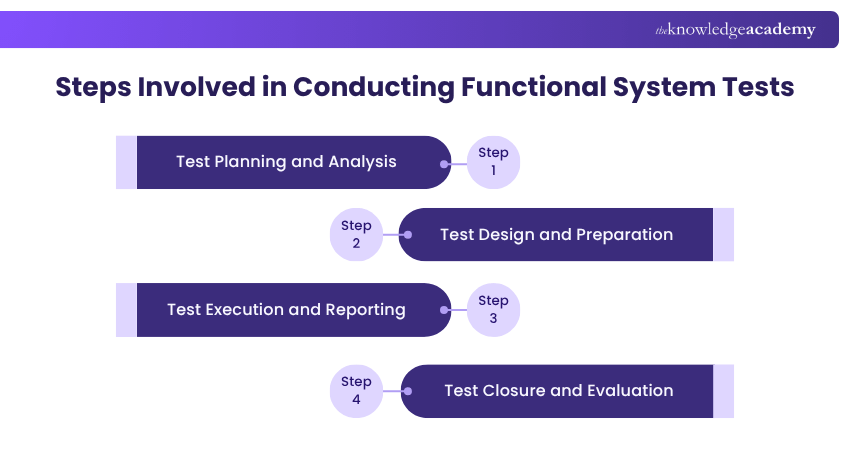
Step 1: Test Planning and Analysis
Identify the functional requirements to be tested. Define the test objectives and scope. Prepare a test strategy and test plan. Determine the required resources and timelines for testing.
Step 2: Test Design and Preparation
Develop test cases based on the functional requirements. Generate test data to simulate different scenarios. Set up the test environment with necessary hardware and software. Review and refine the test cases to ensure completeness and accuracy.
Step 3: Test Execution and Reporting
Execute the test cases according to the test plan. Record the test results and capture any defects. Report defects to the development team for resolution. Monitor and track the testing progress using appropriate metrics.
Step 4: Test Closure and Evaluation
Review the test results and analyse the test coverage. Prepare test closure reports summarising the testing activities. Conduct a retrospective to identify lessons learned. Evaluate the overall testing process and suggest improvements.
Upgrade your testing skills and get certified with our ISTQB Software Testing Foundation Course today!
Challenges and Solutions in Functional System Testing
Functional System Testing comes with its own set of challenges. By understanding these challenges and implementing suitable solutions, organisations can overcome them effectively.
Dealing With Complex Systems
Functional System tests often involve complex systems with intricate interactions. To address this challenge and maximise the Benefits of ISTQB Certifications, invest in thorough requirement analysis, create comprehensive test cases, and perform end-to-end testing to verify system behaviour.
Handling Changing Requirements
Agile development methodologies often lead to evolving requirements. In such cases, adaptability and flexibility are crucial. Maintain open communication channels with Stakeholders and employ effective change management practices to ensure testing meets changing requirements.
Managing Time and Resource Constraints
Limited time and resources can impact the depth and breadth of Functional System Testing. Prioritise testing activities based on risk analysis, allocate resources effectively and leverage automation tools to optimise testing efforts.
Master the art of seamless software quality with our Software Testing Automation Course – Sign up now!
Conclusion
Functional System Testing in ISTQB is a vital software testing component that ensures the proper functioning of a system. By following a structured framework, organisations can conduct effective functional system tests and identify defects early in the SDLC. ISTQB certifications, along with preparing for ISTQB Interview Questions, further enhance the expertise of professionals in this field, enabling them to contribute to improved software quality and customer satisfaction.
Elevate your testing career by exploring advanced techniques with the ISTQB Advanced Level Test Analyst Course – Join now!
Frequently Asked Questions
When is Functional System Testing Performed in the Testing Lifecycle?

Functional System Testing is performed after integration testing and before user acceptance testing in the software testing lifecycle. At this stage, the complete system is tested against functional requirements to ensure all features work together correctly under expected real-world conditions.
Who is Responsible for Functional System Testing?
Functional System Testing is typically carried out by dedicated testing teams or Quality Assurance (QA) professionals. In some cases, independent testers or Test Engineers may also be involved to ensure unbiased results. Their role is to validate that the system meets functional requirements and behaves as expected.
What are the Other Resources and Offers Provided by The Knowledge Academy?
The Knowledge Academy takes global learning to new heights, offering over 3,000+ online courses across 490+ locations in 190+ countries. This expansive reach ensures accessibility and convenience for learners worldwide.
Alongside our diverse Online Course Catalogue, encompassing 17 major categories, we go the extra mile by providing a plethora of free educational Online Resources like Blogs, eBooks, Interview Questions and Videos. Tailoring learning experiences further, professionals can unlock greater value through a wide range of special discounts, seasonal deals, and Exclusive Offers.
What is The Knowledge Pass, and How Does it Work?
The Knowledge Academy’s Knowledge Pass, a prepaid voucher, adds another layer of flexibility, allowing course bookings over a 12-month period. Join us on a journey where education knows no bounds.
What are the Related Courses and Blogs Provided by The Knowledge Academy?
The Knowledge Academy offers various Software Testing Courses, including ISTQB Software Testing Foundation Course, ISTQB Advanced Security Testing Training and ISTQB Advanced Level Test Analyst Training. These courses cater to different skill levels, providing comprehensive insights into Software Testing Techniques.
Our Business Analysis Blogs cover a range of topics related to Functional System Testing in ISTQB, offering valuable resources, best practices, and industry insights. Whether you are a beginner or looking to advance your Software Testing skills, The Knowledge Academy's diverse courses and informative blogs have got you covered.

Richard Harris


Senior Full Stack Developer and Technology Educator
Richard Harris is a highly experienced full-stack developer with deep expertise in both frontend and backend technologies. Over his 12-year career, he has built scalable web applications for startups, enterprises and government organisations. Richard’s writing combines technical depth with clear explanations, ideal for developers looking to grow in modern frameworks and tools.

Upcoming Business Analysis Resources Batches & Dates
Date
 ISTQB Certified Tester Advanced Level Test Management Course
ISTQB Certified Tester Advanced Level Test Management Course
Mon 7th Sep 2026
ISTQB Certified Tester Advanced Level Test Management Course
Mon 7th Dec 2026

 If you wish to make any changes to your course, please


