


 Top Rated Course

We may not have the course you’re looking for. If you enquire or give us a call on +44 1344 203999 and speak to our training experts, we may still be able to help with your training requirements.
What Are Data Structures and Algorithms? Explained with Examples
Lily Turner 28 April 2026Data Structures and Algorithms (DSA) focus on organising data efficiently and creating optimised step-by-step solutions for faster and accurate problem solving. Strengthens your understanding of core concepts, optimise solutions, and confidently tackle complex programming challenges. Gain expertise and succeed in competitive coding.
Home
 Resources
Programming & DevOps
What Are Data Structures and Algorithms? Explained with Examples
Resources
Programming & DevOps
What Are Data Structures and Algorithms? Explained with Examples
Resources
Programming & DevOps
What Are Data Structures and Algorithms? Explained with Examples

Training Outcomes Within Your Budget!
We ensure quality, budget-alignment, and timely delivery by our expert instructors.
Table of Contents

The programming world is not limited to producing working code; it’s also about achieving high performance and solving problems efficiently. Data Structures and Algorithms (DSA) are the main things that make every application that has good performance work. Getting hold of these ideas can change the way you approach coding and interviews.
A reliable DSA base, from cracking technical interviews to developing scalable software, can open a great variety of opportunities. In this blog, you are going to explore how to organise data and optimise algorithms, which can save time, reduce errors, and give you a competitive edge.
Table of Contents
1) Understanding Data Structures and Algorithms
2) Importance of Data Structures and Algorithms in Programming
3) The Relationship Between Data Structures and Algorithms
4) Types of Algorithms
5) Types of Data Structures
6) Key Characteristics of an Algorithm
7) Common Mistakes to Avoid When Learning DSA
8) Big O Notation and Time Complexity
9) Real-world Applications of Data Structures and Algorithms
10) Data Structures and Algorithms in Coding Interviews
11) How Do You Analyse an Algorithm in Data Structure?
12) How Does an Algorithm Differ From a Flowchart?
13) Conclusion
Understanding Data Structures and Algorithms
Data Structures and Algorithms is a foundational concept in the Computer Science and Software Development domain. Let's break down what Algorithms and Data Structures entail:

1) Data Structures
Data Structures are the fundamental units that allow us to organise and store data efficiently. Think of them as containers that hold and manage information in a structured manner. Properly chosen Data Structures can significantly impact the efficiency and performance of an Algorithm. Let's explore an example of Data Structures:

The above is an example of an array, which is a critical component in Data Structures. In that example, we've explored how to create it.
Unleash your coding potential with our Python Programming Training – Sign up now!
2) Algorithms
Algorithms, in contrast, are step-by-step instructions for solving a particular problem. They define the logic and operations required to manipulate and process data stored in Data Structures. Efficient Algorithms are vital for optimising resource usage and improving the execution time of programs. Let's explore an example of Algorithm:
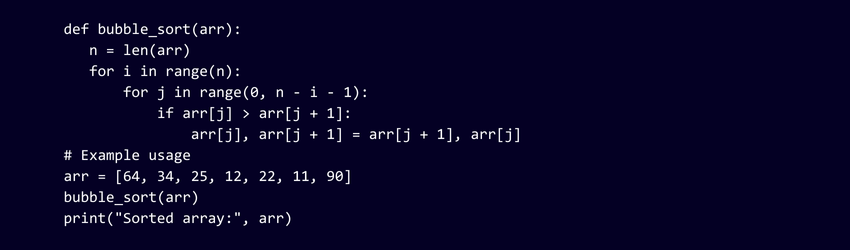
The above is an example of a Bubble sort Algorithm. Bubble sort is an effortless sorting Algorithm that repeatedly steps through the list. It differentiates adjacent elements and swaps them if they are in the wrong order.
Importance of Data Structures and Algorithms in Programming
Data Structures and Algorithms are fundamental to the programming world, from software performance to AI, web development, and beyond. Here are some of the major importance of DAS in programming:

1) Boost Software Performance: Good Data Structures and Algorithms make the software run faster, require less storage, and process larger data sets, making applications more scalable and reliable.
2) Handle Big Data: A must for efficient processing, storing, and analysing huge stacks of data, and facilitating the data mining and parallel processing.
3) Foundation for AI & ML: Structured algorithms always support the learning and prediction processes of many AI and ML models (e.g. decision trees, neural networks).
4) Enhance Web Development: databases, search algorithms, and data management are the backbone of all websites and applications, ensuring a pleasant user experience.
5) Optimise Computer Networks: They are applied for routing, congestion control, and network layout to enhance the performance and ensure the reliability of the communication.
6) Improve Gaming Experiences: The acts of pathfinding, game-state management, and object storage are dependent on sophisticated Data Structures and Algorithms, which make gameplay more interesting.
7) Enable Cryptography: The secure exchange of information via algorithms and the protection of sensitive data using strong mathematical foundations.
8) Support Scientific Simulations: Simulations like weather forecasting and molecular dynamics undergo efficient data processing and accurate prediction generation.
9) Drive Financial Services: Algorithmic trading, risk management, and transaction processing are all heavily reliant on the use of fast and accurate high-quality algorithms.
The Relationship Between Data Structures and Algorithms
Understanding the collaboration between Data Structures and Algorithms is key to designing robust and efficient software solutions. Let’s talk about this in detail:
1) Reciprocal Impact: The interplay between Data Structures and Algorithms is critical; the choice of one can greatly affect the performance of the other.
2) Enhancing Efficiency: The strategic selection of Data Structures can significantly improve the efficiency of Algorithms. Utilising a hash table, for example, can accelerate search processes and increase the speed of search Algorithms.
3) Essential for Problem-solving: Proficiency in both Data Structures and Algorithms is vital for solving complex problems in Computer Science, as they provide the foundation for creating effective and efficient solutions.
4) Optimisation of Algorithms: The relationship between Data Structures and Algorithms allows for the optimisation of Algorithms through the careful selection of the most suitable Data Structures, enhancing performance and conserving resources.
5) Synergistic Role: Data Structures are the backbone for organising and storing data, while Algorithms are the strategies used for processing this data effectively, demonstrating their combined role in software development.
Unleash your coding potential with our Python Course – Sign up now!
Types of Algorithms
Algorithms are the engines that drive the manipulation and processing of data in these Data Structures. Here are some essential Algorithms to be aware of:

1) Sorting Algorithms: Sorting Algorithms arrange elements in a specified order, be it ascending or descending. Common sorting Algorithms include Bubble Sort, Merge Sort, Quick Sort Algorithm, and more.
2) Searching Algorithms: Searching Algorithms are used to find a specific element in a dataset. Binary search and linear search are widely used search techniques.
3) Graph Algorithms: Graph Algorithms, such as Dijkstra's Algorithm and breadth-first search, are used to solve problems related to networks, routing, and traversal.
4) Dynamic Programming: Dynamic Programming is a strategy used to solve complex problems by breaking them into smaller, overlapping subproblems. It's commonly used for optimisation problems, such as the Fibonacci sequence or the Knapsack problem.
5) Divide and Conquer: The divide-and-conquer approach tactic includes dividing an issue into smaller subproblems and solving them independently. Algorithms like the Fast Fourier Transform (FFT) and the merge step in merge sort follow this paradigm.
Elevate your coding skills with our comprehensive Ruby Programming Course – Register now and start building amazing applications!
Types of Data Structures
Data Structures form the fundamentals of Computer Science, serving as the essential containers for organising and storing data. Here are some of the key Data Structures frequently used in various programming and Algorithmic tasks:
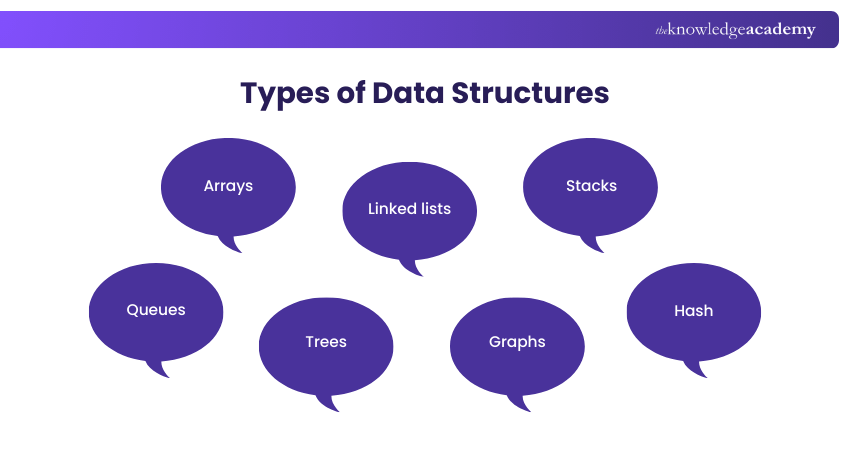
1) Arrays: An array is a sequential Data Structure that holds a set of items sharing the same type. It ensures that elements are stored in adjacent memory locations, which facilitates access in constant time due to each element’s distinct index.
2) Linked lists: It is a sequential Data Structure that organises information into individual elements known as nodes. Each node contains data and a pointer that links to the next node, creating a chain. Distinct from arrays, linked lists do not require consecutive memory spaces, offering greater flexibility in memory allocation.
3) Stacks: A stack is a structured data model that adheres to a specific sequence for executing operations. This sequence is typically characterised as LIFO (Last In, First Out), meaning the most recently added element is the first to be removed. Alternatively, it can be described as FILO (First In, Last Out), where the initial element added is the last to be retrieved. Understanding Stack vs Queue is essential, as a queue follows a different operational structure, typically FIFO (First In, First Out), where the first element added is the first to exit. Essentially, LIFO denotes that the last element to enter is the first to exit, while FILO indicates the first element to enter is the last to exit.
4) Queues: A queue is another linear Data Structure that follows the First-In-First-Out (FIFO) principle. It is used for tasks like scheduling, managing resources, and modelling real-world scenarios where entities are processed in the order they arrive.
5) Trees: These are hierarchical Data Structures with root nodes and child nodes. They have applications in organising data hierarchically and are used for tasks like searching and hierarchical data representation. Common types of trees include binary trees, binary search trees, and Adelson-Velsky and Landis (AVL) trees.
6) Graphs: Graphs are versatile data structures used to model relationships between entities. They consist of nodes (vertices) and edges (connections), making them suitable for applications like social networks, route finding, and network modeling. One important concept in graph theory is the Minimum Spanning Tree, which is used to find the shortest possible path that connects all nodes in a graph. Graphs come in various forms, including directed and undirected graphs.
7) Hash: A hash data structure, which is also referred to as a "hash table" or "hash map", stores the data values by means of a hash function. The hash function generates a hash, which is a special digital key representing the place of a particular data value in memory. A hash table keeps a searchable index and a data value, which makes it fast and convenient for accessing, adding, and removing data from the table.
Such Data Structures serve as the building blocks for solving a wide range of problems in Computer Science and Software Development. Each has its strengths and weaknesses, and the choice of the right Data Structure depends on the specific requirements of a given task. Understanding how to select and use these Data Structures effectively is a crucial skill for any Programmer or Computer Scientist.
Key Characteristics of an Algorithm
There are mainly five different characteristics that deal with different aspects of an algorithm. They are:
1) Input Specified: An algorithm should have clearly defined inputs, detailing what data is needed, in what form, and in what quantity. This ensures the process begins with precise and valid information.
2) Output Specified: It should always output the well-defined results that are expected. The kind, the format, and the nature of the output have to be explicitly mentioned from the very beginning.
3) Definiteness: The algorithm must be spelt out in every step with the utmost clarity and precision, with no room for ambiguity. The operations should be enumerated in full so that nothing is left to interpretation or confusion.
4) Effectiveness: All steps in the algorithm must be practical, executable, and free from unnecessary complexity. Each operation should be feasible using available resources.
5) Finiteness: An algorithm is required to always end after a definite number of steps. It must not go on forever and should eventually either produce a solution or a definite indication that no solution exists.
Common Mistakes to Avoid When Learning DSA
When learning DSA, certain common mistakes can eventually lead to slow progress and can even lead to an inability to stay consistent in the long run. The common mistakes to avoid are:
1) Completely depending on the YouTube playlists without pairing them up with practical training or taking a structured approach
2) Working alone rather than taking learning peers or communities as a source of support and accountability for one’s learning process
3) Not reviewing others' feedback and losing the opportunity to see different angles of solving the problem
4) Attempting to solve problems without a timer results in poor time management and stagnant progress
5) Taking on too many projects at the same time and leaving some uncompleted due to either inconsistency or being overwhelmed
Big O Notation and Time Complexity
The Big O Notation is a mathematical concept applied to describe the changes in the runtime or memory requirements of an algorithm with the increase in input size. It is a way for developers to compare the efficiency of various solutions by looking at their performance in the most unfavourable situation.
To understand time complexity better, here are the most common Big O classes:
1) O(1) – Constant time, where performance remains unchanged regardless of input size.
2) O(log n) – Logarithmic time, seen in algorithms like binary search.
3) O(n) – Linear time, where the runtime grows proportionally with the input.
4) O(n log n) – Linearithmic time, common in efficient sorting algorithms.
5) O(n²) – Quadratic time, often caused by nested loops.
6) O(2ⁿ) – Exponential time, where growth doubles with every additional input element.
When programmers comprehend Big O Notation, they are able to pick the best algorithms, cut down on useless calculations and make certain that their apps will be able to scale well with the data size increase.
Real-world Applications of Data Structures and Algorithms
In order to grasp the practical significance of Data Structure and Algorithms, let's explore their role in a few real-world projects:

1) Web Search Engines: Search engines like Google use complex Data Structure and Algorithms to retrieve relevant results quickly. Web pages are indexed using Data Structures like inverted indexes, and searching is made efficient using Algorithms like PageRank.
2) Natural Language Processing (NLP): NLP techniques like Language translation, sentiment analysis, and chatbots use Algorithms to process and understand human language, enabling communication and automation.
3) Social Media Networks: Social networks like Facebook employ Algorithms to recommend friends, content, and ads. Graph Algorithms are crucial for establishing connections and relationships between users.
4) E-commerce Recommendations: E-commerce platforms like Amazon rely on recommendation systems that use collaborative filtering Algorithms to recommend products to users, as per their past behaviour and preferences.
5) GPS Navigation: Navigation apps like Google Maps use graph Algorithms to find the shortest and fastest routes between locations. Data Structures like maps and spatial indexes facilitate efficient map retrieval.
6) Software Development: Data Structures and Algorithms are fundamental in Software Development. They are used to design efficient data storage solutions, improve program performance, and ensure that applications can scale to tackle large amounts of data.
7) Data Analysis: In Data Science and Analytics, Algorithms are used to process, analyse, and derive insights from vast datasets. Data Structures like trees and hash tables are employed for efficient data storage and retrieval.
Become a pro in coding with our Programming Training – Sign up today!
Data Structures and Algorithms in Coding Interviews
The importance of Data Structures and Algorithms goes beyond just project development. They are also extremely crucial in coding interviews. Tech companies often assess candidates' problem-solving skills through Algorithmic questions.
Here are some tips for mastering Algorithms and Data Structures in coding interviews: If you're preparing for a tech role, reviewing Data Structure Interview Questions can help you sharpen your skills and better understand the types of challenges you may face during the interview process.
1) Start With the Basics: Start your learning journey by gaining a fundamental understanding of Data Structure and Algorithms. This involves comprehending their significance and diving into essential topics to build a strong foundation.
2) Choose a Programming Language: There are multiple programming languages available right now. So, select one from the List of Programming Languages that you are comfortable with or interested in. You'll need this language to implement and experiment with DSA.
3) Practice Consistently: Actively practice what you learn on Algorithms and Data Structures. Work on problems and coding challenges related to the Data Structures and Algorithms you're studying. Practice is essential to reinforce your understanding.
4) Understand Time and Space Complexity: Learn how to analyse the time and space complexity of Algorithms. This skill will help you assess the efficiency of your code and make informed design choices.
5) Online Resources and Courses: Utilise online resources, courses, and communities dedicated to DSA. These can provide structured learning and support, making your journey more efficient.
Remember that learning DSA is a gradual process. It's okay to start with the basics and progressively work your way up to more advanced topics. Patience, practice, and persistence are key to mastering these fundamental concepts in Computer Science.
How Do You Analyse an Algorithm in Data Structure?
Analysing an algorithm entail looking at its time and space complexities to see how it reacts when the input size increases. The counting of operations, the checking of memory usage, and the assessment of the overall efficiency are done. It is all about finding a way to tell if the algorithm is scalable and optimal for the problem.
How Does an Algorithm Differ From a Flowchart?
Algorithms and flowcharts are two distinct ways of representing the same logic for program design, especially in computer programming. An algorithm can be defined as a description of the process in a series of steps, while conversely, a flowchart is a graphical representation of the program's steps.
Conclusion
Data Structures and Algorithms are fundamentally the elements of strong programming skills, allowing you to solve complex problems in an efficient manner and develop critical thinking like a programmer. The ability to handle these concepts not only increases your programming power but also gives you access to cutting-edge technologies and competitive tech professions.
Kickstart your coding career with our D Programming Language Training – join now!
Frequently Asked Questions
What is Stack in Data Structure?

A stack is a linear data structure that stores elements in an ordered sequence and functions as an abstract data type. It operates on the LIFO (Last In, First Out) principle, meaning the most recently added element is the first one to be removed.
What are the Advanced Data Structures in Computer Science?
Advanced Data Structures include balanced trees (AVL, Red Black), B-trees, tries, segment trees, suffix trees, and Fibonacci heaps. These structures optimise complex operations like searching, sorting, and dynamic updates, which are essential for high-performance computing tasks.
What are the Other Resources and Offers Provided by The Knowledge Academy?
The Knowledge Academy takes global learning to new heights, offering over 3,000+ online courses across 490+ locations in 190+ countries. This expansive reach ensures accessibility and convenience for learners worldwide.
Alongside our diverse Online Course Catalogue, encompassing 17 major categories, we go the extra mile by providing a plethora of free educational Online Resources like Blogs, eBooks, Interview Questions and Videos. Tailoring learning experiences further, professionals can unlock greater value through a wide range of special discounts, seasonal deals, and Exclusive Offers.
What is The Knowledge Pass, and How Does it Work?
The Knowledge Academy’s Knowledge Pass, a prepaid voucher, adds another layer of flexibility, allowing course bookings over a 12-month period. Join us on a journey where education knows no bounds.
What are Related Courses and Blogs Provided by The Knowledge Academy?
The Knowledge Academy offers various Programming Trainings, including the Data Structure and Algorithm Training, R Programming Course, and Bootstrap Training. These courses cater to different skill levels, providing comprehensive insights into What is Programming.
Our Programming & DevOps Blogs cover a range of topics related to Data Structures and Algorithms, offering valuable resources, best practices, and industry insights. Whether you are a beginner or looking to advance your Programming skills, The Knowledge Academy's diverse courses and informative blogs have got you covered.

Lily Turner


Senior AI/ML Engineer and Data Science Author
Lily Turner is a data science professional with over 10 years of experience in artificial intelligence, machine learning, and big data analytics. Her work bridges academic research and industry innovation, with a focus on solving real-world problems using data-driven approaches. Lily’s content empowers aspiring data scientists to build practical, scalable models using the latest tools and techniques.
View Detail
Upcoming Programming & DevOps Resources Batches & Dates
Date
 Data Structure and Algorithm Training
Data Structure and Algorithm Training
Fri 10th Jul 2026
Data Structure and Algorithm Training
Fri 23rd Oct 2026

 If you wish to make any changes to your course, please


