


 Top Rated Course

We may not have the course you’re looking for. If you enquire or give us a call on +36 18508731 and speak to our training experts, we may still be able to help with your training requirements.
Fishbone Diagram in Root Cause Analysis: A Comprehensive Guide
John Davies 10 June 2026A Fishbone Diagram in Root Cause Analysis helps identify potential causes of a problem by visually mapping contributing factors for effective solutions. The problem is the fish’s head on the right, with causes extending left as bones. Major causes form ribs branching off the backbone, with sub-branches for root causes.

Training Outcomes Within Your Budget!
We ensure quality, budget-alignment, and timely delivery by our expert instructors.
Table of Contents
Table of Contents
1) What is a Fishbone Diagram?
2) Steps to Create a Fishbone Diagram
3) How to Label or Categorise Fishbone Analysis?
4) Example of a Fishbone Diagram
5) Advantages and Disadvantages of Fishbone Diagram Root Cause Analysis
6) What is Better Than Fishbone Diagram?
7) When not to Use a Fishbone Diagram?
8) Conclusion
What is a Fishbone Diagram?
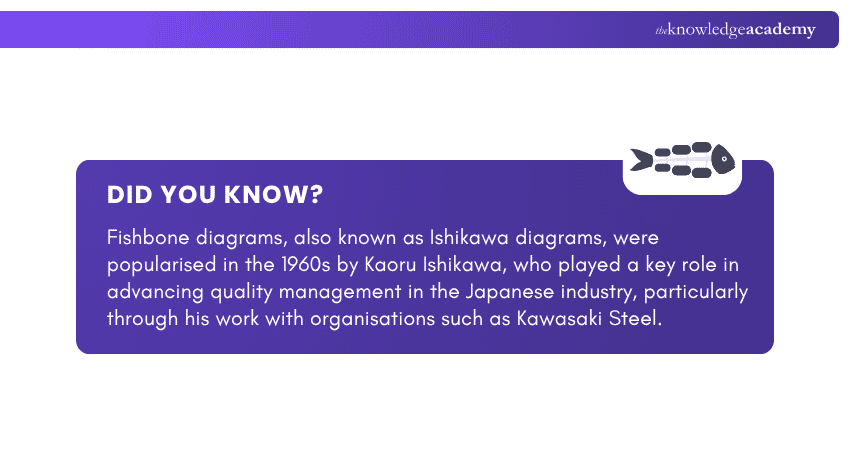
A Fishbone Diagram, also known as an Ishikawa Diagram, is a visual tool for Root Cause Analysis that categorises cause-and-effect relationships in an organised manner. Its nickname, the Fishbone Diagram, comes from its resemblance to a fish skeleton when viewed from the side, making it easier to map out potential causes.
The problem being analysed is placed at the diagram's "head," while the "bones" branching off the central spine represent different categories of contributing factors. It's a fundamental quality control tool and is now recognised as one of the basic tools of quality control.

Steps to Create a Fishbone Diagram
Crafting a What is Root Cause Analysis Fishbone is a structured and systematic process encompassing a series of critical steps. These steps are designed to facilitate an easy identification and examination of the potential causes of a problem. Here’s a detailed breakdown of each step involved in the process:
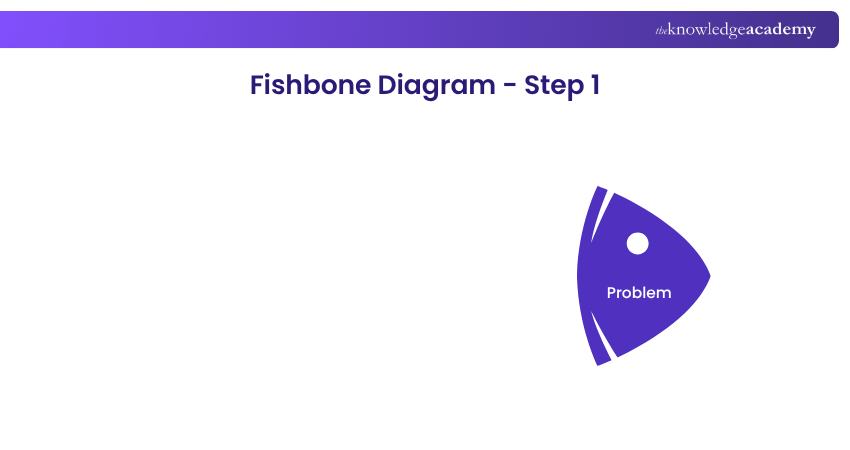
Identify the Problem
Clearly define the issue you're analysing. Write it at the "head" of the fish, usually on the right side of the diagram. Be specific to ensure an effective analysis.
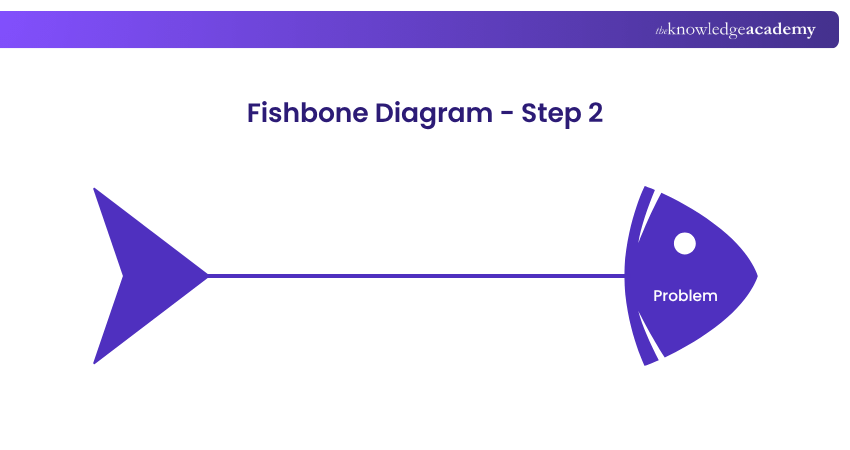
Draw the Backbone
Start with a straight line from the left (the "tail") leading to the problem statement on the right. This line represents the fish’s backbone.
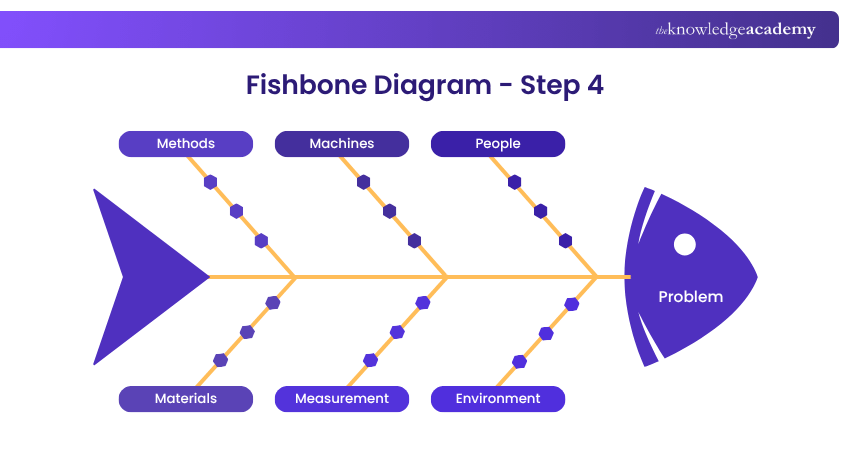
Choose Cause Categories
Identify key categories that might contribute to the problem. Common ones include Methods, Machines, People, Materials, Measurement, and Environment. In IT-related analysis, you might use Products, Processes, People, and Partners. These categories will form the fish’s "ribs."
Add Cause Branches
Draw slanted lines branching out from the backbone to represent each category—these resemble fish bones.
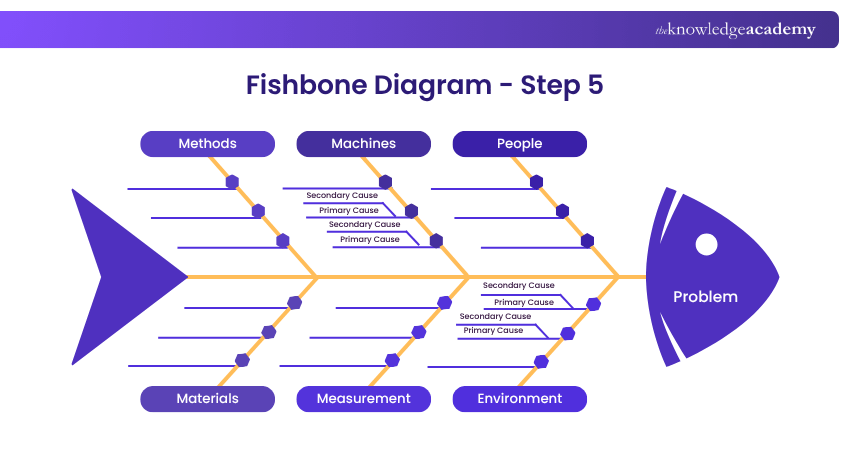
Brainstorm Sub-causes
Under each category, list possible causes that may contribute to the problem. Add smaller branches to represent these sub-causes. Involve your team to get a full picture.
Analyse and Prioritise
After listing all possible causes, carefully review and evaluate each one to determine which are most likely contributing to the problem. Consider patterns, evidence, and expert insights. Engage team members in discussions to prioritise the most significant root causes.
Master various ITIL guiding principles by registering for our ITIL® 4 Leader: Digital and IT Strategy Certification - Sign up now
Take Action
Once the root causes are identified, develop targeted solutions to resolve the problem and prevent recurrence. Assign responsibilities to team members, create a step-by-step action plan, and set deadlines for implementation.
Review and Update
The Fishbone Diagram is not static. As you implement solutions and gather more insights, update the diagram to reflect new findings.
Ready to level up your ITIL skills? Explore our comprehensive ITIL® Certification now!
How to Label or Categorise Fishbone Analysis?
Picking the right categories is key to structuring your Fishbone Diagram. The categories help you organise ideas, making it easier to identify possible causes of a problem. Follow these steps to select the best ones:
Understand the Problem Context
Before choosing the categories, make sure you fully understand the problem. Different issues require different categories, so think about what factors might be involved in your specific situation.
Customise Categories for Your Needs
Adjust the categories based on your industry or type of problem. For example, in customer service, "Procedures" and "Policies" might be useful, while in software development, "Software" and "Hardware" could be more relevant.
Engage the Team
Involve people from different roles who are familiar with the problem. Brainstorming as a team helps uncover overlooked aspects and ensures all relevant areas are covered.
Review Historical Data
Review historical data on similar problems. Past incidents can offer insights into which categories were important before and help you avoid missing key factors.
Be Open to Revision
Be ready to adjust your categories if needed. As you dive deeper into the analysis, you might realise some categories are too broad, too specific, or not relevant at all.
Ensure Comprehensive Coverage
Make sure your selected categories collectively include all possible causes. This ensures a thorough analysis and reduces the risk of missing important root causes.
Example of a Fishbone Diagram
Fishbone Diagrams are widely used across different domains to identify factors contributing to process failures and defects. They help you improve processes by uncovering root causes and preventing quality issues. The following example will illustrate how Fishbone Diagrams play a vital role in diagnosing problems and improving overall quality.
1) Fishbone Diagram for Customer Service Issues in a Call Center
Problem Statement: High customer complaints due to long wait times and unresolved queries.
Here are the facts gathered during the preliminary investigation:
a) Peak Complaint Times: Evenings and weekends
b) Call Types: Billing disputes and technical support requests
c) Employee Turnover Rate: High, with many new hires handling complex queries
d) System Downtime: Frequent slowdowns in the CRM system
e) Customer Feedback: Poor communication, unresolved issues, and long hold times
Fishbone Diagram Analysis – Identified Root Causes:
a) People:
i) High employee turnover, leading to inexperienced agents.
ii) Lack of proper training on handling technical issues.
iii) Agents overwhelmed due to understaffing during peak hours.
b) Process:
i) Inefficient call routing system.
ii) No clear escalation procedure for complex issues.
iii) Lack of follow-up mechanisms for unresolved complaints.
c) Technology:
i) CRM system experiencing frequent downtime
ii) Slow response times due to outdated software
iii) Insufficient integration between different support tools
d) Policy:
i) Unclear refund and dispute resolution policies.
ii) Lengthy approval process for issue resolution.
ii) Lack of consistency in handling similar customer concerns.
e) Communication:
i) Poor script design leading to repetitive questions.
ii) Lack of personalised support.
iii) Limited self-service options for simple queries.
Here are the actions taken:
i) Agent training and retention programs were improved.
ii) Call routing was optimised for faster resolution.
iii) CRM system was upgraded to reduce technical delays.
iv) Customer service policies was revised for faster dispute resolution
2) Fishbone Diagram for Inefficient Healthcare System
Problem Statement: Inefficient healthcare system resulting in poor patient care, long wait times, and communication issues.
Here are the facts gathered during the preliminary investigation:
a) Peak Times: Mornings and afternoons
b) Main Issues: Long wait times, poor communication, and delayed treatment
c) Staffing: Insufficient number of healthcare staff available during peak hours
d) Facility Design: Overcrowding in patient waiting areas
e) Patient Feedback: Complaints about slow response times and lack of coordination
Fishbone Diagram Analysis – Identified Root Causes:
a) People:
i) Staff shortages, leading to longer wait times.
ii) Inadequate training, affecting quality of care.
iii) High turnover rate, leading to inexperienced staff.
b) Process:
i) Long wait times due to inefficient patient scheduling.
ii) Poor communication between departments, leading to delays.
iii) Lack of a streamlined patient flow system.
c) Technology:
i) Outdated medical software, causing delays in data processing.
ii) Lack of integration between patient management systems.
iii) Slow response times from healthcare tech tools.
d) Environment:
i) Overcrowding in waiting areas leading to discomfort and delays.
ii) Poor facility design, hindering efficient patient movement.
e) Policies:
i) Inconsistent patient care protocols across departments.
ii) Lengthy approval processes for necessary treatments or tests.
iii) Limited access to care in certain areas due to insurance policies.
Here are the Actions Taken:
i) Increased staffing during peak hours to reduce wait times.
ii) Implemented cross-departmental communication tools for better coordination.
iii) Upgraded medical software and improved system integration.
iv) Redesigned waiting areas and improved patient flow.
v) Streamlined patient care protocols and approval processes.
Learn how to manage IT-enabled services with our ITIL® 5 Service Certification – Register now!
Advantages and Disadvantages of Fishbone Diagram Root Cause Analysis
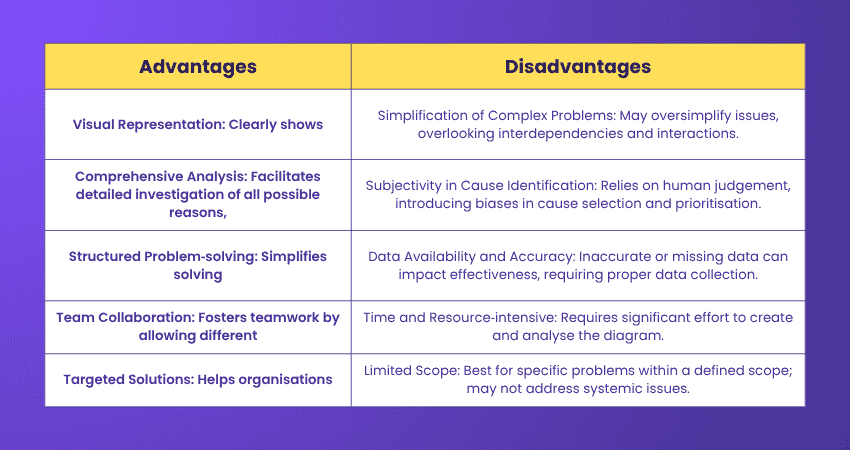
Fishbone Diagram in Root Cause Analysis offers several advantages and disadvantages in identifying and addressing the underlying causes of problems. So, let’s explore the benefits and limitations of Fishbone Diagram in RCA using this diagram:
What is Better Than Fishbone Diagram?
While Fishbone enables grouping the root causes into different categories, 5 why helps you dig deeper into each root cause. The 5 Whys method is especially useful when there's no evident root cause, while Pareto helps you grade the known causes and prioritise the response to each.
When not to Use a Fishbone Diagram?
A Fishbone Diagram might not be suitable when:
1) The problem is not well-defined or understood
2) There's a lack of data or information
3) The problem is very simple and doesn't require a complex analysis.
Also, it is not the best tool for generating new ideas, and other brainstorming techniques might be more helpful.
Conclusion
To conclude, incorporating the Fishbone Diagram in Root Cause Analysis into your problem-solving toolkit can transform the way you tackle complex issues. By breaking down problems into clear, you’re not just fixing the symptoms; you’re addressing the root cause. Be it in manufacturing, service, or any industry, this tool gives you a structured way to find lasting solutions.
Ready to drive better collaboration and value? Start your ITIL® 5 Foundation Certification now!
Frequently Asked Questions
How can Organisations Encourage the Widespread Use of the Fishbone Diagram for Problem-solving?

Organisations can promote the use of the Fishbone Diagram by integrating it into training programmes, team workshops, and standard problem-solving frameworks. Encouraging its use in meetings, root cause analysis sessions, and continuous improvement initiatives helps normalise its application.
How can Incorporating Fishbone Diagram Expertise Improve Job Performance and Efficiency?
Developing expertise in the Fishbone Diagram helps professionals identify root causes quickly and solve problems more effectively. It improves critical thinking, reduces recurring issues, and enhances decision-making. This leads to increased efficiency, better quality outcomes, and stronger overall job performance.
What are the Other Resources and Offers Provided by The Knowledge Academy?
The Knowledge Academy takes global learning to new heights, offering over 3,000+ online courses across 490+ locations in 190+ countries. This expansive reach ensures accessibility and convenience for learners worldwide.
Alongside our diverse Online Course Catalogue, encompassing 17 major categories, we go the extra mile by providing a plethora of free educational Online Resources like Blogs, eBooks, Interview Questions and Videos. Tailoring learning experiences further, professionals can unlock greater value through a wide range of special discounts, seasonal deals, and Exclusive Offers.
What is The Knowledge Pass, and How Does it Work?
The Knowledge Academy’s Knowledge Pass, a prepaid voucher, adds another layer of flexibility, allowing course bookings over a 12-month period. Join us on a journey where education knows no bounds.
What are the Related Courses and Blogs Provided by The Knowledge Academy?
The Knowledge Academy offers various ITIL® Certification Training, including ITIL® 5 Foundation Certification Course, ITIL® 5 Service Certification and ITIL® 5 Managing Professional Certification Course. These courses cater to different skill levels, providing comprehensive insights into What is Automatic Call Distribution.
Our IT Service Management Blogs cover a range of topics related to IT Service, offering valuable resources, best practices, and industry insights. Whether you are a beginner or looking to advance your Management skills, The Knowledge Academy's diverse courses and informative blogs have got you covered.

John Davies


Cyber Security Governance & Assurance Specialist
John Davies is a cybersecurity expert specialising in governance, risk management, and compliance. With over 15 years in the field, he has led enterprise-wide security programmes across finance, healthcare and public sector organisations. His content provides practical guidance on building secure environments, managing risk and aligning with regulatory frameworks.

Upcoming IT Service Management Resources Batches & Dates
Date
 ITIL® 5 Foundation Certification
ITIL® 5 Foundation Certification
Wed 17th Jun 2026
ITIL® 5 Foundation Certification
Mon 22nd Jun 2026
ITIL® 5 Foundation Certification
Wed 24th Jun 2026
ITIL® 5 Foundation Certification
Mon 29th Jun 2026
ITIL® 5 Foundation Certification
Wed 1st Jul 2026
ITIL® 5 Foundation Certification
Mon 6th Jul 2026
ITIL® 5 Foundation Certification
Wed 8th Jul 2026
ITIL® 5 Foundation Certification
Mon 13th Jul 2026
ITIL® 5 Foundation Certification
Wed 15th Jul 2026
ITIL® 5 Foundation Certification
Mon 20th Jul 2026
ITIL® 5 Foundation Certification
Wed 22nd Jul 2026
ITIL® 5 Foundation Certification
Mon 27th Jul 2026
ITIL® 5 Foundation Certification
Wed 29th Jul 2026
ITIL® 5 Foundation Certification
Mon 3rd Aug 2026
ITIL® 5 Foundation Certification
Wed 5th Aug 2026
ITIL® 5 Foundation Certification
Mon 10th Aug 2026
ITIL® 5 Foundation Certification
Wed 12th Aug 2026
ITIL® 5 Foundation Certification
Mon 17th Aug 2026
ITIL® 5 Foundation Certification
Wed 19th Aug 2026
ITIL® 5 Foundation Certification
Mon 24th Aug 2026
ITIL® 5 Foundation Certification
Wed 26th Aug 2026
ITIL® 5 Foundation Certification
Tue 1st Sep 2026
ITIL® 5 Foundation Certification
Mon 7th Sep 2026
ITIL® 5 Foundation Certification
Wed 9th Sep 2026
ITIL® 5 Foundation Certification
Mon 14th Sep 2026
ITIL® 5 Foundation Certification
Wed 16th Sep 2026
ITIL® 5 Foundation Certification
Mon 21st Sep 2026
ITIL® 5 Foundation Certification
Wed 23rd Sep 2026
ITIL® 5 Foundation Certification
Mon 28th Sep 2026
ITIL® 5 Foundation Certification
Wed 30th Sep 2026
ITIL® 5 Foundation Certification
Mon 5th Oct 2026
ITIL® 5 Foundation Certification
Wed 7th Oct 2026
ITIL® 5 Foundation Certification
Mon 12th Oct 2026
ITIL® 5 Foundation Certification
Wed 14th Oct 2026
ITIL® 5 Foundation Certification
Mon 19th Oct 2026
ITIL® 5 Foundation Certification
Wed 21st Oct 2026
ITIL® 5 Foundation Certification
Mon 26th Oct 2026
ITIL® 5 Foundation Certification
Wed 28th Oct 2026
ITIL® 5 Foundation Certification
Mon 2nd Nov 2026
ITIL® 5 Foundation Certification
Wed 4th Nov 2026
ITIL® 5 Foundation Certification
Mon 9th Nov 2026
ITIL® 5 Foundation Certification
Wed 11th Nov 2026
ITIL® 5 Foundation Certification
Mon 16th Nov 2026
ITIL® 5 Foundation Certification
Wed 18th Nov 2026
ITIL® 5 Foundation Certification
Mon 23rd Nov 2026
ITIL® 5 Foundation Certification
Wed 25th Nov 2026
ITIL® 5 Foundation Certification
Mon 30th Nov 2026
ITIL® 5 Foundation Certification
Wed 2nd Dec 2026
ITIL® 5 Foundation Certification
Mon 7th Dec 2026
ITIL® 5 Foundation Certification
Wed 9th Dec 2026
ITIL® 5 Foundation Certification
Sun 13th Dec 2026
ITIL® 5 Foundation Certification
Mon 14th Dec 2026
ITIL® 5 Foundation Certification
Mon 21st Dec 2026
ITIL® 5 Foundation Certification
Wed 23rd Dec 2026
ITIL® 5 Foundation Certification
Tue 29th Dec 2026

 If you wish to make any changes to your course, please


