


 Top Rated Course

We may not have the course you’re looking for. If you enquire or give us a call on +36 18508731 and speak to our training experts, we may still be able to help with your training requirements.
Environmental Aspects and Impacts Register
The Knowledge Academy 15 November 2025An Environmental Aspects and Impacts Register is a structured document that identifies environmental factors about business activities and their potential effects. It helps organisations manage risks, ensure compliance, and improve sustainability. Learn its key components, benefits, and best practices for effective implementation.

Training Outcomes Within Your Budget!
We ensure quality, budget-alignment, and timely delivery by our expert instructors.
Table of Contents
Every business, no matter the industry, leaves an environmental footprint. But do all organisations truly understand the extent of their impact? An Environmental Aspects and Impacts Register helps identify, assess, and manage environmental risks before they become serious problems. It’s not just about compliance; rather it’s about responsibility. So, how can businesses use this tool effectively? Let’s dive into why this register is a game-changer for sustainability.
Table of Contents
1) What is an Environmental Aspects and Impacts Register?
2) How to Create an Environment Aspects and Impacts Register?
3) Environmental Aspects and Impacts Examples
4) Benefits of Implementing an Environmental Aspects and Impacts Register
5) What is the Aspect and Impact Register for ISO 14001 2015?
6) What is a Checklist in Environmental Impact Assessment?
7) Conclusion
What is an Environmental Aspects and Impacts Register?
An Environmental Aspects and Impacts Register is a documented, structured and methodical approach that outlines and plans how an organisation will address the environment in line with their activities, products, and services. This register may also be viewed as a source of information, as it contains a broad description of environmental conditions requiring changes in the organisation.
It typically includes the following:
1) Environmental Aspects
An Environmental Aspect refers to how your actions, products, or services affect the environment. For instance, when washing cars, one environmental aspect could be the use of cleaning agents, which have the potential to pollute water. This pollution represents the environmental impact of the activity. Simply put, environmental aspects are the elements of what you do that can either harm or benefit the planet.
Environmental Impacts
They are the outcomes or impacts that are generated by environmental aspects and which can be positive or negative. Environmental effects can be linked to different variables that entail the state of the atmosphere, water we use, the soil we till and the world we live in as a whole.
Environmental effects are measured in terms of magnitude, extent, duration and significance and when managed, it assists organisations to comprehend the larger picture of their actions.
How to Create an Environment Aspects and Impacts Register?
Creating the register is a crucial step towards effective Environmental Management. The following guide should be of help to you in the process of making the Environment Aspects and Impacts Register to ensure the information is captured as is supposed to be. Let's consider the steps:
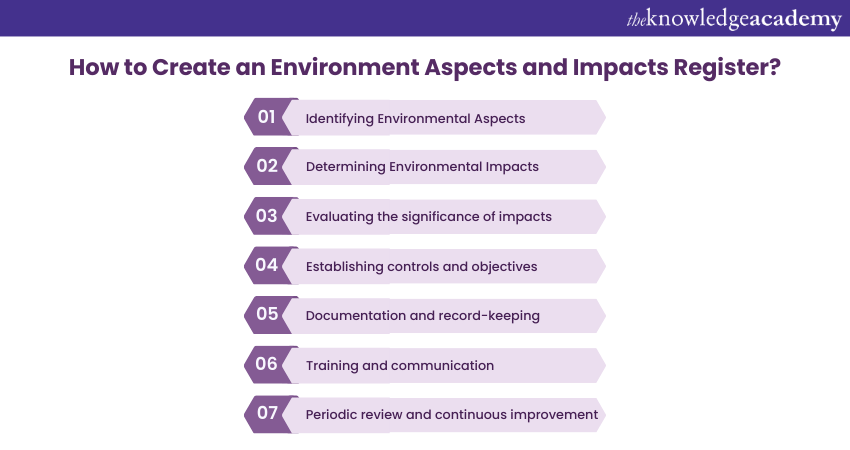
1) Identifying Environmental Aspects
Identify your organisation’s Environmental Aspects, covering all activities, products, and services. Conduct a detailed review of processes, operations, and inputs interacting with the environment. Engage relevant Stakeholders, like Employees, for their insights. Key aspects include energy usage, water consumption, waste generation, and emissions.
2) Determining Environmental Impacts
Evaluate the Environmental Impacts of these Aspects. Assess how each element could affect the environment, positively or negatively. This includes analysing factors like air and water quality, soil contamination, ecosystem disruption, and natural resource depletion.
3) Evaluating the Significance of Impacts
Determine the significance of impacts to decide on actions. Not all impacts are equally significant, so prioritide them to allocate resources effectively. Consider the scale, scope, duration, and whether the impacts are reversible. This helps identify key aspects requiring immediate attention.
4) Establishing Controls and Objectives
Set up controls and objectives to manage identified Aspects and Impacts. Controls are measures to counteract negative impacts and enhance positive ones. Use Specific, Measurable, Achievable, Relevant, Time-bound (SMART) objectives to guide targeted interventions and progress aimed at reducing environmental pollution.
5) Documentation and Record-keeping
Keep precise records and documentation to maintain an up-to-date Register. Log all relevant details, including identified Aspects, Impacts, and objectives, and update regularly. Use a structured format or template for consistency and accessibility. Apply ISO 14001 Document Control practices for consistency and easy access.
6) Training and Communication
Train employees and stakeholders in the Environmental Management process. Ensure they understand the Register’s purpose, how to identify Aspects and Impacts, and their roles in managing them. Establish clear communication methods to inform everyone of the Register’s progress, updates, and changes.
7) Periodic Review and Continuous Improvement
The Register is a dynamic document requiring regular review and updates. Monitor the effectiveness of controls and objectives, noting any changes in processes or activities. Conduct internal audits to verify the Register’s accuracy and completeness and to find areas for improvement.
Take the first step towards ISO 14001 Compliance with our ISO 14001 Foundation Certification Course – Sign up now!
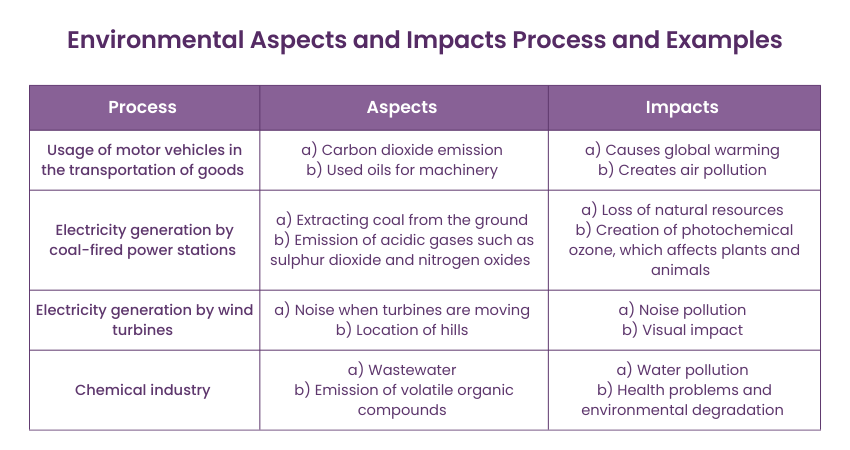
Environmental Aspects and Impacts Examples
The table below shows the types of processes with examples of their Aspects and Impacts:
Benefits of Implementing an Environmental Aspects and Impacts Register
Implementing Environmental Aspects and Impacts Register offers numerous benefits for organisations, including the following:
1) Enhanced environmental performance and resource efficiency.
2) Compliance with environmental regulations and legal requirements.
3) Identification of cost-saving opportunities through waste reduction and energy efficiency.
4) Improved stakeholder trust and reputation through transparent Environmental Management.
5) Improved market competitiveness through environmental responsibility demonstration.
Want to drive sustainable change in your organisation? Sign up for our ISO 14001 Lead Auditor Course now!
What is the Aspect and Impact Register for ISO 14001:2015?
The aspect and impact register in ISO 14001:2015 identifies and assesses environmental aspects of an organisation’s activities, products, or services. It helps track and manage potential environmental impacts, prioritise risks, ensure compliance, and reduce the environmental footprint.
What is a Checklist in Environmental Impact Assessment?
A checklist in an environmental impact assessment (EIA) is a tool used to evaluate the potential environmental effects of a project. It lists aspects like air, water, and biodiversity, ensuring all impacts are considered and mitigated, guiding Decision-Making and ensuring regulatory compliance.
Conclusion
Your Environmental Aspects and Impacts Register isn't just paperwork; rather it's your organisation's roadmap to responsible action. By clearly identifying your environmental footprint, you can spot risks, seize opportunities, and genuinely make a difference. So, start now and set your business on a greener, and smarter path.
Enhance your organisation's Environmental Management practices with our comprehensive ISO 14001 Training - Register Today!
Frequently Asked Questions
Why is Environmental Impact Important for a Business?

Environmental impact is crucial for businesses as it affects their sustainability, reputation, and compliance with regulations. Managing environmental impact helps reduce costs, improve efficiency, meet consumer demand for eco-friendly practices, and minimise risks related to environmental harm.
What are the Environmental Aspects and Impacts Registered?
Environmental aspects refer to elements of a business's activities that can affect the environment, like energy use or waste production. Impacts are the consequences of these aspects, such as pollution or resource depletion. These are registered to assess and manage potential risks and improve sustainability.
What are the Other Resources and Offers Provided by The Knowledge Academy?
The Knowledge Academy takes global learning to new heights, offering over 3,000+ online courses across 490+ locations in 190+ countries. This expansive reach ensures accessibility and convenience for learners worldwide.
Alongside our diverse Online Course Catalogue, encompassing 19 major categories, we go the extra mile by providing a plethora of free educational Online Resources like Blogs, eBooks, Interview Questions and Videos. Tailoring learning experiences further, professionals can unlock greater value through a wide range of special discounts, seasonal deals, and Exclusive Offers.
What is The Knowledge Pass, and How Does it Work?
The Knowledge Academy’s Knowledge Pass, a prepaid voucher, adds another layer of flexibility, allowing course bookings over a 12-month period. Join us on a journey where education knows no bounds.
What are the Related Courses and Blogs Provided by The Knowledge Academy?
The Knowledge Academy offers various ISO 14001 Certification, including ISO 14001 Foundation, ISO 14001 Lead Auditor, ISO 14001 Internal Auditor and ISO 14001 Lead Implementer. These courses cater to different skill levels, providing comprehensive insights into Safety Coordinator vs Safety Manager.
Our Health & Safety Blogs cover a range of topics related to ISO, offering valuable resources, best practices, and industry insights. Whether you are a beginner or looking to advance your Compliance skills, The Knowledge Academy's diverse courses and informative blogs have you covered.

The Knowledge Academy


Global Training Provider
The Knowledge Academy is a world-leading provider of professional training courses, offering globally recognised qualifications across a wide range of subjects. With expert trainers, up-to-date course material, and flexible learning options, we aim to empower professionals and organisations to achieve their goals through continuous learning.

Upcoming Health & Safety Resources Batches & Dates
Date
 ISO 14001 Foundation Certification
ISO 14001 Foundation Certification
Mon 11th May 2026
ISO 14001 Foundation Certification
Mon 3rd Aug 2026
ISO 14001 Foundation Certification
Mon 2nd Nov 2026

 If you wish to make any changes to your course, please


