


 Top Rated Course

We may not have the course you’re looking for. If you enquire or give us a call on +36 18508731 and speak to our training experts, we may still be able to help with your training requirements.
Customer Service Metrics to Measure & Evaluate
The Knowledge Academy 20 February 2026Are you thinking about using Customer Service Metrics to Measure Customer Experience? Use key indicators to improve service quality and customer satisfaction. Metrics like CSAT, NPS, and response time help analyse performance and identify trends. Measuring these metrics ensures better support, happier customers, and business growth.

Training Outcomes Within Your Budget!
We ensure quality, budget-alignment, and timely delivery by our expert instructors.
Table of Contents
Delivering great customer service is not just about being helpful—it is about creating a seamless, satisfying experience. To make real improvements, businesses need to track the right data. That’s where Customer Service Metrics to Measure comes in, providing insights into response times, customer satisfaction and service quality. By understanding these metrics, businesses can identify areas for improvement and build stronger customer relationships. In this blog, we discuss essential Customer Service Metrics, how to measure them, and how they contribute to better services. Let’s dive in!
Table of Contents
1) What are Customer Service Metrics?
2) Key Performance Metrics for Measuring Customer Service
a) Customer Effort Score (CES)
b) Net Promoter Score (NPS)
c) First Response Time
d) Customer Churn Rate
e) Customer Satisfaction Score (CSAT)
f) Average Resolution Time
g) Rates of Customer Service Abandonment
h) Utilising Sentiment Analysis
i) Social Media Metrics
j) First Contact Resolution Rate
3) Why is Measuring Customer Service Important?
4) Conclusion
What are Customer Service Metrics?
Customer Service Metrics are numbers that show how well a company helps its customers. These numbers help businesses understand if customers are happy, how fast problems are solved, and how good the service is. They also help companies find ways to make their customer service better.
Different metrics track different things, like how quickly a customer gets help, how many issues are fixed on the first try, and how satisfied customers feel. Businesses use these numbers to improve their service, keep customers happy, and make sure they provide the best experience possible.
Key Performance Metrics for Measuring Customer Service
Let's explore some of the metrics for measuring customer service:
 ”--
”--
1) Customer Effort Score (CES)
This shows how easy or hard it is for customers to solve their problems or achieve their goals using a product or service. Customers rate their agreement with a statement like "The company made it easy for me to handle my issue" on a scale of 1 to 7.
a) Lower CES: Indicates more effort from customers, which can cause frustration.
b) Higher CES: Indicates less effort from customers, leading to loyalty, satisfaction, and retention.
2) Net Promoter Score (NPS)
This measures whether customers would recommend a product or service to others. Customers rate their likelihood to recommend on a scale from 0 to 10.
a) Scores 9-10: Promoters who are loyal and enthusiastic advocates.
b) Scores 7-8: Passives who are satisfied but not very enthusiastic.
c) Scores 0-6: Detractors who are unhappy and may spread negative feedback.
d) Higher NPS: Indicates higher customer loyalty, advocacy, and growth.
e) Lower NPS: Indicates lower customer loyalty, advocacy, and development.
3) First Response Time
This measures how quickly a company replies to a customer's question or problem. Research shows that 77% of customers value their time highly. Quick responses keep customers happy.
a) Good Response Times: Emails within 24 hours, social media within 60 minutes, phone calls within 3 minutes, and live chat instantly.
b) Measure: Subtract the time of the request from the time of the first reply, then work to make it even faster.
4) Customer Churn Rate
This measures the customers percentage who stop doing business with a company over time.
a) Lower Churn Rate: Higher customer retention, loyalty, and profitability.
b) Higher Churn Rate: Lower customer retention, loyalty, and profitability.
5) Customer Satisfaction Score (CSAT)
This shows how happy customers are with a product, service, or experience. Customers rate their happiness on a scale from 1 to 5.
a) High CSAT: Customers are happy and may buy again or tell others.
b) Low CSAT: Customers are unhappy and may complain or share bad reviews.
Learn techniques for measuring customer interactions with our Customer Experience Training – Join today!
6) Average Resolution Time
This measures how long it takes to fix a customer issue from when it is reported to when it is closed.
a) Lower Resolution Time: Higher customer service speed, responsiveness, and quality.
7) Rates of Customer Service Abandonment
This measures the percentage of customers who give up on resolving their issues or answering their questions through a customer service channel.
a) Lower Abandonment Rate: Higher level of customer service availability, accessibility, and reliability.
b) Higher Abandonment Rate: Lower level of customer service availability, accessibility, and reliability.
8) Utilising Sentiment Analysis
This measures customers' emotional tone and attitude towards a product, service, or interaction using natural language processing and Machine Learning.
a) Sentiment Analysis: Identifies positive, negative, or neutral sentiments and specific emotions like happiness, anger, sadness, or surprise.
b) Purpose: Understand underlying reasons for customer satisfaction or dissatisfaction and improve customer service and experience.
Learn about the sentiment prediction method with our Sentiment Analysis Training – Join today!
9) Social Media Metrics
Customers share their thoughts about a company on social media. Tracking these interactions helps businesses respond to and understand customer feedback.
a) Key Things to Track: Brand mentions, negative comments, customer questions, and existing support materials.
b) Measure: Check these factors monthly to see changes and trends.
10) First Contact Resolution Rate
This measures how often customer problems are solved the first time they reach out.
a) Higher Rate: Smoother customer experience and less extra effort.
b) Measure: Divide the number of issues fixed on the first contact by the total number of issues.
11) Customer Ticket Request Volume
This shows the number of help requests a company receives. Too many requests might indicate problems.
a) Measure: Compare support tickets each week or month. A sudden increase, especially after a new product launch, could mean customer issues.
b) Analyse Trends: Look for patterns over time to identify recurring issues or peak times when support requests increase.
Learn how emotional intelligence can be applied in the company with our Emotional Intelligence Training – Join today!
Why is Measuring Customer Service Important?
Measuring customer service is essential for several reasons. Here are some of them:
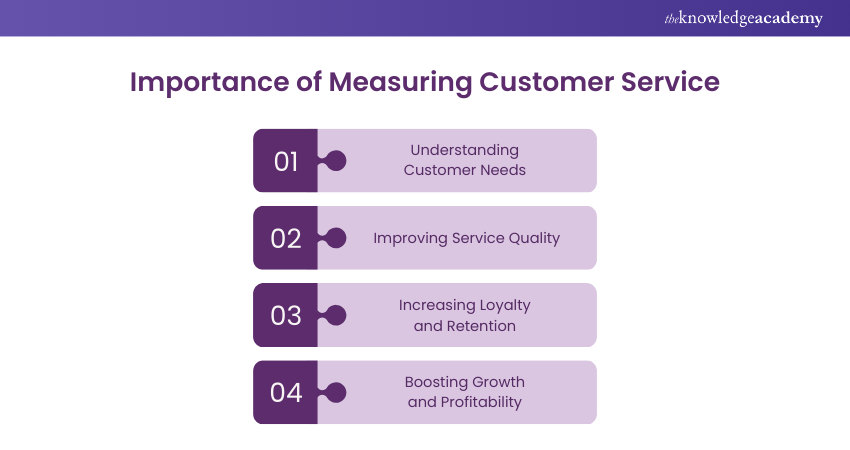
1) It helps you understand your customers' expectations. Collecting and analysing customer feedback lets you learn what your customers value, what they are satisfied or dissatisfied with, and what they want from your business. This can help you change your products to meet their demands.
2) It helps you improve your customer service quality and performance. By tracking and evaluating Customer Service Metrics, you can identify your strengths and weaknesses and the areas where you can improve.
3) It helps you increase your customer loyalty and retention. By measuring and enhancing your customer service, you can build trust with your customers. This can help reduce customer churn, increase lifetime value, and generate positive word-of-mouth and referrals.
4) It helps you boost your business growth and profitability. By measuring and improving your customer service, you can attract more customers and increase their spending and advocacy. This can help you boost your revenue, market share, and competitive advantage.
Conclusion
Tracking Customer Service Metrics to Measure Customer Experience helps businesses improve their support and overall service quality. Metrics like response time, customer satisfaction and resolution rates reveal what is working and what needs improvement. By using these insights, companies can provide better service and keep customers happy. Regularly measuring these metrics leads to long-term success and stronger customer relationships.
Learn strategies for handling customer conflicts with our Exceptional Customer Service Training – Join today!
Frequently Asked Questions
How do Customer Service Metrics Differ From Traditional Business Metrics?

Customer Service Metrics show how happy and loyal customers are and how well a company supports them. Business metrics focus on things like money and market size. Customer Service Metrics help businesses understand service quality and customer experience.
What are Some Common Challenges in Measuring Customer Service Performance?
Common challenges in measuring customer service performance can arise due to selecting irrelevant metrics, low data accuracy, interpreting results ineffectively, and not accounting for the subjective nature of customer feedback. Additionally, integrating data from various sources and dealing with fluctuating customer expectations can pose difficulties.
What are the Other Resources and Offers Provided by The Knowledge Academy?
The Knowledge Academy takes global learning to new heights, offering over 3,000+ online courses across 490+ locations in 190+ countries. This expansive reach ensures accessibility and convenience for learners worldwide.
Alongside our diverse Online Course Catalogue, encompassing 19 major categories, we go the extra mile by providing a plethora of free educational Online Resources like Blogs, eBooks, Interview Questions and Videos. Tailoring learning experiences further, professionals can unlock greater value through a wide range of special discounts, seasonal deals, and Exclusive Offers.
What is The Knowledge Pass, and How Does it Work?
The Knowledge Academy’s Knowledge Pass, a prepaid voucher, adds another layer of flexibility, allowing course bookings over a 12-month period. Join us on a journey where education knows no bounds.
What are the Related Courses and Blogs Provided by The Knowledge Academy?
The Knowledge Academy offers various Personal Development Courses, including Time Management Training, Attention Management Training and Customer Experience Training. These courses cater to different skill levels, providing comprehensive insights into Different Types of Consumer Behaviour.
Our Business Skills Blogs cover a range of topics related to Customer Service, offering valuable resources, best practices, and industry insights. Whether you are a beginner or looking to advance your customer service skills, The Knowledge Academy's diverse courses and informative blogs have you covered.

The Knowledge Academy


Global Training Provider
The Knowledge Academy is a world-leading provider of professional training courses, offering globally recognised qualifications across a wide range of subjects. With expert trainers, up-to-date course material, and flexible learning options, we aim to empower professionals and organisations to achieve their goals through continuous learning.

Upcoming Business Skills Resources Batches & Dates
Date
 Exceptional Customer Service Training
Exceptional Customer Service Training
Fri 11th Sep 2026
Exceptional Customer Service Training
Fri 11th Dec 2026

 If you wish to make any changes to your course, please


