


 Top Rated Course


We may not have the course you’re looking for. If you enquire or give us a call on +36 18508731 and speak to our training experts, we may still be able to help with your training requirements.
Digital Twin vs Simulation: Key Differences
The Knowledge Academy 17 February 2026Ever wondered what distinguishes Digital Twins and Simulations? Dive into this blog to understand how they prioritise efficient operations. Through this blog, you can get an idea of Digital Twin vs Simulation, and how they offer dynamic insights for optimisation. Continue reading to learn more about these differences.

Training Outcomes Within Your Budget!
We ensure quality, budget-alignment, and timely delivery by our expert instructors.
Table of Contents
Digital Twin and Simulations have emerged as two powerful concepts in the dynamic realm of modern technology. These innovations have revolutionised industries, ranging from manufacturing to healthcare, offering unprecedented insights and efficiencies. But what sets them apart? Why is it crucial for businesses to understand the distinction between Digital Twin Vs Simulation?
To answer such queries, we will delve into the nuances of Digital Twin Vs Simulations in this blog. Let's discover the key differences between them and empower businesses to harness the full potential of these transformative technologies.
Table of Contents
1) What is Digital Twin?
2) What is Simulation?
3) Key differences between Digital Twins and Simulations
a) Static Simulations vs Active Digital Twin
b) Possibility vs actual
c) Scope of use
4) Conclusion
What is Digital Twin?
A Digital Twin is a virtual replica of a physical entity or system. It mirrors the physical system's behaviour, enabling real-time monitoring. How to build a digital twin involves integrating data, Artificial Intelligence (AI), and the Internet of Things (IoT) to simulate real-world scenarios. Digital Twins also integrate data, Artificial Intelligence (AI), and the Internet of Things (IoT) to simulate real-world scenarios. These simulations specifically provide insights into performance, maintenance, and future predictions, highlighting the Digital Twin Benefits for various industries. They are used in fields ranging from manufacturing to healthcare.

What is Simulation?
Simulation involves creating a model to imitate the operation of a system. It allows the testing of hypotheses, exploring scenarios, and predicting outcomes. Moreover, they are valuable for understanding complex systems and making informed decisions. Simulations also help in process optimisation and product design during manufacturing. They are widely used in fields like engineering, finance, and logistics.
Key differences between Digital Twins and Simulations
The distinction between Digital Twins and Simulations is crucial for organisations. To optimise operations and decision-making processes in the realm of digital technologies, understanding the distinction is a must. While both concepts involve creating virtual representations of real-world systems, they serve distinct purposes and offer unique benefits. For a detailed overview of those distinctions, you can go through the following points:
1) Static Simulations vs Active Digital Twin
Digital Twin and Simulation refers to how the virtual representation interacts with and reflects the physical system. Now, let's explore the key differences between Digital Twin Vs Simulations:
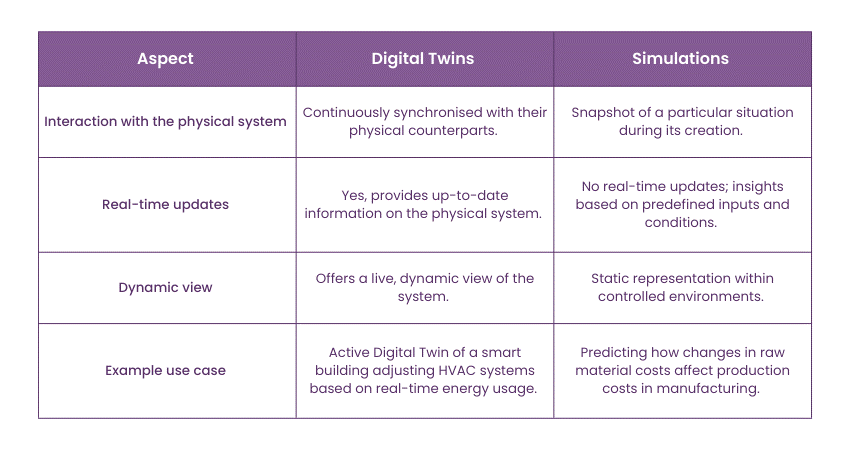
a) Static Simulations: Static simulations serve as valuable tools for understanding specific scenarios within controlled environments. They provide insights based on predefined inputs and conditions. These Simulations do not update in real-time; rather, they offer a snapshot of a particular situation during its creation. For instance, in a manufacturing setting, these can predict how changes in raw material costs might affect production costs.
b) Active Digital Twins: Active Digital Twins, on the other hand, are dynamic and continuously synchronised with their physical counterparts. This real-time connection allows them to provide up-to-date information on the physical system. These active twins adjust to changes in the physical system, offering a live, dynamic view. For example, an Active Digital Twin of a smart building can monitor energy usage and adjust Heating, Ventilation, and Air Conditioning (HVAC) systems accordingly.
Master the future of technology - join our Digital Twin Course today!
2) Possibility vs actual
When it comes to exploring possibilities and reflecting reality, Digital Twin Vs Simulation offers distinct approaches. Let’s talk about them in detail:
a) Simulations: Simulations are powerful tools for exploring hypothetical scenarios and conducting what-if analyses. They create a virtual environment where various conditions and parameters can be tested. For example, in healthcare, Simulations can predict patient outcomes based on different treatment plans. Simulations also offer insights into potential outcomes, helping decision-makers prepare for a range of possibilities. However, these insights are based on hypothetical situations rather than the actual state of the system.
b) Digital Twins: Unlike Simulations, Digital Twins represent the actual state of the physical system. They mirror the real-time data from their physical counterparts, providing an accurate digital reflection. For instance, in a smart city, a Digital Twin of the entire infrastructure can monitor traffic flow and waste management. This real-time data allows for accurate predictions and preventive maintenance. Digital Twins can create a 'digital shadow' of the physical system, offering insights into its current state.
3) Scope of use
Both Simulations and Digital Twins cater to different needs within various industries. Now, let's delve into the specific differences in the scope of use between Digital Twin Vs Simulation:
a) Simulations: Simulations have a broad scope of use and are applicable to a wide range of industries. These versatile tools are used in fields like engineering, finance, healthcare, and beyond. Simulations can also model complex systems, test theories, and simulate processes to improve efficiency. For instance, they are used to test the aerodynamics of new aircraft designs before physical prototypes are built. They further help in understanding trends, exploring possibilities, and making informed decisions.
b) Digital Twins: Digital Twins are more focused and specific, typically centred around individual systems or assets. They provide detailed, granular insights into the components or processes they represent. In manufacturing, Digital Twins can monitor the performance of machinery on the factory floor, predicting maintenance needs before failures occur. This specificity allows for targeted improvements and optimisations. For instance, in the oil and gas industry, Digital Twins of drilling equipment can monitor real-time conditions.
Elevate your expertise with our Sensor and Data Fusion Training – sign up now!
Conclusion
In conclusion, the key differences between Digital Twin Vs Simulation lie in their real-time capabilities, focus, and purpose. While simulations have a broad scope of use across industries, Digital Twins are more focused on specific applications. Understanding these differences is crucial for organisations looking to leverage these technologies effectively.
Gain an immersive learning experience with our Virtual Reality (VR) Training!
Frequently Asked Questions
What is Digital Twin technology?

Digital Twin technology creates virtual replicas of physical systems or assets. It also syncs with real-time data to provide insights, predictions, and monitoring. Additionally, it offers a 'Digital shadow' of the physical entity for enhanced decision-making.
What is the difference between a Digital Twin and a Simulation?
Digital Twins represent the actual state of a physical system with real-time data, enabling precise predictions and proactive maintenance. Simulations, however, explore hypothetical scenarios and possibilities based on predefined inputs, offering insights into potential outcomes.
What are the other resources and offers provided by The Knowledge Academy?
The Knowledge Academy takes global learning to new heights, offering over 3,000 online courses across 490+ locations in 190+ countries. This expansive reach ensures accessibility and convenience for learners worldwide.
Alongside our diverse Online Course Catalogue, encompassing 17 major categories, we go the extra mile by providing a plethora of free educational Online Resources like Blogs, eBooks, Interview Questions and Videos. Tailoring learning experiences further, professionals can unlock greater value through a wide range of special discounts, seasonal deals, and Exclusive Offers.
What is the Knowledge Pass, and how does it work?
The Knowledge Academy’s Knowledge Pass, a prepaid voucher, adds another layer of flexibility, allowing course bookings over a 12-month period. Join us on a journey where education knows no bounds.
What are related courses and blogs provided by The Knowledge Academy?
The Knowledge Academy offers various Advanced Technologies Courses, including the Digital Twin Course, Conda Training, and 5G Wireless Training. These courses cater to different skill levels, providing comprehensive insights into How to Build a Digital Twin.
Our Advanced Technology Blogs cover a range of topics related to Digital Twin, offering valuable resources, best practices, and industry insights. Whether you are a beginner or looking to advance your Advanced Technical skills, The Knowledge Academy's diverse courses and informative blogs have got you covered.

The Knowledge Academy


Global Training Provider
The Knowledge Academy is a world-leading provider of professional training courses, offering globally recognised qualifications across a wide range of subjects. With expert trainers, up-to-date course material, and flexible learning options, we aim to empower professionals and organisations to achieve their goals through continuous learning.


 If you wish to make any changes to your course, please


