


 Top Rated Course

We may not have the course you’re looking for. If you enquire or give us a call on +36 18508731 and speak to our training experts, we may still be able to help with your training requirements.
What is Behaviour-driven Development (BDD), and How Does it Work?
William Brown 27 March 2026Behaviour-driven Development (BDD) is a Software Development process that is based on the Agile methodology that emphasises collaboration between entities. The concept originates from the test-driven development approach which defines software behaviour in plain, human-readable language. It makes teams work smarter.

Training Outcomes Within Your Budget!
We ensure quality, budget-alignment, and timely delivery by our expert instructors.
Table of Contents

Behaviour-driven Development is similar to writing a screenplay for a film before it is shot. The first step is for actors, directors, and writers to agree on the appearance of each scene. The "scene" in BDD refers to how software needs to operate, and the "script" is written in an understandable plain language.
Clear behaviour rules help create better software with fewer surprises. Much like a strong script helps create a great film, they enable more seamless teamwork. Let’s go through this blog to understand exactly What is Behavioural-driven Development.
Table of Contents
1) What is Behaviour Driven Development (BDD)?
2) How BDD Testing Works?
3) Behaviour-driven Development Process
4) Benefits of Behaviour-driven Development (BDD)
5) Challenges of Behaviour-driven Development (BDD)
6) Best Practices for BDD Testing
7) Behaviour-driven Development Examples
8) Conclusion
What is Behaviour Driven Development (BDD)?
Behaviour Driven Development (BDD) helps create user-centric products by designing and documenting them according to user’s expectations and interactions with the product. It is defined as a process that focuses on user requirements and expectations while facilitating collaboration among developers, testers, and project managers.
BDD is a methodology centred on end-user needs and their interactions with the system. It is a highly sought-after software development approach used across diverse industries, from B2B to SaaS. In this process, behaviours are expressed in clear, human-readable statements that describe specific processes in a predefined format.

How BDD Testing Works?
BDD testing enhances collaboration and feedback across teams. It plays a crucial role in improving communication and ensuring clarity among various departments involved in the software development process.
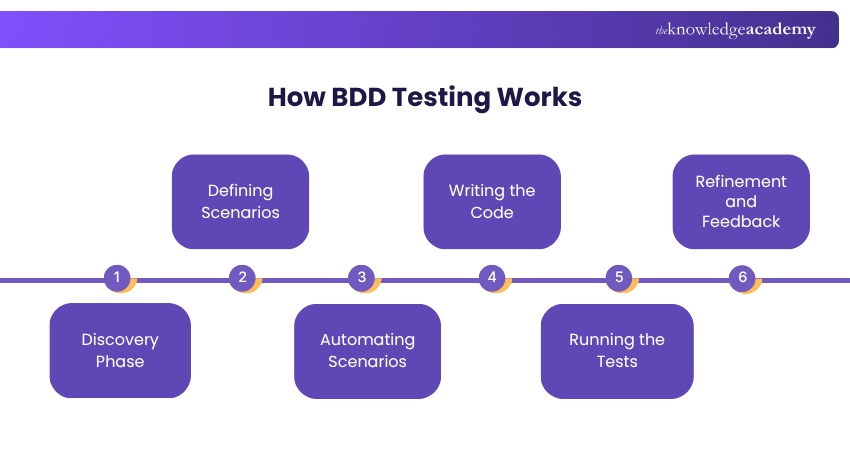
1) Step 1: Discovery Phase
This phase involves conducting workshops with developers, testers, and business stakeholders to discuss requirements. These discussions help define the desired behaviours and expected outcomes of the system, ensuring that all parties share a common understanding before development begins.
2) Step 2: Defining Scenarios
In this step, scenarios are written using a structured format that clearly outlines the context, action, and expected outcome. The initial context describes the situation, followed by the action or event that triggers the behaviour, and finally, the expected result or outcome.
3) Step 3: Automating Scenarios
To automate the above-mentioned scenarios, you can use BDD frameworks like Cucumber or JBehave which provide a way to transform Gherkin Syntax and everything in the GIVEN/WHEN/THEN into executable codes.
4. Step 4: Writing the Code
During this stage, developers follow the Test-driven Development (TDD) approach, writing only the minimal amount of code necessary to make the test scenarios pass. Code refactoring is then carried out to improve quality, readability, and maintainability without altering functionality.
5) Step 5: Running the Tests
BDD tests are integrated into the Continuous Integration (CI) pipeline, allowing them to run automatically with each code commit. Test results are monitored regularly to identify and resolve any failures promptly, ensuring consistent product reliability.
6) Step 6: Refinement and Feedback
This final step involves continuously refining scenarios based on feedback from testing and real-world usage. As requirements evolve, scenarios are updated to reflect the latest changes. Keeping all stakeholders informed throughout ensures transparency and ongoing alignment.
Build confidence in every sprint with smarter, faster Software Testing with our Agile Software Testing Training - Register now!
Behaviour-driven Development Process
The Behaviour-driven Development (BDD) process is built around several key approaches that guide efficient, collaborative, and quality-focused software delivery.

1) Test-first Approach
The test-first approach ensures that testing begins early in the development cycle to validate the product’s efficiency in real-world conditions. This proactive method eliminates many of the limitations found in traditional development and testing processes, where issues often go unnoticed until after the final release.
2) Agile Testing Approach
Rather than following the conventional “build, test, and fix” procedure, BDD relies on the Agile testing approach. This method is rooted in iterative development and continuous feedback, placing strong emphasis on collaboration between customers and cross-functional teams to refine and improve the product at every stage.
3) Built-in Quality Approach
BDD follows a built-in quality principle, ensuring that the product meets market standards and user expectations from the start. This is achieved through competitive and well-structured development practices that incorporate end-user requirements, resulting in a robust and feature-complete product.
4) Discovery Phase
The Discovery phase is where the acceptance criteria are researched and decided. The acceptance criteria are crafted based on product type and other factors while the team will give their inputs. Overall, this phase requires a collaborative effort to end up in acceptance criteria.
5) Formulation Phase
This phase occurs when a backlog item is ready to be implemented. Its main goal is to confirm that the acceptance criteria are clear, accurate, and ready to be applied in real time. The formulation phase bridges the gap between planning and execution, setting the stage for automation
6) Automation Phase
As the name implies, the automation phase focuses on automating acceptance tests. This helps optimise time and resource usage while ensuring that the expected outputs are achieved and all acceptance criteria are met efficiently.
Learn how Agile Testing transforms quality from day one in our comprehensive Agile Tester Training - Sign up now!
Benefits of Behaviour-driven Development (BDD)
Behaviour-driven Development (BDD) offers numerous advantages that improve collaboration, communication, and product quality throughout the software development lifecycle.

1) Enhanced Collaboration
BDD fosters close collaboration between business stakeholders, developers, and testers by using a shared, easily understandable language to describe requirements. This common framework helps bridge communication gaps, ensuring alignment and clarity across all team members.
2) Clearer Requirements
Writing scenarios in plain language using Gherkin syntax helps clarify requirements and expectations. This reduces ambiguity ad ensures that everyone has a shared understanding of the desired behaviour.
3) Higher‑quality Code
BDD encourages developers to write modular, testable code that accurately reflects the described behaviours. This approach leads to well-designed, maintainable software with fewer defects and more predictable performance over time.
4) Focus on User Behaviour
BDD emphasises the behaviour of the system from the user’s perspective. By focusing on user stories and scenarios, BDD ensures that development efforts are aligned with user needs and priorities.
5) Automated Testing
BDD scenarios can be automated using tools such as Cucumber or SpecFlow, providing quick and reliable feedback on the application’s behaviour. Automation enables teams to detect regressions early, maintain consistency, and uphold high standards of quality throughout development.
6) Improved Documentation
BDD scenarios act as living documentation of the system’s behaviour. As tests are continuously executed and updated, they provide an up-to-date reference for the software’s functionality, making it easier for teams to track changes and maintain long-term project clarity.
Learn how to craft high-quality software the SAFe® way. Register for our SAFe® Agile Software Engineering Training now!
Challenges of Behaviour-driven Development (BDD)
Like any other process, BDD while having many benefits also faces challenges that teams must overcome to take full advantage of its potential.
1) Initial Learning Curve
Providing comprehensive training and resources to team members. Organising workshops and pair programming sessions to help everyone get accustomed to BDD practices and tools.
2) Time-consuming Setup
While the initial setup of BDD frameworks and the writing of scenarios can be time-consuming, the effort pays off in the long run.
3) Overhead in Maintenance
Keeping BDD scenarios up to date with changing requirements can become burdensome, particularly for large or rapidly evolving systems.
4) Requires Collaboration
Effective BDD requires continuous collaborations between developers, testers, and non-technical stakeholders which might not always be feasible.
5) Tool Dependency
BDD relies heavily on specific tools which might introduce integration or compatibility issues, especially with legacy systems.
6) Not Suitable for All Projects
For projects with minimal user interaction or straightforward functionality, BDD might be an overkill which would lead to unnecessary complexity.
Best Practices for BDD Testing
When implementing Behaviour-driven Development (BDD), it’s essential to follow a few key practices to maximise its effectiveness and ensure successful collaboration across teams.
1) Focus on User Behaviour
Ensure that scenarios describe the application’s behaviour from the user’s perspective. This user-centric approach helps create a product that truly meets user needs and expectations, keeping development aligned with real-world goals.
2) Keep Scenarios Simple and Atomic
Each scenario should test only one behaviour or feature at a time. Keeping scenarios simple and atomic makes them easier to understand, manage, and debug, reducing complexity and improving test reliability.
3) Use Clear and Consistent Language
Write scenarios in plain, consistent language that everyone on the team can easily understand. Avoid technical jargon to maintain clarity, prevent misunderstandings, and ensure smooth collaboration between technical and non-technical members.
4) Automate Scenarios
Using BDD tools such as Cucumber to run scenarios automatically which can ensure they are executed consistently and can be integrated for instant feedback.
5) Regular Review and Refactor
Always review and improve scenarios to ensure they are still relevant and accurate while also refactoring the same as needed to maintain their clarity and effectiveness.
6) Integrate with Continuous Integration (CI)
Incorporate BDD tests into your Continuous Integration (CI) pipeline so they run automatically whenever code is committed. This helps quickly identify the impact of changes, ensures consistent quality, and prevents regressions in the software.
Behaviour-driven Development Examples
BDD can define that characteristics or behaviour of each product feature through relevant examples. Defining the features with examples takes place before the development process and acts as the acceptance criteria. Some of these are:
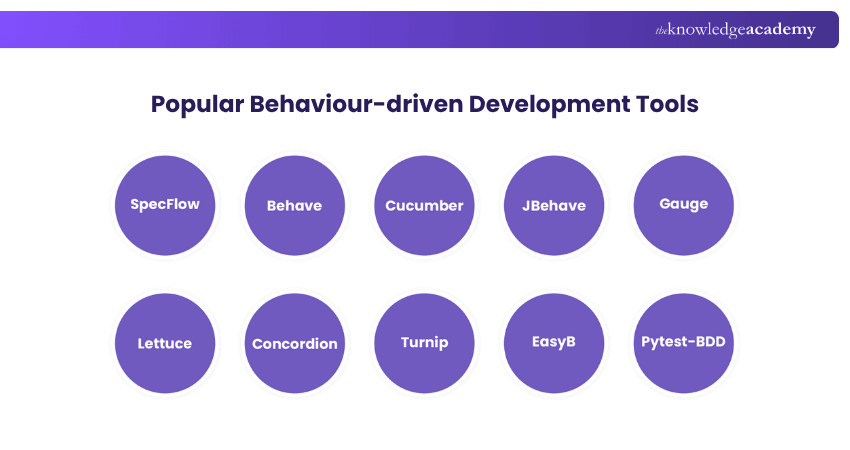
a) Gherkin Syntax: This consists of a set of lines called steps and comes with an additional structure with a simple learning curve.
b) Cucumber: This is another widely used testing framework loved by developers and testers alike as it supports Behaviour Driven Development fully and lets you write diverse test cases easily.
c) SpecFlow: It is like Cucumber but is hosted on GitHub.
d) Impact Mapping: This must be executed at the beginning of any product development.
Conclusion
The BDD approach stands out by letting one think and build from a customer’s viewpoint. It focuses on characteristics that can be an accurate fit for real time applications and cases. BDD aims to ensure that the software meets the business needs and that all stakeholders are aligned on the features and functionality.
From Code to Customer, master end-to-end DevOps in a SAFe® environment. Register for our SAFe® DevOps Certification now!
Frequently Asked Questions
What is the Primary Goal of BDD?

The primary goal of BDD is to help guide development, decrease rework and increase flow. It defines the behaviour of an application in plain human-readable language.
What is the Behavioural Development of a Child?
Behavioural Development in children is a multifaceted process that encompasses the way they learn, act, and react in their environment particularly in social interactions.
What are the Other Resources and Offers Provided by The Knowledge Academy?
The Knowledge Academy takes global learning to new heights, offering over 3,000 online courses across 490+ locations in 190+ countries. This expansive reach ensures accessibility and convenience for learners worldwide.
Alongside our diverse Online Course Catalogue, encompassing 19 major categories, we go the extra mile by providing a plethora of free educational Online Resources like Blogs, eBooks, Interview Questions and Videos. Tailoring learning experiences further, professionals can unlock greater value through a wide range of special discounts, seasonal deals, and Exclusive Offers.
What is The Knowledge Pass, and How Does it Work?
The Knowledge Academy’s Knowledge Pass, a prepaid voucher, adds another layer of flexibility, allowing course bookings over a 12-month period. Join us on a journey where education knows no bounds.
What are the Related Courses and Blogs Provided by The Knowledge Academy?
The Knowledge Academy offers various Agile Software Testing Training, including the Agile Software Testing, Agile Business Analyst Foundation and Practitioner (AgileBA®) Training and Agile Tester Training. These courses cater to different skill levels, providing comprehensive insights into T-Test.
Our Business Analysis Blogs cover a range of topics related to Behaviour-driven Development, offering valuable resources, best practices, and industry insights. Whether you are a beginner or looking to advance your Business Analysis skills, The Knowledge Academy's diverse courses and informative blogs have got you covered.

William Brown


Senior Business Analyst and Strategic Advisor
William Brown is a senior business analyst with over 15 years of experience driving process improvement and strategic transformation in complex business environments. He specialises in analysing operations, gathering requirements and delivering insights that support effective decision making. William’s practical approach helps bridge the gap between business goals and technical solutions.
View Detail
Upcoming Business Analysis Resources Batches & Dates
Date
 Agile Software Testing
Agile Software Testing
Thu 10th Sep 2026
Agile Software Testing
Thu 17th Dec 2026

 If you wish to make any changes to your course, please


