Business Analysis Courses

accredited by

Our BCS course is accredited by BCS

Online Instructor-led (3 days)

Online Self-paced (24 hours)

Official BCS Certificate Business Analysis Practice Exam

BCS Certificate in Business Analysis Practice Course Outline

Module 1: Strategic Context for Business Analysis

  • Business Change Lifecycle
  • Understanding the Strategic Context
  • VMOST
  • Performance Measurement
  • Resource Audit
  • Porter’s 5 Forces
  • PESTLE Analysis and SWOT Analysis
  • Balanced Business Scorecard (BBS)
  • Generic BBS Strategy Map
  • BBS Perspectives
  • CSFs, KPIs, and Performance Targets
  • Critical Success Factors (CSF) and Key Performance Indicators (KPI’s)

Module 2: Analysing and Managing Stakeholders

  • What is a Stakeholder?
  • Business Analysis Service Framework
  • Stakeholder Engagement
  • Recipients of Business Analysis Services
  • Categories of Stakeholder
  • Components of a Business Perspective
  • Approach
  • CATWOE - Corner Shop and Public Lending Library
  • Root Definition
  • Identifying Conflicts
  • Analysing Stakeholders
  • Stakeholder Responsibilities

Module 3: Analysing the Current State

  • Investigative Techniques
  • Interviews and Interview Lifecycle
  • Workshops and Workshop Lifecycle
  • Observation
  • Scenario Analysis
  • Document Analysis
  • Surveys/Questionnaires
  • Identify an Appropriate Technique
  • Customer Journey Map
  • Rich Pictures
  • Elements of a Rich Picture
  • Empathy Mapping and Mind Maps

Module 4: Establishing the Target State

  • Conceptual Business Activity Model
  • Approach to Business Activity Modelling
  • Benefits of BAM
  • Corner Shop
  • Identifying Activities
  • Public Lending Library
  • Building the Business Activity Model
  • Library Business Activity Model
  • Some Common Errors in BAM
  • Building Consensus by Resolving Conflicts
  • Consensus BAM Rationale
  • When – Business Events
  • Improvements to the Business System
  • Identifying areas of concern (BAM)
  • TOM and POPIT™
  • Target Operating Model

Module 5: Designing and Defining the Solution

  • Design Thinking
  • Divergent and Convergent Thinking
  • Gap Analysis Process
  • POPIT™ and Gap Analysis
  • Identify the Areas of Feasibility Assessment

Module 6: Developing a Business Case

  • Structure of a Business Case
  • Categories of Costs and Benefits
  • Analysis of Costs and Benefits
  • Risk Assessment
  • Risk Management Process
  • Risk Areas
  • Risk Analysis
  • Investment Appraisal
  • Investment and Appraisal Techniques
  • Payback
  • Payback and Risk
  • Discounted Cash Flow and Net Present Value
  • Impact Assessment
  • Business Case within the Business Change Lifecycle
  • Alignment
  • Definition
  • Design
  • Implementation
  • Realisation

Show moredown

Who should attend this BCS Certificate in Business Analysis Practice Course?

This course is ideal for professionals aiming to enhance their strategic Business Analysis capabilities and support effective business change through structured investigation and stakeholder engagement.

You should attend this BCS Certificate in Business Analysis Practice Course if you are:

  • Business Analyst: Developing strategic thinking and holistic analysis skills
  • Project Manager: Aligning business needs with project objectives and outcomes
  • Consultant: Advising clients on business improvement through structured analysis
  • Change Manager: Identifying and supporting key drivers for business transformation
  • Business Architect: Framing business problems and opportunities for high-level solutions
  • Aspiring Strategic Analyst: Building advanced competencies in business analysis practice

Prerequisites of the BCS Certificate in Business Analysis Practice Course

This Business Analysis Certification Course demands no formal prerequisite. However, a basic understanding of business concepts and terminology might help delegates move forward with the course.

BCS Certificate in Business Analysis Practice Course Overview

The BCS Certificate in Business Analysis Practice Course by The Knowledge Academy helps you develop the strategic skills needed to investigate business problems, evaluate options, and support effective business change initiatives.

This Business Analysis Practice Training focuses on high-level analysis, including understanding the business context, applying strategic analysis tools, identifying key issues, and evaluating solutions. You will explore techniques such as PESTLE, SWOT, and five forces analysis while learning how to define business objectives and measure benefits.

This course is ideal for Business Analysts, Consultants, Change Managers, and professionals involved in strategy, business improvement, or transformation projects. It also supports your journey towards a respected Business Analysis Certification from BCS, The Chartered Institute for IT.

BCS Certificate in Business Analysis Practice Course Objectives

  • To investigate business problems using structured analytical techniques
  • To identify opportunities for business improvement and define a business case
  • To engage stakeholders and support strategic decision-making
  • To define and justify business changes that align with organisational goals

Delivered over 3 Days, this Business Analysis Practice Training blends real-world scenarios with expert instruction. You will leave with the skills to assess business needs, develop strategic recommendations, and drive meaningful change.

Advance your Business Analysis capability with The Knowledge Academy. We provide comprehensive training, practical tools, and full support to help you achieve your Business Analysis Certification and succeed in complex business environments.

Show moredown

What’s included in this BCS Certificate in Business Analysis Practice Course?

  • BCS Certificate in Business Analysis Practice Examination.
  • World-Class Training Session from Experienced Instructors.
  • BCS Certificate in Business Analysis Practice Certificate.
  • Digital Delegate Pack.

Show moredown

Official BCS Certificate Business Analysis Practice Exam Information

The BCS Certificate in Business Analysis Practice exam assesses participants' understanding of business analysis principles and practices in a practical context. This certification focuses on evaluating an individual's knowledge of applying business analysis techniques to various scenarios within an organisation. The format of the exam is as follows: 

  • Question Type: Multiple Choice 
  • Total Questions: 40 
  • Total Marks: 40 Marks  
  • Pass Mark: 65%, or 26/40 Marks 
  • Duration: 60 minutes 
  • Open Book/ Closed Book: Closed Book

Show moredown

accredited by

Our BCS course is accredited by BCS

Online Instructor-led (5 days)

Online Self-paced (40 hours)

Official BCS Intermediate and Practitioner Certificate in Enterprise and Solution Architecture Exams

BCS Foundation Certificate in Architecture Concepts and Domains​ Training Course Outline

Duration: 3 Days

Module 1: Fundamentals of Architecture

  • Meaning and Levels of Architecture 
  • Various Subdomains of Enterprise Architecture and the Interactions Between Them 
  • Purpose and Role of Standards and Frameworks in Architecture 
  • Relevant Frameworks and Professional Standards Which Apply to Architecture 
  • Meaning and Objectives of Governance, Risk Management and Compliance 
  • Architect’s Contribution to a Business Case 
  • Purpose and Methods of Performing Gap Analysis 
  • Range of Drivers for Architecture 
  • Purpose and Use of an Architecture Description 

Module 2: Business Architecture 

  • Meaning and Objectives of Business Architecture 
  • Key Artefacts Commonly Used in Business Architecture 
  • Key Activities Undertaken by a Business Architect 
  • Structure and Behaviour of a Business System 

Module 3: Applications Architecture 

  • Meaning and Objectives of Applications Architecture 
  • Key Artefacts Commonly Used in Applications Architecture 
  • Key Activities Undertaken by an Applications Architect 
  • Use and Behaviour of Applications in a Business 
  • Purpose and Use of Cross-Reference Grids 
  • Different Kinds of Application 

Module 4: Data Architecture 

  • Meaning and Objectives of Data Architecture 
  • Key Artefacts Commonly Used in Data Architecture 
  • Key Activities Undertaken by a Data Architect 
  • Differences Between Data and Information and How They are Used 
  • Data Structures Used by a Business and/or its Applications 

Module 5: Infrastructure Architecture 

  • Meaning and Objectives of Infrastructure Architecture 
  • Key Artefacts Commonly Used in Infrastructure Architecture 
  • Key Activities Undertaken by an Infrastructure Architect 

Module 6: Software Architecture 

  • Meaning and Objectives of Software Architecture 
  • Key Artefacts Commonly Used in Software Architecture 
  • Key Activities Undertaken by a Software Architect 
  • System Modelling Techniques 
  • Role of APIs in Software Architecture 

Module 7: Security Architecture 

  • Identify the Meaning and Objectives of Security Architecture 
  • Describe the Key Artefacts Commonly Used in Security Architecture 
  • Describe the Key Activities Undertaken by a Security Architect 
  • Identify Legislation and Professional Standards Relevant to Security Architecture 
  • Identify the Key Concepts in Data Architecture Security 
  • Identify the Key Concepts in Applications Architecture Security 
  • Key Concepts in Infrastructure Architecture Security 

Module 8: Solution Architecture 

  • Identify the Meaning and Objectives of Solution Architecture 
  • Describe the Key Artefacts Commonly Used in Solution Architecture 
  • Describe the Key Activities Undertaken by a Solution Architect 
  • Describe Different Types of Solution Requirements 
  • Explain the Purpose and Stages of the Solution Architecture Lifecycle 
  • Stakeholder Categories in Solution Architecture 

BCS Practitioner Certificate in Enterprise and Solution Architecture Training Course Outline

Duration: 2 Days

Module 1: Architecture Domains and Frameworks 

  • Role of Architecture in an Organisation 
  • Different Architecture Domains and the Relationships Between Them 
  • Key Architecture Frameworks 
  • How are Industry Standards Relevant to Architecture? 

Module 2: Architecture and the Organisation 

  • Role of Architecture to Other Business Areas 
  • Discuss Use of the Business Change Lifecycle as an Input for Architecture 
  • Business Needs and the Intended Solution 

Module 3: Professionalism in Architecture 

  • Compliance with Professional Standards 
  • Types of Stakeholders 
  • Explain Specific Stakeholder Needs 
  • How to Influence Others? 
  • Apply a Practical Customer Focus 
  • Roles and Dynamics of a Successful Team 
  • Social, Ethical and Economic Concerns to the Role of an Architect 

Module 4: Corporate Governance 

  • Corporate Governance and the Impact it has on the Role of an Architect 
  • Key Architecture Governance Concepts, Roles, and Artefacts 
  • Importance of Risk Management to the Role of an Architect 

Module 5: Architectural Process, Tools, and Vision 

  • Practical Application of the Solution Architecture Framework 
  • Three Varieties of the Software Development Lifecycle (SDLC) 
  • Design of a Target Solution Architecture 
  • Use of Common Architecture Models 
  • Use of Common Information Systems Modelling Techniques 
  • Different Types of Business Requirements 
  • Method of Preparing a Gap Analysis 
  • Business Case for Presentation 

Module 6: Quality Assurance 

  • Use of a Range of Quality Assurance Tools or Techniques 
  • Principle of Separation of Concerns (Soc) 
  • Explain Change Management Tools and Processes 
  • Opportunities for Continuous Improvement 

Show moredown

Who should attend this BCS Foundation and Practitioner in Enterprise Architecture?

This certificate is ideal for anyone involved with IT architecture, including those new to the profession. Anyone who is involved in any aspect of enterprise and solution architecture.

Prerequisites for the BCS Foundation and Practitioner in Enterprise Architecture

For the foundation level there are no prerequisites, however for the practitioner level you are required to have the following. 

  • You must have obtained either the BCS Intermediate Certificate in Enterprise and Solutions Architecture or the new BCS Foundation Certificate in Architecture Concepts and Domains or have the TOGAF level 2 certificates.
  • Candidates should also have six or more years’ experience of IS / IT work, with some contact with architects and architecture descriptions. Training with a BCS accredited training provider is recommended.

BCS Foundation and Practitioner Certificate in Enterprise and Solution Architecture Overview

This course is a bundled course comprised of two separate courses:

During this course, candidates will learn about the essentials of Architecture concepts and domains. Next candidates will learn about Enterprise and Solution Architecture. This course is a combination of the Foundation and Practitioner courses for Enterprise & Solution Architecture and covers a wide range of topics including Infrastructure architecture, architecture management and data architecture.

What will you learn upon completion of this BCS training course?

At the Foundation level you will learn:

  • The meaning of IT architecture and the various levels within it.
  • Different kinds of IT architects and the roles they play in IT and information systems.
  • How architecture fits into the broader business context.
  • Architecture precursors: goals, directives, and constraints.
  • Architecture development process and description frameworks.
  • The subdomains of enterprise and solution architecture, and their purpose.
  • The key activities carried out in each subdomain, and the related artefacts.

At the Practitioner level you will learn:

  • Candidates should be able to demonstrate knowledge and understanding of enterprise and solution architecture principles and techniques. Key areas are:
    • Intermediate level concepts, including architecture processes and descriptions.
    • The ability to demonstrate and apply this knowledge to a case study that involves producing deliverables in the following areas:
    • Architecture precursors: goals, directives, and scope.
    • Architecture descriptions: business, data, applications, and infrastructure architecture.

BCS Membership

Included in your professional certification; one year’s free BCS, The Chartered Institute for IT, Associate membership.

Upon passing your examination, make the most of your professional certification and continue your career development with BCS Associate membership. Whether you’re looking for career support through the BCS global skills, training, and development framework, SFIAplus, seeking promotion or a network of new contacts, we’re here to support you. BCS membership provides exclusive access to resources, content and opportunities that will enrich your career.

BCS Membership allows you to give back to society. Some of the industry’s challenges are around personal data, health, education, and IT capabilities. By becoming part of our professional community, you can get involved and do your bit to make IT good for society.

Show moredown

What’s included in this BCS Foundation and Practitioner Certificate in Enterprise and Solution Architecture (Bundle Course) Training Course

  • BCS Foundation Certificate in Architecture Concepts and Domains exam.
  • BCS Practitioner Certificate in Enterprise and Solution Architecture exam.
  • World-class training from experienced BCS Instructors.
  • Digital Delegate Pack.

Show moredown

BCS Practitioner Certificate in Enterprise and Solution Architecture Exam

The course prepares you for the BCS Practitioner Certificate in Enterprise and Solution Architecture exam, which is included. This exam follows the following format:

  • One-hour
  • Closed Book
  • 40 multiple choice questions based on a case study
  • 65% (26/40) pass mark

Show moredown

accredited by

Our BCS course is accredited by BCS

Online Instructor-led (2 days)

Online Self-paced (16 hours)

Official BCS Practitioner Certificate in Enterprise and Solution Architecture Exam

BCS Practitioner Certificate in Enterprise and Solution Architecture Training Course Outline

Module 1: Architecture Domains and Frameworks

  • Role of Architecture in an Organisation
  • Different Architecture Domains and the Relationships Between Them
  • Key Architecture Frameworks
  • How Industry Standards are Relevant to Architecture?

Module 2: Architecture and the Organisation

  • Role of Architecture to Other Business Areas
  • Discuss Use of the Business Change Lifecycle as an Input for Architecture
  • Business Needs and the Intended Solution

Module 3: Professionalism in Architecture

  • Compliance with Professional Standards
  • Types of Stakeholders
  • Explain Specific Stakeholder Needs
  • How to Influence Others?
  • Apply a Practical Customer Focus
  • Roles and Dynamics of a Successful Team
  • Social, Ethical and Economic Concerns to the Role of an Architect

Module 4: Corporate Governance

  • Corporate Governance and the Impact it has on the Role of an Architect
  • Key Architecture Governance Concepts, Roles, and Artefacts
  • Importance of Risk Management to the Role of an Architect

Module 5: Architectural Process, Tools, and Vision

  • Practical Application of the Solution Architecture Framework
  • Three Varieties of the Software Development Lifecycle (SDLC)
  • Design of a Target Solution Architecture
  • Use of Common Architecture Models
  • Use of Common Information Systems Modelling Techniques
  • Different Types of Business Requirements
  • Method of Preparing a Gap Analysis
  • Business Case for Presentation

Module 6: Quality Assurance

  • Use of a Range of Quality Assurance Tools or Techniques
  • Principle of Separation of Concerns (Soc)
  • Explain Change Management Tools and Processes
  • Opportunities for Continuous Improvement

Show moredown

Who Should Attend This BCS Practitioner Certificate in Enterprise and Solution Architecture Course?

The BCS Practitioner Certificate in Enterprise and Solution Architecture is ideal for individuals seeking to advance their career in architecture and IT. This training is particularly beneficial for:

  • Enterprise Architects
  • Solution Architects
  • IT Managers
  • System Architects
  • IT Consultants
  • Business Analysts
  • Project Managers

This course is designed for professionals with foundational architecture experience who aim to take their architectural expertise to a strategic level, aligning business goals with IT solutions effectively.

Prerequisites of the BCS Practitioner Certificate in Enterprise and Solution Architecture Training

Delegates must hold one of the following: the BCS Intermediate Certificate in Enterprise and Solution Architecture, the BCS Foundation Certificate in Architecture Concepts and Domains, or a current TOGAF 9 / TOGAF 10 Level 2 certificate.

BCS Practitioner Certificate in Enterprise and Solution Architecture Training Course Overview

The BCS Practitioner Certificate in Enterprise and Solution Architecture Course by The Knowledge Academy is a professional certification that builds skills to design and implement solutions aligned with business goals.

It enables organisations to develop scalable architectures, improve performance, and reduce costs. For individuals, it enhances expertise and prepares them for leadership roles in enterprise architecture.

Delegates gain knowledge of TOGAF frameworks, practical methods, and tools. They learn to align technology with business needs, manage stakeholders effectively, and create future-proof solutions for long-term success.

BCS Practitioner Certificate in Enterprise and Solution Architecture Training Course Objectives

  • To understand architecture's role in aligning business and IT
  • To develop skills in stakeholder engagement and governance practices
  • To apply frameworks for designing enterprise and solution architectures
  • To analyse and implement quality assurance and risk management
  • To create and evaluate architecture artefacts like blueprints and models
  • To manage architecture processes including migration and change
  • To integrate non-functional requirements into architectural designs

This 2-day training introduces principles, frameworks, governance, and risk management for enterprise and solution architecture. Through case studies, delegates gain practical skills to design solutions and align technology with business needs.

Show moredown

What’s included in this BCS Practitioner Certificate in Enterprise and Solution Architecture Course?

  • BCS Practitioner Certificate in Enterprise and Solution Architecture Examination
  • World-Class Training Sessions from Experienced Instructors
  • BCS Practitioner Certificate in Enterprise and Solution Architecture Certificate
  • Digital Delegate Pack

Show moredown

BCS Practitioner Certificate in Enterprise and Solution Architecture Exam Information

The BCS Practitioner Certificate in Enterprise and Solution Architecture Exam assesses professionals' understanding and proficiency in enterprise and solution architecture principles and practices. The format of the exam is as follows: 

  • Question Type: Scenario-based
  • Pass Marks: 65% 
  • Duration: 50 Minutes 
  • Open Book/Closed Book: Closed book

Show moredown

accredited by

Our BCS course is accredited by BCS

Online Instructor-led (10 days)

Online Self-paced (80 hours)

Official BCS International Diploma in Business Analysis Exams

BCS International Diploma in Business Analysis Outline

BCS Core modules you must pass both:

BCS Knowledge based modules, you must pass one of these:

BCS Practitioner Modules, you must pass one of these:

BCS Oral Preparation Workshop - Exam to be booked separately

After you have taken and passed 2 Core modules, 1 Knowledge based module, 1 Practitioner module & BCS Oral Preparation Workshop you are then ready to take the Oral Exam.

After you have taken the Oral Preparation Workshop, you're required to book the actual oral exam through the BCS Portal.

Show moredown

Who should attend this BCS International Diploma in Business Analysis Course?

This course is also perfect for those professionals who wish to understand the principles of business analysis in a very holistic manner and would also like to get a globally recognised qualification in the area.

You are eligible to attend this BCS International Diploma in Business Analysis Course if you are:

  • Business Analyst: Moving your career and gaining a credential that is respected in the industry.
  • Project Manager: Enhancing your business requirements definition, analysis and management.
  • Business Change Manager: Nurturing successful change with systematic analysis.
  • Consultant: Providing insights and recommendations that are based on analysis to clients.
  • IT Professional: The match between technical and business goals and needs.
  • Aspiring Business Analyst: Building a strong background in business analysis.

Prerequisites of the BCS International Diploma in Business Analysis Course

Although there are no fixed set of prerequisites for the course, there are certain eligibility criteria that the delegates must adhere to. For registering in such Business Analysis Courses, the candidates typically need:

  • Work experience, ideally in a business field
  • Prior Business Analysis experience
  • Basic IT and systems knowledge
  • Proficiency in the instruction language, usually English
  • Possibly, the BCS Business Analysis Foundation Certificate

In addition to the above, candidates must pass four written examinations, each granting an individual certificate, before attending an oral interview with two BCS examiners. This final interview assesses their technical knowledge, business understanding, and interpersonal competencies to qualify for the diploma.

BCS International Diploma in Business Analysis Overview

The BCS International Diploma in Business Analysis Course is a globally recognised professional qualification equipping learners with advanced principles, techniques, and the Business Analysis Framework to deliver strategic change and value in complex organisations.

Mastering analysis at this level supports innovation, operations, and change initiatives. Ideal for Analysts, Consultants, and Project Managers, it includes four modules and an oral exam within the BCS International Diploma in Business Analysis.

This 10-day course by The Knowledge Academy blends theory, practice, and exam prep, covering lifecycle, process modelling, requirements, and solution evaluation. It builds confidence to apply the Business Analysis Framework in real-world contexts.

BCS International Diploma in Business Analysis Course Objectives

  • To understand the full scope and strategic impact of business analysis
  • To apply industry-standard business analysis principles and techniques
  • To manage stakeholders and requirements effectively across projects
  • To use business process modelling to map and improve business operations
  • To prepare thoroughly for the oral examination and achieve diploma success

Completing all modules and exams awards the BCS International Diploma in Business Analysis, a globally recognised professional qualification from BCS, The Chartered Institute for IT, proving readiness for advanced roles and professional excellence.

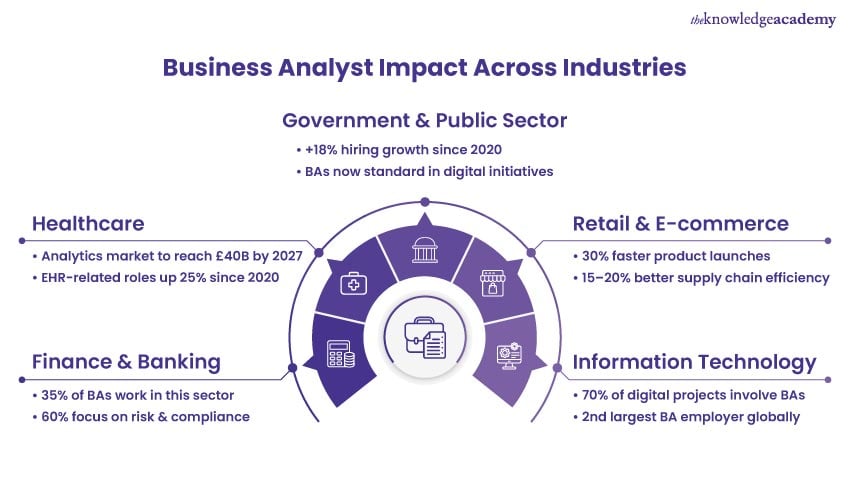
Sectors Employing the Power of Business Analysis

Impact of Business Analyst across industries, highlighting how Business Analysis Training applies in diverse sectors.

Through this course you can become a Business Analyst (BAs) who drives measurable impact across major industries. From healthcare to government, the demand for analytical expertise continues to grow; making BA skills highly valuable across sectors.

  • Government & Public Sector:
  • +18% hiring growth since 2020; BAs are now central to digital transformation initiatives.
  • Retail & E-commerce:
  • Enable 30% faster product launches and improve supply chain efficiency by up to 20%.
  • Information Technology:
  • 70% of digital projects require BAs; IT is the second largest global employer of business analysts.
  • Finance & Banking:
  • 35% of all BAs work in this field; 60% are involved in risk and compliance operations.
  • Healthcare:
  • The analytics market is projected to reach £40B by 2027; EHR (Electronic Health Record) roles up 25% since 2020.

Show moredown

What's included in the BCS Business International Diploma in Business Analysis Training Course?

  • BCS International Diploma in Business Analysis Examination.
  • World-Class Training Sessions from Experienced Instructors.
  • BCS International Diploma in Business Analysis Certificate.
  • Digital Delegate Pack.

Show moredown

BCS International Diploma In Business Analysis Examination Information

Two Core Modules to pass:

  • BCS Certificate in Business Analysis Practice
  • BCS Certificate in Requirements Engineering

One Knowledge Based Module:

  • BCS Certificate in Commercial Awareness
  • BCS Foundation Certificate in Business Analysis
  • BCS Foundation Certificate in Organisational Behaviour
  • BCS Foundation Certificate in Business Change
  • BCS Foundation Certificate in IS Project Management

One Practitioner Module:

  • ​BCS Certificate in Modelling Business Processes
  • BCS Practitioner Certificate in Benefits Management and Business Acceptance

BCS Core Modules:

BCS Certificate in Business Analysis Practice Examination Information

This BCS Business Analysis Practice exam is formatted in the following way:

  • Type: Scenario Based Written Examination
  • Duration: 60 Minutes
  • Supervised: Yes
  • Open Book: No
  • Pass Mark: 52/80
  • Calculators: Calculators cannot be used during this examination

BCS Certificate in Requirements Engineering Examination Information

This BCS Business Analysis Practice exam is formatted in the following way:

  • Type: Scenario Based Written Examination
  • Duration: 60 Minutes
  • Supervised: Yes
  • Open Book: No
  • Pass Mark: 50/80
  • Calculators: Calculators cannot be used during this examination

BCS Knowledge Based Modules

BCS Foundation Certificate in Organisational Behaviour

  • Type: Multiple Choice
  • Duration: 60 Minutes
  • Supervised: Yes
  • Open Book: No
  • Pass Mark: 26/40
  • Calculators: Calculators cannot be used during this examination

BCS Foundation Certificate in Business Analysis Examination Information

  • Type: Multiple Choice
  • Duration: 60 Minutes
  • Supervised: Yes
  • Open Book: No
  • Pass Mark: 26/40
  • Calculators: Calculators cannot be used during this examination

BCS Foundation Certificate in Business Change Examination Information

  • Type: Multiple Choice
  • Duration: 60 Minutes
  • Supervised: Yes
  • Open Book: No
  • Pass Mark: 26/40
  • Calculators: Calculators cannot be used during this examination

BCS Foundation Certificate in IS Project Management Examination Information

  • Type: Multiple Choice
  • Duration: 60 Minutes
  • Supervised: Yes
  • Open Book: No
  • Pass Mark: 26/40
  • Calculators: Calculators cannot be used during this examination

BCS Practitioner Modules

BCS Practitioner Certificate in Modelling Business Processes Examination

  • Type: Scenario Based Written Examination
  • Duration: 60 Minutes
  • Supervised: Yes
  • Open Book: No
  • Pass Mark: 50/80
  • Calculators: Calculators cannot be used during this examination

BCS Practitioner Certificate in Benefits Management and Business Acceptance Examination Information

  • Type: Scenario Based Written Examination
  • Duration: 60 Minutes + 15 Minutes Reading Time
  • Supervised: Yes
  • Open Book: Yes
  • Pass Mark: 50%
  • Calculators: Calculators cannot be used during this examination

Show moredown

accredited by

Our BCS course is accredited by BCS

Online Instructor-led (3 days)

Online Self-paced (24 hours)

Official BCS Certificate in Requirements Engineering Exam

BCS Practitioner Certificate in Requirements Engineering Course Outlines

Module 1: Requirements Definition as a Service

  • Elements That Form the Requirements Definition Service
  • Stages of the RE Framework and How to Plan the Approach

Module 2: Eliciting Requirements

  • Relevant Strengths and Limitations of Elicitation Techniques in Terms of Stakeholder Knowledge Types and Behaviours
  • Use of Prototyping to Elaborate Requirements
  • Analyse a Given Scenario and Apply Appropriate Elicitation Techniques

Module 3: Documenting Requirements

  • Different Requirement Types
  • How Requirements Are Documented and Apply Best Practice to Authoring and Capturing Requirements

Module 4: Analysing Requirements

  • Ex Purpose of Analysing Requirements
  • Analyse Requirements
    • Refine a Set of Requirements
    • Refine an Individual Requirement
  • Additional Methods Used to Analyse and Organise Requirements

Module 5: Validating Requirements

  • Purpose of Validating Requirements
  • Roles and Responsibilities of Stakeholders During Requirements Validation
  • Different Approaches to Requirements Validation

Module 6: Managing Requirements

  • Rationale of Requirements Management and the Elements of Requirements Management
  • Manage Changes to Requirements

Show moredown

Who should attend this BCS Practitioner Certificate in Requirements Engineering Training?

This BCS Practitioner Certificate in Requirements Engineering Training Course is ideal for individuals who are involved in any aspect of requirements gathering, documentation, and analysis. It is particularly beneficial for:

  • Business Analyst
  • Requirements Engineer
  • Product Owner
  • Project Manager
  • Systems Analyst
  • IT Consultant
  • Business Consultant

Prerequisites of BCS Practitioner Certificate in Requirements Engineering Training:

There are no formal prerequisites to attend this BCS Practitioner Certificate in Requirements Engineering Training.  

BCS Practitioner Certificate in Requirements Engineering Training Course Overview

BCS Practitioner Certificate in Requirements Engineering is a comprehensive training programme designed to equip professionals with the essential skills and knowledge needed to manage the entire requirements engineering lifecycle. This certification is crucial as it ensures that individuals can accurately gather, analyse, document, validate, and manage requirements, leading to more successful project outcomes. For organisations, this training enhances the effectiveness of their teams in delivering projects that meet business needs and stakeholder expectations. For individuals, it provides a deeper understanding of best practices and boosts their confidence in handling requirements challenges. Professionally, this certification significantly enhances career prospects in business analysis and project management roles.

In this course, delegates will gain a thorough understanding of requirements engineering concepts and methodologies. They will learn how to effectively elicit requirements, document them clearly, and ensure they align with business objectives. The course will also cover requirements validation techniques, such as prototyping and stakeholder engagement, ensuring that the requirements meet both functional and non-functional needs. Delegates will gain insights into managing changes to requirements, prioritising them, and ensuring traceability throughout the project lifecycle.

BCS Practitioner Certificate in Requirements Engineering Training Course Objectives

  • To understand the fundamental concepts of requirements engineering
  • To develop skills in eliciting requirements from stakeholders effectively
  • To apply best practices in documenting and writing requirements
  • To analyse and validate requirements with the relevant stakeholders
  • To manage changes to requirements and ensure consistency
  • To prioritise requirements using effective techniques and frameworks

After completing this training, delegates will be proficient in eliciting and capturing requirements from various stakeholders, ensuring that they are clear, concise, and aligned with business goals. They will be able to document requirements effectively, using industry-recognised techniques that enhance communication and understanding across teams. Delegates will also be able to apply requirements validation methods to ensure that the requirements are feasible and meet the business needs.

Show moredown

What’s included in the BCS Practitioner Certificate in Requirements Engineering Course?

  • BCS Foundation Certificate in Organisational Behaviour Examination
  • World-class training sessions from Experienced Instructors
  • BCS Foundation Certificate in Organisational Behaviour Certificate
  • Digital Delegate Pack

Show moredown

BCS Practitioner Certificate in Requirements Engineering Exam Information

The BCS Practitioner Certificate in Requirements Engineering Exam assesses participants' understanding of requirements engineering principles and practices. This BCS Certificate in Requirements Engineering exam is formatted in the following way: 

  • Question Type: Multiple Choice 
  • Total Questions: 40 Questions 
  • Total Marks: 40 Marks 
  • Pass Marks: 65%, or 26/40 Marks 
  • Duration: 60 Minutes 
  • Open Book/Closed Book: Closed book

Show moredown

accredited by

Our BCS course is accredited by BCS

Online Instructor-led (2 days)

Online Self-paced (16 hours)

Official BCS Foundation Certificate in Agile Exam

BCS Foundation Certificate in Agile Course Outline

Module 1: Why Agile?

  • Linear Development Approach, Such as Waterfall and V-Model
  • Why Linear Development Approaches are Not Suitable?
  • Origins of Agile
  • Recognise the Agile Manifesto and Its Principles
  • How the Pillars of Scrum Underpin Agile Thinking

Module 2: Individuals and Their Interactions Over Processes and Tools

  • Ways That the Processes and Tools Can Undermine Agile Team Performance
  • Connection Between Team Motivation and Self-organising Autonomous Teams
  • Describe How Agile Teams Interact

Module 3: Working Software Over Comprehensive Documentation

  • How Working Software Means More than Just Code?
  • How Agile Can Be Applied to Non-software Products?
  • How the Seven Wastes of Lean (Software Development) Relates to Comprehensive Documentation?

Module 4: Customer Collaboration Over Contract Negotiation

  • Agile Team’s Relationship with its Customers
  • How Agile Teams Use Time Boxes and Iterations to Decide What Work to Commit To?
  • Product Owner Role and Their Responsibilities

Module 5: Responding to Change Over Following a Plan

  • How Regular Feedback Helps Agile Teams Respond to Change?
  • How Agile Teams Recognise When Change Is Underway?
  • Different Levels of Planning That Agile Teams Use
  • Risks of Detailed, Upfront Planning

Module 6: The Agile Mindset

  • Servant Leadership
  • How Agile Teams Are Cross-functional and Self-organising?
  • How the Pillars of Scrum Enable Continuous Improvement?
  • How Agile Teams Demonstrate Transparency?
  • Importance of Maximising the Amount of Work Not Done
  • How Agile Teams Maintain Sustainable Pace
  • Recall the Critical Factors in Creating Motivated Teams
  • Importance of Psychological Safety for High Performing Teams
  • Incremental and Iterative Delivery

Module 7: Roles in Agile Teams

  • Describe the Three Scrum Roles
  • Identify and Describe Commonly Used Non-Scrum Agile Roles

Module 8: Common Agile Practices

  • Practices of Team Leadership and Organisation in Agile
  • Use of Requirements
  • Practice of Estimation
  • Common Software Development Practices

Module 9: Agile in Practice

  • Describe the Agile Approaches
  • How the Following Practices Can Remove the Need to Adopt a Scaling Method?
  • Why the Following Metrics Are Indicators of Healthy Agile Teams?

Show moredown

Who Should Attend this BCS Foundation Certificate in Agile Course?

This course is ideal for individuals looking to gain a solid understanding of Agile principles, practices, and frameworks to support flexible and collaborative project delivery. You should attend this course if you are:

  • Aspiring Agile Practitioner: Learning core Agile values, roles, and methodologies
  • Project Manager: Transitioning from traditional to Agile project environments
  • Business Analyst: Supporting Agile teams through iterative requirement gathering
  • Developer or Tester: Collaborating effectively in Agile development cycles
  • Scrum Team Member: Understanding how Agile frameworks improve team performance
  • Change Manager: Facilitating adaptive planning and continuous improvement

Prerequisites for the BCS Foundation Certificate in Agile Course

There are no formal prerequisites for this BCS Foundation Certificate in Agile Course. However, a basic familiarity with Project Management and Software Development concepts can be beneficial.

BCS Foundation Certificate in Agile Course Overview

BCS Foundation Certificate in Agile introduces delegates to the core concepts, principles, and practices that define adaptive project delivery. The training focuses on collaboration, incremental delivery, and continuous improvement in modern organisations.

This training supports upskilling by strengthening adaptability, team collaboration, and responsiveness to changing business needs. Delegates strengthen their ability to contribute effectively in Agile environments while demonstrating commitment to recognised Agile practices.

This 2-Day course offered by The Knowledge Academy helps delegates apply Agile principles confidently in real-world scenarios. Delegates gain practical knowledge of iterative delivery techniques and are prepared to contribute effectively to Agile projects while working towards certification.

Course Objectives

  • To understand the values and principles outlined in the Agile Manifesto
  • To explore key Agile frameworks such as Scrum and Kanban
  • To recognise the roles and practices that support Agile delivery
  • To apply Agile thinking to support collaboration and responsiveness

This training combines theory with examples and group discussions. You will leave with the knowledge to support Agile projects confidently and contribute to Agile transformations in your organisation.

Begin your Agile journey with The Knowledge Academy. We provide expert-led instruction, practical insights, and full support to help you achieve your Agile Certification and advance your career in modern project environments.

Show moredown

What’s Included in this BCS Foundation Certificate in Agile Course?

  • BCS Foundation Certificate in Agile Examination
  • World-Class Training Sessions from Experienced Instructors
  • BCS Foundation Certificate in Agile Qualification
  • Digital Delegate Pack

Show moredown

BCS Foundation Certificate in Agile Exam Information

The BCS Foundation Certificate in Agile Examination assesses participants' understanding of foundational principles and practices of Agile methodologies. This certification focuses on evaluating an individual's knowledge of Agile concepts and techniques used in delivering value and managing projects in an Agile environment. The format of the exam is as follows: 

  • Question Type: Multiple Choice 
  • Total Questions: 40 Questions 
  • Total Marks: 40 Marks 
  • Pass Marks: 65%, or 26/40 Marks 
  • Duration: 60 Minutes 
  • Open Book/Closed Book: Closed book 

Show moredown

accredited by

Our BCS course is accredited by BCS

Online Instructor-led (2 days)

Online Self-paced (16 hours)

Official BCS Certificate in Modelling Business Processes Exam

BCS Practitioner Certificate in Modelling Business Processes Training Course Outline

The content of this Business Analysis Training Course covers a range of subjects to provide delegates with a broad understanding of Modelling Business Processes.

Module 1: Context for Business Process Modelling

  • Business Systems and IT Systems
  • Some Definitions of ‘Process’
  • Processes
  • Why Model Business Processes?
  • Mapping Vs Modelling
  • Role of IT in Businesses
  • Approaches to Business Process Modelling
  • Hierarchy of Business Processes
  • Process Levels
  • Functional View of an Enterprise
  • Functional Vs Process View
  • Advantages of Process View
  • Organisation Chart View of an Enterprise
  • Process View

Module 2: Modelling at Enterprise Level

  • Enterprise View of Process Hierarchy
  • Map Before Model
  • SIPOC View of the Enterprise
  • Harmon Model of the Organisation
  • Enterprise View of Business Process SIPOC
  • Core Operation – Home Cinema Example
  • Supporting Processes
  • At Home Cinema – Process Map
  • Enterprise Level Process Model
  • Value Proposition
  • Relationship and Image Aspects
  • Porter’s Value Chain
  • Porter’s Value Chain– Manufacturing Example
  • Manufacturing Value Chain to Manufacturing Process Map
  • Porter’s Value Chain– Manufacturing Example
  • Value Chain for Service Enterprises

Module 3: Modelling at the Event-Response Level

  • Event-Response View of Process Hierarchy
  • Process Elements
  • Actors
  • Business Rules
  • Customer
  • Business Events
  • Process Elements Examples
  • Process Elements Example– Alternate View
  • Business Process Modelling Technique
  • Process Dependency Vs Process Flow
  • Why Model Business Processes?
  • Process Modelling Notations
  • BPMN
  • UML Activity Diagrams
  • Notation-Swim Lanes
  • Notation-Start
  • Notation-Tasks
  • What is a Task?
  • Identifying Tasks
  • Notation
    • Flows
    • Decisions
    • Merges
    • Forks and Joins
    • Finish
  • UML Notation - Reminder
  • Purpose of Measuring Process Performance
  • Measuring Processes
  • Timelines
  • Process Management

Module 4: Modelling at the Actor-Task Level

  • Actor-Task View of Process Hierarchy
  • What is a Task?
  • Task Analysis
  • Example Task Narrative for at Home Cinema
  • Example Task Description for Take Payment Task
  • Documenting Business Rules
  • Task Performance Measures
  • Documenting the Steps of a Task
  • Task Steps Shown as Activity Diagram
  • Use Case Descriptions
    • Header
    • Flows
  • Structured English Conventions and Constructs
  • DOWHILE Vs DOUNTIL
  • Task Steps Shown Using Structured English

Module 5: Improving Business Processes

  • Identifying Process Problems
  • Possible Process Flow Problems
  • Potential Process Flow Improvements
  • Robotic Process Automation (RPA) in Process Improvement
  • Unsatisfactory Performance
  • Challenging Business Rules
  • Task Analysis
  • Typical NVAs
  • Scenario Analysis
  • Challenging Assumptions
  • RPA Key Benefits
  • Alternative Approaches to Change
  • Importance of Overall View
  • Modelling the To-Be Processes
  • Gap Analysis - Identifying IT System Requirements
  • Gap Analysis – the COTS Approach

Module 6: Managing and Implementing Change

  • Gap Analysis
  • Taking a Holistic Approach
  • POPIT
  • How POPIT Helps?
  • Implementing Business Change
  • Pros and Cons

Show moredown

Who should attend the BCS Practitioner Certificate in Modelling Business Processes Training Course?

The BCS Certificate in Modelling Business Processes Course is designed for individuals who are involved in or interested in the field of business process modelling  and management. This Business Analysis Course is particularly beneficial for the following professionals:

  • Business Analysts
  • Systems Analysts
  • Process Analysts
  • Process Improvement Specialists
  • Business Process Managers
  • Quality Assurance Professionals
  • Operations Managers

Prerequisites of the BCS Practitioner Certificate in Modelling Business Processes Training Course

There are no formal prerequisites for attending this BCS Certificate in Modelling Business Processes Course. However, a basic understanding of business operations would be beneficial.

BCS Practitioner Certificate in Modelling Business Processes Course Overview

Business Process Modelling is crucial for those involved in fields like project management, business analysis, and process improvement. It involves graphically representing business processes to identify inefficiencies, improve workflow, and facilitate stakeholder communication. Organisations can streamline operations, enhance customer satisfaction, and achieve strategic goals by understanding and applying business process modelling techniques.

Proficiency in business process modelling is essential for Business Analysts, Process Architects, Project Managers, Business Change Managers, and anyone involved in optimising organisational processes. Professionals can effectively visualise, analyse, and improve business processes by mastering business process modelling techniques, contributing to organisational efficiency and success.

The 2-day training on Business Analysis comprehensively covers all the essential topics, enabling delegates to develop a thorough understanding of modelling business processes. Throughout the training, participants will delve into various aspects, including the context for business process modelling, process levels, implementing business change, outline process mapping, business events, potential process flow improvements, and more.

BCS Practitioner Certificate in Modelling Business Processes Course Objectives

  • To evaluate the role of IT, including Robotic Process Automation (RPA), in process improvement
  • To manage and implement change in business processes
  • To understand the fundamental concepts of business process modelling and its role in organisational improvement
  • To identify and analyse business processes using various modelling techniques
  • To communicate business process models effectively to stakeholders
  • Identify areas for process improvements and rank opportunities for better results.

Upon completing theBCS Practitioner Certificate in Modelling Business Processes Training Course, delegates will have acquired the skills and knowledge to proficiently analyse and model business processes across various levels, including enterprise-wide, event-response, and actor-task levels.

Show moredown

What’s included in the BCS Practitioner Certificate in Modelling Business Processes Training Course?

  • BCS Practitioner Certificate in Modelling Business Processes Examination
  • World-class training sessions from Experienced Instructors
  • BCS Certificate in Modelling Business Processes Certificate
  • Digital Delegate Pack

Show moredown

BCS Practitioner Certificate in Modelling Business Processes Exam Information

The BCS Practitioner Certificate in Modelling Business Processes is designed for those who wish to gain understanding of a range of business process modelling and analysis techniques, know how they are used, and identify when to use them. This BCS Practitioner Certificate in Modelling Business Processes Exam is formatted in the following way: 

  • Question Type: Multiple Choice 
  • Total Questions: 40 Questions 
  • Total Marks: 40 Marks 
  • Pass Mark: 65%, or 26/40 Marks 
  • Duration: 60 Minutes 
  • Open Book/Closed Book: Closed book

Show moredown

accredited by

Our BCS course is accredited by BCS

Online Instructor-led (1 days)

Online Self-paced (8 hours)

Business Analysis Diploma Oral Preparation Workshop

The course revisits the essential content from the core modules and the specialist modules.

Domain 1: Business Context

  • Rationale for Business Analysis
  • Holistic View of a Business System
  • Competencies of a Business Analyst
  • Professionalism in Business Analysis
  • Business Environment Analysis
  • SWOT Analysis
  • Business Performance Measurement
  • Business Analysis within the Lifecycle for Business Change

Domain 2: Business Analysis Techniques

  • Investigating and Documenting Business Situations
  • Stakeholder Analysis
  • Modelling Business Activities
  • Business Events
  • Business Rules
  • Gap Analysis

Domain 3: Business Case Development

  • Rationale for Making a Business Case
  • Contents of a Business Case
  • Options
  • Financial Case
  • Investment Appraisal Techniques
  • Risk Analysis
  • Impact Analysis
  • Lifecycle for the Business Case

Domain 4: Requirements Definition

  • Requirements Engineering
  • Requirements Elicitation
  • Requirements Analysis
  • Requirements Validation

Domain 5: Requirements Management and Documentation

  • Requirements Management
  • Change Control
  • Version Control
  • Tools in Requirements Management
  • Types of Requirements
  • Legal Issues and Business Analysis
  • Documenting Requirements
  • Requirements Modelling

Domain 6: Practitioner Specialism

  • Relevance to the Business Analyst Role
  • Relevance of the Module to an Organisation
  • Description of the Module

Show moredown

Who should attend this BCS Business Analysis Diploma Oral Preparation Workshop?

This course is ideal for candidates preparing to undertake the oral examination for the BCS Business Analysis Diploma and aiming to strengthen their confidence, articulation, and exam technique.

You should attend this BCS Business Analysis Diploma Oral Preparation Workshop if you are:

  • Business Analyst: Finalising your BCS Diploma with targeted oral exam preparation
  • BA Diploma Candidate: Seeking structured guidance and feedback on oral performance
  • Project Manager: Preparing to validate your business analysis skills through formal assessment
  • IT or Change Professional: Completing the final step of the BCS BA Diploma Certification
  • BA Career Changer: Transitioning to business analysis with BCS accreditation goals
  • Aspiring Senior Business Analyst: Aiming to achieve a recognised industry qualification

Prerequisites of the BCS Business Analysis Diploma Oral Preparation Workshop

To register in the BCS Business Analysis Diploma Oral Preparation Workshop, delegates must meet specific criteria. They should have already passed the written examinations required for the BCS Business Analysis Diploma and be in the process of preparing for the oral examination. Having a solid understanding of the BCS Business Analysis syllabus is also advantageous for delegates as it will facilitate their participation in the workshop.

Business Analysis Diploma Oral Preparation Workshop Overview

The BCS Business Analysis Diploma Oral Preparation Workshop by The Knowledge Academy prepares you thoroughly for the final oral interview of the BCS International Diploma in Business Analysis, equipping you with the confidence and techniques to succeed.

The oral exam is a crucial component in achieving the full diploma. This BCS Business Analysis Diploma Oral Preparation Workshop helps you consolidate your knowledge across the four mandatory modules and demonstrate your understanding of business analysis practices. It focuses on exam technique, communication skills, and structured responses to typical oral exam questions.

This targeted Business Analysis Training is ideal for candidates who have completed the required modules and are ready to take the final step towards their qualification. It also supports those seeking to refine their knowledge and secure their BCS Business Analysis Certification.

BCS Business Analysis Diploma Oral Preparation Workshop Objectives

  • To prepare for the structure and expectations of the oral exam
  • To practise answering common oral exam questions clearly and concisely
  • To consolidate knowledge from all diploma modules
  • To build confidence in presenting and justifying your analysis approach

Delivered as a focused 1-day session, this workshop offers expert guidance, mock interviews, and personalised feedback. You will leave fully equipped to handle the oral exam with confidence and achieve your full diploma.

Advance your professional standing with The Knowledge Academy. We support you with specialist coaching and preparation to help you succeed in your BCS Business Analysis Certification journey.

Show moredown

What’s included in the BCS Business Analysis Diploma Oral Preparation Workshop?

  • BCS Business Analysis Diploma Oral Preparation Workshop Examination
  • World-class training sessions from Experienced Instructors
  • BCS Business Analysis Diploma Oral Preparation Workshop Certificate
  • Digital Delegate Pack

Show moredown

accredited by

Our BCS course is accredited by BCS

Online Instructor-led (3 days)

Online Self-paced (24 hours)

Official BCS Foundation Certificate in Business Analysis Exam

BCS Foundation Certificate in Business Analysis Course Outline

Module 1: What is Business Analysis?

  • Describe the Business Change Lifecycle
  • List the Key Principles of Business Analysis
  • Variants of the Business Analyst Role

Module 2: The Competencies of a Business Analyst

  • Concept of the T-shaped Professional
  • Identify the Three Areas of Business Analysis Competency

Module 3: The Strategic Context for Business Analysis

  • Business Analysis and the Strategic Context
  • Factors Assessed Using PESTLE to Analyse an External Environment
  • Identify the Elements of the VMOST Technique Used to Analyse an Internal Environment
  • Elements of Performance Measurement
  • Structure of a SWOT Analysis
  • Techniques Used in Strategy Execution

Module 4: The Business Analysis Service Framework

  • Identify the Activities in the Business Analysis Service Framework (BASF)

Module 5: Investigating the Business Situation

  • Define Workshops
  • Define Observation
  • Define Interviews
  • Define Scenarios
  • Define Prototyping
  • Define User Role Analysis
  • Define Quantitative Approaches
  • Describe Two Diagrammatic Techniques Used to Record a Business Situation

Module 6: Analysing and Managing Stakeholders

  • Identify Stakeholder Categories Using the Stakeholder Wheel
  • Use of the Power/Interest Grid Technique to Analyse Stakeholders
  • Stakeholder Responsibilities Using a RACI Chart

Module 7: Improving Business Services and Processes

  • Business Process Hierarchy
  • Techniques Used to Model the Enterprise-Level Processes
  • Aspects of the Event-Response Level
  • Aspects of the Actor-Task Level
  • Aspects of the As-Is Process Model
  • Identify Generic Approaches to Improving Business Processes
  • Purpose of Customer Journey Maps

Module 8: Defining the Solution

  • Describe the Gap Analysis Process
  • Explain the Use of POPIT™ in Gap Analysis
  • Process for Developing Options
  • Purpose of Design Thinking

Module 9: Making the Business Case

  • Lifecycle for a Business Case in Business Case Development
  • Identify the Areas of Feasibility Assessment
  • Structure and Contents of a Business Case
  • List the Key Features Relevant to the Production of a Business Case within an Agile Environment
  • Identify the Elements of a CARDI Log
  • Purpose of the Investment Appraisal Techniques

Module 10: Establishing the Requirements

  • Requirements Engineering (RE) Framework
  • Identify the Actors in Requirements Engineering
  • Identify the Types of Requirements
  • Hierarchy of Requirements
  • Describe the Requirements Elicitation Techniques
  • Explain the Elements of Requirements Analysis

Module 11: Documenting and Modelling Requirements

  • Identify the Documentation Styles
  • List the Elements of a Requirements Catalogue
  • Format of User Stories
  • Elements of the Use Case Diagram Used to Model Functional Requirements
  • Elements of a Class Model Used to Model Data
  • Product Backlog in Modelling and Documentation in an Agile Environment
  • Define the Structure of the Business Requirements Document

Module 12: Validating and Managing Requirements

  • Types of Requirements Validation
  • Aspects of Requirements Management

Module 13: Delivering the Requirements

  • Describe the Types of Delivery Lifecycle
  • Explain the Advantages and Disadvantages of the Lifecycles

Module 14: Delivering the Business Solution

  • Role of the Business Analyst in the Business Change Lifecycle
  • Role of the Business Analyst During the Design, Development, and Test Stages
  • Approaches Used in the Implementation Stage
  • Describe How the Benefits Plan is Used in the Realisation Stage

Show moredown

Who should attend this BCS Foundation Certificate in Business Analysis Course?

This course is ideal for individuals seeking to understand the fundamentals of Business Analysis, including Business Analysis techniques, tools, and the role of a Business Analyst in change initiatives.

You should attend this BCS Foundation Certificate in Business Analysis Course if you are:

  • Aspiring Business Analyst: Building a strong foundation in BA principles and techniques
  • Project Manager: Gaining insight into business analysis practices to support project success
  • Business Stakeholder: Understanding how analysis contributes to effective change delivery
  • IT Professional: Bridging the gap between technical solutions and business needs
  • Change Manager: Applying analysis skills to support transformation initiatives
  • Recent Graduate or Career Changer: Entering the business analysis field with recognised certification

Prerequisites of the BCS Foundation Certificate in Business Analysis Course

There are no formal prerequisites to attend this BCS Foundation Certificate in Business Analysis Course. However, a basic understanding of business operations and projects can be beneficial for the delegates and might give them a headstart in the BCS Training.

BCS Foundation Certificate in Business Analysis Course Overview

The BCS Foundation Certificate in Business Analysis is an entry-level professional qualification which introduces stakeholder analysis, requirements engineering, and process modelling, preparing learners for business change and further study.

Business analysis improves processes and drives change. This course suits aspiring Analysts, Project Members, and IT professionals, leading to a globally recognised certification from BCS, The Chartered Institute for IT.

Delivered over 3 days by The Knowledge Academy, this Business Analysis Training blends theory and practice, exploring lifecycle, requirements, stakeholder analysis, and modelling to build confidence in supporting organisational change.

BCS Foundation Certificate in Business Analysis Course Objectives

  • To understand the business analyst role and core responsibilities
  • To perform stakeholder analysis and manage stakeholder expectations effectively
  • To apply the principles of requirements engineering in business change projects
  • To model business processes for analysis and improvement
  • To gain a recognised entry-level professional qualification from the Chartered Institute for IT
  • To support business change initiatives through structured analysis and solution evaluation

After completing this Business Analysis Course, delegates will receive the BCS Foundation Certificate in Business Analysis. This certification demonstrates your ability to contribute to business change, work across stakeholder groups, and apply analysis techniques in real-world projects.

Show moredown

What’s included in the BCS Foundation Certificate in Business Analysis Course?

  • BCS Foundation Certificate in Business Analysis Examination
  • World-class training sessions from Experienced Instructors
  • BCS Foundation Certificate in Business Analysis Certificate
  • Digital Delegate Pack

Show moredown

BCS Foundation Certificate in Business Analysis Exam Information

The BCS Foundation Certificate in Business Analysis Exam assesses participants' understanding of foundational business analysis principles and practices. This certification focuses on evaluating an individual's knowledge of key concepts and techniques used in business analysis. The format of the exam is as follows: 

  • Question Type: Multiple Choice 
  • Total Questions: 40 Questions 
  • Total Marks: 40 Marks 
  • Pass Mark: 65%, or 26/40 Marks 
  • Duration: 60 Minutes 
  • Open Book/Closed Book: Closed book 

Show moredown

accredited by

Our BCS course is accredited by BCS

Online Instructor-led (3 days)

Online Self-paced (24 hours)

BCS Foundation Certificate in Digital Business Change Exam

BCS Foundation Certificate in Digital Business Change Training Course Outline

Module 1: Change Principles

  • Business Change Lifecycle
  • Drivers of Change
  • Risk Appetite and Categories

Module 2: Aligning Change with the Business

  • Techniques for Analysing External
  • Techniques for Internal Environments
  • SWOT Analysis Components and Purpose
  • Cultural Web Framework for Analysing Organisational Culture
  • Organisational Performance Measurement Techniques
  • Enterprise Architecture Components
  • Ethical Considerations of Digital Change

Module 3: Identifying Change

  • Purpose, Advantages, and Disadvantages of Investigation Techniques
  • Techniques for Recording Business Situations
  • Stakeholder Identification Using Stakeholder Wheel
  • Power/Interest Grid for Stakeholder Analysis
  • Business Process Modelling
  • Customer Journey Mapping
  • Use of POPIT ™ in Gap Analysis
  • Developing Options Process
  • Three Main Areas for Evaluating the Feasibility of Options
  • Identifying Change in Agile Environments
  • Design Thinking for Generating Options

Module 4: Change Requirements

  • Establishing Change Requirements Process
  • Roles and Responsibilities in Requirements Establishment
  • Types of Requirement
  • Principles of User-Centred Design
  • Design Principles of Web Content Accessibility Guidelines (WCAG)
  • Configuration Management and Change Control

Module 5: Business Case

  • Structure and Content of a Business Case
  • Payback Investment Appraisal Technique
  • Business Case Development in an Agile Environment

Module 6: Design and Development

  • Linear and Incremental Development Lifecycles
  • Agile Development Lifecycle
  • Values of the Agile Manifesto
  • Techniques in Business Acceptance Testing

Module 7: Change Implementation

  • CPPOLDAT Framework for Readiness Assessment
  • Strategies for Implementing Solutions
  • Stages of Human Response to Change
  • Techniques for Gathering Post-Implementation Feedback

Module 8: Benefits Management

  • Examples of Benefits
  • Elements of a Benefits Plan
  • Purpose and Processes of a Benefits Review

Show moredown

Who should attend this BCS Foundation Certificate in Digital Business Change Training?

This course is ideal for individuals aiming to understand how people, processes, and structures influence behaviour within organisations and how to support effective change.

You should attend this BCS Foundation Certificate in Digital Business Change Training if you are:

  • Business Analyst: Understanding organisational dynamics to support analysis and change
  • HR Professional: Enhancing knowledge of team behaviour and organisational culture
  • Change Manager: Supporting smoother transitions through behavioural insights
  • Project Manager: Managing teams with greater awareness of organisational structures
  • Team Leader: Improving communication, motivation, and team performance
  • Aspiring Organisational Development Professional: Building core knowledge in organisational behaviour

Prerequisites of the BCS Foundation Certificate in Digital Business Change Training Course

There are no formal prerequisites for attending the BCS Foundation Certificate in Digital Business Change Training Course. This course is ideal for professionals involved in business transformation, digital strategy, or organisational change initiatives.

BCS Foundation Certificate in Digital Business Change Course Overview

The BCS Foundation Certificate in Digital Business Change Course by The Knowledge Academy provides a structured introduction to managing and enabling business change in the digital age. It equips professionals with the knowledge and tools to support digital transformation effectively across organisations.

As digital technologies continue to reshape industries, organisations must adapt quickly to stay competitive. This Digital Business Change Training explores how digital disruption affects business models, customer expectations, and internal operations. It focuses on aligning people, processes, and technology to drive sustainable transformation.

Key areas covered include the digital business landscape, business change lifecycle, stakeholder engagement, change strategies, and benefits management. This course is particularly valuable for Business Analysts, Change Managers, Project Managers, and anyone responsible for implementing digital initiatives. By completing this course, delegates will be prepared for the globally recognised Digital Business Change Certification from BCS, The Chartered Institute for IT.

BCS Foundation Certificate in Digital Business Change Course Objectives

  • To understand the principles of digital transformation and business change
  • To explore the lifecycle and key components of business change initiatives
  • To identify the role of stakeholders and manage their engagement effectively
  • To apply techniques for realising and measuring digital business benefits

Delivered over 3 days, this Digital Business Change Training provides practical insights into how organisations can evolve in response to digital disruption. Delegates gain a solid foundation in change management aligned to modern digital practices.

Empower your organisation’s transformation journey with The Knowledge Academy. Our expert-led training, comprehensive resources, and end-to-end support help you gain your Digital Business Change Certification and succeed in a rapidly evolving digital landscape.

Show moredown

What’s included in the BCS Foundation Certificate in Digital Business Change Training Course?

  • BCS Foundation Certificate in Digital Business Change Examination
  • World-Class Training Sessions from Experienced Instructors
  • BCS Foundation Certificate in Digital Business Change Certificate
  • Digital Delegate Pack

Show moredown

BCS Foundation Certificate in Digital Business Change Exam Information

The BCS Foundation Certificate in Digital Business Change exam evaluates a candidate’s comprehensive understanding of the principles, methodologies, and tools essential for managing digital business change effectively. The format of the exam is as follows:

  • Question Type: Multiple Choice 
  • Total Questions: 40 
  • Total Marks: 40 Marks 
  • Pass Mark: 65%, or 26/40 Marks 
  • Duration: 60 Minutes 
  • Open Book/Closed Book: Closed book

Show moredown

accredited by

Our BCS course is accredited by BCS

Online Instructor-led (3 days)

Online Self-paced (24 hours)

Official BCS Foundation Certificate in IS Project Management Exam

BCS Foundation Certificate in IS Project Management Course Outline

The following outline contains the aims and objectives that shall be covered during the course.

Module 1: Projects and Project Work

  • What is a Project?
  • Business-as-Usual
  • Project
  • Project Management Problems
  • Development Process Models
  • PRINCE2® Methodology
  • AGILE® Methodology
  • System Development Life Cycle
  • Concept of Initiation
  • Elements of Project Management
  • Project, Stage, Team, and Project Plans
  • Contents of a PID and PRINCE2® PID
  • Cost/Benefit Analysis
  • Net Present Value and Payback Period
  • Implementation Strategies

Module 2: Project Planning

  • Approaches to Planning
  • Product Based Planning Benefits
  • Product Breakdown Structure
  • Product Flow Diagram
  • Activity Planning
  • Precedence Network Conventions
  • Activity Network
  • Estimating Elapsed Time
  • Layout of an Activity Box
  • Activity Span
  • Resource Histograms and Gantt Chart

Module 3: Monitoring and Control

  • Project Control Life Cycle Steps
  • What Should We Monitor?
  • How Should We Measure?
  • Apply Control Through Reporting
  • Team Meetings
  • Project Board Meetings
  • Highlight Report
  • Take Corrective Action
  • Standard Control Strategies
  • Cumulative Resource Chart and Earned Value Analysis

Module 4: Change Control and Configuration Management

  • Change Management
  • Change Management Roles
  • Change Management Process
  • Configuration Management and Item

Module 5: Quality

  • Phillip Crosby
  • Quality Characteristics
  • Establishing Quality Requirements
  • Product Description
  • Elements of Quality Management
  • Detecting Defects
  • Roles in Quality Reviews
  • Walkthrough of an Inspection
  • Dynamic Testing
  • Evaluating Suppliers
  • ISO 9001:2000 Principles

Module 6: Estimating

  • Generic Techniques
  • Expert Judgement (Delphi)
  • Top-Down Estimates and Bottom-Up Estimates
  • Parametric
  • Function Points
  • Analogy
  • Checklist

Module 7: Risk

  • Overview
  • Where do Risks Come From?
  • Types of Risk
  • Risk Management
  • Risk Identification Techniques
  • Identifying and Assessing the Risks
  • Approaches to Risk
  • Risk Impact
  • Probability Impact Grid
  • Risk Responses

Module 8: Project Communications and Organisation

  • Projects and Programmes
  • Identifying Stakeholders
  • Organisation Framework
  • PRINCE2® Organisation Structure
  • Project Board, Project Manager, and Stage Manager
  • Team Leader(s) and Member(s)
  • Project Support Office
  • Project and Quality Assurance Function
  • Project Team and Matrix Management
  • Belbin Types
  • Management Styles
  • Communication and Categorised Methods

Show moredown

Who should attend this BCS Foundation Certificate in IS Project Management Course?

This course is ideal for individuals seeking to understand the principles, processes, and practices involved in managing information systems (IS) projects successfully.

You should attend this BCS Foundation Certificate in IS Project Management Course if you are:

  • Aspiring Project Manager: Building core knowledge in IS project planning and execution
  • IT Professional: Gaining insight into structured approaches for managing tech projects
  • Business Analyst: Supporting IS project delivery through effective analysis and coordination
  • Team Leader: Overseeing small-scale IS initiatives and project tasks
  • Project Support Staff: Assisting in documentation, scheduling, and resource management
  • Career Starter or Career Changer: Entering project management with a strong IS focus

Prerequisites of this BCS Foundation Certificate in IS Project Management Course

There are no formal prerequisites for the BCS Foundation Certificate in IS Project Management Course. However, a basic understanding of IT concepts and exposure to IT projects might help delegates move forward with the course.

BCS Foundation Certificate in IS Project Management Course Overview

The BCS Foundation Certificate in IS Project Management Course by The Knowledge Academy provides a solid introduction to managing information systems projects, helping you deliver value through effective planning, execution, and control.

Project management plays a vital role in ensuring the success of IT and digital initiatives. This Project Management Training covers key topics such as project lifecycles, roles and responsibilities, risk and quality management, business case development, and stakeholder communication. It is mapped to real-world IS project environments and industry best practices.

This course is ideal for aspiring Project Managers, IT professionals, Business Analysts, and Team Members involved in technology-based projects. It also prepares you for a globally recognised IS Project Management Certification from BCS, The Chartered Institute for IT.

BCS Foundation Certificate in IS Project Management Course Objectives

  • To understand the lifecycle of IS projects and key management activities
  • To explore planning, monitoring, risk, and quality techniques
  • To recognise the roles, responsibilities, and structures within a project team
  • To develop skills for managing resources, stakeholders, and change

Delivered over 3 days, this Project Management Training offers a balanced mix of theory, practical examples, and exam preparation. You will leave with the confidence to contribute to or manage IS projects effectively.

Start building your project leadership skills with The Knowledge Academy. We offer expert guidance, real-world context, and full support to help you earn your IS Project Management Certification and progress in your IT career.

Show moredown

What’s included in this BCS Foundation Certificate in IS Project Management Course?

  • BCS Foundation Certificate in IS Project Management Examination
  • World-Class Training Sessions from Experienced Instructors
  • BCS Foundation Certificate in IS Project Management Certificate
  • Digital Delegate Pack

Show moredown

BCS Foundation Certificate in IS Project Management Exam Information

The BCS Foundation Certificate in IS Project Management Exam assesses participants' understanding of project management principles and practices within the context of Information systems (IS) projects. The format of the exam is as follows: 

  • Question Type: Multiple Choice 
  • Total Questions: 40 
  • Total Marks: 40 Marks 
  • Pass Mark: 65%, or 26/40 Marks 
  • Duration: 60 minutes 
  • Open Book/ Closed Book: Closed Book

Show moredown

accredited by

Our BCS course is accredited by BCS

Online Instructor-led (3 days)

Online Self-paced (24 hours)

Official BCS Professional Certificate in Benefits Planning and Realisation Exam

BCS Professional Certificate in Benefits Planning and Realisation Course Outline

Domain 1: Context of Benefits Management

  • Issues with the Relationship of IS/IT Delivery to Benefits
  • Dissatisfaction with Current Approaches to Benefits Delivery
  • Characteristics of a Benefits Management Approach
  • Focusing on Value and Value Networks
  • Value Chains and Value Networks

Domain 2: Benefits Management Process

  • Rationale for Benefits Management
  • Origins of Benefits Management Approach and Process
  • Overview of Benefits Management Process

Domain 3: Identifying Drivers, Benefits, and Establishing a Benefits Dependency Network

  • Why: Identifying Business and Organisational Drivers
  • Establishing Investments Objectives
  • Linking Business Benefits to Drivers
  • What: Business Benefits
  • How: Benefits Dependency Network
  • Measurements and Ownership
  • Benefits and Change Template

Domain 4: Building Business Case

  • Rationale of Business Case
  • Structure for Analysing and Describing Benefits
  • Quantifying Benefits
  • Financial Benefits
  • Investment Appraisal
  • Risk Assessment
  • Completing Business Case

Domain 5: Stakeholders and Change Management

  • Assessing the Feasibility of Achieving Benefit
  • Stakeholder Analysis and Management Techniques
  • Stakeholder Analysis to Stakeholder Management Action
  • Completing the Benefits Plan
  • Approaches to Managing Change
  • Matching Management Approach with Stakeholder Behaviours
  • Change Management Strategies

Domain 6: Implementing Benefits Management Approach

  • Rationale for Introducing Benefits Management
  • Initiating and Managing a Benefits Driven Project
  • Roles within Benefits Management
  • Benefits Management Workshop
  • Benefits Plan and Project Plan
  • Reviewing and Evaluating Results
  • Establishing Potential for Further Benefits
  • Monitoring Benefits After Implementation
  • Maturity Model for Organisational Benefits

Domain 7: Future of Benefits Management

  • Characteristics of Benefits Management Approach
  • Using Benefits Management to Formulate and Implement Strategy
  • Incorporating Benefits Management into Strategic Thinking
  • Future Trends in IS/IT and their Implications for Benefits Management

Show moredown

Who should attend this BCS Professional Certificate in Benefits Planning and Realisation Course?

This course is ideal for professionals aiming to maximise the value of change initiatives by effectively identifying, planning, and realising business benefits.

You should attend this BCS Professional Certificate in Benefits Planning and Realisation Course if you are:

  • Business Analyst: Aligning project outcomes with strategic business benefits
  • Change Manager: Ensuring benefits are tracked and delivered throughout transformation
  • Project or Programme Manager: Managing benefit plans across the project lifecycle
  • Strategy Consultant: Advising on benefit-led approaches to organisational change
  • Portfolio Manager: Prioritising initiatives based on measurable business value
  • Aspiring Benefits Manager: Building expertise in planning and realising organisational value

Prerequisites of this BCS Professional Certificate in Benefits Planning and Realisation Course

There are no formal prerequisites for this BCS Professional Certificate in Benefits Planning and Realisation Course. However, some experience in Project or Programme Management might be beneficial for the candidates.

BCS Professional Certificate in Benefits Planning and Realisation Course Overview

The BCS Professional Certificate in Benefits Planning and Realisation Course by The Knowledge Academy provides the tools and techniques to define, plan, and track benefits that support strategic business outcomes and ensure project value delivery.

Effective benefits management is critical to realising the full potential of business change. This Benefits Realisation Training covers the benefits lifecycle, including identification, modelling, planning, delivery, and evaluation. You will learn how to align benefits with business cases, engage stakeholders, and track realisation throughout the change process.

This course is ideal for Business Analysts, Project Managers, Change Leaders, and Portfolio Managers involved in delivering value through initiatives and programmes. It also supports your path to earning a globally recognised Benefits Management Certification from BCS.

BCS Professional Certificate in Benefits Planning and Realisation Course Objectives

  • To identify and define measurable business benefits
  • To develop benefits maps and realisation plans
  • To manage stakeholder expectations and governance around benefits
  • To track, measure, and optimise benefits over time

Delivered over 3 days, this practical Benefits Realisation Training combines structured methodologies with real-world case examples. You will leave with a clear framework for ensuring your projects and programmes deliver tangible, lasting value.

Maximise strategic impact with The Knowledge Academy. We offer expert-led learning and support to help you gain your Benefits Management Certification and drive successful outcomes in your organisation.

Show moredown

What’s included in this BCS Professional Certificate in Benefits Planning and Realisation Course?

  • BCS Professional Certificate in Benefits Planning and Realisation Examination
  • World-Class Training Sessions from Experienced Instructors
  • BCS Professional Certificate in Benefits Planning and Realisation Certificate
  • Digital Delegate Pack

Show moredown

BCS Professional Certificate in Benefits Planning and Realisation Exam Information

The BCS Professional Certificate in Benefits Planning and Realisation assesses participants' understanding of principles and practices related to benefits management within the context of projects and programs. The format of the exam is as follows: 

  • Question Type: Scenario Based Multiple Choice Questions 
  • Total Questions: 40 
  • Pass Mark: 65%  
  • Duration: 90 Minutes 
  • Open Book/Closed Book: Closed book

Show moredown

accredited by

Our BCS course is accredited by BCS

Online Instructor-led (11 days)

Online Self-paced (88 hours)

BCS Advanced International Diploma in Business Analysis Course Outline

Additional one from Above Two Specialisms (1 or 2)

  1. Analytical Skills (you must pass one of these modules)
  1. Business Skills (you must pass one of these modules)
  1. People Skills (you must pass one of these modules)

Show moredown

Who should attend this BCS Advanced International Diploma in Business Analysis Course?

The BCS Advanced International Diploma In Business Analysis Course is ideal for experienced professionals seeking to deepen their strategic business analysis skills and achieve the highest level of BCS Certification in the field.

You should attend this BCS Advanced International Diploma in Business Analysis Course if you are:

  • Business Analysts: Advance into strategic roles.
  • Project Managers: Lead projects with analysis skills.
  • Stakeholder Managers: Manage stakeholder relationships.
  • Process Improvement Specialists: Optimise organisational processes.
  • Consultants: Provide stronger client insights.

Prerequisites of the BCS Advanced International Diploma in Business Analysis Course

Entry requirements for the BCS Advanced International Diploma in Business Analysis Course:

  • BCS International Diploma in Business Analysis
  • BCS Professional BA certificates in analytical, business, and people skills specialisms
  • One additional BCS Professional BA certificate in analytical or business skills
  • Minimum five years’ BA experience

BCS International Diploma in Business Analysis Prerequisites

BCS Advanced International Diploma in Business Analysis Course Overview

The BCS Advanced International Diploma in Business Analysis Course by The Knowledge Academy is designed to help experienced Business Analysts develop strategic-level skills and gain recognition as expert practitioners in their field.

The BCS Advanced International Diploma in Business Analysis by BCS, The Chartered Institute for IT builds enterprise-level thinking, stakeholder engagement, strategic analysis, and leadership to align solutions with organisational goals.

This expert-level course, based on the Business Analysis Framework, is for Senior Analysts, Consultants, and Change Professionals. It proves excellence, supports chartered status, and delivers a globally recognised Business Analysis Certification.

BCS Advanced International Diploma in Business Analysis Course Objectives

  • To develop strategic and enterprise-level analysis capabilities
  • To lead complex change and digital transformation initiatives
  • To apply advanced techniques in stakeholder engagement and governance
  • To prepare for Chartered IT Professional (CITP) status through BCS

Delivered over 11 days, this intensive Advanced Business Analysis Training combines expert instruction, real-world case studies, and a flexible assessment framework. You will leave with a deep understanding of advanced business analysis and the confidence to lead with insight and impact.

Achieve recognition as a senior Business Analysis professional with The Knowledge Academy. We offer expert support, structured progression, and clear pathways to Business Analysis Certification at the highest level.

Show moredown

What’s included in this BCS Advanced International Diploma in Business Analysis?

  • World-Class Training Sessions from Experienced Instructors
  • BCS Advanced International Diploma in Business Analysis Certificate
  • Digital Delegate Pack

Show moredown

accredited by

Our BCS course is accredited by BCS

Online Instructor-led (3 days)

Online Self-paced (24 hours)

Official BCS Practitioner Certificate in Benefits Management and Business Acceptance Exam

BCS Practitioner Certificate in Benefits Management and Business Acceptance Course Outline

Module 1: Introduction

  • Rationale for Benefits Management During the Solution Development Lifecycle
  • Rationale for Business Acceptance During the Solution Development Lifecycle
  • Describe the Following Stages of the Solution Development Lifecycle:
    • Requirements Analysis
    • Solution Design
    • Solution Development/Procurement
    • Solution Testing and Assurance

Module 2: Defining the Business Benefits

  • Explain the Rationale for Developing a Business Case
  • Describe the Contents of a Business Case
  • Identify Benefits That Align to the Business Strategy for a Given Scenario
  • Define Critical Success Factors and Key Performance Indicators
  • Explain the Content and Structure of Porter’s Value Chain
  • Identify the Drivers for Business Change Within a Given Scenario

Module 3: Benefits Classification and Networks

  • Demonstrate an Understanding of the Ward and Daniel Classification Scheme
  • How Anticipated Benefits Can Be Measured
  • Following Terms Used in Benefits Management
    • Business Benefits
    • Business Changes
    • Enabling Changes
  • Construct a Benefits Dependency Network for a Given Scenario

Module 4: Planning for Benefits Management

  • Different Types of Benefit Owner Involved in Benefits Management
  • Describe the Role and Responsibilities of the Senior Responsible Owner
  • Contents of a Benefits Delivery Plan
  • Identify the Different Types of Stakeholder Involved in Benefits Management
  • Different Types of Costs Relevant to Benefits Management for a Given Scenario
  • Describe the Following Investment Appraisal Techniques
    • Payback Period
    • Discounted Cash Flow/Net Present Value
    • Internal Rate of Return

Module 5: Testing for Business Acceptance

  • Objectives of Acceptance Testing
  • Principles of Acceptance Testing
  • Key Roles and Responsibilities Involved in Acceptance Testing in a Given Scenario
  • Use of Acceptance Testing in the System Development Lifecycle (SDLC)
  • Describe Functional and Non-Functional Testing

Module 6: Test Design Techniques

  • Terms Test Conditions and Test Cases
  • Show Understanding of the Use of Models to Design Tests and Establish Coverage
  • Construct Models Used to Design Tests and Test Coverage Which
    • Show Clear Traceability to the Original Requirement
    • Contain an Expected Result
  • Function of a Test Procedure Specification for a Given Scenario

Module 7: Test Planning, Management and Confirmation (5%)

  • Rationale for Test Progress Monitoring and Control Including
    • Importance of Monitoring Test Progress
    • Importance of Test Reporting
    • Importance of Control in Testing
  • Concept of Incident Management to a Given Scenario
  • Concept of Confirmation Testing to a Given Scenario

Module 8: Reviewing the Business Case

  • Rationale for Review Gateways
  • How the Impact of Changes Can Be Assessed
  • Identify Aspects of the Business Case That Should Be Revised in Light of Changes to a Given Scenario
  • Rationale and Approach for Reassessing Benefits

Module 9: Implementing the Business Change

  • Importance of Planning When Implementing Change
  • Implementation Strategies to a Given Scenario
  • Contingency Planning Within the Context of a Given Scenario
  • Rationale and Approach for Stakeholder Management
  • Identify Skills and Knowledge Needed for Business Change Implementation

Module 10: Benefits Delivery

  • How Business Changes Can Be Embedded
  • Rationale of Reviewing the Achievement of Predicted Benefits
  • Actions and Adjustments Required to Deliver the Benefits Identified for a Given Scenario
  • Rationale for Confirming the Delivery of the Benefits Plan
  • Based on a Given Scenario, Identify Further Benefits That May Be Realised
  • Rationale for Signing Off the Business Case

Show moredown

Who should attend this BCS Practitioner Certificate in Benefits Management and Business Acceptance Course?

This course is ideal for professionals involved in managing project benefits, defining success criteria, and ensuring solutions meet business needs before acceptance.

You should attend this BCS Practitioner Certificate in Benefits Management and Business Acceptance Course if you are:

  • Business Analyst: Ensuring solutions deliver measurable business benefits
  • Project Manager: Overseeing benefit planning and acceptance processes
  • Change Manager: Aligning transformation outcomes with strategic objectives
  • Quality Assurance Professional: Validating that deliverables meet agreed requirements
  • Business Stakeholder: Defining acceptance criteria and supporting benefits realisation
  • Aspiring Business Analyst: Building practical skills in benefits management and acceptance

Prerequisites of the BCS Practitioner Certificate in Benefits Management and Business Acceptance Course

There are no formal prerequisites for this BCS Practitioner Certificate in Benefits Management and Business Acceptance Course. However, foundational knowledge of Business Analysis, Project Management, or Change Management can be beneficial for delegates.

BCS Practitioner Certificate in Benefits Management and Business Acceptance Course Overview

The BCS Practitioner Certificate in Benefits Management and Business Acceptance Course by The Knowledge Academy provides the essential skills to ensure that business solutions deliver measurable value and are fully accepted by stakeholders.

Successful change initiatives depend on both clear benefit planning and effective solution validation. This Benefits Management Training covers the entire benefits lifecycle, including identification, modelling, planning, delivery, and tracking. It also explores business acceptance processes such as defining acceptance criteria, conducting user acceptance testing, and ensuring stakeholder sign-off.

This course is ideal for Business Analysts, Project Managers, Change Managers, and professionals involved in business transformation. It also supports your path to earning a recognised Business Acceptance Certification awarded by BCS, The Chartered Institute for IT.

BCS Practitioner Certificate in Benefits Management and Business Acceptance Course Objectives

  • To identify and define business benefits aligned with strategic goals
  • To develop and implement effective benefits realisation plans
  • To plan and manage business acceptance activities and criteria
  • To support successful solution delivery and stakeholder satisfaction

Delivered over 3 days, this Benefits Management Training offers a practical approach through case studies, interactive discussions, and expert-led sessions. You will leave with the ability to ensure that business change initiatives deliver value and meet user expectations.

Strengthen your role in change delivery with The Knowledge Academy. We provide expert training and full support to help you achieve your Business Acceptance Certification with confidence.

Show moredown

What’s included in this BCS Practitioner Certificate in Benefits Management and Business Acceptance Course?

  • BCS Practitioner Certificate in Benefits Management and Business Acceptance Examination
  • World-Class Training Sessions from Experienced Instructors
  • BCS Practitioner Certificate in Benefits Management and Business Acceptance Certificate
  • Digital Delegate Pack

Show moredown

BCS Practitioner Certificate in Benefits Management and Business Acceptance Exam Information 

The BCS Practitioner Certificate in Benefits Management and Business Acceptance exam evaluates a candidate's skills in aligning projects with strategic goals and ensuring value delivery, as outlined by BCS standards. The format of the exam is as follows: 

  • Question Type: Scenario-based 
  • Pass Mark: 50%  
  • Duration: 60 Minutes  
  • Open Book/ Closed Book: Open Book

Additional time is granted to delegates whose native language is not the language the exam is formulated in. 

Show moredown

accredited by

Our BCS course is accredited by BCS

Online Instructor-led (2 days)

Online Self-paced (16 hours)

BCS Foundation Certificate in User Experience Exam

BCS Foundation Certificate in User Experience​ Training Course Outline

Module 1: Guiding Principles

  • Articulate the Importance of Taking the Users’ Perspective
  • Paraphrase the Key Principles of User Centred Design
  • Understand That Users Will Have Different Perspectives of Systems
  • Recall the Difference Between Usability and User Experience
  • Summarise the Benefits of Accessibility

Module 2: User Research

  • Appropriate Research Method to Understand the Context of Use
  • State the Key Principles of Contextual Inquiry
  • Difference Between Opinion-based and Behaviour-based Research Methods
  • State the Components of the Context of Use
  • Identify the Potential Users of the System
  • Importance of Gaining Informed Consent from the Users
  • Plan Site Visits to End Users to Understand the Context of Use
  • Recognise Good and Poor Questions to Ask in User Interviews
  • Kinds of Data That Should Be Collected During a Site Visit to Users
  • Interpret the Data from a Site Visit in Ways That Can Be Used to Develop
  • List Discount Usability Research Techniques
  • Requirements Gathering and Conceptual Design Should Be Truly Accessible

Module 3: Documenting User Research Findings

  • Illustrate the Specific Users of the System
  • Write Descriptions of Users That Can Be Used for Design
  • Explain the Rationale for Focusing on User Needs
  • Interpret Key User Needs
  • State the Elements of a User Story

Module 4: Measuring Usability

  • Define Usability
  • How Can the Definition of Usability Be Used to Construct Measures of Usability?
  • How to Choose Between Good and Poor Design Ideas by Using Behavioural Data?
  • Role Design Experiments Play in Validated Learning
  • Key Differences Between Quantitative and Qualitative Usability Research
  • Importance of Good Usability and Iterative Design

Module 5: Information Architecture

  • How Information Flows Between a Person and a Product or Service?
  • Appropriate Schemes for Classifying, Organising and Structuring Information?
  • Steps in Carrying Out an Open and a Closed Card Sort
  • Compare and Contrast an Implementation Model, a Mental Model and a Conceptual Model
  • State the Concept of Affordance

Module 6: Interaction Design

  • Different User Interface Design Patterns
  • Correct Interactive Control in a User Interface Design
  • How the Choice of User Interface Control Has an Impact on the Time
  • Concept of Progressive Disclosure
  • Difference Between Interaction Design and Information Architecture
  • Why User Interface Consistency Is an Important Design Principle?
  • Importance of Focusing on the User’s Tasks When Designing the Flow of a User Interface

Module 7: Visual Design

  • List the Fundamental Principles of Visual Design
  • Advantages and Disadvantages of Using Metaphorical Representations in Visual Design
  • Fundamental Basics on Web Content Writing

Module 8: User Interface Prototyping

  • Different Types of Prototypes, for Example Paper and Electronic, and Recall the Merits of Each
  • Appropriate Type of Prototype for the Phase of Design
  • Importance of Identifying Multiple Different Design Solutions Before Deciding on a Specific Design Solution

Module 9: Usability Evaluation

  • Difference Between a Usability Inspection and a Usability Test
  • Recall Nielsen’s Usability Heuristics and Have an Awareness of Other Usability Principles
  • Plan Usability Evaluations to Test Design Hypotheses
  • Moderate a Usability Test
  • Choose Between Good and Poor Tasks for a Usability Test
  • Record the Data from Usability Evaluations
  • Interpret the Data from Usability Tests to Distinguish High and Low Severity Usability Problems
  • Difference Between Observation and Interpretation
  • Identify W3C’s Web Content Accessibility Guidelines as an Important Standard in the Field of Web Accessibility

Show moredown

Who should attend this BCS Foundation Certificate in User Experience Training Course?

This course is ideal for professionals aiming to understand core UX principles, enhance user-centred design skills, and gain a recognised certification in the field of user experience.

You should attend this BCS Foundation Certificate in User Experience Course if you are:

  • UX Designer: Building a strong foundation in user research and usability principles
  • UI Designer: Enhancing design decisions with user behaviour insights
  • Web or App Developer: Creating user-friendly, accessible digital experiences
  • Business Analyst: Aligning business goals with user needs through UX practices
  • Product Manager: Ensuring products are intuitive and meet user expectations
  • Aspiring UX Professional: Starting a career in the field of user experience design

Prerequisites of this BCS Foundation Certificate in User Experience Training Course

There are no formal prerequisites for the BCS Foundation Certificate in User Experience Training Course, as it is designed for both beginners and professionals.

BCS Foundation Certificate in User Experience Training Course Overview

The BCS Foundation Certificate in User Experience Course by The Knowledge Academy equips you with essential UX principles, enabling you to design digital experiences that are functional, user-friendly, and impactful.

User experience (UX) is critical in the development of digital products and services. This BCS Foundation Certificate in User Experience Course introduces you to key UX concepts, including user research, interaction design, prototyping, usability testing, and information architecture. You'll learn how to align user needs with business goals to create intuitive and effective digital interfaces.

This entry-level UX Training is ideal for Designers, Developers, Product Managers, Business Analysts, and anyone involved in the design or improvement of digital products. It also prepares you for a globally recognised User Experience Certification awarded by BCS – The Chartered Institute for IT.

BCS Foundation Certificate in User Experience Course Objectives

  • To understand the principles and process of user-centred design
  • To conduct user research and usability evaluations
  • To create wireframes, prototypes, and journey maps
  • To apply UX best practices in real-world digital projects

Delivered over 2 days, this comprehensive UX Training offers both theoretical understanding and practical application. You will leave with a strong foundation in user experience and be ready to apply UX thinking across various industries and roles.

Build your capability to design meaningful digital experiences with The Knowledge Academy. We provide the knowledge, tools, and BCS User Experience Certification support to help you advance your UX career with confidence.

Show moredown

What's included within this BCS Foundation Certificate in User Experience Training Course?

  • BCS Foundation Certificate in User Experience Examination
  • World-Class Training Sessions from Experienced Instructors
  • BCS Foundation Certificate in User Experience Certificate
  • Digital Delegate Pack

Show moredown

BCS Foundation Certificate in User Experience Exam Information

The BCS Foundation Certificate in User Experience exam assesses candidates on their foundational knowledge of User Experience (UX) principles, methodologies, and best practices, ensuring their understanding of creating user-centric digital products and services in line with BCS standards. The format of the exam is as follows: 

  • Question Type: Multiple choice 
  • Total Questions: 40 
  • Total Marks: 40 Marks 
  • Pass Marks: 65%, or 26/40 Marks 
  • Duration: 60 Minutes 
  • Open Book/Closed Book: Closed book

Show moredown

accredited by

Our BCS course is accredited by BCS

Online Instructor-led (3 days)

Online Self-paced (24 hours)

BCS Foundation Certificate in Architecture Concepts and Domains Exam

BCS Foundation Certificate in Architecture Concepts and Domains​ Course Outline

Module 1: Fundamentals of Architecture

  • Meaning and Levels of Architecture
  • Various Subdomains of Enterprise Architecture and the Interactions Between Them
  • Purpose and Role of Standards and Frameworks in Architecture
  • Relevant Frameworks and Professional Standards Which Apply to Architecture
  • Meaning and Objectives of Governance, Risk Management and Compliance
  • Architect’s Contribution to a Business Case
  • Purpose and Methods of Performing Gap Analysis
  • Range of Drivers for Architecture
  • Purpose and Use of an Architecture Description

Module 2: Business Architecture

  • Meaning and Objectives of Business Architecture
  • Key Artefacts Commonly Used in Business Architecture
  • Key Activities Undertaken by a Business Architect
  • Structure and Behaviour of a Business System

Module 3: Applications Architecture

  • Meaning and Objectives of Applications Architecture
  • Key Artefacts Commonly Used in Applications Architecture
  • Key Activities Undertaken by an Applications Architect
  • Use and Behaviour of Applications in a Business
  • Purpose and Use of Cross-Reference Grids
  • Different Kinds of Application

Module 4: Data Architecture

  • Meaning and Objectives of Data Architecture
  • Key Artefacts Commonly Used in Data Architecture
  • Key Activities Undertaken by a Data Architect
  • Differences Between Data and Information and How They are Used
  • Data Structures Used by a Business and/or its Applications

Module 5: Infrastructure Architecture

  • Meaning and Objectives of Infrastructure Architecture
  • Key Artefacts Commonly Used in Infrastructure Architecture
  • Key Activities Undertaken by an Infrastructure Architect

Module 6: Software Architecture

  • Meaning and Objectives of Software Architecture
  • Key Artefacts Commonly Used in Software Architecture
  • Key Activities Undertaken by a Software Architect
  • System Modelling Techniques
  • Role of APIs in Software Architecture

Module 7: Security Architecture

  • Identify the Meaning and Objectives of Security Architecture
  • Describe the Key Artefacts Commonly Used in Security Architecture
  • Describe the Key Activities Undertaken by a Security Architect
  • Identify Legislation and Professional Standards Relevant to Security Architecture
  • Identify the Key Concepts in Data Architecture Security
  • Identify the Key Concepts in Applications Architecture Security
  • Key Concepts in Infrastructure Architecture Security

Module 8: Solution Architecture

  • Identify the Meaning and Objectives of Solution Architecture
  • Describe the Key Artefacts Commonly Used in Solution Architecture
  • Describe the Key Activities Undertaken by a Solution Architect
  • Describe Different Types of Solution Requirements
  • Explain the Purpose and Stages of the Solution Architecture Lifecycle
  • Stakeholder Categories in Solution Architecture

Show moredown

Who should attend this BCS Foundation Certificate in Architecture Concepts and Domains Course?

The BCS Foundation Certificate in Architecture Concepts and Domains Training Course caters to professionals either engaged in or intrigued by IT Architecture. This Business Analysis Training can be beneficial for a wide range of professionals, including:

  • Aspiring Architects
  • IT Professionals
  • Business Analysts
  • Enterprise Leaders
  • Decision Makers
  • IT Consultants
  • Continuous Integration/Continuous Deployment (CI/CD) Engineers

Prerequisites of the BCS Foundation Certificate in Architecture Concepts and Domains Course

There are no specific prerequisites for attending this BCS Foundation Certificate in Architecture Concepts and Domains. However, some understanding of IT systems and basic business processes could be beneficial.

BCS Foundation Certificate in Architecture Concepts and Domains Course Overview

IT Architecture is the cornerstone of any successful business, encompassing the tools, solutions, and processes needed to realise an organisation's vision efficiently, compliantly, and cost-effectively. This Business Analysis Training delves into the essential concepts of architecture and explores the various domains in which architects operate. Proficiency in this course empowers individuals with the knowledge needed to drive rapid professional growth and gain  career opportunities in the field of architecture.

As businesses increasingly rely on digital technology to drive growth and innovation, the demand for skilled IT architects is soaring. The BCS Foundation Certificate in Architecture Concepts and Domains is designed for individuals who aspire to establish their career in IT architecture, IT management, systems engineering, and software development. By mastering the fundamentals of IT architecture, delegates can create, develop, and execute IT solutions that meet the evolving needs of their organisations.

In this 3-day Business Analysis certification, delegates will gain a thorough understanding of the gap analysis tools to identify differences between two situations or solutions, embodied by two architecture descriptions.  This Business Analysis Certification will be led by our highly professional trainers who have years of experience teaching such courses and will assist delegates in gaining skills and understanding of architecture.

Additionally, this Business Analysis Certification not only imparts knowledge about architecture concepts but also instills the critical skills needed to align an organisation's strategic objectives with its architectural solutions. Delegates will learn how to assess and balance business goals, technical requirements, and compliance regulations, ensuring that architectural decisions align with the overarching vision.

Course Objectives

  • To gain the skills  to maintain suitable hardware and software solutions
  • To understand  how data can be moved through the data lifecycle
  • To know the role and responsibilities of an IT architect
  • To learn about complying with data legislation and regulations
  • To design and develop IT architectures that meet business goals and objectives
  • To apply industry-standard architecture frameworks and methodologies

Upon completing this BCS Foundation Certificate in Architecture Concepts and Domains Training Course, delegates will not only possess a solid understanding of architecture principles but will also be equipped with practical skills to analyse, evaluate, and implement architectural solutions effectively.

Show moredown

What's included in this BCS Foundation Certificate in Architecture Concepts and Domains Course?

  • BCS Foundation Certificate in Architecture Concepts and Domains Examination
  • World-Class Training Sessions from Experienced Instructors
  • BCS Foundation Certificate in Architecture Concepts and Domains Certificate
  • Digital Delegate Pack

Show moredown

BCS Foundation Certificate in Architecture Concepts and Domains Exam Information

The BCS Foundation Certificate in Architecture Concepts and Domains exam evaluates a candidate's foundational understanding of architectural principles, methodologies, ensuring alignment with BCS standards for effective IT and business architectural practices. The format of the exam is as follows: 

  • Question Type: Multiple Choice 
  • Total Questions: 40 
  • Total Marks: 40 Marks 
  • Pass Mark: 65% or 26/40 Marks 
  • Duration: 1 Hour
  • Open Book/Closed Book: Closed Book

Show moredown

accredited by

Our BCS course is accredited by BCS

Online Instructor-led (5 days)

Online Self-paced (40 hours)

BCS Practitioner Certificate in Information Assurance Architecture Exam

BCS Practitioner Certificate in Information Assurance Architecture Training Course Outline

Module 1: Basics of Information Assurance (IA) Architecture

  • Concepts of IA and Cyber Security, Role of IA Architect, and Security Architectures
  • Knowledge, Skills, and Experience for IA Architects
  • Concepts and Design Principles used by IA Architects
  • High-Level Security Architectures and Related Concepts
  • Importance of Design Patterns and Conceptual Architectures
  • Methods and Techniques used for
  • Risk Assessment
  • Business Impact Analysis
  • Establishing Countermeasures
  • Contingency Plans

Module 2: Innovation and Business Improvement

  • Security Implications and Governance in Business Transitions
  • Organisational Risk, Culture, Appetite, and Risk Tolerance
  • Security as a Business Enabler
  • Continuous Improvement Philosophy
  • Techniques to Measure Security Maturity Levels

Module 3: Advanced Security Architecture Concepts

  • Security Monitoring, Response Solutions, and Services
  • Role of Directories in Authentication and Authorisation
  • Functions of Security Management Within Organisations
  • Network Technologies, Security Controls, and Threats
  • Resilience and Recovery Capabilities
  • Virtualisation and Cloud Platforms Security
  • Industrial Control Systems Threats and Countermeasures
  • Digital Right Managements (DRM) and Data Loss Prevention (DLP) Standards and Technologies
  • Security Threats from Microprocessor-Controlled Devices
  • Mobile Platforms and Technologies
  • Security Mechanisms for Organisational Scenarios
  • Application Security and Framework Compliance
  • Cryptographic Mechanisms and Techniques
  • Threat Modelling Techniques
  • Security Design Patterns and Threat Countermeasures
  • Supplier Assurance and Service Management
  • Authentication, Authorisation, and Accounting Techniques
  • New and Emerging Technologies Impact on Security
  • How Operational Changes can be Managed, Controlled, and Assured?

Module 4: Information Assurance Methodologies

  • Information Assurance and Enterprise Architecture Methodologies
  • Methods, Tools, and Techniques for Identifying Potential Vulnerabilities
  • Penetration Testing: Methods, Tools, and Techniques
  • Vulnerability and Penetration Testing Programs
  • Analyse Frameworks and Tools to Secure Code
  • Product Evaluation and Maturity Models
  • Cryptographic Assurance Framework and Standards

Module 5: Security Across the Lifecycle

  • Roles in Information Assurance Architecture Development
  • Embedding Security Throughout Development
  • Auditability and Traceability Techniques
  • Design Artefacts at Conceptual, Logical, and Physical Layers
  • Security Issues in Commercial Systems and Products
  • Systems Hardening Importance
  • Value of Information Security Architecture in Business Processes

Show moredown

Who Should Attend this BCS Practitioner Certificate in Information Assurance Architecture Training Course?

The BCS Practitioner Certificate in Information Assurance Architecture Training Course is designed for professionals looking to enhance their technical and strategic skills in information security. It is particularly suitable for:

  • Chief Information Security Officers
  • Information Security Managers
  • IT Security Architects
  • Network Security Engineers
  • Security Compliance Analysts
  • Information Assurance Consultants
  • Security Systems Administrators

Prerequisites for BCS Practitioner Certificate in Information Assurance Architecture Training Course

There are no formal prerequisites to attend this BCS Practitioner Certificate in Information Assurance Architecture Training Course.

BCS Practitioner Certificate in Information Assurance Architecture Training Course Overview

Information Assurance Architecture is the strategic framework that integrates policies and technologies to protect and manage an organisation's data. Its importance lies in providing a comprehensive approach to safeguarding sensitive information against cybersecurity threats, ensuring business continuity, and maintaining legal compliance. Furthermore, the career benefits for delegates are significant, as this training opens doors to advanced roles in cybersecurity, risk management, and compliance, positioning them as key players in the information security field.

In this 5-day BCS Practitioner Certificate in Information Assurance Architecture Training, delegates will dive deep into the complex landscape of information security architecture, learning how to create robust security frameworks that are essential for protecting organisational data. This course covers a wide range of topics, from basic concepts of information assurance to advanced security design patterns and compliance frameworks. This training will be conducted by our highly professional and skilled trainer, who has years of experience in teaching.

BCS Practitioner Certificate in Information Assurance Architecture Training Course Objectives:

  • To understand the roles and responsibilities of IA architects
  • To apply security design principles in organisational scenarios
  • To evaluate and mitigate risks using advanced security architectures
  • To implement continuous improvement strategies for security maturity
  • To conduct comprehensive threat modelling and penetration testing
  • To integrate security practices across business processes and lifecycles

After attending this training, delegates will be equipped with the necessary skills to design and implement comprehensive security architectures that align with business objectives and regulatory requirements. They will be capable of identifying vulnerabilities, assessing risks, and applying appropriate mitigation strategies effectively.

Show moredown

What’s included in this BCS Practitioner Certificate in Information Assurance Architecture Training Course?

  • BCS Practitioner Certificate in Information Assurance Architecture Examination.
  • World-Class Training Session from Experienced Instructors.
  • BCS Practitioner Certificate in Information Assurance Architecture Certificate.
  • Digital Delegate Pack.

Show moredown

BCS Practitioner Certificate in Information Assurance Architecture Exam Information

The BCS Practitioner Certificate in Information Assurance Architecture exam rigorously tests a candidate expertise and skills in designing and implementing secure architectures to safeguard information assets. The format of the exam is as follows:

  • Question Type: Multiple-Choice
  • Total Questions: 40
  • Total Marks: 70 Marks
  • Pass Marks: 65%, or 45/70 Marks
  • Duration: 90 Minutes
  • Open Book/ Closed Book: Closed Book

Show moredown

accredited by

Our BCS course is accredited by BCS

Online Instructor-led (2 days)

Online Self-paced (16 hours)

BCS Foundation Level Certificate in DevOps Training Exam

BCS Foundation Level Certificate in DevOps Training Course Outline

Module 1: Introducing DevOps

  • Understand the Traditional IT Challenges That Have Allowed DevOps to Emerge
  • Recall the History of DevOps and Associated Key Events
  • Understand What is Involved When an Organisation Embarks
  • Understand the Business Case Justification for a DevOps Transformation

Module 2: Benefits of DevOps

  • Various Agile Practices That Complement a DevOps Way of Working
  • Understand Why an Organisation Should Focus on Products and Services and How DevOps Allows the Benefits of These to Thrive
  • Understand Why Autonomous Teamwork Is Vital for DevOps
  • CALMS Model and the Impact It Has on a DevOps Transformation

Module 3: Culture

  • Various Models That Explain How Teams Operate Differently
  • Team Agility Is a Mindset: a Common Understanding Within a Team of How to Operate
  • Why Cross-functional Teams are Mandatory to Allow for Commitment-based Delivery and Fully Autonomous Teams
  • Key Differences Between Motivators and De-motivators
  • Differences Between Servant Leadership and Traditional Management Techniques in Modern IT Delivery

Module 4: Automation

  • What Continuous Integration (CI) Is and Vital for Reducing Time to Market
  • Improve Agility and Automation via Environmental Management Practices and Techniques
  • Understand How to Apply Critical Release Management Activities
  • Test Automation as the Use of Software to Control the Execution of Tests
  • How Deployments in DevOps Allow Changes to Travel the Entire Pipeline
  • How to Use Data and Data Management to Ensure Code Is Ready for Production?

Module 5: Lean

  • Apply Techniques to Maximise Flow Optimisation Within a Team
  • Why Work in Progress (WIP) Is Potentially Wasteful and Apply Techniques to Limit WIP?
  • Know the Theory of Constraints (TOC) and Basic Constraint Management Practices
  • 8 Types of Waste According to Lean Guidelines
  • Customer Focus Should Always Be the Driving Factor of a DevOps Team

Module 6: Measurement

  • How Product Goals Should Align with Business Goals to Ensure Value is Added?
  • Metrics That Can Be Used to Determine Successful Delivery
  • Metrics That Ensure Business Operations Are Working Effectively
  • How Captured Metrics Can Be Analysed for Efficient Feedback?
  • Differences Between Lead Time and Cycle Time

Module 7: Sharing

  • Collaboration is Vital for DevOps Success and How to Ensure Consistent Collaboration
  • Reasons for Implementing Feedback Loops to Build the Right Product Fit for Purpose
  • Benefits of Visualising Work, Workflow, and Blockers, and Why Visualisation Encourages Collaboration
  • Why Business and IT Teams Must Work Together Daily to Ensure Goals are Aligned
  • Why High-performing Teams Always Look for Opportunities?

Module 8: Common DevOps Roles

  • Understand the Duties and Responsibilities of DevOps Evangelist
  • DevOps Evangelist
  • Automation Architect
  • Cloud Infrastructure Engineer
  • Software Developer
  • Software Tester
  • Security Engineer
  • Database Administrator
  • Product Owner

Module 9: Common DevOps Practices and Techniques

  • Practices of Continuous Integration (CI) and Testing and Deployment
  • Infrastructure as Code (IaC) for Managing and Provisioning Data Centres
  • Importance of Test Driven Development (TDD) and Helps Create Simple Solutions
  • Concept of a Toolchain as a Set of Programming Tools
  • Distributed Version Control and the Importance of Complete Codebase Mirroring
  • Tools Used for Effective Production Monitoring
  • Differences Between Public, Private, and Hybrid Cloud Technologies

Module 10: Relevant Methods and Approaches for DevOps Teams

  • DevOps Topologies and Target Operating Models (TOM) and Why Organisations Use Them
  • Scrum Development Delivery and Its Suitability for DevOps-focused Organisations
  • How Kanban Workflow Can Identify Bottlenecks and Visualise Workflow?
  • Transformational Leadership Is Required for DevOps Success
  • What Full Stack Engineering Is and Its Benefits for DevOps Teams?
  • How Collective Ownership Can Form Strong Teams with Shared Goals?
  • Why Continuous Experimentation Ensures Creative Solutions and Early Learning?

Show moredown

Who Should Attend this BCS Foundation Level Certificate in DevOps Training

This course is designed for those who are looking to gain a foundational understanding of DevOps practices and principles. However, this course is beneficial for the following job roles:

  • IT Professionals
  • Software Developers
  • Operations Managers
  • IT Operations Manager
  • DevOps Engineers
  • System Administrators
  • IT Project Managers

Prerequisites for the BCS Foundation Level Certificate in DevOps Training

There are no formal prerequisites for attending this BCS Foundation Level Certificate in DevOps Training course.

BCS Foundation Level Certificate in DevOps Training Course Overview

DevOps has revolutionised the way IT operations and development teams collaborate, enabling faster delivery of high-quality software. The BCS Foundation Level Certificate in DevOps Training is designed to provide a comprehensive introduction to DevOps principles, practices, and tools. Over the course of two intensive days, participants will gain a solid foundation in DevOps, from understanding its origins and benefits to exploring automation, culture, and measurement techniques essential for successful implementation.

This 2-day BCS Foundation Level Certificate in DevOps training will delve into the history and key events that have shaped DevOps, the benefits of adopting DevOps practices, and the cultural changes required to foster a DevOps environment. Delegates will learn about automation practices, lean methodologies, effective measurement strategies, and the importance of sharing and collaboration within DevOps teams.

BCS Foundation Level Certificate in DevOps Training Course Objectives:

  • Understand the emergence of DevOps and its relationship with Agile
  • Explore the business case and key benefits of DevOps
  • Analyse cultural aspects, focusing on team models and cross-functional teamwork
  • Learn automation practices like Continuous Integration (CI) and test automation
  • Apply lean principles to optimise team flow and manage work in progress
  • Utilise metrics to align product goals with business objectives

This course will equip you with the knowledge and skills needed to drive transformation within your organisation, enhancing collaboration, efficiency, and the delivery of high-quality software.

Show moredown

What’s included in this BCS Foundation Level Certificate in DevOps Training Course?

  • BCS Foundation Level Certificate in DevOps Examination.
  • World-Class Training Session from Experienced Instructors.
  • BCS Foundation Level Certificate in DevOps Certificate.
  • Digital Delegate Pack.

Show moredown

BCS Foundation Level Certificate in DevOps Training Exam Information

The BCS Foundation Level Certificate in DevOps exam assesses learners understanding of DevOps principles, practices, and tools. This certification focuses on evaluating an individual knowledge of DevOps culture, automation, lean methodologies, measurement techniques, and common DevOps roles and practices within an organisation. The format of the exam is as follows:

  • Question Type: Multiple Choice
  • Total Questions: 40
  • Total Marks: 40 Marks 
  • Pass Mark: 65%, or 26/40 Marks
  • Duration: 60 minutes
  • Open Book/ Closed Book: Closed Book

Show moredown

accredited by

Our BCS course is accredited by BCS

Online Instructor-led (2 days)

Online Self-paced (16 hours)

Official BCS Foundation Certificate in Organisational Behaviour Exam

BCS Foundation Certificate in Organisational Behaviour Course Outline

Module 1. Organisational Principles

  • Explain Delivering Value
    • Competitive Advantage
    • Value Proposition
    • Value Stream Analysis
  • Explain Organisation Structuring
    • Elements of Organisation Structure
    • Six Structure Levels
    • Levitt Diamond
  • Explain Budgets and Departmentalised Businesses
    • Purpose of Budgets
    • Reasons for Departmentalisation
    • Cost Centres and Profit Centres
  • Describe Types of Jobs
    • Work Specialisation
    • Flat and Tall Hierarchies
    • Span of Control
  • Describe Line Management, Staff and Functional Relationships
  • Explain Formalisation of Rules and Procedures
  • Explain Centralisation vs Decentralisation
    • Advantages
    • Disadvantages

Module 2. Operating Models

  • Explain Organisation Structures and Their Characteristics
    • Functional
    • Divisional – Product or Service/ Geography/ Customer
    • Matrix
    • Team-Based – Cross Functional/ Project
  • Recognise Organisational Boundaries
    • Boundaryless Organisations
    • Outsourcing
    • Offshoring
    • Hollow Organisation Structures
    • Virtual Organisation Structures
    • Virtual Organisations
    • Collaborations and Strategic Alliances
    • Agile Organisations

Module 3. Organisational Motivation, Behaviour and Culture

  • Explain Organisational Motivation
  • Describe the Organisational Behaviour Field Map
  • Explain Organisational Effectiveness and the Balanced Scorecard
  • Describe Understanding and Analysing Culture
    • Organisational Cultural Types
    • Strong, Weak and Appropriate Cultures
    • National Cultures
    • Cultural Web

Module 4: Group Formation

  • Explain Groups and Group Dynamics
  • Describe Formal and Informal Groups
    • Groups in Organisations
    • Characteristics of Formal Groups
    • Homan’s theory of group formation
    • Tuckman and Jensen’s theory of group development
    • Characteristics of informal groups
    • Social networks of informal groups

Module 5: Principles of Financial Reporting

  • Describe Statement of Financial Position
    • Purpose and Structure
    • Nature, Purpose and Types of Capital
    • Current and Non-Current Liabilities
    • Current and Non-Current Assets
  • Explain Income and Expenditure
    • Importance of Operating Profit
    • Revenue
    • Cost of Sales
    • Administrative Expenses
    • Profit After Tax
  • Describe Cash Flow
    • Cash Flow Forecasting
    • Use of Cash Flow in Decision Making
    • Cash Flow and Profit
  • Explain Costing and Pricing
    • Fixed and Variable Costs
    • Cost Volume Profit Analysis
    • Break Even and Contribution Analysis

Module 6: Project Finance

  • Rationale for and the Techniques Used for Evaluating a Financial Case
    • Costs and Benefits
    • Payback
    • Discounted Cash Flow Net Present Value
    • Internal Rate of Return (IRR)

Show moredown

Who should attend the BCS Foundation Certificate in Organisational Behaviour Training Course?

This course is ideal for individuals aiming to understand how people, processes, and structures influence behaviour within organisations and how to support effective change.

You should attend this BCS Foundation Certificate in Organisational Behaviour Course if you are:

  • Business Analyst: Understanding organisational dynamics to support analysis and change
  • HR Professional: Enhancing knowledge of team behaviour and organisational culture
  • Change Manager: Supporting smoother transitions through behavioural insights
  • Project Manager: Managing teams with greater awareness of organisational structures
  • Team Leader: Improving communication, motivation, and team performance
  • Organisational Development Professional: Building core knowledge in organisational behaviour

Prerequisites of the BCS Foundation Certificate in Organisational Behaviour Training Course

There are no formal prerequisites for attending the BCS Foundation Certificate in Organisational Behaviour Training Course. It is suitable for anyone interested in understanding organisational structure, behaviour, and culture, particularly those in business analysis or related roles.

BCS Foundation Certificate in Organisational Behaviour Course Overview

The BCS Foundation Certificate in Organisational Behaviour Course by The Knowledge Academy introduces the principles of how individuals and teams behave within organisations, helping you understand workplace dynamics and support effective business change.

Understanding organisational behaviour is essential for improving communication, collaboration, and performance. This Organisational Behaviour Training covers key areas such as motivation, leadership, team development, culture, structure, and decision-making. You will explore how these factors influence employee behaviour and organisational effectiveness.

This course is ideal for Business Analysts, Change Professionals, Team Leaders, and anyone involved in managing or influencing people in a business environment. It also prepares you for a globally recognised Organisational Behaviour Certification from BCS, The Chartered Institute for IT.

BCS Foundation Certificate in Organisational Behaviour Course Objectives

  • To understand individual and group behaviour in organisational settings
  • To explore leadership styles, motivation theories, and team development models
  • To analyse organisational structures and cultural influences
  • To support change initiatives through behavioural insight

Delivered over 2 days, this Organisational Behaviour Training provides a practical foundation in behavioural science as it applies to the workplace. You will leave with valuable insights to support team performance and organisational change.

Build stronger teams and lead with insight through The Knowledge Academy. We offer expert-led learning and full support to help you achieve your Organisational Behaviour Certification and advance your career in business analysis or change management.

Show moredown

What’s included in the BCS Foundation Certificate in Organisational Behaviour Course?

  • BCS Foundation Certificate in Organisational Behaviour Examination
  • World-class training sessions from Experienced Instructors
  • BCS Foundation Certificate in Organisational Behaviour Certificate
  • Digital Delegate Pack

Show moredown

Official BCS Foundation Certificate in Organisational Behaviour Exam Information

The BCS Foundation Certificate in Organisational Behaviour exam assesses participants' understanding of foundational principles and concepts related to organisational behavior. The format of the exam is as follows: 

  • Question Type: Multiple Choice 
  • Total Questions: 40 
  • Total Marks: 40 Marks 
  • Pass Mark: 65%, or 26/40 Marks 
  • Duration: 60 minutes 
  • Open Book/ Closed Book: Closed Book

Show moredown

accredited by

Our BCS course is accredited by BCS

Online Instructor-led (4 days)

Online Self-paced (32 hours)

BCS Practitioner Certificate in Digital Product Management Exam

BCS Practitioner Certificate in Digital Product Management Training Course Outline

Module 1: Effective Stakeholder Management and Communication Techniques

  • Role of the Product Manager
  • Identify Stakeholder Categories Using the Stakeholder Wheel
  • Apply Effective Methods to Communicate with Stakeholders at Various Levels
  • Apply the Power/Interest Grid to Categorise Stakeholders
  • Choose an Appropriate Stakeholder Management Strategy
  • Importance and Methods of Gaining Stakeholder Buy-in
  • Apply Problem Solving Techniques

Module 2: Analyse the Internal and External Environment and Undertake Market Analysis

  • Analyse the Business Environment Using an Appropriate Framework
  • Importance of Alignment Between Commercial Considerations and Overarching Business Strategy
  • How the Organisation’s IT Environment Supports Product Development, Delivery, and Marketing Activities?
  • Apply Legal Requirements, Legislation, and Organisational Guidelines Relevant to Digital Product Development
  • Prepare an Analysis Using Porter’s Value Chain
  • Apply Customer Research Methodologies Taking into Account the Diversity of the Target Market
  • Analyse the Market to Determine Its Size
  • Prepare and Monitor Budgets to Manage Costs and Maximise Revenue
  • Apply Data Analysis to Evaluate Research Findings

Module 3: Product Delivery Lifecycle

  • Create a Product Roadmap
  • Purpose of a Vision for the Product and the Organisation
  • Create and Apply Personas to Inform Decision Making
  • Analyse the Stages of the Product Delivery Lifecycle
  • Concept of Pivoting
  • Apply Risk Management Techniques Throughout the Product Delivery Lifecycle
  • Apply Appropriate Quality Assurance and Quality Control Methods
  • Choose Appropriate Testing Methods to Evaluate Compliance with Product Requirements
  • Analyse Metrics to Monitor Product Performance

Module 4: Product Development Techniques

  • Apply Prioritisation Techniques
  • Apply Product Development Techniques
  • Create Business Cases, User Stories, and Use Cases
  • Minimum Viable Product
  • Prototyping Approaches
  • What is Sustainable Product Development?
  • Key Features of Different Coding Languages and Use Terminology Associated with Coding

Module 5: Methods and Techniques of Marketing

  • Analyse the Different Types of User Acquisition Models
  • Concepts Used to Promote a Product into the Market
  • Digital Marketing Techniques
  • Advantages and Disadvantages of Various Advertising Methods

Show moredown

Who Should Attend BCS Practitioner Certificate in Digital Product Management Training Course?

This course is ideal for professionals seeking to master product lifecycle management, stakeholder engagement, and strategic delivery in digital environments.

You should attend this BCS Practitioner Certificate in Digital Product Management Training if you are:

  • Product Manager: Enhancing strategic thinking and product delivery capabilities
  • Business Analyst: Supporting product development through data and user insights
  • Project Manager: Aligning digital products with business goals and timelines
  • UX or UI Designer: Collaborating effectively on product strategy and execution
  • Marketing Professional: Understanding product positioning and customer engagement
  • Aspiring Product Leader: Building skills for a career in digital product management

Prerequisites of BCS Practitioner Certificate in Digital Product Management Training Course

There are no formal prerequisites for attending this BCS Practitioner Certificate in Digital Product Management Training Course.

BCS Practitioner Certificate in Digital Product Management Course Overview

The BCS Practitioner Certificate in Digital Product Management Course by The Knowledge Academy equips you with the skills to manage the full lifecycle of digital products, from ideation to delivery and beyond.

Effective Product Management is vital for business success. This BCS Practitioner Certificate in Digital Product Management Course covers product vision, roadmap development, stakeholder communication, prioritisation techniques, and agile delivery methods. You’ll also explore customer-centric design, metrics, and cross-functional team leadership.

This advanced Product Management Training is ideal for current or aspiring Product Managers, Digital Strategists, and professionals involved in delivering digital solutions. It also prepares you for a widely recognised Product Management Certification awarded by BCS – The Chartered Institute for IT.

BCS Practitioner Certificate in Digital Product Management Course Objectives

  • To define and communicate a clear product vision and strategy
  • To manage product backlogs, roadmaps, and value delivery
  • To collaborate effectively with development, UX, and business teams
  • To align product outcomes with customer and business needs

Delivered over 4 days, this in-depth Product Management Training blends theory with real-world practice. You will leave with a comprehensive understanding of digital product lifecycles and the skills to lead products from concept to success.

Advance your digital product career with The Knowledge Academy. We offer expert-led learning, practical insights, and full support towards achieving your Product Management Certification.

Show moredown

What's Included this BCS Practitioner Certificate in Digital Product Management Training Course?

  • World-Class Training Sessions from Experienced Instructors   
  • BCS Practitioner Certificate in Digital Product Management Certificate
  • Digital Delegate Pack

Show moredown

BCS Practitioner Certificate in Digital Product Management Exam Information

  • Closed Book
  • Duration: 90 minutes
  • Format: Multiple Choice
  • Number of questions: 40
  • Pass Mark: 65%. (26/40)
  • Supervised

Show moredown

accredited by

Our BCS course is accredited by BCS

Online Instructor-led (4 days)

Online Self-paced (32 hours)

BCS Practitioner Certificate in Being an IT Business Partner Exam

BCS Practitioner Certificate in Being an IT Business Partner Training Course Outline

Module 1: Driving an IT Perspective

  • Role of an IT Business Partner
  • Impact of an IT Business Partner on an Organisation

Module 2: Planning for Change in Your Organisation

  • Interpret a Scenario to Identify a Need for Change
  • Analyse the Type of Change Required
  • Analyse the Suitability of Colleagues to Support the Change
  • Interpretation of “Deliverables” in Projects

Module 3: Proposing a Solution

  • Purpose and Need for a Business Case
  • Contents of a Business Case
  • Risks, Costs, and Benefits of Proposed Solutions
  • Metrics to Assess Solution Success

Module 4: Leading Teams and Projects in Your Organisation

  • Similarities and Differences Between Leader and Manager
  • Interpret Professional Standards or Legal Requirements
  • Suitability of Performance Management Tools
  • Need to Escalate Decisions or Tasks
  • Presence of Equality, Diversity, and Inclusion in Teams

Module 5: Implementing Change in Your Organisation

  • Impact of Culture in a Workplace
  • Suitability of Implementation Styles
  • Importance of Ownership and Accountability When Implementing Change

Show moredown

Who Should Attend This BCS Practitioner Certificate in Being an IT Business Partner Training Course?

This BCS Practitioner Certificate in Being an IT Business Partner Training Course is ideal for professionals who are keen to enhance their ability to integrate IT strategies with broader business goals. It is particularly beneficial for:

  • IT Managers
  • Directors
  • Business Analysts
  • Project Managers
  • Change Managers
  • IT Consultants
  • Operational Managers

Prerequisites for BCS Practitioner Certificate in Being an IT Business Partner Training Course:

There are no formal prerequisites to attend this BCS Practitioner Certificate in Being an IT Business Partner Training Course.

BCS Practitioner Certificate in Being an IT Business Partner Training Course Overview

An IT Business Partner bridges IT and business strategies, enhancing organisational efficiency and alignment. This role is essential for facilitating effective communication and collaboration between IT departments and business units, ensuring that technological developments directly support business objectives. Through this training, organisations will benefit from more effective change management, improved project deliverables, and enhanced operational agility. For delegates, this course equips them with the skills to advance to influential roles, effectively managing IT-driven business transformations and contributing to strategic decision-making processes.

In the 4-day BCS Practitioner Certificate in Being an IT Business Partner Training, delegates will gain comprehensive insights into integrating IT strategies with business goals. The course covers the essential roles and responsibilities of IT Business Partners, including effective change management, solution proposal development, and leadership skills for driving team and project success. Delegates will explore methodologies to assess risks, manage project deliverables, and implement changes that align with organisational culture and goals.

BCS Practitioner Certificate in Being an IT Business Partner Training Course Objectives:

  • To understand the role and impact of IT Business Partners
  • To analyse change needs and propose effective solutions
  • To develop skills for leading diverse and inclusive teams
  • To evaluate risks, costs, and benefits of IT projects
  • To manage deliverables and metrics for solution success
  • To implement change while ensuring workplace culture alignment

Upon completing this training, delegates will be able to effectively act as a liaison between IT departments and business units, ensuring that IT initiatives align with and support broader business objectives. They will be skilled in managing change processes, from planning and proposing solutions to implementing and assessing their effectiveness.

Show moredown

What’s included in this BCS Practitioner Certificate in Being an IT Business Partner Training Course?

  • BCS Practitioner Certificate in Being an IT Business Partner Examination.
  • World-Class Training Session from Experienced Instructors.
  • BCS Practitioner Certificate in Being an IT Business Partner Certificate.
  • Digital Delegate Pack.

Show moredown

BCS Practitioner Certificate in Being an IT Business Partner Exam Information

The BCS Practitioner Certificate in Being an IT Business Partner exam evaluates a candidates ability to effectively bridge the gap between IT and business strategies. This assessment confirms the understanding of critical aspects such as IT and business alignment, change management, and leadership within IT projects, ensuring alignment with BCS standards for effective business partnerships. The format of the exam is as follows:

  • Question Type: Multiple Choice, Multi Response, Ranking, and Fill in the blanks
  • Total Questions: 40
  • Total Marks: 40 Marks
  • Pass Marks: 65%, or 26/40 Marks
  • Duration: 60 Minutes
  • Open Book/ Closed Book: Closed Book

Show moredown

accredited by

Our BCS course is accredited by BCS

Online Instructor-led (2 days)

Online Self-paced (16 hours)

BCS International Diploma in Solution Development Course Outline

Module 1: Solution Development Principles

  • Rationale for Solution Development
    • Reasons for Initiating a Solution Development Project
    • Inputs to a Solution Development Project
  • Relationship Between Solution Development and Other Disciplines
    • Business Analysis
    • Software Development / Software Engineering
    • Software Testing
    • Service Management 
    • Solution Architecture
    • Project Management
  • Identify Different Solution Development Approaches
    • Bespoke – Linear and Iterative 
    • COTS (Commercial Off-the-Shelf) and MOTS (Modified Off-the-Shelf)
    • Component Based
  • Solution Development Lifecycles
    • Waterfall
    • V-Model
    • Iterative / Evolutionary
  • Define Roles and Responsibilities
    • Business Analyst
    • Solution Architect
    • Solution Designer / Software Architect
    • Solution Developer
    • Solution Tester
    • End User
    • Subject-Matter Expert (SME)
    • Product Owner
    • Project Manager
    • Project Sponsor
  • Recognise Professionalism in Solution Development
    • Role of BCS in Professional Development
    • Importance of a Code of Conduct and Professional Standards

Module 2: Solution Development Practices

  • Understand Requirements Engineering
    • System Investigation Techniques
    • Requirement Types
    • Defining Requirements
  • Apply Prioritisation Techniques
    • Prioritisation in Linear Development
    • Prioritisation in Iterative Development
  • Understand Prototyping
    • Evolutionary vs. Throwaway Prototypes
    • Storyboards and Wireframes
    • Benefits: Proof of Concept, Requirements Visualisation
    • Risks of Prototyping

Module 3: Systems Modelling Techniques

  • Understand the Use of Models in Systems Development
    • System Definition, Design, and Testing
    • Logical and Physical System Aspects
  • Model Different Views of a System
    • Rationale for Multiple Views
  • Model System Data
    • Class Diagram (UML) or Entity-Relationship Diagram
  • Model System Functionality
    • Use Case Diagram & Descriptions (UML) or Data Flow Diagram (DFD) & Process Descriptions
  • Model Dynamic System Behaviour
    • State Machine Diagram (UML) or Entity Life History
    • Interaction Diagrams, Flowcharts, or Structured English
  • Apply Cross-Checking of Models
    • Rationale for Cross-Checking
    • Cross-Checking Data and Functionality via CRUD Matrix
    • Cross-Checking Data and Events via CRUD Matrix

Module 4: Design and Quality Assurance

  • Identify Elements of System Design
    • Input and Output Design 
    • Data Design
    • Process Design
  • Apply System Controls
    • Verification and Validation
    • Security Controls
  • Implement Quality Assurance
    • Software Testing 
    • Quality Reviews
    • Solution Evaluation and Post-Implementation Reviews
    • Service Level Agreements

Module 5: Deployment and Maintenance

  • Manage Release Activities
    • Planning and Communicating Deployment
    • Data Take-On and Migration 
    • Packaging the Release 
    • Back-Out Plans
    • Post-Implementation Reviews
  • Understand Deployment Approaches
    • Distribution and Deployment of Software Artefacts
    • Installation and Activation
    • Changeover Strategies
  • Manage Changes to the Solution
    • Types of Maintenance
    • Change Control Process
    • Configuration Management and Version Control
  • Use Software Tools Supporting Solution Development
    • Requirements Management
    • Visual Modelling
    • Forward and Reverse Engineering
    • Change and Release Management
    • Quality Management 
    • Integrated Development Environments (IDEs)

Module 6: Practitioner Specialism

  • Understand the Relevance of the Selected Module to Solution Development
  • Describe the Chosen Approach and Techniques
  • Apply the Chosen Approach and Techniques


Show moredown

Who should attend this BCS International Diploma in Solution Development Course?

The BCS International Diploma in Solution Development is a globally recognised professional certification that validates a professional's expertise in designing, implementing, and managing comprehensive IT solutions. This course can be beneficial for a wide range of professionals, including:

  • Software Developer
  • IT Project Manager
  • Systems Analyst
  • Technical Architect
  • Business Analyst
  • Quality Assurance Specialist
  • IT Consultant

Prerequisites of this BCS International Diploma in Solution Development Course

There are no formal prerequisites to attend the training. However, to be eligible for the oral examination, candidates must successfully complete four modules:

  • Two core modules
  • One knowledge-based specialist module
  • One practitioner specialist module

BCS International Diploma in Solution Development Course Overview

The BCS International Diploma in Solution Development by BCS, The Chartered Institute for IT, explores modern methodologies, tools, and best practices to design and implement software solutions, preparing delegates to tackle practical challenges.

Ideal for Software Developers, Systems Analysts, and IT Project Managers, this course helps professionals stay competitive by enhancing their ability to build scalable solutions aligned with business needs in today’s fast-changing tech landscape.

This 2-day training by The Knowledge Academy blends theory with practical exercises, equipping delegates with the confidence and skills to deliver impactful solutions and contribute to organisational success.

BCS International Diploma in Solution Development Course Objectives

  • To develop advanced skills in designing and implementing IT solutions
  • To gain expertise in modern solution development methodologies and technologies
  • To enhance ability to manage complex projects within time and budget
  • To understand the integration of new technologies in business settings
  • To learn strategic planning for long-term IT solution sustainability
  • To improve problem-solving and analytical skills in real-world scenarios

After attending the BCS International Diploma in Solution Development training, delegates will be empowered to take on significant roles in solution development within their organisations. They will possess the skills to design, implement, and manage sophisticated IT solutions that effectively address specific business needs.

How to get the BCS International Diploma in Solution Development?  

Earn a Diploma in Solution Development by completing two core and two specialist modules and an interview by BCS interviewers about assessing competencies.

Pathway for BCS International Diploma in Solution Development

To earn the BCS International Diploma in Solution Development, delegates must complete four modules from three categories:

A) Core Modules (required)

  • Systems Development Essentials: Lifecycles, requirements, testing, and quality.
  • Systems Modelling Techniques: UML, DFD, and requirement validation.

B) Knowledge-based Specialism (choose one)

  • Foundation in Digital Solutions Development: Coding, testing, and deployment.
  • Foundation in Architecture Concepts and Domains: Frameworks and governance.
  • ISTQB Certified Tester Foundation Level: Testing principles and quality assurance.

C) Practitioner Specialism (choose one)

  • Business Analysis Practice: Analyse needs and identify solutions.
  • Systems Design Techniques: Design efficient, business-aligned systems.
  • Practitioner in Enterprise & Solution Architecture: Align and govern enterprise architecture.

Show moredown

What’s included in this BCS International Diploma in Solution Development Course?

  • World-Class Training Sessions from Experienced Instructors
  • BCS International Diploma in Solution Development Certificate
  • Digital Delegate Pack

Show moredown

accredited by

Our BCS course is accredited by BCS

Online Instructor-led (3 days)

Online Self-paced (24 hours)

BCS Practitioner Award in Leading with an IT Mindset Training Practice Exam

BCS Practitioner Award in Leading with an IT Mindset Training Course Outline

Module 1: Skills of a Successful Leader

  • Understanding Leadership Preferences
  • Suitability and Application of Leadership Styles
  • Suitability and Application of Delegation Styles
  • Developing Personal Resilience
  • Investment in Personal Development

Module 2: Build and Support Teams to Provide Solutions

  • Need for Resilience in Teams
  • Interpret of Team Dynamics
  • Methods for Managing Change
  • Presence of Ethics in an Organisation
  • Behaviours that Driving Innovation
  • Collaboration with Experts in Different Fields
  • Sustainable Practices and Actions in an Organisation

Module 3: Role of Technology in Driving Continuous Improvement and Productivity

  • Use of Technology Internally and Externally to Improve Productivity
  • Impact of Digital Transformation
  • Potential Impact of Future Technology

Show moredown

Who should attend this BCS Practitioner Award in Leading with an IT Mindset Training Course?

This BCS Practitioner Award in Leading with an IT Mindset Training Course is ideal for individuals looking to merge their IT expertise with leadership and management skills. It is particularly beneficial for:

  • IT Managers and Directors
  • Project Managers
  • Business Analysts
  • IT Consultants
  • Change Managers
  • Systems Architects
  • Senior IT Technicians

Prerequisites for BCS Practitioner Award in Leading with an IT Mindset Training Course

There are no formal prerequisites to attend this BCS Practitioner Award in Leading with an IT Mindset Training Course.

BCS Practitioner Award in Leading with an IT Mindset Training Course Overview

Leading with an IT Mindset is designed to merge leadership capabilities with strategic IT insights, crucial for steering businesses towards success in today's digital age. This training is pivotal for cultivating adaptive, forward-thinking leaders capable of navigating the complexities of modern technology landscapes. Additionally, for delegates, this course serves as a stepping stone for career progression, especially in roles that demand a fusion of IT expertise and leadership acumen.

In this 3-day BCS Practitioner Award in Leading with an IT Mindset course, delegates will explore the intersection of leadership and technology to harness the full potential of IT in driving business strategies. They will delve into various leadership styles, understand the nuances of team dynamics, and learn how to leverage technology for continuous improvement and productivity. This training will be conducted by our highly professional and skilled trainer, who has years of experience in teaching.

BCS Practitioner Award in Leading with an IT Mindset Training Course Objectives:

  • To understand and apply different leadership styles effectively
  • To build and support resilient teams for innovative solutions
  • To leverage technology for productivity and continuous improvement
  • To foster ethical behaviours and sustainable practices organisation-wide
  • To develop personal resilience and investment in self-growth

After completing this training, delegates will be equipped with the skills to lead effectively within an IT-focused environment. They will be able to apply appropriate leadership and delegation styles to maximise team performance and innovation. Additionally, delegates will have the tools to drive digital transformation initiatives and future technology integrations seamlessly within their organisations.

Show moredown

What’s included in this BCS Practitioner Award in Leading with an IT Mindset Training Course?

  • BCS Practitioner Award in Leading with an IT Mindset Examination.
  • World-Class Training Session from Experienced Instructors.
  • BCS Practitioner Award in Leading with an IT Mindset Certificate.
  • Digital Delegate Pack.

Show moredown

BCS Practitioner Award in Leading with an IT Mindset Training Practice Exam Information

The BCS Practitioner Award in Leading with an IT Mindset Training exam rigorously tests a candidates ability to integrate IT strategies with leadership skills. This exam evaluates the understanding of effective leadership within the technology sector, focusing on enhancing team dynamics and innovation. The format of the exam is as follows:

  • Question Type: Mixture of Multiple-Choice, Ordering, Complete the Blanks and Multiple-Response Questions
  • Total Questions: 20 (10 one mark and 10 two mark questions)
  • Total Marks: 30 Marks
  • Pass Marks: 70%, or 21/30 Marks
  • Duration: 45 Minutes
  • Open Book/ Closed Book: Closed Book

Show moredown

accredited by

Our BCS course is accredited by BCS

Online Instructor-led (2 days)

Online Self-paced (16 hours)

BCS Practitioner Certificate In Data Protection Training Exam

BCS Practitioner Certificate in Data Protection Training Course Outline

Module 1: Context of Data Protection Legislation

  • Concepts of Data Protection and Privacy
  • Data Protection History in the UK
  • Territorial Scope and Jurisdiction of GDPR
  • Representative of the Controller Requirements

Module 2: Principles of Data Protection and Applicable Terminology

  • Key Terminology
  • UK GDPR Principles Regulating Data Processing

Module 3: Lawful Bases for Processing Personal Data

  • Lawful Bases under UK GDPR Article 6
  • Conditions for Processing Special Category Data (Article 9)
  • Rules for Processing Criminal Offence Data

Module 4: Accountability Principle

  • Accountability and Data Governance (Articles 5(2), 24)
  • Data Protection Impact Assessment (DPIA) Purposes and Consultation Needs (Article 36)
  • DPIA Process (Article 35)
  • Record of Processing Activity (RoPA) Details (Article 30)
  • Privacy Notices Interaction (Articles 13 & 14)
  • Data Protection by Design and Default (Article 25)
  • Information Security Measures (Article 32)
  • Data Protection Officer (DPO) Role and Tasks (Articles 37-39)
  • DPO's Compliance Monitoring and Risk Management (Article 39(1)b)

Module 5: Obligations of Controllers, Joint Controllers, and Data Processors

  • Controller and Processor Obligations (Articles 24 & 28)
  • Joint Controllers Concept (Article 26)
  • Processing Authority (Article 29)
  • Data Processing Agreements

Module 6: International Data Transfers under EU and UK GDPR

  • Principles for Transferring Personal Data to Third Countries

Module 7: Data Subject Rights

  • Detailed Knowledge of Key Rights (Articles 12 to 17, 21 to 22)
  • Additional Rights Awareness
  • Restrictions and Exemptions Affecting Data Subject Rights
  • Fundamental Rights of Information Requests

Module 8: The Role of Independent Supervisory Authorities (ISAs) and the ICO

  • Supervisory Authorities' Role
  • Information Commissioner’s Office (ICO) Role

Module 9: Breaches, Enforcement, and Liability

  • Personal Data Breach Definitions and Reporting Requirements
  • Breach Reporting Obligations (Articles 33 and 34)
  • Data Protection Complaint Handling (Article 57(1)(f))
  • Sanctions for Data Breaches or Complaints
  • Tribunal and Judicial Courts Role

Module 10: Processing of Personal Data in Relation to Children

  • Data Protection Legislation Application to Children

Module 11: Specific Provisions Relevant to Public Authorities

  • Definitions and Implications for Public Authority and Public Body (Section 7, DPA 18)
  • DPO Provisions for Public Authorities
  • Health, Social Work, and Education Exemptions (Schedule 3, DPA 18)

Module 12: Privacy and Electronic Communications Regulations (PECR) 2003 to 2021

  • Relationship Between PECR and GDPR, Including PECR’s

Module 13: Application in Key Industry Areas

  • Employment Practices Code and Data Protection
  • Video Surveillance and CCTV Governance
  • Data Sharing Practices (ICO Data Sharing Code of Practice)

Module 14: AI and the Processing of Personal Data

  • AI Benefits and Risks
  • AI Impact on Data Protection Principles and Concepts
  • DPIA for AI Use

Show moredown

Who Should Attend this BCS Practitioner Certificate in Data Protection Training?

The BCS Practitioner Certificate in Data Protection Training is a professional qualification designed for individuals responsible for managing and securing personal data. This course is ideal for professionals in roles such as:

  • Data Protection Officers
  • Compliance Professionals
  • Legal Advisors
  • Data Protection Officers (DPOs)
  • Compliance Managers
  • IT Security Managers
  • Risk Managers
  • Information Governance Leads

Prerequisites of BCS Practitioner Certificate in Data Protection Training

There are no formal prerequisites for the BCS Practitioner Certificate in Data Protection Training; however, prior knowledge of GDPR principles or data protection concepts is strongly recommended.

BCS Practitioner Certificate in Data Protection Course Overview

The BCS Practitioner Certificate in Data Protection Course provides a practical understanding of data protection laws, including UK GDPR, EU GDPR, and the Data Protection Act 2018. It focuses on how organisations must lawfully process personal data and protect individual rights.

The training strengthens professional capability in handling real data protection challenges such as breach management, DPIAs, and accountability frameworks. It builds readiness to apply governance controls confidently, and reduce compliance risks,

This 2-Day course offered by The Knowledge Academy enables delegates to apply data protection principles with confidence. It supports practical decision-making across governance, risk management, and cross-border data handling in real-world organisational contexts.

BCS Practitioner Certificate in Data Protection Course Objectives

  • Understand key GDPR and UK Data Protection Act 2018 changes and their impact on data protection practices
  • Recognise individual and organisational responsibilities, including effective record-keeping requirements
  • Apply data subject rights and understand their practical and legal implications
  • Understand the role, responsibilities, and positioning of a Data Protection Officer
  • Prepare organisations to manage and handle personal data in line with GDPR and UK data protection requirements

Upon successful completion of this course, delegates gain practical and theoretical knowledge to support data protection compliance, informed decision making, and effective data governance. The training also strengthens professional credibility while helping organisations build trust and accountability in handling personal data.

Show moredown

What’s included in this BCS Practitioner Certificate in Data Protection Training Course

  • World-Class Training Session from Experienced Instructors.
  • BCS Practitioner Certificate in Data Protection Examination.
  • BCS Certificate in Business Analysis Practice Certificate.
  • Digital Delegate Pack.

Show moredown

BCS Practitioner Certificate In Data Protection Training Exam Information

The BCS Practitioner Certificate in Data Protection Exam assesses a candidate’s understanding of data protection principles, laws, and practices, including the UK GDPR. It is designed for professionals responsible for managing data protection compliance within their organisation.

  • Question Type: Multiple choice
  • Total Questions: 40
  • Pass Marks: 65%
  • Duration: 90 minutes
  • Open Book/ Closed Book: Closed Book

Show moredown

accredited by

Our BCS course is accredited by BCS

Online Instructor-led (3 days)

Online Self-paced (24 hours)

BCS Professional Certificate in Agile Business Analysis Exam

BCS Professional Certificate in Agile Business Analysis Course Outline

Module 1: Agile Philosophy

  • Business Analysis Service Framework
  • Business Agility
    • Definition of Business Agility
    • Four Dimensions of Business Agility
  • Agile Business Analyst
    • Enabling Business Agility
    • Supporting Agile Software Projects
    • Agile Manifesto for Business Analysts
  • Growth and Fixed Mindsets
    • Definitions

Module 2: Agile Principles

  • Three Elements of Agile Delivery
    • Mindset
    • Practices
    • Methods
  • Agile Manifesto
  • Six Core Agile Values
    • Collaborative Working
    • Self-Managing Teams: Tuckman & Jenson Theory of Group Development
    • Continuous Improvement and Analysis
    • Kaizen
    • 8 Wastes of Lean (TIMWOODS)
    • PDSA
    • Iterative Development and Incremental Delivery
    • Planning for and Building in Change
    • Doing the Right Thing and the Thing Right

Module 3: Agile Methods

  • Key Elements in Agile Methods
  • Agile Methods
    • Scrum: Three Pillars of Scrum, the Sprint, Four Key Scrum Events, the Scrum Team, Three Scrum Artefacts
    • XP: Five Rules of XP
    • DSDM/Agile PM: DSDM Life Cycle Phases
    • SAFe: Overview Description

Module 4: Working with Stakeholders and Roles

  • Stakeholder Engagement
    • Nature of Stakeholders
    • Multi-Skilled Team
  • Stakeholder Categories, Roles and Perspectives
    • Business/Governance Stakeholders: Project Sponsor, Business Managers, Project Manager, Programme Manager
    • Architecture Domain Stakeholders: Business Architect, Solution Architect, Software Architect, Data Architect
    • Development Team Stakeholders: Domain Expert, End-user, Team Leader, Software Developer, Software Tester
    • External Stakeholders: Customer, Supplier, Competitor, Regulator

Module 5: Modelling the Business Context

  • Business Analysis and the Business Context
  • Cynefin Framework
  • Functional Model Map (FMM)
    • Three Perspectives of the FMM
    • Areas of Relevance for Business Analysts
  • Modelling the Business System
    • POPIT™ Model
    • Business Activity Models
    • Business Use Case Models
    • Business Epics

Module 6: Goal Decomposition and Prioritisation

  • Goal and Functional Decomposition
  • Cockburn’s Levels of Goal
  • The Importance of Prioritisation
  • Prioritisation Techniques
    • Kano
    • MoSCoW
    • WSJF
  • Prioritisation Decomposition

Module 7: Deciding the Requirements Approach

  • Requirements Engineering Framework: Requirements Slices
  • Product Owner Role
  • Techniques for Elaborating Requirements Iteratively
  • Prototyping
    • Five Prototyping Dimensions
    • Types of Prototype
  • Definition of Ready and Definition of Done

Module 8: Modelling Roles, Stories and Scenarios

  • User Research and Analysis
  • User Roles
    • Identifying and Documenting User Roles
    • Analysing Personas and Misuse Characters
  • Modelling the System Context and Scope
    • Context Diagram
  • User Stories
    • INVEST
    • Hierarchy of User Stories
    • Compound Stories
    • Complex Stories
    • 3Cs
  • Techniques
    • Scenario Analysis
    • Behaviour-Driven Development
    • Story Mapping

Module 9: Organising and Estimating Requirements

  • Types of Requirements: Technical, General, Functional, Non-Functional
  • Itemised Backlogs
    • Solution Backlog
    • Release Backlog
    • Iteration Backlog
  • Ordering the Backlog
  • Documenting Non-Functional Requirements
  • Hierarchy of Use Cases and User Stories
  • Estimation Techniques
    • Wideband Delphi
    • Relative Sizing
    • Planning Poker

Module 10: Planning and Managing Iterations

  • Iteration
  • Iterations and Goals
  • Planning the Iteration
    • Calculating Team Velocity
  • Techniques to Manage the Iteration
    • Daily Stand-Ups
    • Agile Boards
    • Burn Down Charts
    • Iteration Reviews
    • Show and Tell
    • Retrospectives

Show moredown

Who Should Attend the BCS Professional Certificate in Agile Business Analysis?

This course is designed to empower professionals involved in Agile projects with the tools and knowledge to thrive in dynamic and adaptive environments. This certification equips delegates with the skills to identify business needs, assess solutions, and support the successful delivery of Agile projects. Here is a list of professionals who will benefit from attending this course:

  • Business Analysts
  • Agile Project Managers
  • Product Owners
  • Scrum Masters
  • Change Managers
  • Programme Managers
  • Risk Analysts
  • Quality Assurance Professionals

Prerequisites of the BCS Professional Certificate in Agile Business Analysis

There are no formal prerequisites for pursuing this certification. However, a basic understanding of Agile principles and methodologies is recommended to help delegates gain maximum value from this training course.

BCS Professional Certificate in Agile Business Analysis Course Overview

Agile Business Analysis is the process that is used to match business objectives to project implementation by agile techniques and agile practices. Agile business analysts are very crucial in ensuring value in Agile structures. 

Agile practices enable delegates to work out customer requirements, evaluate the effects of solutions, and extract maximum value. They learn how to collaborate in Agile cross-functional and dynamic teams through Agile frameworks. 

This is a 3-day Professional Certificate in Agile Business Analysis by The Knowledge Academy, which discusses agile approaches and models. It enables Agile business analysts to utilize principles in order to achieve successful projects.

BCS Professional Certificate in Agile Business Analysis Course Objectives

To provide delegates with an in-depth understanding of Agile Business Analysis practices

  • To equip delegates with the knowledge and skills required to align business goals with Agile delivery
  • To help delegates identify and deliver maximum value to stakeholders through effective analysis
  • To develop the ability to foster collaboration within cross-functional Agile teams
  • To enable delegates to support the successful delivery of Agile projects through value-driven approaches
  • To emphasise customer satisfaction and adaptive planning, ensuring project success

Upon successful completion of the course and examination, delegates will receive the BCS Professional Certificate in Agile Business Analysis, a globally recognised qualification that strengthens their profile in Agile and business analysis roles.

Show moredown

What’s Included in this BCS Professional Certificate in Agile Business Analysis Course?

  • BCS Professional Certificate in Agile Business Analysis Examination
  • World-Class Training Session from Experienced Instructors
  • BCS Professional Certificate in Agile Business Analysis Certificate
  • Digital Delegate Pack

Show moredown

BCS Professional Certificate in Agile Business Analysis Exam Information

The exam assesses candidates understanding of Agile philosophy, core principles, methods, stakeholder analysis, and Agile techniques. It also evaluates their ability to apply Lean concepts, user story techniques, planning methods, and the Business Analysts role in Agile adoption.

  • Question Type: 40 Multiple Choice questions
  • Duration: 90 minutes
  • Supervised: Yes
  • Open Book: No (no materials can be taken into the examination room)
  • Pass mark: 26/40 (65%)
  • Delivery: Digital or paper based

Show moredown

accredited by

Our BCS course is accredited by BCS

Online Instructor-led (5 days)

Online Self-paced (40 hours)

BCS Practitioner Certificate in Information Risk Management Practice Exam

BCS Practitioner Certificate in Information Risk Management Training Course Outline

Module 1: Concepts and Framework of Information Risk Management

  • Need for Information Risk Management
  • Explain the Context of Risk in Organisations

Module 2: Information Risk Management Fundamentals

  • Fundamentals of Information Security
  • Information Risk Management Standards and Good Practice Guides
  • Process of Information Risk Management
  • Information Risk Terms and Definitions

Module 3: Establishing an Information Risk Management Programme

  • Requirements of an Information Risk Management Programme
  • Development of a Strategic Approach to Information Risk Management
  • Principles of Information Classification

Module 4: Risk Identification

  • Process to Identify Information Assets
  • Conduct a Business Impact Analysis
  • Conduct a Threat and Vulnerability Assessment

Module 5: Risk Assessment

  • Undertake a Risk Analysis
  • Conduct Risk Evaluation

Module 6: Risk Treatment

  • Risk Treatment Options, Controls and Processes
  • Explain the Use of a Risk Treatment Plan

Module 7: Monitor and Review

  • Information Risk Monitoring
  • Undertake an Information Risk Review

Module 8: Presenting Risks and Business Case

  • Report and Present the Progress of a Risk Management Programme
  • Present a Business Case

Show moredown

Who Should Attend this BCS Practitioner Certificate in Information Risk Management Training Course?

The BCS Practitioner Certificate in Information Risk Management Training Course is tailored for professionals involved in the safety and security of information systems. It is particularly suited for those looking to certify or enhance their capabilities in managing information risks. Ideal candidates include:

  • Chief Information Security Officers
  • Risk Management Analysts
  • IT Security Consultants
  • Data Protection Officers
  • Security Operations Centres
  • Compliance Auditors
  • Network Security Engineers

Prerequisites for BCS Practitioner Certificate in Information Risk Management Training Course

There are no formal prerequisites to attend this training course.

BCS Practitioner Certificate in Information Risk Management Training Course Overview

The BCS Practitioner Certificate in Information Risk Management focuses on developing advanced knowledge and practical skills in identifying, assessing, and managing information risks within an organisation.

Gaining this certification enhances your ability to implement robust risk management strategies, protect critical information assets, and ensure business continuity. It is ideal for professionals aiming to strengthen organisational resilience against information security threats.

This 5-Day training by The Knowledge Academy is designed to provide delegates with an in-depth understanding of risk assessment methodologies, mitigation planning, and governance frameworks, preparing them to confidently handle complex information risk scenarios.

Course Objectives

  • To identify and classify information assets systematically
  • To assess vulnerabilities and potential threats effectively
  • To develop strategic risk mitigation responses
  • To implement risk treatment plans and controls
  • To monitor and review risk management processes

After attending this training, delegates will be equipped to actively contribute to their organisations' risk management efforts. They will possess the skills to identify critical information assets, assess and prioritise risks, and implement tailored risk mitigation strategies.

Show moredown

What’s Included in this BCS Practitioner Certificate in Information Risk Management Practice Training Course?

  • BCS Practitioner Certificate in Information Risk Management Practice Examination
  • World-Class Training Session from Experienced Instructors
  • BCS Practitioner Certificate in Information Risk Management Practice Certificate
  • Digital Delegate Pack

Show moredown

BCS Practitioner Certificate in Information Risk Management Practice Exam Information

The BCS Practitioner Certificate in Information Risk Management Training exam assesses a participant comprehensive understanding of managing and mitigating information risks effectively. This certification validates the individual ability to apply information risk management principles, standards, and methodologies in alignment with best practices for safeguarding information assets. The format of the exam is as follows:

  • Question Type: A scenario-based online exam that includes a range of question types including multiple choice, multiple response, and matching questions.
  • Total Questions: 60
  • Total Marks: 60 Marks
  • Pass Marks: 65%, or 39/60 Marks
  • Duration: 90 Minutes
  • Open Book/ Closed Book: Closed Book

Show moredown

accredited by

Our BCS course is accredited by BCS

Online Instructor-led (2 days)

Online Self-paced (16 hours)

BCS Professional Certificate in Stakeholder Engagement Exam

BCS Professional Certificate in Stakeholder Engagement Training Course Outline

Module 1: Managing Stakeholders

  • Stakeholder Categories
  • Stakeholder Analysis and Prioritisation
  • Stakeholder Planning and Monitoring
  • Stakeholder Perspectives
  • RACI Analysis

Module 2: Communicating with Stakeholders

  • Communication Process
  • Barriers to Communication: Semantic, Physical, Psychological
  • 4As Communication Planning
  • Active Listening
  • Listening Behaviours: Judging, Filtering, Being Right, Rehearsing

Module 3: Working with Stakeholder Groups

  • Group Development Process: Forming, Storming, Norming, Performing, Adjourning
  • Learning Styles: Activist, Pragmatist, Reflector, Theorist

Module 4: Facilitating Workshops

  • Benefits of Facilitated Workshops
  • Roles in a Facilitated Workshop
  • Stages of a Facilitated Workshop
  • Facilitated Workshop Planning
  • Running a Facilitated Workshop
  • Facilitation Techniques: Elicitation and Visualisation

Module 5: Building Rapport

  • Nature of Rapport
  • Mehrabian’s Elements in Communication
    • Words (Verbal)
    • Tone of Voice (Vocal)
    • Body Language (Visual)
  • Techniques for Creating and Sustaining Rapport
  • Building Rapport Using Mirror, Match, Pace

Module 6: Ensuring Equality

  • Equality, Diversity and Inclusion: Definitions
  • Empathy Maps
  • Unconscious Bias

Module 7: Managing Expectations

  • Categories of Expectations
  • Sources of Expectations: Controllable and Uncontrollable Expectation Creators
  • Process for Managing Expectations

Module 8: Negotiating with Stakeholders

  • Principled Negotiation
  • BATNA
  • Integrative and Distributive Negotiation

Module 9: Managing Conflict

  • Roots of Conflict – Goals, Judgements, Values
  • Options for Conflict Resolution
  • Thomas-Kilmann Conflict Styles

Show moredown

Who Should Attend this BCS Professional Certificate in Stakeholder Engagement Training?

This course is ideal for professionals aiming to build strong stakeholder relationships, manage expectations, and drive successful project outcomes through effective engagement.

You should attend this BCS Professional Certificate in Stakeholder Engagement Training if you are:

  • Business Analyst: Managing stakeholder needs and fostering collaboration
  • Project Manager: Engaging stakeholders to ensure project alignment and success
  • Change Manager: Building trust and securing buy-in for transformation initiatives
  • Product Owner: Balancing stakeholder priorities to deliver customer value
  • Consultant: Facilitating effective communication and relationship-building with clients
  • Aspiring Stakeholder Manager: Developing core skills to lead engagement strategies

Prerequisites for BCS Professional Certificate in Stakeholder Engagement Training Course

There are no formal prerequisites to attend this BCS Professional Certificate in Stakeholder Engagement Course.

BCS Professional Certificate in Stakeholder Engagement Training Course Overview

The BCS Professional Certificate in Stakeholder Engagement by The Knowledge Academy helps you master the techniques to identify, analyse, and engage stakeholders effectively to drive successful business change and project outcomes.

This course focuses on mapping, communication, influence, conflict resolution, and collaboration, with an emphasis on trust, transparency, and active listening for strong stakeholder engagement.

This course is ideal for Business Analysts, Project Managers, Consultants, and Change Professionals. It equips learners to handle stakeholders at all levels while preparing them for the BCS-recognised Stakeholder Engagement Certification.

Course Objectives

  • To identify and analyse stakeholders across business initiatives
  • To apply effective communication and engagement strategies
  • To manage expectations, conflicts, and stakeholder influence
  • To support collaboration and alignment across projects

Delivered over 2 days, this practical Stakeholder Engagement Training combines frameworks, real-world examples, and interactive exercises. You will leave with the confidence to build strong stakeholder relationships and drive meaningful engagement in complex environments.

Enhance your ability to lead business change with The Knowledge Academy. We provide expert instruction, practical tools, and Stakeholder Engagement Certification support to strengthen your impact as a business professional.

Show moredown

What’s included in this BCS Professional Certificate in Stakeholder Engagement Training Course?

  • BCS Professional Certificate in Stakeholder Engagement Examination
  • World-Class Training Session from Experienced Instructors
  • BCS Professional Certificate in Stakeholder Engagement Certificate
  • Digital Delegate Pack

Show moredown

BCS Professional Certificate in Stakeholder Engagement Exam Information

The BCS Professional Certificate in Stakeholder Engagement exam evaluates a candidate ability to effectively engage and manage stakeholders across a variety of business contexts. This assessment ensures a comprehensive understanding of stakeholder analysis, prioritisation techniques, communication processes, and engagement strategies, aligning with BCS standards for excellence in stakeholder management. The format of the exam is as follows:

  • Question Type: Multiple-Choice
  • Total Questions: 40
  • Total Marks: 40 Marks
  • Pass Marks: 65%, or 26/40 Marks
  • Duration: 90 Minutes
  • Open Book/ Closed Book: Closed Book

Show moredown

accredited by

Our BCS course is accredited by BCS

Online Instructor-led (3 days)

Online Self-paced (24 hours)

BCS Professional Certificate in Business Architecture Training Exam

BCS Professional Certificate in Business Architecture Training Course Outline

Module 1: Business Architecture Domain

  • Rationale for Business Architecture
  • Architecture Principles
  • Relationship of Business Architecture with the Data, Applications and Infrastructure Architectures
  • Roles in Business Architecture

Module 2: Business Architecture Frameworks

  • Artefacts of a Business Architecture
  • Business Architecture Views
  • Frameworks

Module 3: Business Motivation/Organisation view

  • Rationale for Business Motivation View
  • OMG Business Motivation Model
  • Business Model Canvas
  • Organisation Map

Module 4: Capability View

  • Business Capability Modelling
  • Three Strata of a Business Capability Model
  • Levels of Capability
  • Defining Capabilities
  • Business Capability, Competency and Capacity

Module 5: Value/Process View

  • Business Services and Value Propositions
  • Value Chain Analysis
  • Value Stream Analysis
  • Value Network Analysis
  • Relationships Between Capabilities, Value Streams and Processes

Module 6: People View

  • RACI Analysis
  • Functional, Divisional and Matrix Organisation Structures
  • Business Culture Analysis

Module 7: Information View

  • Meta Data, Data and Information
  • Information Concepts Modelling
  • Relationships Between Information Concepts and Capabilities and Value Streams

Module 8: Business Architecture and Business Change

  • BCS Business Change Lifecycle
  • Use of the Business Architecture to Evaluate and Enable Change Initiatives
  • Organisational Memory

Show moredown

Who Should Attend this BCS Professional Certificate in Business Architecture?

This course is ideal for professionals looking to understand how to align business strategy with operational execution through structured business architecture practices.

You should attend this BCS Professional Certificate in Business Architecture Course if you are:

  • Business Architect: Designing and aligning enterprise capabilities with strategic goals
  • Business Analyst: Mapping business processes, services, and value streams
  • Enterprise Architect: Integrating business architecture into broader architecture frameworks
  • Change Manager: Supporting transformation through structural business insights
  • Strategy Consultant: Advising organisations on business alignment and capability planning
  • Aspiring Business Architect: Building foundational knowledge for strategic architecture roles

Prerequisites of BCS Professional Certificate in Business Architecture

There are no formal prerequisites for attending this BCS Professional Certificate in Business Architecture Course.

BCS Professional Certificate in Business Architecture Training Course Overview

The BCS Professional Certificate in Business Architecture Course by The Knowledge Academy equips you with the knowledge and frameworks to design, align, and improve business structures, capabilities, and strategies in support of organisational goals.

Business architecture bridges the gap between strategy and execution. This Business Architecture Training explores key elements such as capability mapping, value streams, operating models, and governance structures. You will learn how to model current and future states, align business needs with change initiatives, and contribute to enterprise-level transformation.

This course is ideal for Business Analysts, Enterprise Architects, Transformation Leads, and Strategy professionals seeking to develop a structured approach to business design. It also supports your journey towards achieving a globally recognised Business Architecture Certification from BCS.

BCS Professional Certificate in Business Architecture Course Objectives

  • To understand the principles and frameworks of business architecture
  • To define capabilities, value streams, and business operating models
  • To align business architecture with strategic and project objectives
  • To contribute to enterprise-wide change using structured models

Delivered over 3 days, this practical Business Architecture Training combines theoretical insights with real-world modelling techniques. You will leave equipped to support business transformation, drive clarity, and enable strategy execution within your organisation.

Shape the future of your organisation with The Knowledge Academy. We provide expert guidance, practical tools, and Business Architecture Certification support to advance your professional capability and impact.

Show moredown

What’s included in this BCS Professional Certificate in Business Architecture Training Course?

  • BCS Professional Certificate in Business Architecture Examination.
  • World-Class Training Session from Experienced Instructors.
  • BCS Professional Certificate in Business Architecture Certificate.
  • Digital Delegate Pack.

Show moredown

BCS Professional Certificate in Business Architecture Training Exam Information

The BCS Certificate in Business Analysis Practice exam assesses participants understanding of business analysis principles and practices in a practical context. This certification focuses on evaluating an individuals knowledge of applying business analysis techniques to various scenarios within an organisation. The format of the exam is as follows:

  • Question Type: Multiple Choice
  • Total Questions: 40
  • Total Marks: 40 Marks
  • Pass Mark: 65%, or 26/40 Marks
  • Duration: 90 minutes
  • Open Book/Closed Book: Closed Book

Show moredown

accredited by

Our BCS course is accredited by BCS

Online Instructor-led (5 days)

Online Self-paced (40 hours)

BCS Practitioner Certificate in Freedom of Information Training Practice Exam

BCS Practitioner Certificate in Freedom of Information Training Course Outline

Module 1: Legislation, Codes of Practice and Ethics Within Public Authorities

  • Public Authorities Covered by the Freedom of Information Act
  • Describe the Need for Governance in a Public Authority
  • State Codes of Practice and Legislations
  • Difference Between Ethics and Legislation

Module 2: Scope and Principles of the Freedom of Information Act

  • Purpose of the Freedom of Information Act Legislation
  • Principles the FOIA Legislation
  • Purpose of Schedule 1
  • Relationship between Freedom of Information Act and Private Sector
  • Who and What is covered by Freedom of Information Act

Module 3: Obligations and Responsibilities

  • Good Practice in Relation to Record Management
  • Use of Publication Schemes
  • Utilising FOIA and Codes of Practice 2018
  • Fees, Regulations, and Costs Associated With a
  • Apply the Time Deadlines to the Request for Information

Module 4: Disclosure, Non-disclosure and Exemptions

  • Apply Exemptions from Disclosure

Module 5: Environmental Information and Personal data

  • Environmental Information Regulations and the Relevance and Differences to the FOIA
  • Principles and Lawful Decisions in Regards to the Data Protection Act

Module 6: Enforcement and Appeals Process

  • Enforcement Powers
  • Offences in Relation to the Disclosure of Information
  • Appeals Process

Show moredown

Who Should Attend this BCS Practitioner Certificate in Freedom of Information Training Course?

The BCS Practitioner Certificate in Freedom of Information Training Course is designed for delegates involved in managing, advising, or responding to requests under the Freedom of Information Act. Based on guidance from BCS, this FOI Training is particularly suitable for:

  • Freedom of Information (FOI) Officers and Practitioners
  • Information Governance and Assurance Managers
  • Data Protection and Privacy Officers
  • Solicitors and Legal Advisors handling disclosure matters
  • Compliance and Regulatory Professionals
  • Risk and Assurance Managers
  • Records and Information Management Specialists
  • Project and Programme Managers working with public information
  • Procurement and Contract Management Professionals
  • Senior Managers and Directors with information governance responsibilities

Prerequisites for the BCS Practitioner Certificate in Freedom of Information Training Course

There are no formal entry requirements; however, having some prior understanding of Freedom of Information law and its workplace application can be beneficial for smoother learning and better exam preparation.

BCS Practitioner Certificate in Freedom of Information Training Course Overview

The BCS Practitioner Certificate in Freedom of Information Training introduces delegates to the principles of the Freedom of Information Act 2000. It explains how to interpret legislation, manage information requests, and make confident, lawful decisions.

This training supports professionals responsible for handling FOI requests. It builds the ability to apply exemptions, conduct public interest tests, manage appeals, and understand the relationship between FOI, Environmental Information Regulations, and data protection laws.

This 5-Day course offered by The Knowledge Academy enables delegates to apply FOI principles with confidence. It strengthens practical decision-making, builds compliance capability, and prepares delegates to manage Freedom of Information duties effectively within their organisations.

BCS Practitioner Certificate in Freedom of Information Training Course Objectives

  • To identify FOI exemptions and apply the public interest test
  • To apply legal judgments fairly under legislation and case law
  • To implement procedures ensuring FOI and EIR 2004 compliance
  • To understand FOI’s link with UK-GDPR, EU-GDPR, and the Data Protection Act 2018
  • To develop review processes for consistent organisational FOI compliance
  • To apply FOI in practice and advise colleagues and the public accurately

After attending the BCS Practitioner Certificate in Freedom of Information Training, delegates will be able to handle requests under the FOI Act with confidence, ensure compliance with regulations, manage records, implement publication schemes, and address disclosure challenges while upholding ethical standards.

Show moredown

What’s Included in this BCS Practitioner Certificate in Freedom of Information Training Course?

  • BCS Practitioner Certificate in Freedom of Information Examination
  • World-Class Training Session from Experienced Instructors
  • BCS Practitioner Certificate in Freedom of Information Certificate
  • Digital Delegate Pack

Show moredown

BCS Practitioner Certificate in Freedom of Information Training Practice Exam Information

The BCS Practitioner Certificate in Freedom of Information exam rigorously assesses a candidate understanding and practical application of the Freedom of Information Act. It evaluates the participant’s ability to manage public information requests effectively, apply legal judgments, and implement FOI policies within an organisational context. The format of the exam is as follows:

  • Question Type: Multiple-Choice, Multiple-Response, and Scenario-based
  • Total Questions: 21
  • Total Marks: 60 Marks
  • Pass Marks: 65%, or 39/60 Marks
  • Duration: 90 Minutes
  • Open Book/ Closed Book: Closed Book

Show moredown

accredited by

Our BCS course is accredited by BCS

Online Instructor-led (3 days)

Online Self-paced (24 hours)

BCS Practitioner Award in Business Skills for the IT Professional Training Practice Exam

BCS Practitioner Award in Business Skills for the IT Professional Training Course Outline

Module 1: Business Strategy and Transformation

  • Types of Organisations and Operating Sectors
  • Interpretation of Mission and Vision
  • Organisational Objectives and Key Performance Indicators
  • Demonstration of Organisational Values

Module 2: Financials

  • Analysis of Budgets and Variance Calculation
  • Understanding CAPEX and OPEX
  • Application of Cost-Benefit Analysis

Module 3: Role of People in Teams and Organisations

  • Interpret Requirements to Select a Suitable Project Approach
  • Continuous Improvement Techniques
  • Interpretation of Stakeholder Roles and Needs

Module 4: Organisation’s Proposition

  • Analysis of Organisation’s Specific Proposition
  • Description of Internal and External Customers
  • Factors Impacting Organisation’s Reputation

Show moredown

Who should attend this BCS Practitioner Award in Business Skills for the IT Professional Training Course?

This BCS Practitioner Award in Business Skills for the IT Professional Training Course is ideal for IT professionals eager to elevate their business acumen and strategic insight within technology-driven environments. It is especially beneficial for:

  • IT Managers
  • Project Managers
  • Business Analysts in IT
  • IT Consultants
  • Systems Integrators
  • Enterprise Architects
  • Change Managers

Prerequisites for the BCS Practitioner Award in Business Skills for the IT Professional Training Course

There are no formal prerequisites to attend this BCS Practitioner Award in Business Skills for the IT Professional Course.

BCS Practitioner Award in Business Skills for the IT Professional Training Course Overview

Business Skills for the IT Professional encompasses essential management and operational skills tailored for the technology sector. This training is crucial for aligning IT strategies with business objectives, enhancing efficiency and decision-making. Organisations benefit through improved project outcomes and more strategic use of technology resources. Individuals gain invaluable skills that enhance their problem-solving abilities and leadership potential within tech environments. For delegates, this training paves the way for career advancement and opens opportunities in IT management and strategy.

In this 3-day comprehensive Business Skills for the IT Professional course, delegates will embark on a transformative journey through the intersection of business and IT. Beginning with the essentials of understanding organisational structures and strategic objectives, to advanced insights into financial management and team dynamics, this course covers a broad spectrum of crucial skills. This training will be conducted by our highly professional and skilled trainer, who has years of experience in teaching.

BCS Practitioner Award in Business Skills for the IT Professional Training Course Objectives

  • To analyse various business strategies and their transformations
  • To understand financial metrics like CAPEX and OPEX
  • To apply cost-benefit analysis in IT project decisions
  • To interpret and implement organisational mission and values
  • To enhance team dynamics and stakeholder engagement

After completing this BCS Practitioner Award in Business Skills for the IT Professional training, delegates will be equipped to make informed decisions that align IT initiatives with broader business goals. They will be adept at managing financial resources effectively, fostering team collaboration, and driving organisational change.

Show moredown

What’s included in this BCS Practitioner Award in Business Skills for the IT Professional Training Course?

  • BCS Practitioner Award in Business Skills for the IT Professional Examination.
  • World-Class Training Session from Experienced Instructors.
  • BCS Practitioner Award in Business Skills for the IT Professional Certificate.
  • Digital Delegate Pack.

Show moredown

BCS Practitioner Award in Business Skills for the IT Professional Training Practice Exam Information

The BCS Practitioner Award in Business Skills for the IT Professional exam rigorously assesses a candidate understanding of strategic business skills tailored for the IT sector. This certification examines the integration of IT strategies with business objectives, focusing on financial management, team dynamics, and strategic decision-making. The format of the exam is as follows:

  • Question Type: Multiple-Choice
  • Total Questions: 20
  • Total Marks: 30 Marks
  • Pass Marks: 70%, or 21/30 Marks
  • Duration: 45 Minutes
  • Open Book/ Closed Book: Closed Book

Show moredown

accredited by

Our BCS course is accredited by BCS

Online Instructor-led (1 days)

Online Self-paced (8 hours)

BCS Essentials Certificate in Artificial Intelligence Exam

BCS Essentials Certificate in Artificial Intelligence Training Course Outline

Module 1: An Introduction to AI and Historical Development

  • State Definitions of Key Artificial Intelligence Terms
  • Identify Key Milestones in the Development of Artificial Intelligence
  • Identify Different Types of AI

Module 2: Ethical and Legal Considerations

  • Identify the Role of Ethics in AI
  • State Key Ethical Concerns in AI
  • Identify Guiding Principles in the Use of Ethical AI

Module 3: Enablers of Artificial Intelligence

  • List Common Examples of AI
  • Identify Robotics in AI
  • Describe Machine Learning
  • Identify Common Machine Learning Concepts

Module 4: Finding and Using Data in Artificial Intelligence

  • State Key Data Terms
  • Identify the Characteristics of Data Quality
  • State the Risks Associated with Handling Data in AI
  • Identify Data Visualisation Techniques and Tools
  • State Key Generative AI Terms
  • Identify the Use of Data in the Machine Learning Process

Module 5: Using AI in Your Organisation

  • Identify Opportunities for AI in Your Organisation
  • Identify Project Management Approaches
  • Identify Governance Activities Associated with Implementing AI

Module 6: Future Planning and Impact – Human Plus Machine

  • Describe the Roles and Career Opportunities Presented by AI
  • Identify AI Uses in the Real World
  • Identify AI’s Impact on Society
  • Describe the Future of AI

Show moredown

Who Should Attend BCS Essentials Certificate in Artificial Intelligence Training?

This course is ideal for individuals who want to gain a basic understanding of Artificial Intelligence, its terminology, and how it is applied across industries.

You should attend this BCS Essentials Certificate in Artificial Intelligence Training if you are:

  • Business Leader: Exploring how AI can transform operations and decision-making
  • Data Enthusiast: Building awareness of how AI works with data and analytics
  • Project Manager: Exploring AI’s role in delivering innovative projects
  • Operations Manager: Understanding how AI can improve efficiency and productivity
  • Compliance Officer: Exploring AI ethics, risks, and governance implications
  • Technology Enthusiast: Gaining insight into AI’s potential across industries and careers

Prerequisites of BCS Essentials Certificate in Artificial Intelligence Training

There are no formal prerequisites for attending this BCS Essentials Certificate in Artificial Intelligence Course.

BCS Essentials Certificate in Artificial Intelligence Training Course Overview

The BCS Essentials Certificate in Artificial Intelligence Course by The Knowledge Academy is a foundational qualification that introduces AI, its potential, and industry impact, showing how systems can imitate human intelligent behaviour effectively.

This AI Essentials Training covers AI fundamentals like Machine Learning, Neural Networks, NLP, and Robotics. It also explores ethics, regulations, and practical applications for informed decision-making.

This course by The Knowledge Academy suits professionals in Business, IT, Marketing, Operations, or Management seeking AI fundamentals. It also prepares learners for recognised AI certification from BCS, The Chartered Institute for IT.

BCS Essentials Certificate in Artificial Intelligence Course Objectives

  • To understand key AI concepts, technologies, and terminology
  • To explore machine learning, data-driven decision-making, and robotics
  • To recognise ethical and societal considerations related to AI
  • To identify current and future applications of AI in various sectors

This 1 day BCS Essentials Certificate in Artificial Intelligence Training provides a balance of theoretical insight and practical examples. You will leave with the confidence to engage in AI discussions, assess opportunities, and support innovation within your organisation.

Begin your AI journey with The Knowledge Academy. We offer expert-led learning and full support to help you gain your Artificial Intelligence Certification and prepare for a future shaped by smart technologies.

Show moredown

What’s included in this BCS Essentials Certificate in Artificial Intelligence Training Course?

  • BCS Essentials Certificate in Artificial Intelligence Examination.
  • World-Class Training Session from Experienced Instructors.
  • BCS Essentials Certificate in Artificial Intelligence Certificate.
  • Digital Delegate Pack.

Show moredown

BCS Essentials Certificate in Artificial Intelligence Exam Information

The BCS Essentials Certificate in Artificial Intelligence exam assesses candidates on their foundational knowledge of Artificial Intelligence (AI) principles, methodologies, and best practices, ensuring their understanding of developing and applying AI technologies in line with BCS standards. The format of the exam is as follows:

  • Question Type: Multiple choice
  • Total Questions: 20
  • Total Marks: 20 Marks
  • Pass Marks: 65%, or 13/20 Marks
  • Duration: 30 Minutes
  • Open Book/Closed Book: Closed book

Show moredown

accredited by

Our BCS course is accredited by BCS

Online Instructor-led (3 days)

Online Self-paced (24 hours)

BCS Foundation Certificate in Data Protection Exam

BCS Foundation Certificate in Data Protection Training Course Outline

Module 1: Introduction to the History of Data Protection in Croatia

  • Demonstrate an Awareness Around Personal Data Rights in the EU and in Croatia
  • Describe the Territorial Scope and Jurisdiction in Croatia GDPR

Module 2: Principles of Data Protection and Applicable Terminology

  • Key Items of Terminology
  • Data Protection Principles

Module 3: Lawful Bases for Processing of Personal Data

  • Lawful Basis to Process Personal Data Listed Under in Croatia GDPR
  • Describe the Conditions Permitted for Processing Special Category Data Listed Under in Croatia GDPR/ Schedule 1 of the DPA

Module 4: Accountability Principle

  • Identify the Accountability Obligations in Croatia GDPR
  • Describe the Purpose of a Data Protection Impact Assessment (DPIA) in Croatia GDPR
  • Process of Conducting a DPIA in Croatia GDPR and Identify When Risks Arising from a DPIA May Need Prior Consultation with the ICO in Croatia GDPR
  • Identify the Importance of Keeping a Record of Processing Activity (RoPA) in Croatia GDPR
  • Outline the Interplay with Privacy Notices in Croatia GDPR
  • How to Adopt a ‘Data Protection by Design and by Default’ Approach?
  • Identify Suitable Information Security Measures
  • Explain the Designation, Position and Tasks of the Data Protection Officer
  • Explain the Role of the DPO and Compliance Monitoring

Module 5: Obligations of Controllers, Joint Controllers and Data Processors

  • Identify the Controller and Processor Obligations

Module 6: International Data Transfers

  • Principles of Data Transfers Under in Croatia GDPR and the Impact of Data Transfers to and from the European Union (EU)

Module 7: Data Subjects Rights

  • Explain the Key Rights Granted to Individuals
  • Fundamental Rights of Other Information Requests
  • Impact of AI on Data Rights

Module 8: Independent Supervisory Authorities (ISAS) and the Information Commissioner’s Office (ICO)

  • Express Awareness of the Role of ISAs Under EU GDPR
  • Role of the ICO

Module 9: Breaches, Enforcement and Liability

  • Obligation and Requirements Surrounding the Reporting of Personal Data Breaches
  • Identify the Powers of the ICO that can be Imposed as a Result of a Data Protection Breach or Data Protection Complaint
  • Describe Liabilities

Module 10: Privacy and Electronic Communications (EC Directive) Regulations (PECR) 2003 and Subsequent Amendments

  • Identify the Relationship Between in Croatia GDPR, Data Protection Act 2018 and PECR in Respect of Marketing

Show moredown

Who Should Attend BCS Foundation Certificate in Data Protection Training?

This course is designed for anyone who wants to enhance their knowledge and career prospects in data protection and privacy. There are some professionals who can benefit from attending this course:

  • Data Protection Officers (DPO)
  • Compliance Managers
  • IT Security Specialists
  • HR Data Managers
  • Legal Advisors
  • Privacy Consultants
  • Information Governance Managers
  • Risk and Compliance Analysts

Prerequisites of BCS Foundation Certificate in Data Protection Training 

There are no formal prerequisites for this BCS Foundation Certificate in Data Protection Course. However, some understanding of data protection law is beneficial, along with a basic working knowledge of IT systems and GDPR principles.

BCS Foundation Certificate in Data Protection Training Course Overview

BCS Foundation Certificate in Data Protection introduces delegates to the principles and legal frameworks that govern responsible handling of personal information. It explains how effective data protection supports compliance, accountability, and public trust in data-driven environments.

This training supports professionals who manage or access sensitive data. It builds the ability to understand regulatory requirements, mitigate risk, and apply ethical data handling practices across compliance, IT, HR, and legal roles.

This 3-Day course offered by The Knowledge Academy enables delegates to apply data protection principles with confidence. Delegates gain practical knowledge of GDPR, the UK Data Protection Act, lawful processing, and key tools such as DPIAs and RoPA.

BCS Foundation Certificate in Data Protection Course Objectives

  • To learn key principles and terminology of data protection
  • To conduct Data Protection Impact Assessments (DPIAs) effectively
  • To maintain accurate Records of Processing Activities (RoPA)
  • To understand obligations of controllers, joint controllers, and processors
  • To navigate complexities of international data transfers compliantly
  • To understand and uphold data subjects' rights under GDPR
  • To comprehend the roles of ISAs and the Information Commissioner’s Office

After attending this training, delegates will be able to confidently navigate and apply the principles of data protection laws, including in the UK GDPR and Data Protection Act 2018. They will be equipped to identify and implement lawful bases for processing personal data, conduct thorough Data Protection Impact Assessments (DPIAs), and maintain comprehensive Records of Processing Activities (RoPA).

Show moredown

What’s Included in this BCS Foundation Certificate in Data Protection Training Course?

  • BCS Foundation Certificate in Data Protection Examination.
  • World-Class Training Session from Experienced Instructors.
  • BCS Foundation Certificate in Data Protection Certificate.
  • Digital Delegate Pack.

Show moredown

BCS Foundation Certificate in Data Protection Exam Information

The BCS Foundation Certificate in Data Protection exam assesses candidates on their foundational knowledge of data protection principles, methodologies, and best practices, ensuring their understanding of implementing and managing data protection measures in line with BCS standards. The format of the exam is as follows:

  • Question Type: Multiple choice
  • Total Questions: 40
  • Total Marks: 40 Marks
  • Pass Marks: 65%, or 26/40 Marks
  • Duration: 60 Minutes
  • Open Book/Closed Book: Closed book

Show moredown

accredited by

Our BCS course is accredited by BCS

Online Instructor-led (3 days)

Online Self-paced (24 hours)

BCS Practitioner Award in Collaborating with Business Teams Training Exam

BCS Practitioner Award in Collaborating with Business Teams Training Course Outline

Module 1: Purpose and Need for Collaboration

  • Purpose and Intention of Communication
  • Analysing and Modifying Information for Your Audience
  • Suitability of Communication Methods and Tools
  • Selection of Appropriate Formats for Presenting Data
  • Interpretation of Information in Various Formats

Module 2: Your Own Collaboration Style

  • Analysis of Your Collaboration Skills
  • Importance of Emotional Intelligence in Collaboration
  • Importance and Use of Personal Branding
  • Impact of a Positive Attitude in Collaboration

Module 3: Skills for Successful Collaboration

  • Demonstration of Active Listening Skills
  • Purpose and Benefits of Storytelling in Communication
  • Skills for Business Networking
  • Adaptation of Collaboration and Communication Styles

Module 4: Value of Feedback

  • Need for Clarity in Communications
  • Suitability and Effectiveness of Feedback Methods
  • Interpretation of Feedback for Appropriate Responses

Show moredown

Who Should Attend this BCS Practitioner Award in Collaborating with Business Teams Training Course?

This BCS Practitioner Award in Collaborating with Business Teams Training Course is ideal for professionals who are keen to enhance their collaboration and communication skills within business environments. It is particularly beneficial for:

  • Project Managers
  • Team Leaders
  • HR Professionals
  • Business Analysts
  • Marketing Managers
  • Sales Professionals
  • Customer Service Managers

Prerequisites for BCS Practitioner Award in Collaborating with Business Teams Training Course

There are no formal prerequisites to attend this BCS Practitioner Award in Collaborating with Business Teams Training Course.

BCS Practitioner Award in Collaborating with Business Teams Training Course Overview

Collaborating with Business Teams focuses on enhancing communication and cooperation among professionals in diverse business environments, underscoring the critical nature of effective collaboration for optimising workflow and boosting team productivity. This training not only improves interpersonal relations but also opens up opportunities for leadership roles, enhancing their potential for career advancement in management and coordination-focused positions.

In this 3-day BCS Practitioner Award in Collaborating with Business Teams Training course, delegates will engage in comprehensive training to enhance their ability to collaborate effectively within business teams. The course covers essential communication techniques, understanding different collaboration styles, and the strategic use of emotional intelligence. Delegates will also explore the impact of personal branding on collaboration and learn how to adapt their communication styles to suit various business contexts.

BCS Practitioner Award in Collaborating with Business Teams Training Course Objectives:

  • To master effective communication methods for team success
  • To understand and apply diverse collaboration styles
  • To enhance emotional intelligence for professional interactions
  • To develop impactful personal branding within teams
  • To cultivate advanced active listening and feedback skills
  • To adapt communication strategies across different business scenarios

Upon completing this training, delegates will be equipped to significantly improve their collaborative efforts within their organisations. They will be adept at choosing the most suitable communication methods and formats for diverse audiences and situations. Furthermore, they will have the skills to effectively interpret and provide feedback, leading to more constructive interactions and better-aligned team objectives.

Show moredown

What’s included in this BCS Practitioner Award in Collaborating with Business Teams Training Course?

  • BCS Practitioner Award in Collaborating with Business Teams Examination.
  • World-Class Training Session from Experienced Instructors.
  • BCS Practitioner Award in Collaborating with Business Teams Certificate.
  • Digital Delegate Pack.

Show moredown

BCS Practitioner Award in Collaborating with Business Teams Training Exam Information

The BCS Practitioner Award in Collaborating with Business Teams exam assesses a candidate adeptness in employing effective communication and collaboration strategies within business environments. The format of the exam as follow:

  • Question Type: Multiple-Choice, Multi-response, and Scenario-based
  • Total Questions: 30
  • Total Marks: 30 Marks
  • Pass Marks: 70%, or 21/30 Marks
  • Duration: 45 Minutes
  • Open Book/ Closed Book: Closed Book

Show moredown

accredited by

Our BCS course is accredited by BCS

Online Instructor-led (3 days)

Online Self-paced (24 hours)

BCS Foundation Certificate in Artificial Intelligence Training Exam

BCS Foundation Certificate in Artificial Intelligence Training Course Outline

Module 1: An Introduction to AI and Historical Development

  • Identify the Key Definitions of Key Artificial Intelligence Terms
  • Key Milestones in the Development of Artificial Intelligence
  • Different Types of AI
  • Impact of AI on Society
  • Sustainability Measures to Help Reduce the Environmental Impact of AI

Module 2: Ethical and Legal Considerations

  • Ethical Concerns, Including Bias and Privacy, in AI
  • the Importance of Guiding Principles in Ethical AI Development
  • Strategies for Addressing Ethical Challenges in AI Projects
  • Role of Regulation in AI
  • Process of Risk Management in AI

Module 3: Enablers of Artificial Intelligence

  • List Common Examples of AI
  • Role of Robotics in AI
  • Describe Machine Learning
  • Identify Common Machine Learning Concepts
  • Supervised and Unsupervised Learning

Module 4: Finding and Using Data in Artificial Intelligence

  • Describe Key Data Terms
  • Characteristics of Data Quality and Why It Is Important in AI
  • Risks Associated with Handling Data in AI and How to Minimise Them
  • Purpose and Use of Big Data
  • Explain Data Visualisation Techniques and Tools
  • Key Generative AI Terms
  • Purpose and Use of Generative AI Including Large Language Models
  • How Data Is Used to Train AI in the Machine Learning Process

Module 5: Using AI in Your Organisation

  • Identify Opportunities for AI in Your Organisation
  • List the Contents and Structure of a Business Case
  • Identify and Categorise Stakeholders Relevant to an AI Project
  • Project Management Approaches
  • Identify the Risks, Costs and Benefits Associated with a Proposed Solution
  • Ongoing Governance Activities Required When Implementing AI

Module 6: Future Planning and Impact - Human Plus Machine

  • Roles and Career Opportunities Presented by AI
  • Identify AI Uses in the Real World
  • AI’s Impact on Society, and the Future of AI
  • Consciousness and Its Impact on Ethical AI

Show moredown

Who Should Attend this BCS Foundation Certificate in Artificial Intelligence Training?

This course is ideal for individuals seeking to understand fundamental AI concepts, explore real-world applications, and gain a recognised certification in artificial intelligence.

You should attend this BCS Foundation Certificate in Artificial Intelligence Training if you are:

  • IT Professional: Exploring how AI impacts systems, services, and workflows
  • Data Analyst: Understanding how AI supports data-driven decision-making
  • Software Developer: Learning AI fundamentals for integration into applications
  • Business Leader or Manager: Gaining insight into AI trends and strategic implementation
  • Project Manager: Managing AI-related initiatives with greater awareness and precision
  • Aspiring AI Specialist: Building a strong foundation for a future in artificial intelligence

Prerequisites of BCS Foundation Certificate in Artificial Intelligence Training

There are no formal prerequisites for attending this BCS Foundation Certificate in Artificial Intelligence Training.

BCS Foundation Certificate in Artificial Intelligence Training Course Overview

The BCS Foundation Certificate in Artificial Intelligence Course by The Knowledge Academy is a professional qualification introducing core concepts and Artificial Intelligence techniques, preparing you to understand, evaluate, and apply AI across sectors. 

The BCS Foundation Certificate in Artificial Intelligence provides essential knowledge of Machine Learning, Robotics, NLP, and ethics, exploring how AI enhances business, strategy, society, and imitates human intelligence.

This beginner-friendly AI Training is perfect for Business Leaders, Project Managers, IT professionals, and others seeking AI fundamentals. It also prepares for the globally recognised Artificial Intelligence Certification from BCS, The Chartered Institute for IT.

BCS Foundation Certificate in Artificial Intelligence Course Objectives

  • To understand key AI concepts, terminology, and technologies
  • To explore machine learning, data-driven decision-making, and robotics
  • To examine the ethical and regulatory considerations of AI use
  • To identify practical applications of AI in business and society

Delivered over 3 days, this comprehensive AI Training provides a clear and practical introduction to Artificial Intelligence. You will leave with the knowledge to support AI discussions, strategy, and implementation within your organisation.

Position yourself at the forefront of innovation with The Knowledge Academy. We offer expert guidance, accessible learning, and BCS Artificial Intelligence Certification support to help you move forward in the evolving digital landscape.

Show moredown

What’s included in this BCS Foundation Certificate in Artificial Intelligence Training Course?

  • BCS Foundation Certificate in Artificial Intelligence Examination.
  • World-Class Training Session from Experienced Instructors.
  • BCS Foundation Certificate in Artificial Intelligence Certificate.
  • Digital Delegate Pack.

Show moredown

BCS Foundation Certificate in Artificial Intelligence Training Exam Information

The BCS Foundation Certificate in Artificial Intelligence Training exam assesses candidates on their foundational knowledge of Artificial Intelligence (AI) principles, methodologies, and best practices, ensuring their understanding of developing and applying AI technologies in line with BCS standards. The format of the exam is as follows:

  • Question Type: Multiple choice
  • Total Questions: 20
  • Total Marks: 40 Marks
  • Pass Marks: 65%, or 26/40 Marks
  • Duration: 60 Minutes
  • Open Book/Closed Book: Closed book

Show moredown

accredited by

Our BCS course is accredited by BCS

Online Instructor-led (3 days)

Online Self-paced (24 hours)

BCS Foundation Certificate in Digital Solution Development Exam

BCS Foundation Certificate in Digital Solution Development Training Course Outline

Module 1: Digital Solution Development

  • Distinguish Between the Terms Digital Service and Digital Solution and Characteristics of Modern Digital Solutions
  • Factors that Influence Investment in Digital Solution Development
  • Scope of Digital Solution Development
  • Constraints that Commonly Affect DSD
  • Identify the Purpose of the following Enterprise Frameworks, and Their Relationship with DSD

Module 2: Digital Service Definition

  • Need for Requirements Engineering, its Key Elements and Benefits
  • Sources of Requirements and Classify Different Types
  • Use of the Requirements Documentation and Modelling Techniques
  • Purpose of Requirements Management Techniques

Module 3: User Experience (UX) And User Interface (UI)

  • Fundamental Terms Commonly Used in UI/UX and their Significance for UI Design
  • UI/UX Principles, Centred Around Usability
  • UI Paradigms
  • UI Related Models and Techniques
  • Recognise a UI is Made Up and Identify the Type of a Given Control

Module 4: Digital Solution Architecture and Design

  • Importance of Architecture in Developing a Successful Digital Solution
  • Key Elements of a Typical Contemporary Digital Solution
  • Term Web Service and its Value
  • Issues that are Inherent in a Distributed Systems Architecture, and Typical Design Trade-Offs and Solutions

Module 5: Data and Information Architecture and Design

  • Distinguish Between Data, Information and Information Systems
  • Rationale for the Architecture and Design of Data
  • Describe Modelling Data and Information
  • Relationships Between Applications Software and the Information System
  • Issues Surrounding Concurrency of Data in Multi-User Environments, and Main Strategies

Module 6: Quality Assurance and Quality Control

  • Distinguish Between Quality Assurance and Quality Control
  • Quality-Oriented Activities
  • Fundamentals of Software Testing
  • Range of Common Testing Practices and Processes

Module 7: Digital Solution Acquisition, Deployment, and Maintenance

  • Benefits and Drawbacks of Various Approaches to Software Acquisition
  • Software Engineering Concepts and Practices
  • Key Aspects, Benefits and Considerations of the Practices and Techniques
  • Concepts Used in the Deployment of Software
  • Distinguish Between Types of Maintenance and Monitoring Techniques

Module 8: Cyber Security

  • Importance of Having Secure Systems
  • Generic Approach Used by Security Experts for Managing Cyber Security Risks
  • Inherent Security Weaknesses and Secure Coding Practices
  • Security Principles Which Apply to Secure Code Application Development
  • Threat Modelling Takes Place as Part of Software Design

Show moredown

Who Should Attend this BCS Foundation Certificate in Digital Solution Development Training?

This BCS Foundation Certificate in Digital Solution Development Course is designed for anyone who wants to enhance basic understanding of general technology and software development concepts is beneficial. There are some of the professionals who can benefit from attending this course:

  • IT Professionals
  • Software Developers
  • Business Analysts
  • Project Managers
  • UX/UI Designers
  • Data Analysts
  • Cyber Security Professionals

Prerequisites of BCS Foundation Certificate in Digital Solution Development Training

There are no formal prerequisites for attending this BCS Foundation Certificate in Digital Solution Development Course.

BCS Foundation Certificate in Digital Solution Development Training Course Overview

The BCS Foundation Certificate in Digital Solution Development (DSD) is an entry-level qualification providing foundational knowledge and skills to create robust, modern solutions, enhancing employability and career growth.

Delegates gain insights into Data Architecture, Quality Assurance, Deployment, and Maintenance of solutions. Skilled trainers highlight the Benefits of Business Analysis while sharing extensive experience in Digital Solution Development (DSD).

This 3-day training explores principles, processes, and lifecycles in Digital Solution Development (DSD). Learners understand the differences between digital services and solutions while mastering effective methodologies for sustainable outcomes.

BCS Foundation Certificate in Digital Solution Development Training Course Objectives

  • To understand the principles and scope of digital solution development
  • To learn about the key elements of requirements engineering processes
  • To explore user experience (UX) and user interface (UI) design principles
  • To comprehend the fundamentals of digital solution architecture and design
  • To gain knowledge of data and information architecture in digital solutions
  • To understand quality assurance and quality control practices in development

After attending this training course, delegates will be able to confidently navigate the entire lifecycle of digital solution development, from initial requirements engineering to final deployment and maintenance. They will be equipped to design user-centric interfaces and experiences, architect robust digital solutions, and ensure quality through rigorous testing and best practices.

Show moredown

What’s included in this BCS Foundation Certificate in Digital Solution Development Training Course?

  • BCS Foundation Certificate in Digital Solution Development Examination.
  • World-Class Training Session from Experienced Instructors.
  • BCS Foundation Certificate in Digital Solution Development Certificate.
  • Digital Delegate Pack.

Show moredown

BCS Foundation Certificate in Digital Solution Development Exam Information

The BCS Foundation Certificate in Digital Solution Development exam assesses candidates on their foundational knowledge of digital solution development principles, methodologies, and best practices. It ensures their understanding of creating efficient and effective digital solutions that align with BCS standards. The format of the exam is as follows: 

  • Question Type: Multiple choice
  • Total Questions: 40
  • Total Marks: 40 Marks
  • Pass Marks: 65%, or 26/40 Marks
  • Duration: 60 Minutes 
  • Open Book/Closed Book: Closed book

Show moredown

accredited by

Our BCS course is accredited by BCS

Online Instructor-led (2 days)

Online Self-paced (16 hours)

BCS Practitioner Certificate in Systems Modelling and Development Course Outline

Module 1: Introduction

  • Identify the Actors/Roles and Responsibilities Within System Development
  • Typical Team Structures for a Computing-Related Project
  • Differences between a Business Analyst and a Systems Analyst
  • Discuss Relevant Legal and Ethical Considerations with Respect to Computing Projects

Module 2: Systems Development Lifecycles

  • Concepts of Initial Software Lifecycles
  • What are Spiral, Iterative, And Incremental Development Styles
  • What is Meant by an Agile Approach and the Agile Manifesto
  • Key of Elements of RAD and How They Could be Used in an Agile Development Project
  • Analyse Scenarios and Apply Specific Solutions Development Lifecycles (SDLC)

Module 3: Development Practices

  • Analyse the Use of Bespoke and Off-The-Shelf Development Practice
  • Discuss Hybrid Approaches to Systems Modelling and Development
  • Describe the Merits of Various Types of Prototyping

Module 4: Process Modelling

  • Apply Knowledge of Use Cases to Identify Actors, Roles, And Interactions Between Each Other And / Or External Systems
  • Main Elements of Sequence Diagrams
  • Main Elements of Activity Diagrams and the Flow of Actions

Module 5: Data Modelling

  • Main Elements of Class Diagrams, Classes, Attributes, and Behaviours
  • Analyse the Use of Class Diagrams, Interfaces, Tables, Associations, Generalisations
  • Issues Related to Mapping Relational Table Structures / Models

Module 6: Event / Dynamic Modelling

  • Behaviour of Single Object and What Compound States Are
  • How Timing Diagrams Show the Change in State of an Item Over Time

Module 7: Methods

  • Structure and Content of a Chosen Method / Methodology
  • Issues with Converting a Logical Module into a Physical Development
  • Impacts of Design Decisions

Show moredown

Who Should Attend this BCS Practitioner Certificate in Systems Modelling and Development Training?

This course is ideal for professionals aiming to apply structured modelling techniques and support the development of robust, well-documented IT systems.

You should attend this BCS Practitioner Certificate in Systems Modelling and Development Training if you are:

  • Business Analyst: Using modelling tools to define system requirements and processes
  • Systems Analyst: Designing and specifying technical system solutions
  • Solution Architect: Applying modelling standards to create effective system architectures
  • Software Developer: Understanding system models to enhance design and development
  • IT Consultant: Advising clients on best practices in systems modelling and development
  • Aspiring Systems Designer: Gaining essential skills for technical and analytical roles

Prerequisites of this BCS Practitioner Certificate in Systems Modelling and Development Training Course

There are no formal prerequisites for taking this course.

BCS Practitioner Certificate in Systems Modelling and Development Training Course Overview

The BCS Practitioner Certificate in Systems Modelling and Development Training by The Knowledge Academy provides the skills needed to analyse, design, and model effective system solutions that support business objectives and technological innovation.

Systems modelling plays a vital role in understanding, documenting, and improving complex systems. This Systems Modelling Course covers structured and object-oriented modelling techniques, such as UML and data flow diagrams, along with approaches to system development lifecycles, stakeholder requirements, and solution validation.

This practical training is ideal for Business Analysts, Systems Developers, Solution Architects, and IT professionals involved in system design or transformation projects. It also prepares you for a recognised Systems Development Certification awarded by BCS – The Chartered Institute for IT.

BCS Practitioner Certificate in Systems Modelling and Development Training Objectives

  • To apply structured and object-oriented modelling methods
  • To document and communicate system requirements clearly
  • To select and apply appropriate development lifecycles
  • To ensure traceability from stakeholder needs to system design

Delivered over 2 days, this Systems Modelling Course combines theory with hands-on exercises to develop practical modelling and development skills. You will leave with the ability to translate business problems into clearly defined system solutions.

Advance your systems thinking and design capability with The Knowledge Academy. We deliver expert-led learning, tools, and Systems Development Certification support to help you contribute confidently to digital and IT projects.

Show moredown

What’s included in this BCS Practitioner Certificate in Systems Modelling and Development Course?

  • World-Class Training Sessions from Experienced Instructors
  • BCS Practitioner Certificate in Systems Modelling and Development Certificate
  • Digital Delegate Pack

Show moredown

accredited by

Our BCS course is accredited by BCS

Online Instructor-led (2 days)

Online Self-paced (16 hours)

BCS Practitioner Certificate in User Experience Exam

BCS Practitioner Certificate in User Experience Course Outline

Module 1: Human-Centred Design

  • Describe the Principles of Human-Centred Design
  • Summarise the Stages in the Human-Centred Design Lifecycle

Module 2: User Research

  • Define User Populations, Target Users, And Segments
  • Evaluate Appropriate User Research Techniques
  • Apply User Research Techniques
  • Communicate the Outcomes of User Research
  • Apply Ethical and Legal Considerations When Conducting Research
  • Apply Research Methods to Guide the User to a Sustainable Product or Service

Module 3: User Experience Analysis

  • Describe the Context of Use for a Product, System, or Service
  • Analyse the Main Features of a Given Persona
  • Identify Stakeholder Groups and Methods to Resolve Conflicts
  • Analyse the Use of User Stories to Describe Capabilities
  • Identify Usability and User Experience Design Goals
  • Describe Measurable Accessibility Requirements

Module 4: User Experience Design

  • Analyse the Use of Techniques to Design User Interactions
  • Analyse How and When to Translate Concepts into Concrete UX Work Products
  • Describe Effective Visual Design Principles
  • Apply Relevant Cognitive Principles in Design
  • Analyse The Use of a User-Centred Approach to Content Design
  • Understand the Use of Visual Design and Branding Guidelines to Create a Consistent and Impactful Experience

Module 5: User Experience Evaluation

  • Describe Appropriate Tools and Techniques to Evaluate the User Experience
  • Analyse the Use of Usability Testing Plans
  • Analyse the Use of Suitability Testing
  • Apply Heuristics to Evaluate an Interface
  • Analyse an Interpret Results of Evaluations and Prioritise Issues

Show moredown

Who should attend this BCS Practitioner Certificate in User Experience Training?

This course is ideal for professionals aiming to deepen their understanding of UX design, apply advanced methods, and create meaningful, user-centred digital experiences.

You should attend this BCS Practitioner Certificate in User Experience Course if you are:

  • UX Designer: Expanding skills in research, prototyping, and usability testing
  • UI Designer: Enhancing visual design with deeper UX principles
  • Product Manager: Aligning product features with user expectations and needs
  • Business Analyst: Applying UX techniques to improve requirements and user satisfaction
  • Web Developer: Collaborating effectively with UX teams on front-end design
  • Aspiring UX Professional: Gaining practical experience and a recognised UX certification

Prerequisites of this BCS Practitioner Certificate in User Experience Course

There are no formal prerequisites for taking this course.

BCS Practitioner Certificate in User Experience Course Overview

The BCS Practitioner Certificate in User Experience Course by The Knowledge Academy provides advanced skills in user-centred design, enabling you to create digital experiences that are intuitive, accessible, and aligned with business goals.

This UX Training covers in-depth user research methods, information architecture, interaction design, wireframing, and usability testing. You will learn how to apply design thinking principles, analyse user behaviours, and create solutions that improve satisfaction and engagement across digital platforms.

The course is ideal for UX Designers, Developers, Business Analysts, Product Managers, and professionals involved in digital delivery. It also supports your path to earning a globally recognised User Experience Certification from BCS, The Chartered Institute for IT.

BCS Practitioner Certificate in User Experience Course Objectives

  • To conduct and analyse user research to inform design decisions
  • To create and evaluate wireframes, prototypes, and user journeys
  • To apply user-centred design techniques in real-world projects
  • To integrate UX best practices into agile and cross-functional teams

Delivered in 2-day, this UX Training combines hands-on exercises with expert instruction to strengthen your design and research capabilities. You will leave with the confidence to deliver user-focused solutions that meet both customer needs and business requirements.

Enhance your UX expertise with The Knowledge Academy. We offer practical tools, project-based learning, and full support to help you gain your User Experience Certification and drive better digital outcomes.

Show moredown

What’s included in this BCS Practitioner Certificate in User Experience Course?

  • World-Class Training Sessions from Experienced Instructors
  • BCS Practitioner Certificate in User Experience Certificate
  • Digital Delegate Pack

Show moredown

BCS Practitioner Certificate in User Experience Exam Information

The BCS Practitioner Certificate in User Experience Examination assesses delegate ability to apply user experience principles and techniques to design, evaluate, and improve user-centred digital products and services. This certification focuses on evaluating an individual’s practical understanding of UX concepts, user research, interaction design, usability evaluation, and accessibility considerations in real-world contexts. The format of the exam is as follows: 

  • Question Type: Multiple Choice 
  • Total Questions: 40 Questions 
  • Total Marks: 40 Marks 
  • Pass Marks: 65%, or 26/40 Marks 
  • Duration: 60 Minutes 
  • Type: Closed book 

Show moredown

accredited by

Our BCS course is accredited by BCS

Online Instructor-led (2 days)

Online Self-paced (16 hours)

BCS Practitioner Certificate in Systems Integration Exam

BCS Practitioner Certificate in Systems Integration Training Course Outline

This BCS Practitioner Certificate in Systems Integration Training course will be launched on September 30th, 2024.

Module 1: Introduction

  • Define the Role of the System Integrator
  • Identify the Scope and Design of the Integration
  • Explain the Impact of Legacy Systems and Cots Solutions

Module 2: Systems Investigation

  • Identify Fact Finding Approaches
  • Explain the Purpose of a Feasibility Study
  • Articulate the Role of System Requirements Documentation
  • Analyse Functional Vs. Non-Functional Requirements
  • Compare Data Models
  • Explain Data Flow and Use Case Diagrams
  • Explain Process Models

Module 3: Software Integration Mechanisms

  • Explain Levels of Integration
  • Compare Styles of Integration
  • Categorise Different Protocols and Languages
  • Compare Application Programming Interfaces
  • Analyse the Use of Message-Oriented Architectures
  • Explain Workflow Automation
  • Describe Orchestration and Rules Engines

Module 4: System Deployment / Implementation

  • Analyse And Identify Appropriate Security Controls
  • Explain Different Types of System Implementations
  • Compare Definitions of Quality
  • Explain Configuration and Version Control
  • Define Deployment Signoff

Module 5: Summary

  • Discuss Ethical, Legal, And Green IT Design Principles and Constraints
  • Explain Lifecycle Coverage
  • Define the Role of Post-Project Review

Show moredown

Who Should Attend this BCS Practitioner Certificate in Systems Integration Training Course?

This course is ideal for professionals looking to manage system interfaces, ensure seamless data flow, and oversee the successful integration of complex IT systems.

You should attend this BCS Practitioner Certificate in Systems Integration Training if you are:

  • Systems Integrator: Managing integration architecture and interface design
  • IT Project Manager: Overseeing integration tasks within technology projects
  • Business Analyst: Supporting system integration through requirements and process mapping
  • Solution Architect: Designing scalable and interoperable systems across platforms
  • Technical Consultant: Advising on integration strategies and implementation
  • Aspiring Integration Specialist: Building core skills for systems integration roles

Prerequisites of this BCS Practitioner Certificate in Systems Integration Training Course

There are no formal prerequisites for taking this course.

BCS Practitioner Certificate in Systems Integration Training Course Overview

The BCS Practitioner Certificate in Systems Integration Training by The Knowledge Academy equips you with the knowledge and skills to successfully plan, design, and manage the integration of complex IT systems within and across organisations.

Systems integration is essential for enabling seamless data exchange and process automation in modern enterprises. This Systems Integration Course covers integration architecture, interface design, data transformation, testing strategies, and managing interoperability challenges. You’ll learn how to deliver reliable and scalable solutions that align with business needs.

This intermediate-level training is ideal for IT Professionals, Systems Analysts, Architects, and Project Managers involved in digital transformation projects. Completing this course also prepares you for a recognised Systems Integration Certification awarded by BCS – The Chartered Institute for IT.

BCS Practitioner Certificate in Systems Integration Training Objectives

  • To understand the principles and approaches to systems integration
  • To design and manage APIs, data flows, and interfaces
  • To identify and resolve integration challenges and risks
  • To ensure system reliability, scalability, and compliance

Delivered over 2 days, this Systems Integration Course blends theory with practical scenarios to give you a clear, actionable understanding of integration projects. You will leave with the confidence to lead or contribute to successful system integrations.

Enhance your technical and project delivery skills with The Knowledge Academy. We provide expert-led training, real-world insights, and Systems Integration Certification support to help you excel in complex IT environments.

Show moredown

What’s included in this BCS Practitioner Certificate in Systems Integration Training Course?

  • World-Class Training Sessions from Experienced Instructors
  • BCS Practitioner Certificate in Systems Integration Examination
  • BCS Practitioner Certificate in Systems Integration Certificate
  • Digital Delegate Pack

Show moredown

BCS Practitioner Certificate in Systems Integration Exam Information:

To achieve the BCS Practitioner Certificate in Systems Integration Training, candidate will need to sit for an examination. The exam format is as follows: 

  • Question Type: Multiple Choice 
  • Total Questions: 40 
  • Total Marks: 40 Marks 
  • Pass Mark: 65%, or 26/40 Marks 
  • Duration: 60 minutes 
  • Exam Type: Closed Book 

Show moredown

Not sure which course to choose?

Speak to a training expert for advice if you are unsure of what course is right for you. Give us a call on +44 1344 203 999 or Enquire.

Introduction to Business Analysis Courses

Business Analysis Courses equip professionals with the skills to identify business needs, analyse processes, and deliver solutions. Accredited by BCS, The Chartered Institute for IT, these courses are globally recognised, enhancing careers in Business Analysis and IT.

Professionals build expertise to utilise data in identifying business needs, managing stakeholders, and improving processes. This enables them to support business functions and drive the organisation's growth.
 

Core Concepts in Business Analysis Training

Core Concepts in Business Analysis Training

The Knowledge Academy’s Business Analysis Courses help professionals in developing key skills to cope with the changing demands of modern industries. The following are the core concepts covered in our courses:

  • Business Analysis Practice: Learners explore methods to identify business needs, define objectives, and propose actionable solutions that improve organisational performance.
  • Requirements Engineering: Learn how to gather, document, and manage business requirements to ensure project success.
  • Modelling Business Processes: Develop the ability to analyse and visualise workflows, optimising business processes for efficiency and clarity.
  • Stakeholder Management: Understand how to identify, engage, and communicate effectively with stakeholders to build consensus and support project objectives.
  • Agile Business Analysis: Learn to apply agile principles within business analysis, ensuring flexibility, iterative development, and faster delivery of business value.
  • Organisational Behaviour: Gain insight into how people, culture, and structure influence workplace dynamics and decision-making.
Show more blue-arrow

Package deals for Business Analysis Courses

Our training experts have compiled a range of course packages on a variety of categories in Business Analysis Courses, to boost your career. The packages consist of the best possible qualifications with Business Analysis Courses, and allows you to purchase multiple courses at a discounted rate.

Swipe for more. Don’t miss out!

Business Analysis Courses FAQs

 Business Analysis is the process of identifying business needs and finding solutions to problems. It involves analysing processes, systems, and data to improve performance and drive strategic decision-making across an organisation.

 The duration of these Business Analysis Courses varies. Please visit our course pages for specific information.

Key skills include critical thinking, stakeholder communication, problem-solving, process modelling, data analysis, and the ability to translate business requirements into actionable outcomes. Familiarity with tools like UML, BPMN, or Agile frameworks is a bonus.

The prerequisites for Business Analysis Courses depend on the specific programme and the target group of professionals it serves. As a reputable training provider in Croatia, we outline all entry requirements clearly on each course page, so learners can easily check what is needed before joining.

The benefits of attending these courses equips you with industry-relevant tools and techniques, enhances your decision-making abilities, prepares you for certification, and boosts your employability in project management, operations, and business improvement roles.

As a global accredited training provider, The Knowledge Academy offers delegates intensive training delivered by experienced instructors. You will also receive a digital delegate pack with important course notes and a certificate upon successful completion of the training.

As a top training provider, The Knowledge Academy offers 24/7 support via phone & email before attending, during, and after the course. Our customer support team is available to assist and promptly resolve any issues you may encounter.

Yes. The Knowledge Academy is an accredited BCS Training Provider, and all our Business Analysis Courses are fully accredited by The BCS (The Chartered Institute for IT). This guarantees globally recognised standards and high‑quality training delivery.

Yes. Since The Knowledge Academy is an established certification provider, you will receive a certificate of completion after finishing the course. This verifies your accomplishment and showcases your expertise in the subject.

Most exams are multiple-choice or scenario-based, lasting 60 to 90 minutes, depending on the course level. Some advanced certifications may include case studies or oral components.

Earning a Business Analysis Certification through a trusted training provider enhances your credibility, opening doors to senior roles and greater salary progression. Certified Business Analysts are highly valued for their ability to drive organisational transformation and improve business efficiency.

After completing these Business Analysis Courses, you can pursue roles such as Business Analyst, Process Analyst, Requirements Engineer, Product Owner, or Consultant across sectors like IT, healthcare, finance, government, and logistics.

People who enjoy solving problems, working with stakeholders, improving processes, and interpreting data are well-suited for Business Analysis. Strong communicators and critical thinkers thrive in this field.

It validates your ability to analyse and improve business processes. Certification makes you stand out to employers, enabling faster career progression and eligibility for senior or strategic business roles.

Our Business Analysis Courses are regularly updated based on BCS standards, Agile practices, technology trends, and evolving business methodologies. As an Accredited Business Analysis Training Provider, we ensure our content reflects real‑world case studies and remains relevant in today’s dynamic business landscape.

The Knowledge Academy in Croatia stands out as a prestigious training provider known for its extensive course offerings, expert instructors, adaptable learning formats, and industry recognition. It's a dependable option for those seeking these Business Analysis Courses.

The Knowledge Academy is one of the Leading global training provider for Business Analysis Courses.

The training fees for Business Analysis Courses in Croatia starts from €2295

Show more down

Why we're the go to training provider for you

icon

Best price in the industry

You won't find better value in the marketplace. If you do find a lower price, we will beat it.

icon

Trusted & Approved

Recognised by leading certification bodies, we deliver training you can trust.

icon

Many delivery methods

Flexible delivery methods are available depending on your learning style.

icon

High quality resources

Resources are included for a comprehensive learning experience.

barclays Logo
deloitte Logo
Thames Water Logo

"Really good course and well organised. Trainer was great with a sense of humour - his experience allowed a free flowing course, structured to help you gain as much information & relevant experience whilst helping prepare you for the exam"

Joshua Davies, Thames Water

santander logo
bmw Logo
Google Logo
cross

Exclusive Deals Big Savings This March!

Grab up to 40% OFF and level up your skills this spring! march-madness

WHO WILL BE FUNDING THE COURSE?

close

close

Thank you for your enquiry!

One of our training experts will be in touch shortly to go over your training requirements.

close

close

Press esc to close

close close

Back to course information

Thank you for your enquiry!

One of our training experts will be in touch shortly to go overy your training requirements.

close close

Thank you for your enquiry!

One of our training experts will be in touch shortly to go over your training requirements.