

CISSP Courses

Online Instructor-led (5 days)

Online Self-paced (40 hours)

Certified Information Systems Security Professional Course Outline

Domain 1: Security and Risk Management

  • Understand, Adhere to, and Promote Professional Ethics
    • Code of Professional Ethics
    • Organisational Code of Ethics
  • Understand and Apply Security Concepts
    • Overview
    • Confidentiality
    • Integrity
    • Availability
    • Authenticity
    • Nonrepudiation
  • Evaluate and Apply Security Governance Principles
    • Security Governance
    • Alignment of Security Function to Business Strategy, Goals, Mission, and Objectives
    • Organisational Processes
    • Organisational Roles and Responsibilities
    • Security Control Frameworks
    • Due Care and Due Diligence
  • Legal and Regulatory Issues that Pertain to Information Security in a Global Context
    • Cybercrimes and Data Breaches
    • Licensing and Intellectual Property Requirements
    • Import/Export Controls
    • Transborder Data Flow
    • Issues Related to Privacy
    • Contractual, Legal, Industry Standards, and Regulatory Requirements
  • Requirements for Investigation Types (i.e., Administrative, Criminal, Civil, Regulatory, Industry Standards) 
    • Understand Requirements for Investigation Types
  • Develop, Document, and Implement Security Policy, Standards, Procedures, and Guidelines 
    • Introduction
    • Security Policies
    • Security Policies and Individuals
    • Acceptable Use Policy
    • Security Standards, Baselines, and Guidelines
  • Identify, Analyse, and Prioritise Business Continuity (BC) Requirements
    • Introduction
    • Business Impact Analysis
    • External Dependencies
  • Contribute to and Enforce Personnel Security Policies and Procedures 
    • Candidate Screening and Hiring
    • Employment Agreements and Policy Driven Requirements
    • Onboarding, Transfers, and Termination Processes
    • Vendor, Consultant, and Contractor Agreements and Controls
  • Understand and Apply Risk Management Concepts 
    • Threat and Vulnerability Identification
    • Risk Analysis, Assessment, and Scope
    • Risk Response and Treatment
    • Applicable Types of Controls
    • Control Assessments
    • Continuous Monitoring and Measurement
    • Reporting
    • Continuous improvement 
    • Risk frameworks
  • Understand and Apply Threat Modeling Concepts and Methodologies
    • Introduction
    • Identifying Threats
    • Determining and Diagramming Potential Attacks
    • Performing Reduction Analysis
    • Prioritisation and Response
  • Apply Supply Chain Risk Management (SCRM) Concepts
    • Risks Associated with the Acquisition of Products and Services from Suppliers and Providers
    • Risk Mitigations
  • Establish and Maintain a Security Awareness, Education, and Training Program
    • Methods and Techniques to Increase Awareness and Training
    • Periodic Content Reviews to Include Emerging Technologies and Trends 
    • Program Effectiveness Evaluation

Domain 2: Asset Security

  • Identify and Classify Information and Assets
    • Data Classification
    • Asset Classification
  • Establish Information and Asset Handling Requirements
    • Establish Information and Asset Handling Requirements
  • Provision Information and Assets Securely
    • Information and Asset Ownership
    • Asset Inventory
    • Asset Management
  • Manage Data Lifecycle (e.g., EOL and EOS)
    • Data Roles
    • Data Collection
    • Data Location
    • Data Maintenance
    • Data Retention
    • Data Remanence
    • Data Destruction
  • Ensure Appropriate Asset Retention 
    • Ensure Appropriate Asset Retention (e.g., EOL and EOS)
  • Determine Data Security Controls and Compliance Requirements
    • Data States
    • Scoping and Tailoring
    • Standards Selection
    • Data Protection Methods

Domain 3: Security Architecture and Engineering

  • Research, Implement and Manage Engineering Processes Using Secure Design Principles
    • Overview of Research, Implement and Manage Engineering Processes
  • Understand the Fundamental Concepts of Security Models
    • Fundamental Concepts of Security Models 
  • Select Controls Based Upon Systems Security Requirements
    • Overview of Select Controls Based Upon Systems Security Requirements
  • Understand Security Capabilities of Information Systems
    • Security Capabilities of Information Systems
  • Assess And Mitigate the Vulnerabilities of Security Architectures, Designs, and Solution Elements
    • Assess and Mitigate Security Vulnerabilities
  • Select and Determine Cryptographic Solutions
    • Cryptographic Lifecycle
    • Cryptographic Methods
    • Public Key Infrastructure
  • Understand Methods of Cryptanalytic Attacks
    • Methods of Cryptanalytic Attacks
  • Apply Security Principles to Site And Facility Design
    • Overview of Apply Security Principles to Site and Facility Design
  • Design Site And Facility Security Controls
    • Design Site and Facility Security Controls
    • Wiring Closets
    • Server Rooms/Data Centres
    • Media Storage Facilities
    • Evidence Storage
    • Restricted and Work Area Security
    • Utilities and HVAC
    • Environmental Issues
    • Fire prevention, detection, and suppression
    • Power
  • Manage the information system lifecycle
    • Stakeholders Needs and Requirements
    • Requirements Analysis
    • Architectural Design
    • Development/Implementation
    • Integration
    • Verification and Validation
    • Transition/Deployment
    • Operations and Maintenance/Sustainment
    • Retirement/Disposal

Domain 4: Communication and Network Security

  • Apply Secure Design Principles in Network Architectures
    • Open System Interconnection (OSI) and Transmission Control Protocol
    • Internet Protocol (IP) Version 4 and 6 (IPv6)
    • Secure Protocols 
    • Implications of Multilayer Protocols
    • Converged Protocols
    • Transport Architecture
    •  Performance Metrics
    • Traffic Flows
    • Physical Segmentation
    • Logical Segmentation
    • Micro-Segmentation
    • Edge Networks
    • Wireless Networks
    • Cellular/Mobile Networks 
    • Content Distribution Networks
    • Software Defined Networks (SDN)
    • Virtual Private Cloud (VPC)
    • Monitoring and Management
  • Secure Network Components
    • Operation of Infrastructure
    • Transmission Media
    • Network Access Control
    • Endpoint Security
  • Implement Secure Communication Channels According to Design 
    • Voice, Video, and Collaboration 
    • Remote Access
    • Data Communications
    • Third-party Connectivity

Domain 5: Identity and Access Management (IAM)

  • Control Physical and Logical Access to Assets
    • Information
    • Systems
    • Devices
    • Facilities
    • Applications
    • Services 
  • Design Identification and Authentication Strategy
    • Groups and Roles
    • Authentication, Authorisation and Accounting (AAA)
    • Session Management
    • Registration, Proofing, and Establishment of Identity
    •  Federated Identity Management (FIM)
    • Credential Management Systems
    • Single sign-on (SSO)
    • Just-In-Time
  • Integrate Identity as a Third-Party Service 
    • On-premises
    • Cloud
    • Hybrid 
  • Implement and Manage Authorisation Mechanisms
    • Role-Based Access Control (RBAC)
    • Rule based access control
    • Mandatory Access Control (MAC)
    • Discretionary Access Control (DAC)
    • Attribute-based Access Control (ABAC)
    •  Risk-based Access Control
    • Access Policy Enforcement
  • Manage the Identity and Access Provisioning Lifecycle 
    • Account Access Review
    • Provisioning and Deprovisioning
    • Role Definition and Transition
    • Privilege Escalation
    • Service Accounts Management
  • Implement Authentication Systems 
    • Overview of Implement Authentication Systems 

Domain 6: Security Assessment and Testing

  • Design and Validate Assessment, Test, and Audit Strategies 
    • Internal
    • External
    • Third-party
    • Location 
  • Conduct Security Control Testing 
    • Vulnerability Assessment
    • Penetration Testing
    • Log Reviews
    • Synthetic Transactions/Benchmarks
    • Code Review and Testing
    • Misuse Case Testing
    • Coverage Analysis
    • Interface Testing
    • Breach Attack Simulations
    • Compliance Checks 
  • Collect Security Process Data 
    • Account Management
    • Management Review and Approval
    • Key Performance and Risk Indicators
    • Backup Verification Data
    • Training and Awareness
    • Disaster Recovery (DR) and Business Continuity (BC)
  • Analyse Test Output and Generate Report 
    • Remediation
    • Exception Handling
    • Ethical Disclosure
  • Conduct or Facilitate Security Audits 
    • Internal
    • External
    • Third-party
    • Location

Domain 7: Security Operations

  • Understand and Comply with Investigations 
    • Evidence Collection and Handling  
    • Reporting and Documenting
    • Investigative Techniques
    • Digital Forensics Tools, Tactics, and Procedures
    • Artifacts (E.G., Data, Computer, Network, Mobile Device) 
  • Conduct Logging and Monitoring Activities 
    • Intrusion Detection and Prevention
    • Security Information and Event Management
    • Continuous Monitoring
    • Egress Monitoring
    • Log Management
    • Threat Intelligence (E.G., Threat Feeds, Threat Hunting)
    • User and Entity Behaviour Analytics (UEBA)
  • Perform Configuration Management
    • Apply Foundational Security Operations Concepts 
    • Applying Security Operations 
    • Need-to-know and Least Privilege 
    • Separation of Duties and Responsibilities 
    • Privileged Account Management 
    • Job Rotation
    • Service-Level Agreements 
  • Apply Resource Protection
    • Media Management
    • Media Protection Techniques
    • Data at Rest/Data in Transit
  • Conduct Incident Management
    • Detection
    • Response
    • Mitigation
    • Reporting
    • Recovery
    • Remediation
    • Lessons learned
  • Operate and Maintain Detective and Preventative Measures 
    • Sandboxing
    • Honeypots/Honeynets 
    • Anti-Malware 
    • Machine Learning and Artificial Intelligence (AI) Based Tools
  • Implement and Support Patch and Vulnerability Management
  • Participate in Change Management Processes
    • Change Management 
  • Implement Recovery Strategies
    • Backup Storage Strategies
    • Recovery Site Strategies
    • Multiple Processing Sites
    • System Resilience, High Availability (HA), Quality of Service (Qos), and Fault Tolerance
  • Implement Disaster Recovery Processes
    • Response
    • Personnel
    • Communications
    • Assessment
    • Restoration
    • Training and Awareness
    • Lessons learned
  • Test Disaster Recovery Plans
  • Participate in Business Continuity (BC) Planning and Exercises 
  • Implement and Manage Physical Security
  • Address Personnel Safety and Security Concerns 
    • Travel
    • Security Training and Awareness 
    • Emergency Management
    • Duress

Domain 8: Software Development Security

  • Understand and Integrate Security in the Software Development Life Cycle (SDLC)
    • Development Methodologies
    • Maturity Models 
    • Operation and Maintenance
    • Change Management
    • Integrated Product Team
  • Identify and Apply Security Controls in Software Development Ecosystems
    • Programming Languages
    • Libraries
    • Tool Sets
    • Integrated Development Environment
    • Runtime
    • Continuous Integration and Continuous Delivery (CI/CD)
    • Software Configuration Management (CM)
    • Code Repositories
    • Application Security Testing
  • Assess the Effectiveness of Software Security
    • Auditing and Logging of Changes
    • Risk Analysis and Mitigation
  • Assess Security Impact of Acquired Software 
    • Commercial-off-the-shelf (COTS)
    • Open Source
    • Third-party
    • Managed Services
    • Cloud Services
  • Define and Apply Secure Coding Guidelines and Standards
    • Security Weaknesses and Vulnerabilities at the Source-code Level 
    • Security of Application Programming Interfaces (API)
    • Secure Coding Practices
    • Software-defined Security
       

Show moredown

Who Should Attend this CISSP Training Course?

The Certified Information Systems Security Professional (CISSP) Training Course is a globally acknowledged credential that demonstrates a high level of expertise in Information Security. This course can be beneficial for a wide range of professionals, including:

  • Information Security Professionals
  • Security Consultants
  • Security Managers
  • Security Analysts
  • Risk Management Specialists
  • Network Architects
  • Compliance Officers

Prerequisites of the CISSP Training Course

There are no formal prerequisites for this CISSP Training.

CISSP Training Overview

CISSP Training equips delegates with essential knowledge of information security principles to protect organisational assets. It covers risk management, operations, access control, and security governance.

This training strengthens delegates’ ability to manage risks and apply effective incident response practices. It supports organisational resilience by improving readiness for security threats.

This 5-Day course offered by The Knowledge Academy enables delegates to apply information security and incident response principles confidently in real-world situations. Delegates gain practical insight to support robust security operations.

CISSP Training Course Objectives

  • To master key CISSP domains, including security and risk management, asset security, and communication and network security
  • To gain proficiency in security engineering, identity and access management, and security assessment and testing
  • To understand the legal, ethical, and regulatory issues pertaining to information security
  • To learn to develop and manage security policies, standards, procedures, and guidelines
  • To explore cryptography and its applications in securing data
  • To acquire expertise in security architecture and design

After completing this CISSP Training, delegates will be armed with the knowledge and skills required to advance their careers in the Information Security domain. This course is the launchpad for individuals aspiring to become elite professionals in the ever-changing landscape of cybersecurity.

Show moredown

What’s Included in this CISSP Training Course?

  • World-Class Training Sessions from Experienced Instructors
  • Interactive Learning with 24*7 Support
  • Digital Delegate Pack

Show moredown

Online Instructor-led (4 days)

Online Self-paced (32 hours)

CISSP-ISSAP Training Course Outline

Domain 1: Governance, Risk, and Compliance (GRC)

Module 1: Identify Legal, Regulatory, Organisational, and Industry Requirements
  • Applicable Information Security Standards and Guidelines
  • Third-Party and Contractual Obligations
  • Applicable Sensitive and Personal Data Standards and Privacy Regulations
  • Resilient Solutions
Module 2: Architecting for Governance, Risk, and Compliance
  • Identify Key Assets, Business Objectives, and Stakeholders
  • Design Monitoring and Reporting
  • Design for Auditability
  • Incorporate Risk Assessment Artifacts
  • Advise Risk Treatment

Domain 2: Security Architecture Modelling

Module 1: Identify Security Architecture Approach
  • Scope and Types of Security Architecture
  • Frameworks and Reference Architectures
  • Threat Modelling Frameworks
  • Common Vulnerability Scoring Systems
Module 2: Verify and Validate Design
  • Results of Threat Modelling
  • Gaps
  • Alternative Solutions/Mitigations/Compensating Controls
  • Internal or External Third-Party
  • Code Review Methodology

Domain 3: Infrastructure and System Security Architecture

Module 1: Identify Infrastructure and System Security Requirements
  • Deployment Models
  • Information Technology and Operational Technology
  • Physical Security
  • Infrastructure and System Monitoring
  • Infrastructure and System Cryptography
  • Application Security
Module 2: Architect Infrastructure and System Security
  • Physical Security Control Set
  • Platform Security
  • Network Security
  • Storage Security 
  • Data Repository Security
  • Cloud Security
  • Operational Technology 
  • Endpoint Security
  • Secure Shared Services 
  • Third-Party Integrations
  • Infrastructure Monitoring 
  • Content Monitoring
  • Out-of-Band Communications
  • Evaluation of Security Controls for System Components
Module 3: Architect Infrastructure and System Cryptographic Solutions
  • Determine Cryptographic Design Considerations and Constraints
  • Determine Cryptographic Implementation in Various States
  • Plan Key Management Lifecycle

Domain 4: Identity and Access Management (IAM) Architecture

Module 1: Architect Identity Lifecycle
  • Establish and Verify Identity
  • Assign Identifiers to Users and Systems
  • Identity Provisioning and De-Provisioning
  • Identity Management Technologies
Module 2: Architect Identity Authentication
  • Define Authentication Approach
  • Authentication Protocols and Technologies
  • Authentication Control Mechanisms
  • Define Trust Relationships
Module 3: Architect Identity Authorisation
  • Authorisation Concepts and Principles
  • Authorisation Models
  • Authorisation Processes and Workflows
  • Roles, Rights, and Responsibilities Related to System, Application, and Data Access Control
  • Management of Privileged Accounts and Access Rights
  • Authorisation Approaches
Module 4: Architect Identity Accounting
  • Determine Accounting, Analysis, and Forensic Requirements
  • Define Audit Events 
  • Establish Audit Log Alerts and Notifications
  • Log Management 
  • Log Analysis and Reporting
  • Compliance with Policies and Regulations

Show moredown

Who Should Attend this CISSP-ISSAP Training?

The CISSP-ISSAP is an advanced credential for those who have already completed the CISSP Course. This course can be beneficial for a wide range of professionals, including:

  • Chief Security Architects
  • Security System Engineers
  • Chief Security Analysts
  • Security Consultants
  • IT Managers & Directors
  • Security Planners
  • Network Architects

Prerequisites of the CISSP-ISSAP Training

There are no formal prerequisites for CISSP-ISSAP Training. However, delegates with at least two years of work experience in one or more of the six CISSP-ISSAP domains will be able to understand the advanced concepts covered in the course effectively.

CISSP-ISSAP Training Course Overview

CISSP ISSAP Training focuses on Information Systems Security Architecture, covering the design and governance of secure systems. It develops knowledge of architectural principles, risk-based design, and security controls to protect organisational information assets.

This training enables delegates to strengthen their ability to design, evaluate, and implement secure enterprise architectures. It supports informed architectural decision-making while aligning security requirements with business objectives and evolving cyber risks.

This 4-Day course offered by The Knowledge Academy equips delegates with practical insight into security architecture frameworks. Real-world scenarios-based learning help delegates apply architectural principles confidently within complex organisational environments.

CISSP-ISSAP Training Course Objectives

  • To gain a thorough understanding of Information Security Architecture principles
  • To master security assessment and risk management methodologies
  • To learn to align business objectives with security requirements
  • To develop skills in designing secure information systems
  • To implement best practices for Information Security
  • To understand the role of security architecture in compliance and governance
  • To enhance expertise in security planning and risk assessment
  • To acquire valuable insights into securing critical information assets

After completing the ISSAP Training, delegates will be able to make valuable assets in the field of Information Security. Armed with the knowledge and skills acquired, they can contribute to the design and management of secure information systems, protecting critical data, and ensuring the resilience of their organisations against modern cybersecurity threats.

Show moredown

What’s Included in this CISSP-ISSAP Training?

  • World-Class Training Sessions from Experienced Instructors
  • Interactive Learning with 24*7 Support
  • Digital Delegate Pack

Show moredown

Online Instructor-led (3 days)

Online Self-paced (24 hours)

Chief Information Security Officer Training Course Outline

Domain 1: Governance and Risk Management

Module 1: Governance
  • Introduction to Governance
  • Information Security Governance
Module 2: Information Security Management Structure
  • Introduction
  • Sizing
  • Management Structure
Module 3: Principles of Information Security
  • Principles of Information Security
  • CIA Triad
  • Security Vulnerabilities, Threats, Risks, and Exposures
  • Cyberattack Elements
  • Defence-in-depth
Module 4: Risk Management
  • Risk Management Programme
  • Best Practice Frameworks for Risk Management
Module 5: Management and Technical Information Security Elements
  • Management and Technical Information Security Elements
  • Security Programme Plan
  • Security Policies, Standards, and Guidelines
  • Asset Security
  • Identity and Access Management
  • Security Engineering
  • Security Operations
  • Software Development Security
  • Security Assessments and Testing
  • Security Training and Awareness
  • Business Continuity and Disaster Recovery
Module 6: Compliance
  • Compliance
  • Compliance Team
  • Compliance Management
Module 7: Privacy
  • Privacy
  • Privacy Impact Assessment
  • Privacy and Security
Module 8: Laws and Regulatory Drivers
  • Laws and Regulatory Drivers
  • Federal Information Security Modernisation Act
  • Who Does FISMA Apply to?
  • How Does Compliance Impact an Organisation?
  • Defence Federal Acquisition Regulation Supplement 252.204-7012
  • Who Does DFARS 252.204-7012 Apply to?
  • How Does Compliance Impact an Organisation?
  • Clinger-Cohen Act
  • Who Does the Clinger-Cohen Act Apply to?
  • How Does Compliance Impact an Organisation?
  • Who Does PCI DSS Apply to?
  • How Does Compliance Impact an Organisation?
  • Privacy Act of 1974
  • Who Does the Privacy Act Apply to?
  • GRAMM-LEACH-BLILEY ACT
  • Who Does the Gramm-Leach-Bliley Act Apply to?
  • SARBANES-OXLEY ACT
  • Who Does SOX Apply to?
Module 9: Standards and Frameworks
  • ISO/IEC 27000 Series
  • ISO/IEC 27001
  • NIST Cybersecurity Framework
  • Federal Information Processing Standards
  • Privacy Shield
  • COBIT
Module 10: Information Security Trends and Best Practices
  • Information Security Trends and Best Practices
  • Open Web Application Security Project
  • Cloud Security Alliance
  • Centre for Internet Security
Module 11: Ethics
  • Introduction to Ethics

Domain 2: Information Security Controls, Compliance, and Audit Management

Module 12: Information Security Controls
  • Control Fundamentals
  • Control Frameworks
Module 13: Information Security Control Life Cycle Framework
  • NIST Risk Management Framework
  • NIST Cybersecurity Framework
  • ISO/IEC 27000
Module 14: Information Security Control Life Cycle
  • Information Security Control Life Cycle
  • Risk Assessment
  • Design
  • Implementation
  • Assessment
  • Monitoring
Module 15: Exploring Information Security Control Frameworks
  • Exploring Information Security Control Frameworks
  • NIST SP 800-53
  • NIST Cybersecurity Framework
  • ISO/IEC 27002
  • CIS Critical Security Controls
Module 16: Auditing for the CISO
  • Audit Management
  • Audit Process
  • Control Self-assessments
  • Continuous Auditing
  • Specific Types of Audits and Assessments

Domain 3: Security Programme Management and Operations

Module 17: Security Programme Management
  • Security Areas of Focus
  • Security Streams of Work
  • Security Projects
Module 18: Security Programme Budgets, Finance, and Cost Control
  • Establishing the Budget
  • Managing and Monitoring Spending
  • Security Programme Resource Management: Building the Security Team
Module 19: Project Management
  • Project Management Fundamentals
  • Phases of Project Management
    • Initiating
    • Planning
    • Executing
    • Monitoring and Controlling
    • Closing

Domain 4: Information Security Core Competencies

Module 20: Malicious Software and Attacks
  • Malware
  • Scripting and Vulnerability-Specific Attacks
Module 21: Social Engineering
  • Types of Social Engineering Attacks
  • Why Employees are Susceptible to Social Engineering?
  • Social Engineering Defences
Module 22: Asset Security
  • Asset Inventory and Configuration
  • Secure Configuration Baselines
  • Vulnerability Management
  • Asset Security Techniques
Module 23: Data Security
  • Data at Rest
  • Data in Transit
  • Data in Use
  • Data Life Cycle
Module 24: Identity and Access Management
  • Identity and Access Management Fundamentals
  • Identity Management Technologies
  • Authentication Factors and Mechanisms
  • Access Control Principles
  • Access Control Models
  • Access Control Administration
  • Identity and Access Management Life Cycle
Module 25: Communication and Network Security
  • WANs and LANs
  • IP Addressing
  • Network Address Translation
  • Network Protocols and Communications
  • Wireless
  • Network Technologies and Defences
Module 26: Cryptography
  • Cryptography
  • Cryptographic Services
  • Symmetric, Asymmetric, And Hybrid Cryptosystems
  • Hash Algorithms
  • Message Authentication Codes
  • Digital Signatures
Module 27: Cloud Security
  • Cloud Security
  • Cloud Deployment Models
  • Cloud Service Models
  • Cloud Security Risks and Assurance Levels
  • Cloud Security Resources
Module 28: Physical Security
  • Making Security Decisions
  • Physical Security Threats
  • Physical Security Program Planning
  • Physical Security Resources
  • Physical Security Controls
  • Physical Security Auditing and Measurement
Module 29: Personnel Security
  • Personnel Security
  • Software Development Security
  • Integrating Security into the SDLC
  • Security SDLC Roles and Responsibilities
  • Software Vulnerabilities
  • Software Vulnerability Analysis and Assessments
Module 30: Forensics, Incident Handling, and Investigations
  • Relevant Law
  • Logging and Monitoring
  • Incident Response and Investigations
  • Forensics and Digital Evidence
Module 31: Security Assessment and Testing
  • Introduction to Security Assessment and Testing
  • Vulnerability Assessments
  • Penetration Testing
  • Regulatory Compliance Assessments
  • Security Programme Assessments
Module 32: Business Continuity and Disaster Recovery
  • Introduction to Business Continuity and Disaster Recovery
  • Continuity Planning Initiation
  • Business Impact Analysis
  • Identify Preventive Controls
  • Develop Recovery Strategies and Solutions
  • Develop the Plan
  • Test the Plan
  • Maintain the Plan

Domain 5: Strategic Planning, Finance, Procurement, and Vendor Management

Module 33: Strategic Planning
  • Introduction to Strategic Planning
  • Organisational Strategic Planning
  • Organisational Strategic Planning Teams
  • Strategic Planning Process
Module 34: Making Security Decisions
  • Introduction to Making Security Decisions
  • Enterprise Architecture
Module 35: Financial Management
  • Financial Management
  • Accounting and Finance Basics
  • Information Security Annual Budget
Module 36: Procurement and Vendor Management
  • Overview of Procurement and Vendor Management
  • Procurement Core Principles and Processes
  • Types of Contracts
  • Scope Agreements
  • Third-party Vendor Risk Management

Show moredown

Who Should Attend this Chief Information Security Officer Training?

This Chief Information Security Officer (CISO) Training Course is designed to provide IT professionals with the skills and knowledge they need to lead and manage an organisation's Information Security programme. This CISO Training can benefit a wide range of professionals, including:

  • Security Consultants
  • IT Security Engineers
  • Chief Information Security Officers (CISOs)
  • Network Architects
  • IT Consultants
  • Risk Managers
  • Compliance Officers

Prerequisites of the Chief Information Security Officer Training

There are no formal prerequisites for this Chief Information Security Officer Training Course.

Chief Information Security Officer Training Course Overview

The Chief Information Security Officer Training equips learners to manage evolving cyber threats and align security strategies with compliance standards. It builds leadership skills in governance, risk management, and incident response.

Delegates gain core benefits such as identifying vulnerabilities, implementing security frameworks, and overseeing enterprise-wide information security program. The course also strengthens decision-making in legal, regulatory, and operational contexts.

This 3-Day course by The Knowledge Academy covers five core domains of information security leadership. It equips delegates with the knowledge and strategic skills required to pursue CISO and progress into senior roles.

Chief Information Security Officer Training Course Objectives

  • To understand the core principles and concepts of Information Security
  • To develop expertise in risk management and compliance
  • To master security architecture and engineering
  • To acquire in-depth knowledge of cryptography and access control systems
  • To learn about network security and security operations
  • To gain proficiency in security assessments and testing

After completing this training, delegates will be equipped with the necessary skills and knowledge to lead and manage organisations’ Information Security programmes. A CISO Training not only validates their knowledge but also opens doors to numerous career opportunities as CISOs, Security Consultants, or Information Security Managers.

Show moredown

What’s Included in this Chief Information Security Officer Training?

  • World-Class Training Sessions from Experienced Instructors
  • Interactive Learning with 24*7 Support
  • Digital Delegate Pack

Show moredown

Online Instructor-led (3 days)

Online Self-paced (24 hours)

Information Systems Security Management Training Course Outline

Module 1: Information Systems

  • Introduction to Information Systems
  • Components
  • Types
  • Acquiring Information Systems and Services
  • Managing Information Systems
  • Information Systems Security and Control
  • Impacts of Information Security Systems

Module 2: Information Security

  • What is Information Security?
  • Need
  • Information Security Triad
  • Threats
  • Active and Passive Attacks
  • Password Security
  • Virtual Private Networks
  • Personal Information Security

Module 3: Information Security Types

  • Application Security
  • Infrastructure Security
  • Cloud Security
  • Cryptography
  • Incident Response
  • Vulnerability Management
  • Disaster Recovery

Module 4: Major Challenges to Information Systems Security

  • Networked Systems
  • Asymmetry Between Defence and Offense
  • Ease-Of-Use Compromises
  • Perimeter Defence
  • Use of COTS Components
  • Threats Posed by Insiders
  • Passive Defence

Module 5: Common Information Security Risks

  • Social Engineering Attacks
  • Advanced Persistent Threats (APT)
  • Insider Threats
  • Cryptojacking
  • Distributed Denial of Service (DDoS)
  • Ransomware
  • Man-in-the-Middle (MitM) Attacks

Module 6: Information Security Technologies

  • Firewalls
  • Security Incident and Event Management (SIEM)
  • Data Loss Prevention (DLP)
  • Intrusion Detection System (IPS)
  • User Behavioural Analytics (UBA)
  • Blockchain Cybersecurity
  • Endpoint Detection and Response (EDR)
  • Cloud Security Posture Management (CSPM)

Show moredown

Who Should Attend this ISSMP Training?

The Information Systems Security Management Training Course in Honduras is designed to equip professionals with the skills and knowledge required to manage and maintain the security of information systems within organisations. This ISSMP Training will benefit the following professionals:

  • Information Security Managers
  • Information Security Analysts
  • IT Professionals
  • Compliance Officers
  • Auditors
  • Cybersecurity Engineers
  • DevOps Engineers

Prerequisites of the ISSMP Training

There are no formal prerequisites for this Information Systems Security Management Training Course. However, prior experience in Information Technology (IT) is recommended but not mandatory. Also, familiarity with security concepts might prove to be beneficial for the delegate.

ISSMP Training Course Overview

Information Systems Security Management Training equips delegates with the knowledge to protect and govern organisational information systems. It covers security principles, risk management, and incident response to safeguard critical digital assets.

Delegates develop practical skills to anticipate and manage security risks effectively. The training enhances organisational resilience, compliance, and the protection of data confidentiality and integrity.

This 3-Day course offered by The Knowledge Academy helps delegates confidently apply security management principles. Real-world scenarios and exercises ensure delegates gain skills for effective decision-making and oversight.

ISSMP Training Course Objectives

  • To prevent unauthorised access and destruction of the information
  • To maintain accuracy and completeness of the data through integrity
  • To verify the user for the input arriving at the destination from a trusted source
  • To encrypt connection over the internet from a device to a network
  • To access a safe and secure way to connect users and devices remotely
  • To implement effective access controls and encryption techniques
  • To develop a security-focused mindset and culture within the organisation

After completing this ISSMP Training, delegates will be equipped with the knowledge and skills required to contribute to the enhanced security of their organisations and further their careers in the field of cybersecurity.

Show moredown

What’s Included in this Information Systems Security Management Training Course?

  • World-Class Training Sessions from Experienced Instructors
  • Interactive Learning with 24*7 Support
  • Digital Delegate Pack

Show moredown

Not sure which course to choose?

Speak to a training expert for advice if you are unsure of what course is right for you. Give us a call on + 1-866 272 8822 or Enquire.

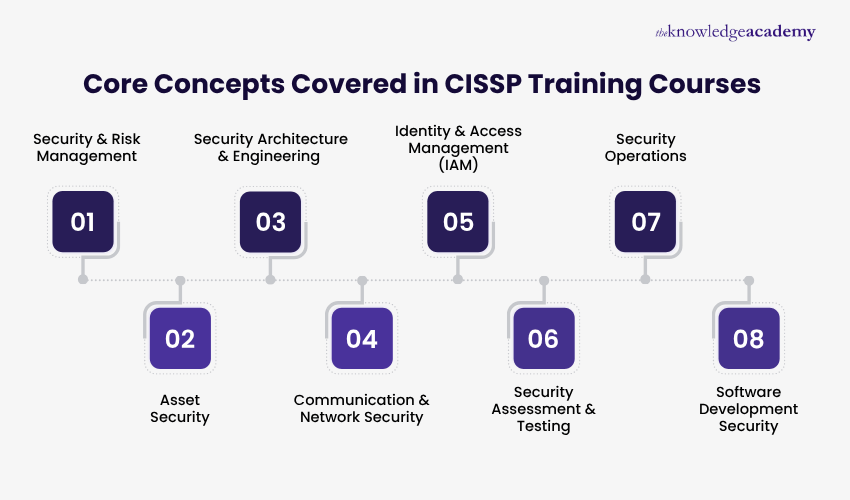
Core Concepts Covered in CISSP Training Courses

The Knowledge Academy’s CISSP Training covers a broad range of essential domains, providing professionals with the knowledge required to secure systems, data, and organisations effectively.

Core Concepts Covered in CISSP Training Courses

  • Security & Risk Management – Protect company data and reduce risks by 40% using CIA Triad principles.
  • Asset Security – Keep sensitive data safe with encryption, ownership rules, and clear privacy controls.
  • Security Architecture & Engineering – Build secure systems using cryptography and trusted design frameworks.
  • Communication & Network Security – Secure data flow using firewalls, VPNs, and network segmentation.
  • Identity & Access Management (IAM) – Manage user access through MFA, SSO, and role-based permissions.
  • Security Assessment & Testing – Find system weaknesses through audits, vulnerability scans, and penetration testing.
  • Security Operations – Respond to incidents fast. Good planning reduces downtime and threats by 35%.
  • Software Development Security – Add security at every SDLC stage using secure coding and DevSecOps.
     

Benefits of Learning CISSP Courses

CISSP Courses deliver significant career and organisational advantages, from global recognition to advanced Cyber Security expertise and leadership opportunities.

  • Global Recognition – Gain CISSP-aligned training respected by Cyber Security employers in more than 180 countries.
  • Professional Credibility – Show strong skills in information security, governance, and risk management.
  • Career Advancement – Move into senior Cyber Security roles such as Security Manager or Risk Analyst.
  • Threat Management – Learn to identify and stop cyber threats using CISSP and NIST practices.
  • Compliance Alignment – Help organisations meet GDPR, ISO 27001, and NIST security requirements.
  • Higher Earning Potential – Certified professionals earn about 25% higher salaries worldwide.
  • Validated Skillset – Prove technical and leadership skills recognised by the global security frameworks.
Show more blue-arrow

Package deals for CISSP Courses

Our training experts have compiled a range of course packages on a variety of categories in CISSP Courses, to boost your career. The packages consist of the best possible qualifications with CISSP Courses, and allows you to purchase multiple courses at a discounted rate.

Swipe for more. Don’t miss out!

CISSP Courses FAQs

CISSP (Certified Information Systems Security Professional) is a globally recognised standard in Information Security. It defines essential practices across areas such as risk management, asset security, and software development security.

Yes, CISSP Training Courses are highly in demand by professionals worldwide. Organisations increasingly rely on skilled delegates to manage cyber security risks and safeguard critical information systems.

CISSP Courses opens opportunities in senior security roles across industries, including finance, healthcare, government, and technology. It equips delegates to handle complex security challenges effectively.

An understanding of Information Security principles, networking, and risk management is recommended but not compulsory. Familiarity with IT systems and security frameworks will help delegates to maximise course outcomes.

Professionals aiming for leadership roles in cyber security, such as Security Managers, Auditors, Consultants, and IT Engineers, will benefit most.

Yes, the course aligns with a widely recognised information security framework. Completing it demonstrates competence that is respected by employers across more than 180 countries.

Delegates gain knowledge of critical security domains, develop strategic risk management skills, and enhance career readiness for senior information security roles with CISSP Training.

The key requirements for the CISSP Course are foundational experience in IT and security, and a clear understanding of networking, systems, and risk principles. This ensures delegates can fully engage with advanced domain topics.

By providing comprehensive domain knowledge and strategic security skills, the CISSP Training prepare delegates for leadership roles, higher responsibilities, and increased employability in information security.

Industries such as banking, government, healthcare, consulting, cloud services, and global IT rely on advanced security expertise to protect systems, data, and operations.

Our CISSP Training is delivered through instructor-led classroom sessions, live virtual training, and online self-paced learning options. This flexible delivery allows professionals to choose a format that fits their schedule and learning preferences.

Security operations are taught through practical scenarios, risk mitigation techniques, and management strategies. Delegates learn how to monitor, detect, and respond to security incidents effectively.

Security assessment and testing are significant because they help identify vulnerabilities and evaluate the effectiveness of security controls. This training builds the ability to assess risks, validate security measures, and strengthen organisational security posture through structured testing practices. 

Identity and access management in this CISSP Training focuses on controlling user privileges, authentication, and authorisation. Delegates gain skills to protect sensitive data and enforce robust security policies.

The Knowledge Academy stands out as a prestigious training provider known for its extensive course offerings, expert instructors, adaptable learning formats, and industry recognition. It's a dependable option for those seeking this training.

Please see our CISSP Courses available in Honduras

The Knowledge Academy is one of the Leading global training provider for CISSP Courses.

The training fees for CISSP Courses in Honduras starts from $4695

Show more down

Why we're the go to training provider for you

icon

Best price in the industry

You won't find better value in the marketplace. If you do find a lower price, we will beat it.

icon

Trusted & Approved

Recognised by leading certification bodies, we deliver training you can trust.

icon

Many delivery methods

Flexible delivery methods are available depending on your learning style.

icon

High quality resources

Resources are included for a comprehensive learning experience.

barclays Logo
deloitte Logo
Thames Water Logo

"Really good course and well organised. Trainer was great with a sense of humour - his experience allowed a free flowing course, structured to help you gain as much information & relevant experience whilst helping prepare you for the exam"

Joshua Davies, Thames Water

santander logo
bmw Logo
Google Logo
cross

Exclusive Deals Big Savings This March!

Grab up to 40% OFF and level up your skills this spring! march-madness

WHO WILL BE FUNDING THE COURSE?

close

close

Thank you for your enquiry!

One of our training experts will be in touch shortly to go over your training requirements.

close

close

Press esc to close

close close

Back to course information

Thank you for your enquiry!

One of our training experts will be in touch shortly to go overy your training requirements.

close close

Thank you for your enquiry!

One of our training experts will be in touch shortly to go over your training requirements.