


 Top Rated Course

We may not have the course you’re looking for. If you enquire or give us a call on + 1-866 272 8822 and speak to our training experts, we may still be able to help with your training requirements.
Scrum Master vs. Project Manager: Key Differences Explained
The Knowledge Academy 08 April 2026A Scrum Master coaches Agile teams and ensures Scrum practices, while a Project Manager manages scope, budget, timelines, and resources across methods. While both support team success, the Scrum Master is team-centric and process-driven, whereas a Project Manager is task- and deliverable-focused with broad organisational accountability.

Training Outcomes Within Your Budget!
We ensure quality, budget-alignment, and timely delivery by our expert instructors.
Table of Contents
Who really calls the shots in a project: the Scrum Master vs Project Manager? At first glance, they might seem indistinguishable in the world of leadership but dig deeper and you’ll find two distinct roles shaping success in very different ways. From guiding Agile teams to steering strategic plans, their authority and skill sets tell unique stories.
In this blog, we’ll unravel the differences between Scrum Master vs Project Manager, clear the confusion, and help you choose the right path. So read on and make the ideal choice for sustained project and organisational success.
Table of Contents
1) Who is a Scrum Master?
2) Who is a Project Manager?
3) Scrum Master vs. Project Manager: Key Differences
4) Scrum Master and Project Manager: Similarities
5) How to Become a Scrum Master or Project Manager?
6) Which is Better Scrum Master or Project Manager?
7) Scrum Master vs Project Managers: Salaries
8) Can a Scrum Master be a Project Manager?
9) Is Scrum Master Higher Than Project Manager?
10) Conclusion
Who is a Scrum Master?
A Scrum Master is an indispensable Agile field professional. They help foster a collaborative environment and help the team to efficiently accomplish its objectives. Moreover, they act as the cornerstone that navigates the Agile project in the right direction.

What Does a Scrum Master Do?
The Scrum Master roles are multi-faceted since they are responsible for multiple tasks monitoring. Let’s dive into their key responsibilities:
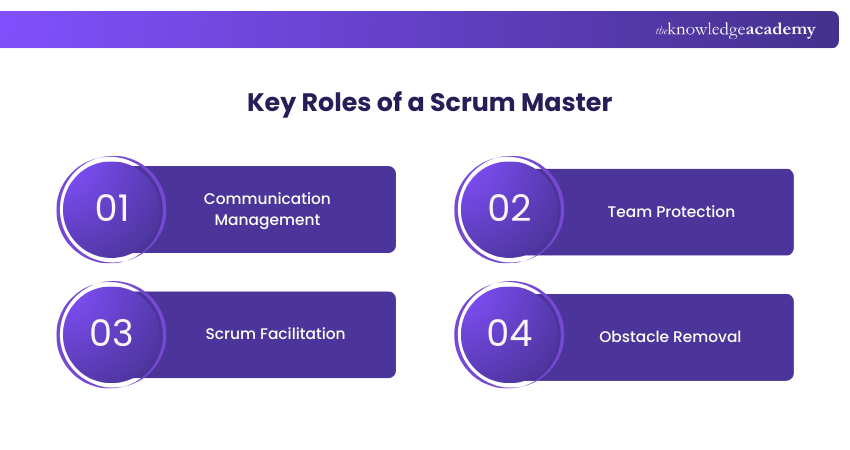
a) Communication Management: Establish Effective communication channels by liaising with the team, Product Owner, and other business functions.
b) Team Protection: Shield the team from disruptions and ensure a smooth changes transitions.
c) Scrum Facilitation: Facilitate Scrum processes and ceremonies, ensuring their smooth execution and effectiveness.
d) Obstacle Removal: Identify and remove obstacles proactively that hinder the team's progress in outcome delivery.
Who is a Project Manager?
A Project Manager is responsible for coordinating project activities. They carry vast experience, and consequently, they meticulously plan, execute, and conclude projects. Their systematic approach often includes applying traditional Project Management methods efficiently.
What Does a Project Manager Do?
Project Managers serve to perform the entire project lifecycle operations, from initiation to closure. Here are some of the key roles of a Project Manager:
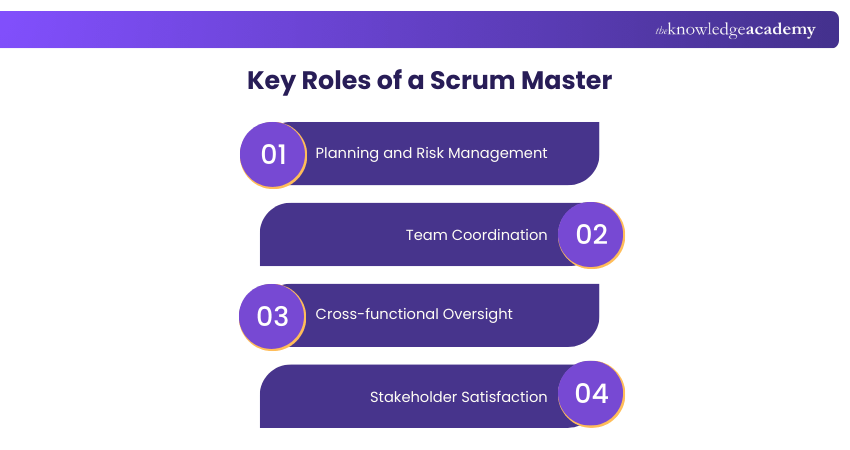
a) Planning and Risk Management: Develop schedules, allocate resources, and mitigate risks.
b) Team Coordination: Assist Scrum Masters in team leading without the additional responsibility of organisational Task Management.
c) Cross-functional Oversight: Maintain multiple teams and functions oversight.
d) Stakeholder Satisfaction: Guarantee satisfaction of all stakeholders' needs and expectations.
Start managing projects the Scrum way with our Managing Agile Projects with Scrum Course - Register today!
Scrum Master vs. Project Manager: Key Differences
Choosing between a Scrum Master vs Project Manager depends on the project's nature, complexity, and organisational context. Here are some of the vital Scrum Masters and Project Managers differences explained in detail:
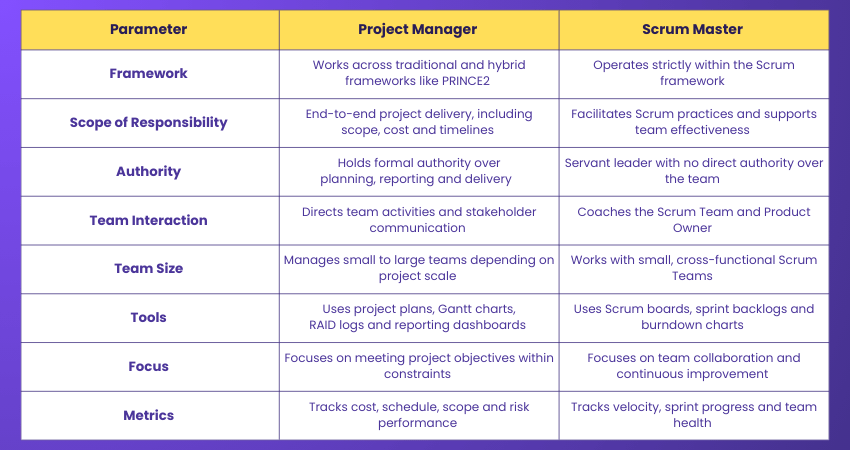
1) Framework
a) Project Manager: Operates within traditional frameworks like Waterfall or broader Agile methods such as Kanban.Supports structured planning and governance across complex, multi-phase projects.
b) Scrum Master: Works strictly within the Scrum framework, for iterative promotion and incremental development. Ensures Scrum rules, roles, and events are consistently applied..
2) Scope of Responsibility
a) Project Manager: Oversees the entire project lifecycle, resources, budgets, risks, timelines, and Stakeholder Communication Management. Accountable for overall project success and delivery outcomes.
b) Scrum Master: Focuses on ensuring the team effectively follows Scrum practices and facilitates Scrum ceremonies.
3) Authority
a) Project Manager: Holds Decision-Making authority, enables task assignment, sets deadlines, and leads the team toward project goals. Acts as the central point of accountability for project decisions.
b) Scrum Master: Acts as a servant-leader, guiding the team while encouraging shared ownership and self-organisation.Influences through coaching rather than formal authority.
4) Team Interaction
a) Project Manager: Provides direct team members’ instructions, feedback, and supervision.Coordinates efforts across teams and stakeholders to maintain alignment.
b) Scrum Master: Enable team collaboration and autonomy promotion, ensuring adherence to Scrum roles and responsibilities.Cultivates a supportive environment built on trust and transparency.
5) Team Size
a) Project Manager: Usually oversees larger teams with more resources and higher budgets, often managing broader initiatives that can extend into programme-level responsibilities.
b) Scrum Master: Typically works with a smaller team to maintain simplicity and effective collaboration.
6) Tools
a) Project Manager: Relies on structured planning and control tools such as detailed project plans, Gantt charts, RAID logs, and performance dashboards. These tools support scheduling, risk tracking, progress monitoring and reporting.
b) Scrum Master: Use Agile-focused tools such as Scrum boards, sprint backlogs and burndown charts. These tools promote transparency, visualise work in progress, track sprint commitments and support continuous improvement within short, iterative development cycles.
7) Focus
a) Project Manager: Concentrates on project goals achievement, staying within scope, time, and budget, and meeting stakeholder needs. Balances constraints to ensure controlled and predictable delivery.
b) Scrum Master: Prioritises team dynamics, continuous improvement, and the faithful Scrum principles implementation. Encourages adaptability and learning through regular inspection and adaptation.
8) Metrics
a) Project Manager: Metrics monitoring like budget performance, schedule variance, and scope control. Uses data to track progress and support reporting and governance.
b) Scrum Master: Tracks team-focused metrics such as velocity, sprint burndown charts, and impediment trends. Uses metrics to improve team performance rather than enforce control.
9) Role in Decision-making
a) Project Manager: Makes key decisions on project direction, scope, budgeting, and risk strategies. Ensures decisions align with organisational priorities and constraints.
b) Scrum Master: Facilitates team-led decisions while ensuring alignment with Scrum Values and Principles. Encourages collective ownership of outcomes.
10) Documentation
a) Project Manager: Responsible for comprehensive documentation, including project plans, reports, and logs. Ensures traceability, compliance, and stakeholder visibility.
b) Scrum Master: Emphasises clear communication and collaboration, using minimal but effective documentation to support agile delivery. Prefers working solutions over extensive paperwork.
Lead with Scrum Product Owner skills - Sign up for our Scrum Product Owner Certification today!
Scrum Master and Project Manager: Similarities
Although several factors differentiate the Project Management and Scrum Master roles, they share certain similarities. The following points highlight some of their similarities:
a) Effective Communication: The Scrum Master and Project Manager maintain continuous and efficient communication throughout all project phases to minimise errors. They value each other's feedback, manage risks and foster strong team cohesion.
b) Equal Hierarchical Level: These professionals operate at the same level; neither holds supreme authority. The Project Manager directly reports to stakeholders and clients, while the Scrum Master reports to the Product Owner, clients, and Stakeholders.
c) Commitment to Principles: Both individuals jeopardise success when they stray from core principles. This can happen if they lack essential specific task skills or ignore team members’ opinions.
How to Become a Scrum Master or Project Manager
Scrum Master vs Project Manager career paths offer distinct growth opportunities and trajectories. Having understanding of these paths helps professionals make informed decisions about their career development.
1) Project Manager Career Path
The Project Manager career path offers clear advancement and leadership opportunities. With the right skills and experience, professionals can grow into cross-industrial strategic roles.
a) Defined Progression: Project Managers have a structured career path. They can grow from entry-level roles into senior positions such as Programme Manager, or even executive leadership roles.
b) Growth Through Expertise: With experience, relevant certifications, and a strong project track record, they can take on greater responsibilities, perform complex Project Management, and lead large teams.
c) Industry-specific Roles: Fields specialisations like IT, construction, or healthcare opens opportunities for industry-focused roles, offering diverse challenges and advancement potential.
2) Scrum Master Career Path
The Scrum Master career path is a rewarding Agile ecosystem journey. With the right skills, certifications, and Continuous Learning, professionals can grow into high-impact Agile roles across industries.
a) Progressive Growth: Professionals often begin as Scrum team members and move up to become Scrum Masters. Further, they advance to roles like Agile Coach or Scrum Consultant for larger, complex projects.
b) Industry Specialisation: Scrum Masters can specialise in domains like software development, finance, or marketing. Learning advanced frameworks and understanding Scrum vs SAFe adds further value.
c) Career Alignment: Project Management and Scrum roles choosing depends on one’s strengths, preferences, and long-term goals as both paths offer strong advancement potential.
Which is Better Scrum Master or Project Manager?
The choice between a Scrum Master vs Project Manager depends on the project’s nature, complexity, organisational culture, and requirement flexibility. Here’s a breakdown of when each role fits best:
1) Project Manager: Best for Structured Projects
a) Ideal Scenarios: Large-scale projects with stable requirements and a hierarchical setup.
b) Industries: Construction, engineering, IT infrastructure, manufacturing.
2) Scrum Master: Best for Agile & Evolving Projects
a) Ideal Scenarios: Dynamic projects with changing requirements and a focus on collaboration.
b) Industries: Software development, digital products, marketing, creative fields.
Build robust Scrum foundations with our Agile and Scrum Awareness Training- Join today!
Scrum Master vs Project Managers: Salaries
Here’s a breakdown of the difference between Scrum Master and Project Manager yearly salaries across three major regions: the UK, the US and India:
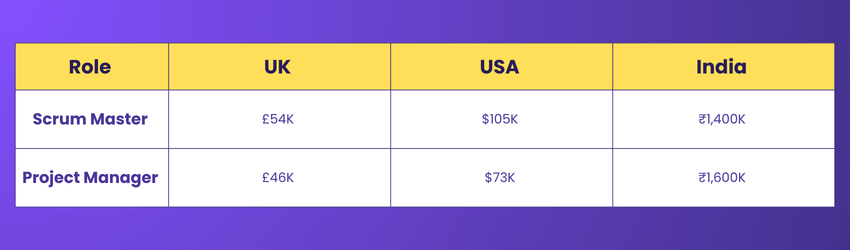
Source: Glassdoor,
Can a Scrum Master be a Project Manager?
Yes, a Scrum Master can become a Project Manager, but they have different roles to play. A Scrum Master focuses on Agile process facilitation, while a Project Manager performs project planning, scope and delivery monitoring. Professional transitions require understanding of both Agile and traditional project practice.
Is Scrum Master Higher Than Project Manager?
Not necessarily. Scrum Master and Project Manager are distinct roles, not ranked by hierarchy. The Scrum Master enables Agile teams, while the Project Manager perform broader project responsibility handling. Their influence depends on the organisation’s structure and the Project Management approach used.
Build high-performing Agile teams with our Scrum for Teams Training - Join today!
Conclusion
When choosing between a Scrum Master vs Project Manager, it’s important to consider the specific project requirements and the organisation’s working style. By evaluating these needs and having their unique strength understanding, businesses can make informed decisions that help in effective and successful project delivery support in today’s fast-paced environment.
Lead Smart Sprints with our Certified Artificial Intelligence for Scrum Master Training - Get started today!
Frequently Asked Questions
Why is it so Hard to Get a Scrum Master Job?

Getting a Scrum Master role can be challenging due to an unclear career pathway and the ease of gaining certifications without practical experience. Additionally, fewer organisations operate in fully Agile environments, which increases the competition for available Scrum Master positions.
When Should You Hire a Scrum Master and a Project Manager?
You should hire a Scrum Master and Project Manager for team collaboration support and blockers removal. The Project Manager profession is ideal for traditional or hybrid projects requiring scope, timeline, and resource control. For complex setups, both roles can work together to make the project a success.
What are the Other Resources and Offers Provided by The Knowledge Academy?
The Knowledge Academy takes global learning to new heights, offering over 3,000 online courses across 490+ locations in 190+ countries. This expansive reach ensures accessibility and convenience for learners worldwide.
Alongside our diverse Online Course Catalogue, encompassing 19 major categories, we go the extra mile by providing a plethora of free educational Online Resources like Blogs, eBooks, Interview Questions and Videos. Tailoring learning experiences further, professionals can unlock greater value through a wide range of special discounts, seasonal deals, and Exclusive Offers.
What is The Knowledge Pass, and How Does it Work?
The Knowledge Academy’s Knowledge Pass, a prepaid voucher, adds another layer of flexibility, allowing course bookings over a 12-month period. Join us on a journey where education knows no bounds.
What are the Related Courses and Blogs Provided by the Knowledge Academy?
The Knowledge Academy offers various Scrum Certification Courses, including the Scrum Certification Courses, Scrum Master Certification, Managing Agile Projects with Scrum Training, and Certified Artificial Intelligence for Scrum Master Training. These courses cater to different skill levels, providing comprehensive insights into Scrum Case Studies.
Our Project Management Blogs cover a range of topics related to Scrum and Project Management, offering valuable resources, best practices, and industry insights. Whether you are a beginner or looking to advance your Project Management skills, The Knowledge Academy's diverse courses and informative blogs have got you covered.

The Knowledge Academy


Global Training Provider
The Knowledge Academy is a world-leading provider of professional training courses, offering globally recognised qualifications across a wide range of subjects. With expert trainers, up-to-date course material, and flexible learning options, we aim to empower professionals and organisations to achieve their goals through continuous learning.

Upcoming Project Management Resources Batches & Dates
Date
 Scrum Master Certification
Scrum Master Certification
Thu 6th Aug 2026
Scrum Master Certification
Thu 19th Nov 2026

 If you wish to make any changes to your course, please


