


 Top Rated Course

We may not have the course you’re looking for. If you enquire or give us a call on +852 2592 5349 and speak to our training experts, we may still be able to help with your training requirements.
Types of 3D Printing: A Comprehensive Guide
Richard Harris 24 February 2026Explore the main types of 3D printing likeFDM, Stereolithography (SLA), and Selective Laser Sintering (SLS) each using unique methods to create precise 3D models. Learn how different technologies suit various materials, applications, and industries. Discover which method best fits your design, speed, and durability needs.

Training Outcomes Within Your Budget!
We ensure quality, budget-alignment, and timely delivery by our expert instructors.
Table of Contents
3D printing has transformed how products are designed, tested and manufactured across industries. The Types Of 3D Printing available today offer unique advantages depending on the material, speed and precision required. From rapid prototyping to large-scale production, each method serves a specific purpose. Let’s explore the key technologies and how they work.
Table of Contents
1) What is 3D Printing?
2) Different Types of 3D Printing
3) Choosing the Right 3D Printing Type
4) Future Trends in 3D Printing
5) Conclusion
What is 3D Printing?
3D Printing, often referred to as additive manufacturing, represents a transformative technological advancement. It fabricates three-dimensional items by sequentially adding material, layer upon layer, based on a digital blueprint. Unlike traditional subtractive manufacturing methods, which involve cutting or moulding material to create an object, 3D printing builds objects by adding material, allowing for intricate and complex designs that were previously challenging or impossible. This opens up a world of 3D Printing Ideas for innovation and customisation.
The origins of 3D printing trace back to the 1980s, marked by the invention of stereolithography (SLA) by Chuck Hull, which laid the foundation for the first 3D printing technology. Since then, various 3D printing methods have been developed, each offering unique advantages and applications.

Different Types of 3D Printing
Let's delve into the explanations for each of the Types of 3D Printing:

1) Stereolithography (SLA)
Stereolithography (SLA) is an additive manufacturing process that works by using a UV laser to solidify layers of liquid photopolymer resin. The 3D printer's build platform is submerged in a vat of liquid resin, and the UV laser traces the cross-section of the object layer by layer. After the completion of a layer, the build platform descends, allowing a fresh layer of liquid resin to be applied over the preceding one. This cycle continues, layer by layer, until the entire object is fully constructed. SLA is known for its high precision and ability to create intricate details, making it suitable for applications such as rapid prototyping and producing detailed models.
2) Selective Laser Sintering (SLS)
Selective Laser Sintering (SLS) involves the use of a laser to selectively fuse powdered material, typically nylon or other thermoplastics, into a solid three-dimensional structure. The 3D printer spreads a thin layer of powdered material across the build platform, and the laser sinters the powder according to the cross-section of the object. This process is repeated layer by layer. One significant advantage of SLS is its ability to produce objects with complex geometries and without the need for support structures, as the unsintered powder acts as a natural support.
3) PolyJet
PolyJet technology operates by employing a print head that jets successive layers of liquid photopolymer onto a build tray. Each layer is instantly solidified and hardened upon exposure to UV light, immediately after it is deposited. PolyJet allows for the simultaneous deposition of multiple materials with different properties, enabling the creation of objects with varying colours, flexibility, and transparency within the same print. This makes it suitable for applications where detailed and multi-material prototypes are needed.
Ready to bring your drawings to life? Elevate your skills with our comprehensive 2D Animation Course.
4) Digital Light Processing (DLP)
DLP is similar to SLA but uses a digital light projector to cure entire layers of liquid resin simultaneously. The projector displays the entire layer's image at once, speeding up the printing process compared to traditional SLA. However, this method may sacrifice some surface quality compared to SLA.
5) Multi Jet Fusion (MJF)
Multi Jet Fusion (MJF) is a powder-based 3D printing technology. The printer spreads a layer of powdered material (usually nylon) and selectively applies fusing and detailing agents using an array of inkjet print heads. The powder is then fused with infrared light, and the process is repeated layer by layer. MJF is known for its high printing speed, fine detail resolution, and the ability to produce functional prototypes with isotropic mechanical properties.
6) Fused Deposition Modelling (FDM)
FDM is one of the most common and widely used 3D printing methods. It works by extruding thermoplastic filament through a heated nozzle. In this process, material is methodically deposited in layers, with each new layer bonding and fusing to the previous one as it cools and solidifies. FDM is known for its affordability, simplicity, and suitability for creating large and durable prototypes. However, it may have limitations in terms of surface finish and precision compared to some other methods.
Acquire the knowledge of 3D effects in games and videos by signing up for our Blender Creator Training now!
7) Direct Metal Laser Sintering (DMLS)
Direct Metal Laser Sintering (DMLS) is a form of metal 3D printing where a high-powered laser is used to selectively melt and fuse particles of metal powder, including Ductile Metals like aluminium, titanium, or stainless steel, building the object layer by layer. DMLS is capable of producing complex metal parts with high strength and precision. It is often used in aerospace, automotive, and medical industries where durable and intricate metal components are required.
8) Electron Beam Melting (EBM)
Electron Beam Melting (EBM) is another metal 3D printing method that uses an electron beam to melt and fuse metal powder. This process occurs in a high-vacuum environment, allowing for precise control over the melting and solidification of the metal powder. EBM is renowned for creating components with superior mechanical properties. It is frequently employed in scenarios requiring high-strength metal parts with intricate shapes, particularly in sectors like aerospace and healthcare.
Unleash your creativity with our Animation and Design Training. Elevate your skills, craft compelling visuals, and embark on a journey of artistic expression.
Choosing the Right 3D Printing Type
Selecting an appropriate 3D printing material will depend on the purpose of the project, the strength you need as well as the ease of use. PLA is a good material that beginners may use since it can easily be printed, it is eco-friendly and can be used in prototyping or decorative purposes.
ABS is stronger and more resistant to heat, so it can be used in such functional components as enclosures or mechanical elements. But it needs a warmed bed, proper ventilation and increased experience to manage warping and fumes.
PETG provides an intermediate between the simplicity of PLA and the power of ABS, and it is the adaptable choice of useful printing. When you know what your project requires in terms of durability, flexibility and exposure to the environment, it will be easy to select the most appropriate material.
Future Trends in 3D Printing
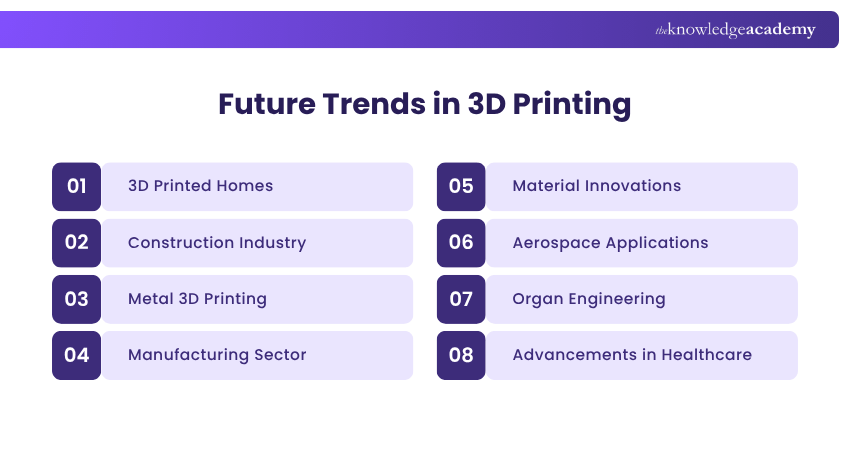
With the continued development of 3D printing, it is set to transform the industries by blending with other new technologies, material developments and diversifying its use. Major trends that will influence the future of additive manufacturing are listed below:
1) 3D Printed Homes
Home construction is changing because of 3D printing, which makes it possible to build with low labour and concrete-based printing techniques, which are not that fast. These houses might be cheaper and more sustainable, particularly in disaster relief and affordable housing. The recycled materials also minimise the effect on the environment.
2) Construction Industry
Apart from residential settings, 3D printing will transform infrastructure such as bridges and tunnels. It enables the use of complicated architectural designs and modular constructions to be erected on site. This method enhances efficiency and beauty, and it may even aid in the future construction of the moon.
3) Metal 3D Printing
The innovations in the sphere of 3D printing of metals are enhancing the quality of materials, speed, and precision. Advanced techniques and materials are facilitating the manufacture of complicated and large-scale components for industries such as aerospace and defence. The workflows and part quality are also being made easier through post-processing.
4) Manufacturing Sector
With 3D printing, sustainable and decentralised manufacturing is becoming centralised. It facilitates multi-material printing, real-time quality and on-demand production. This is minimising waste, cost reduction, and production is brought near the end-users.
5) Material Innovations
Emerging materials such as high-performance polymers, metal alloys, ceramics and composites are increasing the potential of 3D printing. These materials are stronger, heat-resistant and can even be biocompatible.
6) Aerospace Applications
The aerospace sector is also using 3D printing to produce lightweight parts that are complex to manufacture and enhance fuel efficiency and performance. It is applied to such elements as turbine blades and satellite components.
7) Organ Engineering
Bioprinting is advancing rapidly, with researchers developing bioinks and scaffolds to grow patient-specific tissues. The goal is to create functional organs for transplantation and drug testing. Vascularisation remains a challenge, but progress is promising.
8) Advancements in Healthcare
3D printing is enhancing healthcare with custom implants, surgical models, and drug delivery systems. It enables personalised treatments and improves surgical outcomes. Bioprinting and regenerative medicine are opening new frontiers in patient care.
Conclusion
The field of 3D printing continues to evolve, offering a wide range of technologies to suit different applications. Each method offers unique benefits in speed, material compatibility and precision, so selecting the right one depends on your goals, budget and needs. As innovation progresses, the potential of the various Types Of 3D Printing will only expand further.
Ignite your passion for animation with our exclusive Animation Course.
Frequently Asked Questions
Which 3D Printing Process is Best for Metal Parts?

In the case of metal components, one of the most useful 3D printing technologies is the Selective Laser Melting (SLM) process. It employs a high-powered laser to melt out all the metal powder to solid parts which are strong and dense, suitable for aerospace, automobile and medical applications.
How Many Types of 3D Printing are There According to ISO/ASTM Standards?
It has 7 recognised 3D printing processes according to ISO/ASTM standards. They are material extrusion, vat photopolymerisation, powder bed fusion, binder jetting, material jetting, sheet lamination and directed energy deposition. Both of the methods possess distinct strengths in accordance with various materials, applications/industries.
What are the Other Resources and Offers Provided by The Knowledge Academy?
The Knowledge Academy takes global learning to new heights, offering over 3,000 online courses across 490+ locations in 190+ countries. This expansive reach ensures accessibility and convenience for learners worldwide.
Alongside our diverse Online Course Catalogue, encompassing 17 major categories, we go the extra mile by providing a plethora of free educational Online Resources like Blogs, eBooks, Interview Questions and Videos. Tailoring learning experiences further, professionals can unlock greater value through a wide range of special discounts, seasonal deals, and Exclusive Offers.
What is The Knowledge Pass, and How Does it Work?
The Knowledge Academy’s Knowledge Pass, a prepaid voucher, adds another layer of flexibility, allowing course bookings over a 12-month period. Join us on a journey where education knows no bounds.
What are the Related Courses and Blogs Provided by The Knowledge Academy?
The Knowledge Academy offers various Animation and Design Training, including the 3D Printing Training, Video Editing Training, CorelDRAW Training, and 2D Animation Course. These courses cater to different skill levels, providing comprehensive insights into 15 Best CorelDRAW Alternatives.
Our Office Applications Blogs cover a range of topics related to Types of 3D Printing, offering valuable resources, best practices, and industry insights. Whether you are a beginner or looking to advance your Office Applications skills, The Knowledge Academy's diverse courses and informative blogs have got you covered.

Richard Harris


Senior Full Stack Developer and Technology Educator
Richard Harris is a highly experienced full-stack developer with deep expertise in both frontend and backend technologies. Over his 12-year career, he has built scalable web applications for startups, enterprises and government organisations. Richard’s writing combines technical depth with clear explanations, ideal for developers looking to grow in modern frameworks and tools.

Upcoming Office Applications Resources Batches & Dates
Date
 Animation Course

 If you wish to make any changes to your course, please


