


 Top Rated Course


We may not have the course you’re looking for. If you enquire or give us a call on +852 2592 5349 and speak to our training experts, we may still be able to help with your training requirements.
Transcription vs Translation: Differences in Language Services
The Knowledge Academy 19 March 2026Transcription turns audio into the same‑language text for clarity and records, while translation converts it into another language for wider communication. Transcription helps preserve accurate details and supports documentation. Translation bridges language gaps, enabling global understanding and collaboration across diverse audiences.

Training Outcomes Within Your Budget!
We ensure quality, budget-alignment, and timely delivery by our expert instructors.
Table of Contents
Clear communication often depends on how we handle spoken and written language. Understanding the difference between transcription vs translation helps businesses, students, and professionals choose the right service for their needs. Each plays a distinct role in making information accessible and usable.
While one focuses on converting speech into text, the other adapts content across languages. Knowing when to use each can save time, cost, and confusion. Let’s explore how they differ and where each one fits best.
Table of Contents
1) What is Transcription?
2) What is Translation?
3) Difference Between Transcription and Translation
4) How do Transcription and Translation Work?
5) Translation vs Transcription: Which One Do You Need?
6) Conclusion
What is Transcription?
Transcription is the process of converting spoken language into written text, capturing what was said word for word for accurate records. It’s commonly used for meetings, interviews, lectures, and focus groups where an exact written account is needed.
The key point is that transcription stays in the original language of the audio, making it ideal for documentation, review, and accessibility purposes. This helps teams and individuals work with spoken content in a clear, searchable text format.
Benefits of Transcription
Major benefits of Transcription is as follows:
a) Provides better accessibility by offering a text version of audio, supporting individuals with hearing impairments or readers who prefer text.
b) Boosts SEO by making video content more searchable and indexable, helping users quickly locate important information.
c) Enables detailed content analysis, allowing easy extraction of insights from spoken material.
d) Supports efficient caption creation, making subtitle production quicker and more accurate.
e) Helps with content repurposing, turning transcripts into blogs, articles, social posts, or reports for a wider audience reach.
Challenges of Transcription
Challenges of the transcription are as follows:
a) Finding and retaining qualified transcription and QA resources can be difficult, especially for projects requiring multiple languages and tight deadlines.
b) Many projects require large teams, often 25 to 30 dedicated transcribers plus managers and QA leads to meet quality expectations.
c) The work can be repetitive and demanding, causing resource dropouts and creating ongoing needs for new interviews and training.
d) Coordinating the project requires understanding client needs, defining outputs, and managing schedules, which adds operational challenges.
What is Translation?
The concept of translation is of transforming the content of one language into another while preserving the original meaning and intention. It needs excellent linguistic knowledge of the source and the target language. This assists in making sure that nothing crucial is lost in the process of conversion.
It is applied in industries in order to break a language barrier and increase the scope of documents, websites, product manuals, and marketing materials. When organisations can effectively translate, it enables the organisation to communicate effectively with audiences worldwide and to adapt the translated content to international use.
Benefits of Translation
Benefits of translation include:
a) Reaches a global audience by making content accessible to speakers of different languages, helping businesses expand internationally.
b) Improves multilingual collaboration by enabling clearer communication with global clients, teams, and partners.
c) Increases marketability by making products and services more appealing to non‑native speakers and new language markets.
d) Ensures cultural relevance through translations that account for cultural nuances, improving clarity and audience connection.
e) Boosts searchability since a significant percentage of online searches occur in languages other than English, increasing content visibility.
f) Drives higher engagement and sales, with translated content improving user experience and supporting international revenue growth.
g) Supports legal compliance in regions requiring content to be available in their native language.
Strengthens brand image by demonstrating inclusivity and respect for diverse cultures.
Challenges of Translation
Challenges of Translation are as follows:
a) Miscommunication with clients can lead to unclear expectations and mistranslations.
b) Word‑for‑word translation can distort meaning, especially with idioms and cultural expressions.
c) Language nuances pose difficulties when certain terms lack direct equivalents.
d) Incorrect terminology choices may occur in technical, legal, or medical contexts.
e) Cultural differences require careful adaptation to avoid misinterpretation.
f) Structural differences between languages increase complexity and risk of errors.
Difference Between Transcription and Translation
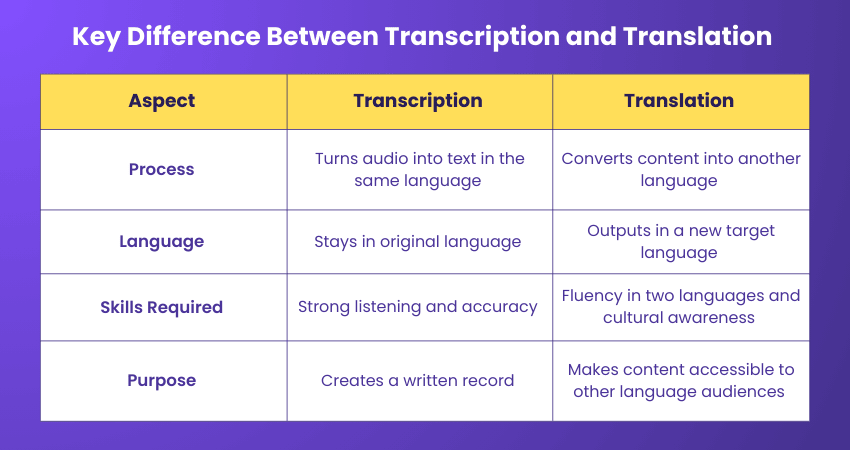
Transcription and translation both convert content, but they serve different purposes. Transcription turns spoken words into written text in the same language, focusing on accuracy and detail. Translation converts content from one language to another to make it understandable to a wider audience.
Transcription requires careful listening and precise typing, while translation demands fluency in multiple languages and cultural understanding. One preserves exact wording, the other preserves meaning.
How do Transcription and Translation Work?
Transcription converts spoken or recorded audio into written text, either verbatim or condensed. Verbatim transcription captures every sound and nuance for complete accuracy. It is essential for accessibility, especially for individuals who are Deaf or hard of hearing.
Translation converts content from one language to another to reach multilingual audiences. It may appear as real‑time subtitles or captions on video platforms. Accurate translation requires contextual and cultural understanding to convey meaning correctly.
Improve your Customer Service Standards through our Emotional Intelligence Training!
Translation vs Transcription: Which One Do You Need?
Transcription creates a text version of your audio or video in the same language and helps make content accessible when audio cannot be heard. Translation converts your content into another language so you can reach multilingual audiences.
Choose transcription if you need a clear written record or want viewers to follow the content without listening. Choose translation if your goal is to communicate with audiences who speak different languages. Many users benefit from using both to maximise accessibility and reach.
Conclusion
Understanding Transcription vs Translation is key to choosing the right approach for your communication needs. Each serves a distinct purpose, whether you need accurate written records or content adapted for a global audience. Hopefully, this blog has clarified the differences and helped you decide which service best fits your goals.
Do you want to understand the five vocal elements for voice training and different voice accents? Sign up for our Voice Over Artist Course today!
Frequently Asked Questions
What are the Four Types of Transcription?

There are four main types of Transcription:
Verbatim: Captures everything, including pauses, filler words, and background noises
Intelligent Verbatim: Cleans up filler words and small errors for clarity
Edited: Improves grammar and flow while keeping the meaning
Phonetic: Focuses on how words sound, often for linguistics
What Languages are Commonly Translated or Transcribed?
Commonly translated or transcribed languages include English, Spanish, Mandarin, and Arabic. The approach may differ based on language complexity, script, and cultural context.
What are the Other Resources and Offers Provided by The Knowledge Academy?
The Knowledge Academy takes global learning to new heights, offering over 3,000+ online courses across 490+ locations in 190+ countries. This expansive reach ensures accessibility and convenience for learners worldwide.
Alongside our diverse Online Course Catalogue, encompassing 17 major categories, we go the extra mile by providing a plethora of free educational Online Resources like Blogs, eBooks, Interview Questions and Videos. Tailoring learning experiences further, professionals can unlock greater value through a wide range of special discounts, seasonal deals, and Exclusive Offers.
What is The Knowledge Pass, and How Does it Work?
The Knowledge Academy’s Knowledge Pass, a prepaid voucher, adds another layer of flexibility, allowing course bookings over a 12-month period. Join us on a journey where education knows no bounds.
What are the Related Courses and Blogs Provided by The Knowledge Academy?
The Knowledge Academy offers various Personal Development Courses, including the Voice Over Artist Course, Creative Writing Training, and Audio Transcription Course . These courses cater to different skill levels, providing comprehensive insights into 12 Types of Listening.
Our Business Skills Blogs cover a range of topics related to Transcription vs Translation, offering valuable resources, best practices, and industry insights. Whether you are a beginner or looking to advance your Communication skills, The Knowledge Academy's diverse courses and informative blogs have got you covered.

The Knowledge Academy


Global Training Provider
The Knowledge Academy is a world-leading provider of professional training courses, offering globally recognised qualifications across a wide range of subjects. With expert trainers, up-to-date course material, and flexible learning options, we aim to empower professionals and organisations to achieve their goals through continuous learning.


 If you wish to make any changes to your course, please


