


 Top Rated Course

We may not have the course you’re looking for. If you enquire or give us a call on +852 2592 5349 and speak to our training experts, we may still be able to help with your training requirements.
What is Supplier Performance Management | Explained
James Smith 28 April 2026Supplier Performance Management (SPM) tracks and improves supplier quality, cost, delivery, and risk using KPIs, scorecards, and audits. It enables procurement teams to consistently measure key metrics such as quality, delivery timeliness, cost efficiency and service levels. It boosts supply chain reliability and continuous improvement.

Training Outcomes Within Your Budget!
We ensure quality, budget-alignment, and timely delivery by our expert instructors.
Table of Contents
Ever had your much-awaited online order arrive late or damaged? Now, imagine that happening to a business handling hundreds of suppliers every day. Even a single mistake can delay production, upset customers, and cut into profits. To prevent such issues, companies rely on Supplier Performance Management (SPM), the key to keeping suppliers reliable and operations running smoothly.
In this blog, we’ll explain what is Supplier Performance Management. We’ll break down its three main phases, explore factors for measuring performance, and cover its benefits, challenges, and goals, all to show how businesses can manage suppliers more effectively.
Table of Contents
1) What is Supplier Performance Management?
2) How to Manage Supplier Performance?
3) Supplier Performance Management in Three Phases
4) Factors to Consider When Measuring Supplier Performance
5) Benefits of Supplier Performance Management
6) Challenges in Supplier Performance Management
7) What are the Goals of Supplier Performance Management?
8) Conclusion
What is Supplier Performance Management?
Supplier Performance Management (SPM) is the process of evaluating and improving how suppliers perform to ensure they meet business needs. It helps ensure suppliers deliver good quality, on-time services, fair prices, and follow rules, while also supporting long-term relationships and encouraging teamwork and innovation.
Here are the key activities involved Supplier Performance Management.
1) Setting clear goals and expectations for suppliers
2) Collecting and reviewing data about their performance
3) Giving feedback and recognising good work
4) Taking action to fix problems and prevent them in the future
How to Manage Supplier Performance?
There are several ways to effectively manage supplier performance. The process must begin with the central administrative team developing structured scorecards and reports that gauge supplier activities. Involving stakeholders in the scorecard process is equally important because their feedback encourages broader participation.
Organisations must also regularly remove outdated scorecards and reports to simplify systems and make them easier for users to navigate. Here are some common methods used to monitor supplier performance:
1) Supplier Scorecards: This includes order fulfilment score, order visibility score, delivery costs, inventory cost and response index.
2) General Metrics: This includes financial health, operational performance, contract compliance, business processes and overall cost efficiency.
3) Key Performance Indicators (KPIs): This includes delivery cost, inventory cost, product quality issues, vendor risk, innovation capability, customer complaints and corporate social responsibility.
Supplier Performance Management in Three Phases
Each procurement team follows its own way of managing Supplier Performance Management. Here are the three phases of Supplier Performance Management:

1) Set Expectations
The first phase involves defining the clear expectations for suppliers before measuring their performance. Organisations establish the key metrics, Service-level Agreements (SLAs) and performance targets related to quality, delivery timelines, cost efficiency and compliance. These expectations are typically agreed upon during supplier onboarding to ensure both parties understand the standards for a successful partnership.
2) Monitor and Evaluate Performance
Once the expectations have been established, organisations continuously monitor the supplier's activities and evaluate their performance against the agreed metrics. This phase involves collecting performance data, conducting regular reviews and using tools such as supplier scorecards or analytics to assess delivery reliability, product quality and cost management. The goal is to identify performance gaps and ensure suppliers meet operational requirements.
3) Feedback and Continuous Improvement
The final phase focuses on improving supplier performance through collaboration and feedback. Organisations share evaluation results with the suppliers, discuss areas for improvement and develop joint action plans to address any performance issues. This stage encourages innovation and stronger supplier relationships while ensuring continuous improvement across the supply chain.
Understand team dynamics to build trust and foster stronger collaboration. Join our Team Development Training now!
Factors to Consider When Measuring Supplier Performance
To optimally manage your supplier performance, it is necessary to set and keep monitoring the Key Performance Indicators (KPIs) that are essential to satisfy your goals and expectations. The KPIs may vary depending on your industry, product, service, and contract, but they generally fall into the following five categories:
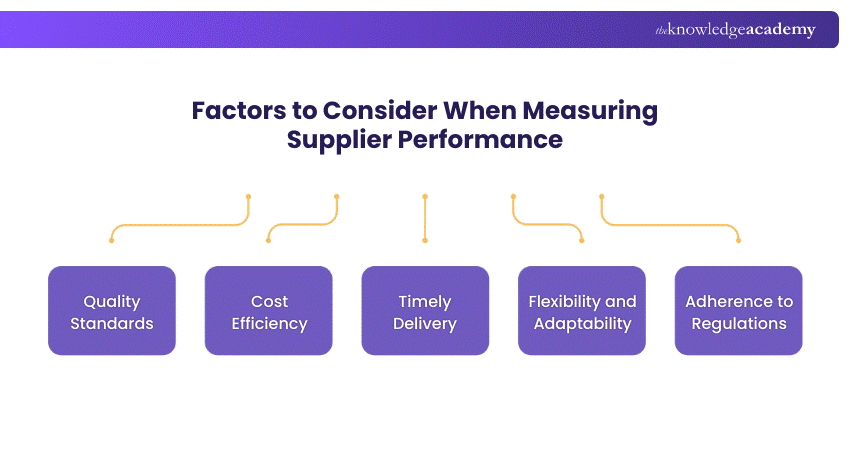
1) Quality Standards
Quality standards measure how well your suppliers meet your specifications and requirements for their products and services. Some examples of quality KPIs are:
a) Defect Rate: The percentage of defective or non-conforming products or services delivered by the supplier.
b) Return Rate: The percentage of products or services returned by the customer because of quality issues.
c) Customer Complaints: The number or frequency of complaints received from customers about the quality of the products or services.
d) Audit Results: The outcome or score of the quality audits conducted on the supplier.
2) Cost Efficiency
Cost efficiency measures how well your suppliers optimise their resources and processes to deliver the products and services at the lowest possible cost. Some examples of cost KPIs are:
a) Total Cost of Ownership: The sum of all the costs associated with acquiring, using, and maintaining the products or services from the supplier.
b) Price Variance: The difference between the actual and the expected price of the products or services.
c) Savings: The amount of money saved by the supplier through process improvements, waste reduction, or other initiatives.
d) Value Added: The value or benefit the supplier creates for the customer.
3) Timely Delivery
Timely delivery measures how well your suppliers deliver the products and services on time and in full. Some examples of delivery KPIs are:
a) On-time Delivery: The percentage of services or products delivered by the supplier within the agreed time frame.
b) Lead Time: It is the amount of time between the order placement and the order delivery.
c) Fill Rate: The percentage of products or services delivered by the supplier in the requested quantity.
d) The Backorder Rate: It is the percentage of products or services that are unavailable or out of stock at the time of the order.
4) Risk
a) Supplier Risk Score: It measures the level of risk associated with a supplier, including factors such as financial stability, political or geopolitical conditions, and operational reliability.
b) Incident Frequency: It tracks how often supply chain disruptions, delays, or operational issues occur within a given timeframe.
5) Innovation and Responsiveness
a) Innovation Contribution: It evaluates how actively a supplier contributes to innovation, including ideas for new products, improved processes, or enhanced solutions.
b) Responsiveness: It measures how quickly and effectively a supplier reacts to enquiries, operational issues, or changes in demand.
6) Sustainability
a) Sustainability Commitment: It assesses a supplier’s dedication to environmentally responsible and socially ethical practices.
b) Regulatory and Ethical Compliance: It evaluates whether suppliers follow environmental regulations, labour standards, and ethical sourcing practices.
Develop effective communication techniques to boost team understanding. Join our Performance Management Training now!
Benefits of Supplier Performance Management
Supplier Performance Management can bring many benefits to your organisation, such as the following:
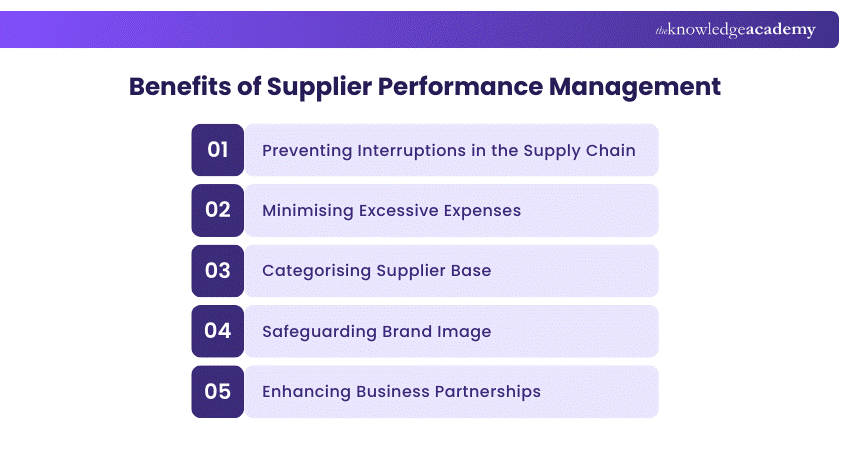
1) Preventing Interruptions in the Supply Chain
One of the biggest benefits of Supplier Performance Management is that it can help you prevent interruptions in your Supply Chain, which could potentially have negative consequences for your business. Interruptions can occur due to multiple reasons, such as supplier failures, natural disasters, political unrest, cyberattacks, or pandemics. By managing your supplier performance, you can reduce the likelihood and impact of these disruptions and ensure the continuity of your Supply Chain.
2) Minimising Excessive Expenses
Supplier Performance Management helps you eliminate the unnecessary expenses that eat into your profits and makes you competitive enough. Unbalanced expenditures can present themselves via several reasons including the price of services or products, wastage, defects, reworks, returns, penalties, fines or your corporation being taken to court. Addressing the issues related to supplier performance offers the ability to lower expenditures, raise your contributions, and improve your business financially.
3) Categorising Supplier Base
Supplier Performance Management can also help you categorise your supplier base and prioritise your resources and efforts. Categorising your supplier base means classifying your suppliers into different groups or segments based on their performance, importance, or potential. By doing so, you can identify and focus on your strategic or critical suppliers and allocate your resources and efforts accordingly. You can also differentiate and manage your suppliers based on their needs, expectations, or opportunities.
4) Safeguarding Brand Image
The reputation of your brand is not only associated with the products and services that are produced by the company but also with those of the suppliers. In case your suppliers provide low-quality products, that are unethically sourced, or are not sustainable.
This can affect your brand image and reputation and make your customers lose their trust and confidence in you. You can rectify this by supervising your vendors performance to see to it that they comply with your brand values and standards and support your brand image and reputation as the result. This is a big role played by Supplier Performance Management.
5) Enhancing Business Partnerships
Business partnerships are strategic and long-term relationships between the suppliers and your business based on trust, respect, and collaboration. Through Supplier Performance Management, you can keep healthy and stable partnerships among other businesses, which in turn helps you to obtain a competitive advantage.
Improves supplier quality assessment and enhancement skills. Join our Supplier Quality Management Training now!
Challenges in Supplier Performance Management
Implementing Supplier Performance Management can be tricky because there is no single approach that works for every business. Each organisation has different goals, processes, and expectations, so finding the right performance measures can be challenging.
Some common challenges include:
1) No Standard Measurements: There isn’t one set of performance metrics that works for all industries, making it harder to create a universal framework.
2) Limited Evaluation: Sometimes, the chosen measures fail to give a complete and dynamic view of supplier performance.
3) Lack of Control and Regulations: Without proper rules and oversight, managing supplier performance can become inefficient and inconsistent.
What are the Goals of Supplier Performance Management?
The goal of Supplier Performance Management is to spot and fix problems early. This includes things like late deliveries, poor product quality, or supply delays. By finding issues quickly, businesses can solve them fast and keep the supply chain running smoothly.
Conclusion
Supplier Performance Management helps businesses work better with their suppliers by tracking quality, delivery, cost, and risks. It allows companies to spot problems early, fix them quickly, and build stronger supplier relationships. By setting clear targets and working closely with suppliers, businesses can avoid disruptions, improve efficiency, and ensure a smooth supply chain that supports long-term success.
Develop essential communication, negotiation, and Conflict Resolution skills. Join our Management Courses now!
Frequently Asked Questions
What is the Standard of Supplier Performance?

A supplier performance standard is a simple set of rules to check how well a supplier works. It looks at things like on-time delivery, good product quality, clear communication, and fair pricing. These standards help businesses see if a supplier is reliable and meets expectations.
How to Measure and Manage Supplier Performance?
Three simple ways to measure and manage supplier performance are:
a) Review data from purchase orders, deliveries, and quality reports
b) Fix issues quickly by working with suppliers
c) Reward good performers and encourage continuous improvement for better results
What are the Other Resources and Offers Provided by The Knowledge Academy?
The Knowledge Academy takes global learning to new heights, offering over 3,000+ online courses across 490+ locations in 190+ countries. This expansive reach ensures accessibility and convenience for learners worldwide.
Alongside our diverse Online Course Catalogue, encompassing 17 major categories, we go the extra mile by providing a plethora of free educational Online Resources like Blogs, eBooks, Interview Questions and Videos. Tailoring learning experiences further, professionals can unlock greater value through a wide range of special discounts, seasonal deals, and Exclusive Offers.
What is The Knowledge Pass, and How Does it Work?
The Knowledge Academy’s Knowledge Pass, a prepaid voucher, adds another layer of flexibility, allowing course bookings over a 12-month period. Join us on a journey where education knows no bounds.
What are the Related Courses and Blogs Provided by The Knowledge Academy?
The Knowledge Academy offers various Management Courses, including the Introduction to Supplier Management Training, Performance Management Training, and the Business Process Improvement Training. These courses cater to different skill levels, providing comprehensive insights into Operational Efficiency.
Our Business Skills Blogs cover a range of topics related to Supplier Performance Management, offering valuable resources, best practices, and industry insights. Whether you are a beginner or looking to advance your Supplier Performance knowledge , The Knowledge Academy's diverse courses and informative blogs have got you covered.

James Smith


Digital Marketing Manager and Trainer
James Smith is a digital marketing professional with over a decade of experience in SEO, content strategy, paid media and analytics. He has supported both SMEs and global brands in transforming their digital presence. James’s writing and training are rooted in results-driven tactics and the latest marketing trends.
View Detail
Upcoming Business Skills Resources Batches & Dates
Date
 Introduction to Supplier Management
Introduction to Supplier Management
Fri 19th Jun 2026
Introduction to Supplier Management
Fri 28th Aug 2026
Introduction to Supplier Management
Fri 18th Dec 2026

 If you wish to make any changes to your course, please


