


 Top Rated Course

We may not have the course you’re looking for. If you enquire or give us a call on +30 2111995372 and speak to our training experts, we may still be able to help with your training requirements.
How to Become an MLOps Engineer: Skills and Salary Explained in 2026
The Knowledge Academy 23 April 2026An MLOps Engineer specialises in the end-to-end lifecycle of Machine Learning models, including data ingestion and model training to deployment and maintenance. They are tasked with bridging the gap between Data Scientists and Software Engineers, by focusing on automating and streamlining Machine Learning workflows.
Home
 Resources
Data, Analytics & AI
How to Become an MLOps Engineer: Skills and Salary Explained in 2026
Resources
Data, Analytics & AI
How to Become an MLOps Engineer: Skills and Salary Explained in 2026
Resources
Data, Analytics & AI
How to Become an MLOps Engineer: Skills and Salary Explained in 2026

Training Outcomes Within Your Budget!
We ensure quality, budget-alignment, and timely delivery by our expert instructors.
Table of Contents
Turning clever Machine Learning models into powerful real-world tools is a skill that continues to dazzle a range of industries. Do you know who makes it possible? It's the MLOps Engineers who blend Data Science with DevOps to redefine how ML models are built, deployed and maintained.
As the world increasingly leans towards AI, the demand for MLOps is soaring, and so are their salaries. This blog unpacks everything you need to know about MLOps Engineer to take that first step into this field. Here we’ll explore the essential skills you need, the tools to master and the kind of paycheck you can expect as you break into this exciting role. So read on!
Table of Contents
1) What is an MLOps Engineer?
2) What Does an MLOps Engineer Do?
3) MLOps Engineer Skills and Experience
4) MLOps Engineer Salary
5) Educational Background Needed to Become an MLOps Engineer
6) How to Become an MLOps Engineer?
7) Difference Between Data Scientist & MLOps Engineer
8) Conclusion
What is an MLOps Engineer?
An MLOps Engineer is a professional who helps turn Machine Learning models into practical, deployable tools. Their role involves automating processes such as data preparation, model training, and post-deployment maintenance to ensure performance and reliability. They use tools like Docker, Kubernetes, and cloud platforms to optimise workflows, making them faster, easier to manage, and more consistent.
MLOps Engineers also ensure Machine Learning initiatives align with business goals. They work closely with Data Scientists and software teams to follow best practices like version control and testing. Their efforts accelerate AI development, improve model quality over time, and help keep things compliant with data laws.

What Does an MLOps Engineer Do?
MLOps Engineers are experts tasked with managing the workflow of an ML platform from design and development through to production and beyond. This is what they do:
1) MLOps Engineers work with developers, Data Scientists, operations staff, and business leaders involved in Machine Learning projects.
2) They handle a wide range of responsibilities across development, deployment, and monitoring stages.
3) During the development phase, they manage ML models within the CI/CD pipeline and approve changes submitted by Data Science teams.
4) They ensure all testing is completed successfully and model components are properly handled.
5) During deployment, they assist in training, tuning, and testing ML models before pushing them into production.
6) They utilise tools such as Docker and Kubernetes to deploy models, either locally or in the cloud.
7) For monitoring, they work with teams to improve pipelines and resolve any workflow issues.
8) They track metrics such as system resource use, error rates, and response times using monitoring tools.
9) MLOps Engineers set up alerts and reports to identify problems or unusual behaviour in model outputs.
10) They analyse data from logs, reports, and monitoring tools to troubleshoot and improve performance.
11) They maintain clear documentation of deployment processes, updates, changes, and fixes.
Turn spreadsheets into something smarter. Learn how Excel can be your gateway to AI & ML mastery with our AI And ML With Excel Training - Sign up now!
MLOps Engineer Skills and Experience
As mentioned above, MLOps Engineers serve as the bridge between Machine Learning concepts and real-world ML product deployment. So, candidates for an MLOps role are expected to bring a wide range of skills, including:
1) Knowledge of Software Development methods like Agile, DevOps, and CI/CD.
2) Strong Programming skills in Python, along with core languages like C++ or Java, and Data Science languages such as R.
3) Experience in Software Testing and debugging using Agile Development tools.
4) Ability to work with cross-functional teams and stakeholders.
MLOps Engineer Salary
The salary of an MLOps Engineer depends on a variety of factors. Key determinants include years of experience, location, industry, company size, project complexity, and whether roles are freelance or full-time. Here are the average annual salaries of this role in three major regions:

Educational Background Needed to Become an MLOps Engineer
MLOps Engineers need a blend of skills from different domains. They must have a strong understanding of Data Science and Machine Learning algorithms, along with solid Software Development knowledge.
Bachelor’s Degree on the following fields is essential:
1) Computer Science
2) Software Engineering
3) Data Science
4) Information Technology
5) Computational Statistics
Core subjects such as Programming, Data Structures, algorithms, databases, Operating Systems, and basic Machine Learning are important.
Certifications are also highly recommended, especially in Cloud platforms like AWS
Google Cloud and Azure AI. Additionally, consider obtaining certifications in DevOps tools such as Kubernetes, Docker, Jenkins, and Terraform to strengthen your technical profile.
Learn how deep learning is teaching machines to see, think and act through our Deep Learning Course - Sign up now!
How to Become an MLOps Engineer?
Consider the following points to kickstart your journey into becoming a seasoned MLOps Engineer:
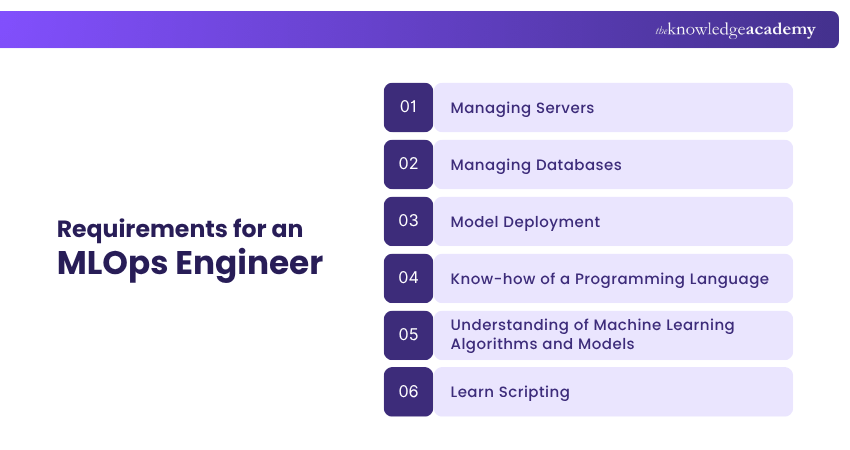
1) Managing Servers
Understanding how servers operate is essential. Get familiar with different operating systems, especially Linux. If you’re not already using it, install a virtual machine such as Ubuntu to practise and learn how server environments operate.
2) Managing Databases
You’ll need to manage databases that store real-time data and model outputs. Learn to work with SQL and NoSQL databases, as different companies use different systems. Being able to scale and maintain these databases is key for smooth ML operations.
3) Model Deployment
You’ll need to deploy ML models to production environments. Start by creating simple Python applications and practise deploying them. Most companies use cloud services, so get hands-on with AWS, Google Cloud (GCP), and Microsoft Azure, as experience with these is often required.
4) Know-how of a Programming Language
Start with Python, as it’s widely used in Data Science and Machine Learning. Learning C++ can also be helpful due to its speed and support for ML libraries.
5) Understanding of Machine Learning Algorithms and Models
It’s vital to understand the Machine Learning models you’ll be working with. Begin by learning core ML algorithms and familiarising yourself with popular frameworks:
1) Start with Scikit-learn for supervised and unsupervised learning.
2) Progress to learn about Deep Learning tools like TensorFlow and PyTorch.
You must understand the basics of Neural Networks like Convolutional Neural Network
(CNNs) which are used for image tasks and Recurrent Neural Network (RNNs) used for sequences.
6) Learn Scripting
MLOps heavily relies on automation. Learn scripting languages such as Bash to automate repetitive tasks. Languages like Python, Go, and Ruby are also valuable for managing ML pipelines and deployments.
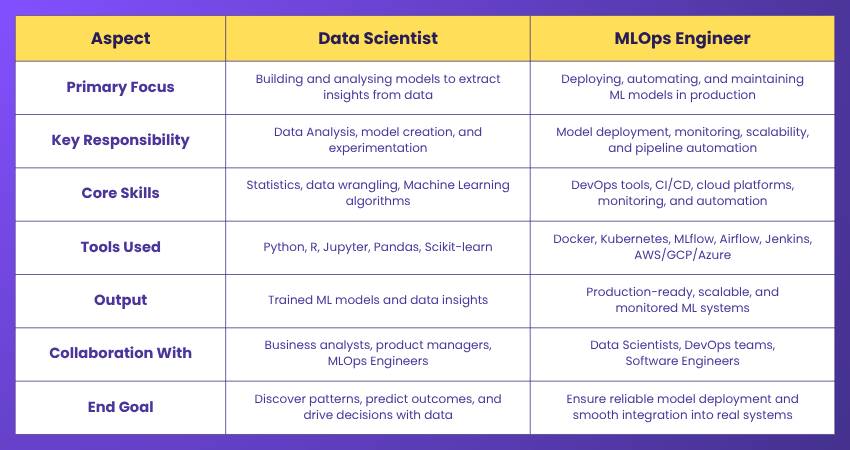
Difference Between Data Scientist & MLOps Engineer
Here are the key distinctions between a Data Scientist and MLOps Engineer:
Conclusion
Becoming an MLOps Engineer means mastering the art and science of turning Machine Learning ideas into scalable solutions. With the right mix of education, skills and adaptability, you can thrive in this fast-growing field. From coding to Cloud tools, the journey may be challenging, but the rewards make it a truly future-ready career choice.
Step into the future where machines evolve and churn out ideas at lightning pace. Sign up for our Artificial Intelligence & Machine Learning Course now!
Frequently Asked Questions
Is MLOps a Good Career?

Yes, MLOps is a strong career choice. As organisations increasingly depend on Machine Learning models, the demand for experts who can deploy, manage and maintain those models continues to rise.
Can a Data Scientist Become an MLOps Engineer?
Yes, a Data Scientist can definitely become an MLOps engineer. Since they already understand how Machine Learning models work, they simply need to acquire additional skills, such as using cloud tools, coding for deployment and managing models after they go live. With some training, this shift is very doable.
What are the Other Resources and Offers Provided by The Knowledge Academy?
The Knowledge Academy takes global learning to new heights, offering over 3,000+ online courses across 490+ locations in 190+ countries. This expansive reach ensures accessibility and convenience for learners worldwide.
Alongside our diverse Online Course Catalogue, encompassing 17 major categories, we go the extra mile by providing a plethora of free educational Online Resources like Blogs, eBooks, Interview Questions and Videos. Tailoring learning experiences further, professionals can unlock greater value through a wide range of special discounts, seasonal deals, and Exclusive Offers.
What is The Knowledge Pass, and How Does it Work?
The Knowledge Academy’s Knowledge Pass, a prepaid voucher, adds another layer of flexibility, allowing course bookings over a 12-month period. Join us on a journey where education knows no bounds.
What are the Related Courses and Blogs Provided by The Knowledge Academy?
The Knowledge Academy offers various Artificial Intelligence & Machine Learning Courses, including the Introduction to Artificial Intelligence Course, Machine Learning Course and the Natural Language Processing (NLP) Fundamentals with Python Course. These courses cater to different skill levels, providing comprehensive insights into Agentic AI.
Our Data, Analytics & AI Blogs cover a range of topics related to MLOps Engineering, offering valuable resources, best practices, and industry insights. Whether you are a beginner or looking to advance your MLOps Engineering skills, The Knowledge Academy's diverse courses and informative blogs have got you covered.

The Knowledge Academy


Global Training Provider
The Knowledge Academy is a world-leading provider of professional training courses, offering globally recognised qualifications across a wide range of subjects. With expert trainers, up-to-date course material, and flexible learning options, we aim to empower professionals and organisations to achieve their goals through continuous learning.

Upcoming Data, Analytics & AI Resources Batches & Dates
Date
 Machine Learning Course
Machine Learning Course
Fri 2nd Oct 2026
Machine Learning Course
Fri 4th Dec 2026

 If you wish to make any changes to your course, please


