


 Top Rated Course

We may not have the course you’re looking for. If you enquire or give us a call on +44 1344 203 999 and speak to our training experts, we may still be able to help with your training requirements.
Mortgage vs Loan: A Comprehensive Comparison for Borrowers
The Knowledge Academy 14 July 2026A Mortgage is a secured property Loan, while a Personal Loan is often unsecured with higher interest, smaller limits, and shorter repayment terms. Mortgages are better for large, long-term borrowing needs, while personal Loans are suited to smaller, short-term financial needs like buying appliances or covering emergencies.

Training Outcomes Within Your Budget!
We ensure quality, budget-alignment, and timely delivery by our expert instructors.
Table of Contents
Related Courses
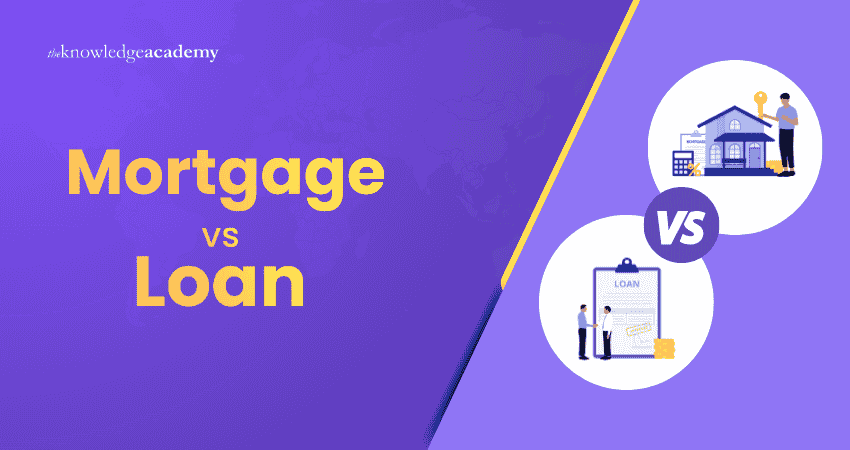
Dreaming of your own home or planning to borrow money for big goals? You’ve probably come across the terms Mortgage and Loan. These terms are often used interchangeably, but they’re not quite the same. Understanding the difference between Mortgage vs Loan can save you confusion, time and potentially thousands of pounds.
This blog dives deep into the key distinctions between Mortgage vs Loan. In this comprehensive comparison, we’ll break down their key features, uses, benefits, interest rates, repayment terms and more to help you make smarter borrowing decisions. So read on and learn how to choose the option that fits your needs best!
Table of Contents
1) What is a Mortgage?
2) What is a Loan?
3) Differences Between Mortgage and Loan
4) What is Collateral?
5) What are the Requirements?
6) Mortgage vs Loan: Interest Rates
7) Mortgage vs Loan: Loan Amounts and Repayment Terms
8) What are the Types of Mortgages?
9) What are the Types of Loans?
10) Can you Pay off a Mortgage Early?
11) How can You Manage Your Mortgage Efficiently?
12) Conclusion
What is a Mortgage?
A Mortgage is a Loan where a home or the piece of property an individual owns is offered as security. When you obtain a Mortgage, the Loan company gains the rights to your house by legally putting a claim on the property, referred to as a lien. This lien allows the lending institution to seize or sell your property if you fail to pay your bills.
Mortgages are often used to purchase or refinance homes or other properties. Due to the value of Real Estate being expensive, many buyers need a Loan to help them instead of buying property in full. During Loan processing, which culminates in the execution of a Mortgage Deed, the following factors are considered: Credit score and history, income, and debt-to-income ratio, among others. An appraisal is commonly required to determine the value of the property, which in turn determines the Loan amount you qualify for.

What is a Loan?
Loans are credit agreements that involve a borrower receiving cash from a lender, with agreed terms regarding the size of the principal amount of money borrowed and the interest to be charged and paid. There are numerous Loans for personal and business financing with different rates of security, which certain valuable items may secure.
Borrowing denotes obtaining a Loan with the understanding that it shall be reimbursed by a certain amount plus interest within some stipulated period. In the case of term Loans, this entails paying the entire amount of the borrowed money before the specified period elapses, although it is done a little at a time in the form of instalments. On the other hand, revolving credit means that a specified amount of money is available at a particular time, and a client can repay and borrow again without limitations.
Differences Between Mortgage and Loan
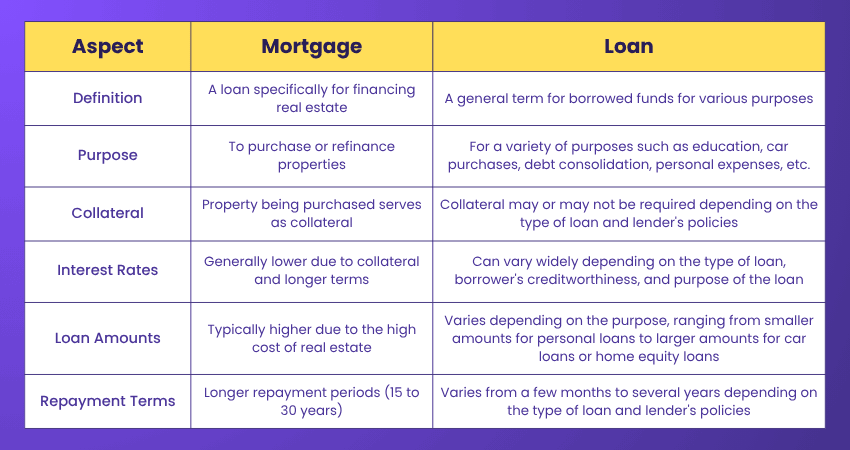
The table showing the aspects of Mortgage and Loan will help you understand the distinctions between them:
What is Collateral?
Some Loans require collateral, which is an asset pledged to secure repayment. If the borrower cannot repay, the lender has the legal right to keep and sell the collateral. For example, in car Loans, the vehicle itself serves as collateral, and if repayments stop, the lender can repossess or sell it to recover the debt. In some cases, collateral can also be cash, such as with secured credit cards that help individuals build or improve their credit.
In Mortgages, the home or property acts as collateral. If the borrower cannot meet the repayment terms, the lender can go for legal action to claim ownership and sell the property. This ensures the lender is protected while also encouraging the borrower to meet their financial obligations.
From paycheck to prosperity, our Personal Finance Course will help you kickstart Your financial journey - Sign up now!
What are the Requirements?
Different Loans have different rules for borrowers. Most lenders usually ask for:
a) Proof of Income and Job: You may need to show salary slips or an employment letter.
b) Debt-to-income Ratio: This means how much debt you pay each month compared to your total monthly income before deductions.
c) Minimum Credit Score: Every lender has its own limit, but a score above 700 is usually seen as good.
d) Collateral for Secured Loans: For a car Loan, the car itself is the collateral. For secured personal Loans, lenders may accept things like paid-off cars, savings deposits, or investments.
e) Credit Cards: These often have fewer requirements, such as proof of income, an address, and a minimum credit score needed.
Mortgages need more documents than most other Loans. If you are applying for a Mortgage or refinancing, lenders often ask for:
a) Proof of income and job
b) A list of assets, such as bank balances, cars and investments
c) A list of debts and payments you owe
d) Details about the property that will be used as collateral
Acquire knowledge of earnings to cash flow and measuring value creation. Join our Corporate Finance Training now!
Mortgage vs Loan: Interest Rates
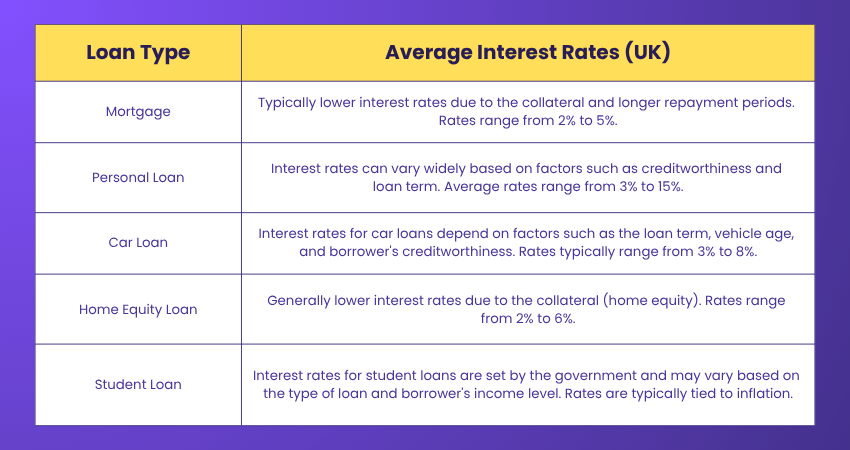
The following differential feature between Mortgages and Loans focuses on interest rates. Here are the key points to remember:
1) Mortgage interest rates are typically less than those of most other types of Loans because they are secured by property and usually have longer repayment tenures.
2) Mortgage interest rates are often fixed, ensuring stability over the repayment period and making financial planning easier.
3) Fixed Mortgage rates allow borrowers to make predictable monthly payments which results in significant savings over the Loan’s lifetime.
4) Loans, on the other hand, may have fixed or floating interest rates depending on the type and terms offered.
5) Personal Loans and credit card borrowing typically carry more interest rates than Mortgages due to their unsecured nature, which increases risk for lenders.
6) Student Loans can be with fixed or variable interest rates, and payments can change based on market fluctuations.
7) Borrowers can assess whether varying interest rates make Mortgages or loans more advantageous for their specific needs.
8) Mortgages offer the dual benefit of lower interest rates and the opportunity to build home equity over time.
9) Rising interest rates on Loans increase borrowing costs, potentially affecting repayment capacity.
10) Reviewing interest rates, lender policies, and product terms is essential before taking any Mortgage or Loan to ensure informed financial decisions.
Mortgage vs Loan: Loan Amounts and Repayment Terms
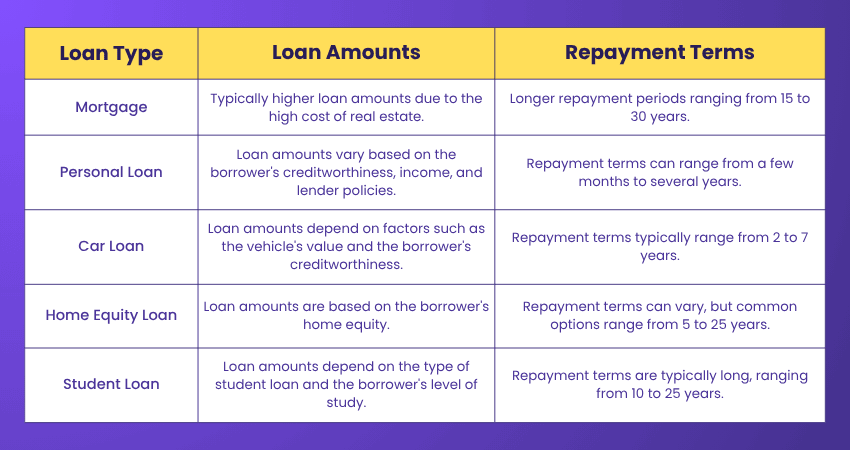
Here are the key points to remember pertaining to Loan amounts and repayment terms related to Mortgage and Loan:
1) Mortgages and Loans differ in borrowing amounts and repayment terms, with Mortgages typically involving larger sums due to high real estate costs.
2) The Loan amount depends on property value and the borrower’s creditworthiness. This allows individuals to buy homes they couldn’t afford upfront.
3) Mortgages usually have long repayment periods, typically between 15 to 30 years. It gives borrowers ample time to repay.
4) Longer repayment terms make monthly instalments more manageable, but they also increase the total interest paid over the Loan’s lifetime.
5) Understanding EMIs helps borrowers evaluate how different tenures affect monthly payments and overall interest costs.
6) Non-mortgage Loans are more varied in size and duration, usually involving smaller amounts and shorter repayment periods.
7) Repayment timelines for other Loans can range from a few months to several years, depending on the Loan type, lender, and borrower’s credit profile.
8) Shorter terms are suitable for borrowers wanting to repay quickly or follow a specific financial timeline.
9) Lenders should ensure Loan amounts and repayment structures align with the borrower’s financial capacity and goals.
10) Borrowers should compare offers, review repayment conditions, and pick the ideal option based on their Budget and needs.
What are the Types of Mortgages?
There are various kinds of Mortgages through which the Loan amount varies depending on the rate of interest, the size of the term, and much more. Let us look at a few of them to gain clarity:
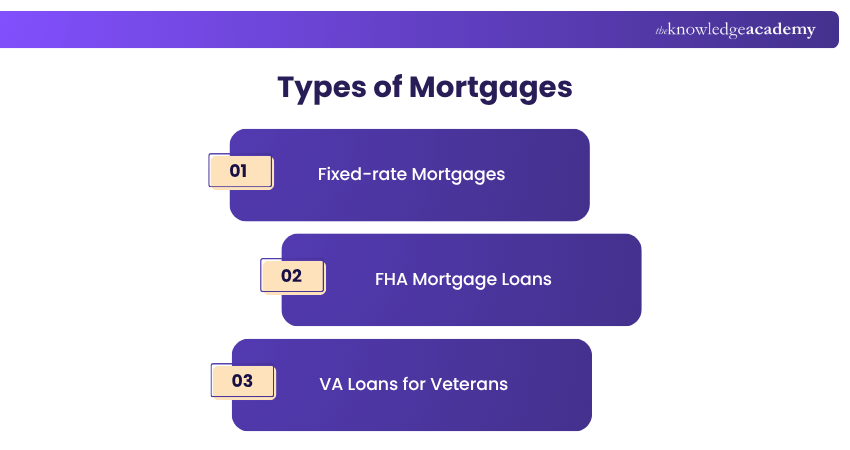
1) Fixed-rate Mortgages
Home Loans are of two main types: fixed-rate and adjustable-rate Mortgages, with hybrid Mortgages as a third option. They are usually repaid over 10–50 years or earlier if possible.
In fixed-rate Mortgages, the interest rate stays the same for the full term. Extra payments can shorten repayment, with instalments first covering interest and then reducing the principal.
2) FHA Mortgage Loans
The Federal Housing Administration (FHA) insures the Mortgage Loans from approved lenders for borrowers with weaker credit. These Loans are offered by private banks, with the government acting as guarantor up to a set amount.
FHA Loans mainly support first-time buyers and low- to moderate-income earners who can’t make a 20% down payment. They allow high-risk borrowers to purchase homes but require Mortgage insurance.
3) VA Loans for Veterans
VA Loans work much like FHA Loans, where the government guarantees Loans given by private lenders rather than lending directly. If a veteran fails to repay, the government covers at least 25% of the Loan amount. VA Loans stand out because they require no down payment and no private Mortgage insurance which makes homeownership more accessible for veterans, even those with limited civilian job records.
Alongside VA and FHA Loans, there are other Mortgage types such as interest-only, adjustable-rate (ARM), Reverse Mortgages, and fixed-rate Mortgages. While several options exist, fixed-rate Mortgages remain the most common and widely preferred, with the 30-year fixed-rate programme being the most popular choice.
Learn how private equity firms evaluate and execute investment deals. Join our Private Equity Training now!
What are the Types of Loans?
Let us look at a few types of Loans to gain clarity on which are suitable for your needs:
Open-end vs Closed-end Loans
There are two main types of Loan credit: open-end credit (revolving credit) and closed-end credit (term Loans). Open-end credit works like a credit card, where borrowers can use funds up to a set limit, repay, and borrow again, as long as payments are made on time and the limit isn’t exceeded. Each time the balance is cleared, the full credit limit becomes available again.
Closed-end credit, on the other hand, allows borrowing a fixed amount that must be repaid within a set time. Unlike revolving credit, once part of the Loan is repaid, it cannot be borrowed again. For example, with a £150,000 closed-end Mortgage, repaying £70,000 doesn’t allow re-borrowing that £70,000, you would need to apply for a new Loan instead.
Secured vs Unsecured
Loans come in two categories: secured and unsecured. A secured Loan needs collateral like a house or car, while an unsecured Loan does not. With unsecured Loans, lenders face more risk since there’s no asset to claim if the borrower cannot repay. Because of this, unsecured Loans typically have increased interest rates, smaller amounts, and depend heavily on the borrower’s income, credit report, and rating. Examples include personal Loans, overdrafts, and credit cards.
Secured Loans (collateral Loans) are backed by an asset offered as security. Mortgages and auto Loans are common examples. Since lenders face less risk, they are more willing to provide larger amounts at lower interest rates. However, if the borrower defaults, the lender has the right to claim or sell the asset used as collateral under the Loan agreement.
Can you Pay off a Mortgage Early?
Yes, you can pay off the Mortgage early to save interest and own your home sooner.
But check your Mortgage papers, as some lenders charge fees. Keep some savings for emergencies, and remember many Mortgages let you pay extra (like 10% a year) without charges. Also, think about whether paying off other debts or investing might be a better use of money.
How Can You Manage Your Mortgage Efficiently?
Smart Mortgage Management can save money and give you more control over your finances. Here’s how:
a) Make Overpayments: Pay extra when possible (often up to 10% a year) to cut interest and shorten the term.
b) Review Your Deal: Check yearly if better rates are available and consider remortgaging.
c) Maintain Good Credit: A strong credit score helps you access cheaper Mortgage options.
d) Plan for Rate Rises: If at a variable rate, budget for possible payment increases.
e) Use Offset Accounts: Link savings to reduce the interest charged.
f) Seek Expert Advice: Brokers can compare options and find deals you may miss.
Conclusion
When comparing Mortgage vs Loan, the key difference lies in security, repayment terms, and purpose. Mortgages are long-term, secured by property, while Loans can be secured or unsecured, often shorter and smaller in amount. Understanding these differences can helpthe borrowers choose the right option for their financial needs and manage repayments more effectively.
Gain expertise in assessing Mortgage products and market trends. Join our CeMAP Course (Level 1,2 and 3) Training now!
Frequently Asked Questions
Which is Better, a Mortgage or a Home Loan?

If you want to choose between a Mortgage and a home Loan, it will depend on the interest rates, Loan rates, and your own individual financial goals.
Is a Remortgage cheaper than a Loan?
A Remortgage can often be cheaper than a personal Loan due to typically lower interest rates, as it is secured against your property.

The Knowledge Academy


Global Training Provider
The Knowledge Academy is a world-leading provider of professional training courses, offering globally recognised qualifications across a wide range of subjects. With expert trainers, up-to-date course material, and flexible learning options, we aim to empower professionals and organisations to achieve their goals through continuous learning.


 If you wish to make any changes to your course, please


