


 Top Rated Course

We may not have the course you’re looking for. If you enquire or give us a call on +44 1344 203 999 and speak to our training experts, we may still be able to help with your training requirements.
What is an Application Server, and How Does it Work?
John Davies 19 December 2025An Application Server is a framework that provides an environment for running and managing applications, typically web-based. It handles business logic and ensures seamless communication between front-end and back-end systems. Application Servers support scalability, security, and resource management in enterprise solutions.

Training Outcomes Within Your Budget!
We ensure quality, budget-alignment, and timely delivery by our expert instructors.
Table of Contents
Have you ever clicked “Buy Now” or logged into an app and thought, “Wow, that was fast”? That smooth experience? You can thank an Application Server. It’s the behind-the-scenes hero that takes your click, runs the code, grabs the right data, and sends it back almost instantly.
Like a super-efficient middleman between you and the tech world, an Application Server makes sure everything works like clockwork. You don’t see it, but it’s doing all the hard work while you scroll, stream, shop, or swipe. If you've ever wondered what keeps your digital world spinning so effortlessly, you're about to find out and trust us; it's cooler than it sounds.
Table of Contents
1) What is an Application Server?
2) Importance of Application Servers
3) Types of Application Server
4) How do Application Servers Work?
5) Limitations of Application Servers
6) Popular Application Server Examples
7) Application Servers vs Web Servers
8) Conclusion
What is an Application Server?
An Application Server is a software platform that offers an environment for executing and managing applications. It acts as a middle layer between the front-end interface that users interact with and the back-end database where data is stored. Essentially, it processes requests from users, executes business logic, connects to databases, and sends back the results.
Think of it as a super-efficient traffic controller. It receives user requests, decides where to send them, pulls the needed information from the database, processes it, and then delivers it neatly packaged back to the user’s screen.
Importance of Application Servers
Why are these servers such a big deal? Because they do a lot more than just run applications. Let’s explore their key benefits.
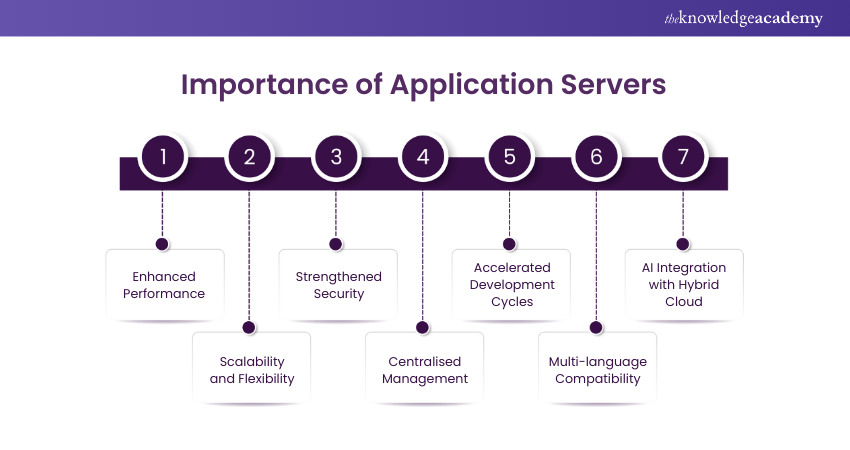
1) Enhanced Performance
Application Servers are designed for high-speed processing. They optimise resource usage, handle concurrent requests smoothly, and ensure your application doesn’t crash under pressure. Whether 10 people are using it or 10,000, a well-architected Application Server keeps things running efficiently.
2) Scalability and Flexibility
Business needs to evolve, and so do user demands. Application Servers offer the flexibility to scale applications vertically or horizontally. You can add more resources or servers as needed without disrupting user experience, making them ideal for growing businesses.
3) Strengthened Security
Application Servers offer centralised control, meaning developers and system admins can enforce security policies, authenticate users, and encrypt sensitive data. It adds another Application Layer of protection between the user and your database.
4) Centralised Management
With everything controlled in one place, updates, configurations, and patches are much easier to manage. Centralised control means less chaos and more streamlined operations, especially for large-scale enterprise applications.
5) Accelerated Development Cycles
Modern Application Servers support rapid development frameworks, built-in APIs, and libraries that save developers from reinventing the wheel. This boosts productivity and shortens the time it takes to get a product to market.
6) Multi-language Compatibility
Most Application Servers support multiple programming languages, including Java, .NET, Python, and Node.js. This allows developers to use the tools and languages they are most comfortable with, creating a more versatile development environment.
7) AI Integration with Hybrid Cloud
As AI becomes more embedded in business operations, Application Servers now support integration with AI models and hybrid cloud infrastructures. This helps businesses innovate faster while keeping control over their data and applications.
Gain in-depth knowledge on the installation of OS and service packs in our Computer Hardware Troubleshooting Course - Register now!
Types of Application Server
Not all Application Servers are created equal. Depending on your needs, you’ll come across different types.
1) Active Servers
These servers actively execute business logic and provide real-time processing for user inputs. They’re the most interactive type and are commonly used in dynamic web applications.
2) Web Information Servers
These are more focused on content delivery, such as serving up HTML pages and multimedia content. While they support web functions, they are often paired with more dynamic Application Servers.
3) Component-Based Servers
These servers use reusable components like Enterprise JavaBeans (EJBs) or .NET assemblies. This modular approach makes them perfect for large enterprise applications with complex business logic.
How Do Application Servers Work?
At their core, Application Servers function by sitting between the client (like a web browser or mobile app) and a database server. When a client sends a request, for example, to log in or submit a form, the Application Server receives it, processes it according to business logic, queries the database if needed, and sends a response back to the client.
Here’s a simplified step-by-step process:
1) A user interacts with the front end (e.g., clicks a button).
2) The front end sends a request to the Application Server.
3) The server interprets the request and applies the business logic.
4) It communicates with the database if data retrieval or storage is needed.
5) The result is processed and returned to the user interface.
This back-and-forth can happen in milliseconds, making modern applications feel almost instantaneous.
Limitations of Application Servers
Like any technology, Application Servers are not without challenges.
1) Complexity: Setting up and maintaining Application Servers can be complex and may require expert knowledge.
2) Cost: Licensing fees and resource demands can be expensive, especially for enterprise-grade solutions.
3) Overhead: If not optimised, they can introduce unnecessary overhead and slow down performance.
4) Security Risks: If poorly configured, they can become targets for cyberattacks.
Despite these drawbacks, their advantages usually far outweigh the limitations, especially when implemented thoughtfully.
From Tech Novice to IT Ninja – Train Smarter with our Nagios System and Network Monitoring Training!
Popular Application Server Examples
Let’s look at some popular Application Servers and what they’re known for.
1) Java EE Application Servers
Java Enterprise Edition (Java EE) servers like GlassFish or WebLogic offer robust features for enterprise applications. They support distributed architectures, high availability, and integration with Java APIs.
2) .NET Application Servers
Microsoft’s IIS (Internet Information Services) supports .NET applications and provides an efficient environment for Windows-based web and enterprise apps.
3) PHP Application Servers
Zend Server is a widely used PHP Application Server that offers performance monitoring and code tracing, especially in e-commerce environments.
4) Node.js Application Servers
Node.js servers like Express.js are lightweight and non-blocking, making them great for real-time applications like chat systems and collaborative tools.
5) Python Application Servers
Gunicorn, uWSGI, and Django’s built-in server are commonly used in Python environments. They’re excellent for scientific computing, AI-driven apps, and web back-ends.
6) Ruby on Rails Application Servers
Puma and Passenger are powerful Ruby-based Application Servers that can serve Rails applications with high concurrency and stability.
7) Apache Tomcat
Apache Tomcat is an open-source Application Server designed for Java applications. It’s lightweight, widely used, and perfect for small to medium-scale applications.
8) Microsoft Internet Information Services (IIS)
IIS supports ASP.NET and other Microsoft technologies. It’s deeply integrated into the Windows ecosystem and supports secure, high-performance web applications.
9) WildFly (formerly JBoss)
An open-source Java EE server by Red Hat, WildFly is known for modularity, flexibility, and cloud-readiness. It’s commonly used in large, enterprise-grade environments.
10) Nginx
While Nginx is often classified as a web server, it can also act as an Application Server when combined with modules or back-end frameworks. It’s known for performance and reliability in high-traffic websites.
Application Servers vs Web Servers
Here’s where things can get confusing. Web servers and Application Servers are not the same, although they often work together.
1) Web Servers deliver static content such as HTML, CSS, and images.
2) Application Servers handle dynamic content and business logic.
Think of a web server as the waiter bringing you a menu and food, while the Application Server is the chef in the kitchen cooking your customised order.
In many modern setups, both servers work hand in hand. For instance, a user visits your website (handled by the web server), submits a form (processed by the Application Server), and then receives a confirmation page (again served by the web server).
Conclusion
Application Servers are the invisible engine rooms of modern digital experiences. Whether you're managing an eCommerce store, running enterprise software, or building the next big thing in AI, Application Servers power the logic, speed, and security your users depend on. They’re not flashy, and they’re rarely in the spotlight, but they do the heavy lifting behind the scenes. From handling thousands of simultaneous requests to keeping your data secure, they make sure everything works as it should.
Understand effective troubleshooting methodologies for addressing diverse IT issues in our IT Support and Solution Training - Sign up now!
Frequently Asked Questions
What is the Main Purpose of an Application Server?

The main purpose of an Application Server is to host and run software applications, enabling users to access services and data through a central platform. It handles business logic, processes requests, and connects users to back-end systems securely and efficiently.
What is the Application Servers Role?
The role of an Application Server is to act as a bridge between users and databases by executing application code, managing user sessions, and ensuring smooth data exchange. It supports scalability, security, and resource management in enterprise-level applications.
What are the Other Resources and Offers Provided by The Knowledge Academy?
The Knowledge Academy takes global learning to new heights, offering over 3,000 online courses across 490+ locations in 190+ countries. This expansive reach ensures accessibility and convenience for learners worldwide.
Alongside our diverse Online Course Catalogue, encompassing 19 major categories, we go the extra mile by providing a plethora of free educational Online Resources like Blogs, eBooks, Interview Questions and Videos. Tailoring learning experiences further, professionals can unlock greater value through a wide range of special discounts, seasonal deals, and Exclusive Offers.
What is The Knowledge Pass, and How Does it Work?
The Knowledge Academy’s Knowledge Pass, a prepaid voucher, adds another layer of flexibility, allowing course bookings over a 12-month period. Join us on a journey where education knows no bounds.
What are the Related Courses and Blogs Provided by The Knowledge Academy?
The Knowledge Academy offers various IT Support and Solution Training, including the CloudFlare Training, Boomi Training Course and the Nagios System and Network Monitoring Training. These courses cater to different skill levels, providing comprehensive insights into IT Outsourcing.
Our IT Infrastructure & Networking Blogs cover a range of topics related to Servers, offering valuable resources, best practices, and industry insights. Whether you are a beginner or looking to advance your internet and networking skills, The Knowledge Academy's diverse courses and informative blogs have got you covered.

John Davies


Cyber Security Governance & Assurance Specialist
John Davies is a cybersecurity expert specialising in governance, risk management, and compliance. With over 15 years in the field, he has led enterprise-wide security programmes across finance, healthcare and public sector organisations. His content provides practical guidance on building secure environments, managing risk and aligning with regulatory frameworks.

Upcoming IT Infrastructure & Networking Resources Batches & Dates
Date
 Nginx Web Server Administration Training
Nginx Web Server Administration Training
Fri 28th Aug 2026
Nginx Web Server Administration Training
Fri 11th Dec 2026

 If you wish to make any changes to your course, please


