


 Top Rated Course

We may not have the course you’re looking for. If you enquire or give us a call on +08000201623 and speak to our training experts, we may still be able to help with your training requirements.
What is Red Ocean Strategy, and How Does it Work?
James Smith 21 April 2026Red Ocean Strategy focuses on competing in existing markets, battling rivals, and maximising the market share through cost leadership or differentiation. This strategy has various types, including Cost Focus or Cost-differentiation Focus, Focus or Niche Strategy, Merger and Acquisition (M&A) and Product or Service Innovation.

Training Outcomes Within Your Budget!
We ensure quality, budget-alignment, and timely delivery by our expert instructors.
Table of Contents

Trying to be the big fish in the shark-infested waters of the modern business market is a massive challenge. It's a sea stained red from fierce battles, companies locked in constant combat, slashing prices and wrestling for attention. That’s where the Red Ocean Strategy comes in. It’s a business approach focused on outperforming rivals in existing markets by capturing a larger share of current demand.
But how exactly does this cutthroat game work? This blog answers this question with a deep dive into the Red Ocean Strategy, outlining its characteristics, benefits, challenges and more. So read on, learn how to outshine your competitors with sharper prices or better branding and survive in these bloody waters!
Table of Contents
1) What is a Red Ocean Strategy?
2) How the Red Ocean Strategy Works?
3) Characteristics of Red Ocean Strategy
4) Types of Red Ocean Strategy
5) Advantages and Challenges of Red Ocean Strategy
6) Examples of Red Ocean Strategy
7) How to Apply a Red Ocean Strategy?
8) Conclusion
What is a Red Ocean Strategy?
The Red Ocean Strategy describes competing in existing market spaces where the industry boundaries are defined and accepted. In these "red oceans," companies try to outperform their rivals by grabbing a bigger share of existing demand. With the focus on price wars and commodification, it leads to cutthroat competition, making it harder to sustain profits and grow.
Essentially, companies using this strategy focus on differentiation and cost leadership to gain an edge over competitors. The term is in stark contrast with the Blue Ocean Strategy, which involves creating new market spaces with little or no competition.

How the Red Ocean Strategy Works?
Unlike the Blue Ocean Strategy, which aims to find uncontested markets, the Red Ocean Strategy advocates simply outwitting the competition and staying profitable in an established industry. As a business decision-maker, you must focus on the following fundamentals when crafting such as strategy:
1) High Competition: Red Ocean Markets are crowded and cutthroat, with constant new entrants intensifying the rivalry.
2) Stagnant Growth: Oversaturation limits opportunities for expansion.
3) Value vs Cost: Businesses must choose between offering more value at higher costs or cutting costs at the expense of value.
4) Fierce Demand Battles: With no new demand created, companies compete for a shrinking customer base.
Want to learn the best trick to turn visitors into loyal customers? Sign up for our Conversion Rate Optimisation Training now!
Characteristics of Red Ocean Strategy
The Red Ocean Strategy is characterised by cutthroat competition. Here are some of its key features:
1) Saturated Markets: Players offer similar services or products in well-defined markets.
2) Focus on Current Customers: This strategy is about gaining a larger share of existing clients instead of creating new market segments.
3) Redundant Differentiation: Companies rely on slight variations in the offerings, which may not create significant unique value for customers.
4) Zero-sum Game: Gains by one company often come at the expense of others.

Types of Red Ocean Strategy
In a Red Ocean Strategy, there are numerous approaches businesses can adopt to outperform their competitors and increase their market share. These tactics generally revolve around competing for quality, cost, service, and branding. Here are some prominent types of Red Ocean Strategies:
Cost Focus or Cost-differentiation Focus
a) This combines cost leadership and focus strategies
b) Businesses can focus on being the lowest-cost provider in a specific market segment
c) They can offer unique or differentiated products in a niche market
Focus or Niche Strategy
a) Companies target a specific market segment.
b) It caters to a particular customer group, product range, or geographical area.
c) This strategy is often adopted by smaller companies that need more resources to compete across the entire market.
Master the budgeting principles of direct and Digital Marketing in our Marketing Budget Course - Sign up now and streamline your business operations like never before!
Market Penetration
This involves elevating market share within existing market segments. This can be achieved by:
a) Attracting competitors’ customers
b) Improving the product or service to encourage higher usage
c) Converting non-users into users
Cost Leadership
a) This involves becoming the industry's lowest-cost producer.
b) Companies pursuing cost leadership seek a competitive edge by reducing costs below their competitors.
c) This leads to streamlined operations and economies of scale.
Merger and Acquisition (M&A)
Companies may merge with or acquire other companies to:
a) Increase market share
b) Reduce competition
c) gain access to new customers or markets
Differentiation
a) This approach is about developing unique service or product attributes that customers value.
b) Differentiation can be based on features, customer service, quality, or brand image.
c) The goal is to create a perception of higher value when compared to competitors’ offerings.
Bring the cutting-edge digital touch to your Marketing Strategies - Sign up for our Digital Marketing Courses now!
Market Development
This strategy involves finding new markets for existing products. This could be through:
a) Geographic expansion
b) Targeting new demographic groups
c) Repositioning the product
Alliances and Partnerships
Strategic alliances with different companies can be a potent way to:
a) Strengthen market position
b) Share resources
c) Capitalise on complementary strengths
Operational Effectiveness
a) This involves improving the internal processes, logistics, and technologies
b) This helps achieve greater efficiency and effectiveness in operations
c) This often leads to lower costs or improved quality
Product or Service Innovation
a) Continuous innovation can apply to the Red Ocean Strategy, not just the Blue Ocean
b) Its focus is on incremental improvements to existing products
c) It uses variations to maintain a competitive edge
Are you still juggling the tools and strategies for your brand's growth, unsure of the right ones? Our Business Marketing Strategies Training will guide you - Sign up now!
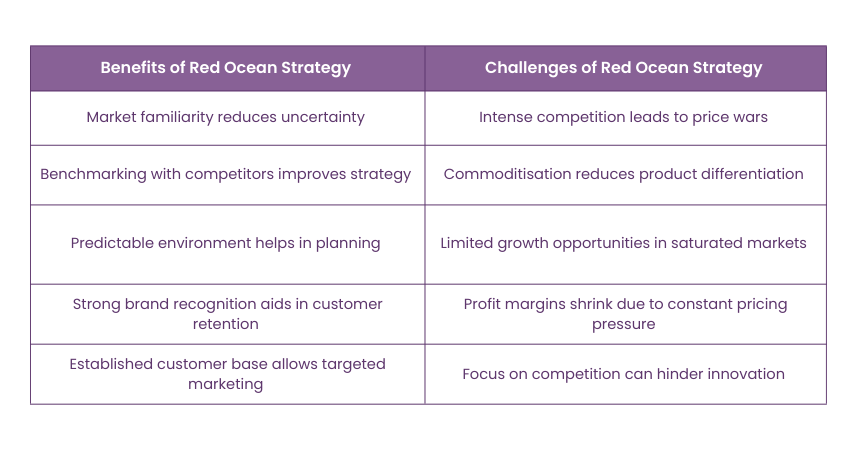
Advantages and Challenges of the Red Ocean Strategy
Here are the key benefits and challenges associated with the Red Ocean Strategy:
Examples of Red Ocean Strategy
Here are three famous real-world examples of Red Ocean Strategies across different industries:
1) Coca-Cola and Pepsi’s Brand Differentiation: Coca-Cola and Pepsi are well-known rivals in the soft drink industry. Both companies have invested heavily in brand differentiation through Marketing, Advertising and variations in taste and product offerings.
2) Luxury Car Brands Differentiation: Companies such as BMW, Mercedes-Benz and Audi focus on quality, brand prestige, advanced technology and superior performance. They compete in the same market but work on outdoing each other regarding product features and brand perception.
3) Netflix’s Content and Market Development: Initially, Netflix competed in the video streaming market by providing various third-party content. As competition intensified, it shifted towards producing original content and expanding into international markets.
How to Apply a Red Ocean Strategy?
There are two main approaches to implementing a Red Ocean Strategy:
1) Differentiation: A company can stand out by focusing on unique selling points (USP), elevated customer experience, strong brand identity and better marketing.
2) Lower Pricing: Existing products in Red Ocean marketplaces share many similarities, so some measures are ineffective. Consequently, companies are left with no choice but to reduce their prices to stay competitive.
Consider this example:
1) Sugar is a highly commoditised product sold under different brand names, but the commodity is pretty much similar.
2) Sugar sold by Company A will taste exactly like the sugar sold by Company B.
3) Consumers want the best value for money, and it's easy for them to switch brands. So, companies selling sugar will often lower their prices to stay competitive in the market.
4) A Red Ocean Strategy will work only if the company has faith in its product and services and has crafted a clear execution plan.
Conclusion
Red Ocean Strategy is about thriving in crowded markets where competition is cutthroat and standing out is everything. Success depends on smart pricing, strong branding and operational efficiency. By understanding how it works, businesses can confidently turn intense competition into opportunity and carve out a space even in the most saturated markets.
Looking to carve your place in the cutthroat business landscape? Our comprehensive Marketing Courses will offer plenty of options – Sign up now!
Frequently Asked Questions
What is the Role of Red Ocean Strategy in Today's World?

Red Ocean Strategy focuses on competing in existing markets, aiming to outperform rivals and capture the biggest market share possible. In today's world, it remains relevant for businesses seeking to leverage established demand, optimise operations, and differentiate through cost leadership or product improvements.
How can We Avoid Red Ocean Traps?
Businesses should focus on innovation and creating new market spaces to avoid red ocean traps. They must do the following:
a) Emphasise value creation
b) Understand customer needs
c) Explore untapped opportunities
d) Diversify offerings
e) Invest in R&D
f) Foster a culture of continuous improvement
What are the Other Resources and Offers Provided by The Knowledge Academy?
The Knowledge Academy takes global learning to new heights, offering over 3,000+ online courses across 490+ locations in 190+ countries. This expansive reach ensures accessibility and convenience for learners worldwide.
Alongside our diverse Online Course Catalogue, encompassing 17 major categories, we go the extra mile by providing a plethora of free educational Online Resources like Blogs, eBooks, Interview Questions and Videos. Tailoring learning experiences further, professionals can unlock greater value through a wide range of special discounts, seasonal deals, and Exclusive Offers.
What is The Knowledge Pass, and How Does it Work?
The Knowledge Academy’s Knowledge Pass, a prepaid voucher, adds another layer of flexibility, allowing course bookings over a 12-month period. Join us on a journey where education knows no bounds.
What are the Related Courses and Blogs Provided by The Knowledge Academy?
The Knowledge Academy offers various Marketing Courses, including the Business Marketing Strategies Training and the Marketing Research Training. These courses cater to different skill levels, providing comprehensive insights into What is Digital Marketing Plan.
Our Digital Marketing Blogs cover a range of topics related to Marketing Strategies, offering valuable resources, best practices, and industry insights. Whether you are a beginner or looking to advance your marketing skills, The Knowledge Academy's diverse courses and informative blogs have got you covered.

James Smith


Digital Marketing Manager and Trainer
James Smith is a digital marketing professional with over a decade of experience in SEO, content strategy, paid media and analytics. He has supported both SMEs and global brands in transforming their digital presence. James’s writing and training are rooted in results-driven tactics and the latest marketing trends.
View Detail
Upcoming Digital Marketing Resources Batches & Dates
Date
 Business Marketing Strategies Training
Business Marketing Strategies Training
Fri 10th Jul 2026
Business Marketing Strategies Training
Fri 6th Nov 2026

 If you wish to make any changes to your course, please


