


 Top Rated Course

We may not have the course you’re looking for. If you enquire or give us a call on +08000201623 and speak to our training experts, we may still be able to help with your training requirements.
What is Lean Management: Definition, Principles, and Benefits
The Knowledge Academy 23 March 2026Lean Management maximises customer value by reducing waste using tools like 5S and Kanban, promoting continuous improvement (Kaizen) in business processes. It helps organisations deliver more business value using fewer resources by improving processes, enhancing quality, and increasing efficiency through continuous improvement.

Training Outcomes Within Your Budget!
We ensure quality, budget-alignment, and timely delivery by our expert instructors.
Table of Contents
Have you ever noticed how some organisations achieve great results with fewer resources and less waste? This efficiency comes from Lean Management, a method that focuses on improving processes and removing unnecessary steps. It helps teams work smarter, reduce delays, and deliver better outcomes for customers by identifying what truly adds value.
Many organisations across industries use this method to streamline operations and improve productivity. It helps teams simplify workflows, reduce costs, and maintain consistent quality. In this blog, you will learn about what is Lean Management, its key principles, benefits, tools, and more. Keep reading ahead!
Table of Contents
1) What is Lean Management?
2) The Origins of Lean Management
3) Five Key Principles of Lean Management
4) Lean Management Tools and Techniques
5) Benefits of Lean Management
6) What are the Challenges to Lean Implementation?
7) Types of Organisations Benefit From Lean
8) What are the 7 Wastes of Lean?
9) What Software Supports Lean Management?
10) Conclusion
What is Lean Management?
Lean Management is one of the methods for running a business that focuses entirely on reducing waste and improving efficiency. This also helps companies work smarter by using fewer resources while still delivering high-quality products or services. The primary goal is to create more value for customers with less effort, which makes processes faster and smoother.
At its core, Lean Management is more than just a set of tools; it's a mindset of continuous improvement. It allows every employee, from leadership to front-line teams, to identify problems, execute solutions, and prevent problems from recurring. By encouraging teamwork, transparency, and learning, Lean Management helps organisations remain agile, competitive, and focused on customer satisfaction.
The Origins of Lean Management
Ever wondered where Lean Management began? It has its roots in post-World War 2 Japan, where Toyota had big dreams but insufficient aid. To survive, they developed the famous Toyota Production System, which is the birthplace of Lean Thinking. The idea was revolutionary and straightforward- cut waste, improve workflow, and focus on what really matters to the customers.
This smart approach transformed not just factories but businesses worldwide. From manufacturing floors to modern offices, Lean Management has travelled far, helping organisations of all sizes work smarter, faster, and with less waste. It all started with the need to do more with less!
Five Key Principles of Lean Management
To apply Lean Management effectively in your organisation, it is mandatory to follow these five key principles:

1) Identify Value
Every company strives to provide goods or services that customers are willing to purchase, identifying the worth of your offerings as determined by your customers' requirements. The key is to resolve the customer's issue, especially in the part they are ready to pay for. Any task that does not provide the benefits of Lean Management is seen as unnecessary. Start by defining the value you aim to deliver.
2) Value Stream Mapping
Value Stream Mapping helps organisations see how work moves through a process and identify where waste occurs. In this approach, teams often use a Kanban board that shows workflow stages such as Requested, In Progress, and Done. Teams can also add additional stages, such as Ready to Start, Design, or Review, to reflect their workflow. This visibility helps identify unnecessary steps and improve overall business efficiency.
3) Create a Continuous Workflow
Once you grasp the value chain, ensure that every team's workflow is seamless and continuous. This frequently involves dividing tasks into smaller segments and picturing the process to identify and eliminate any barriers. Smooth workflows that reduce bottlenecks and interruptions promote efficient teamwork between departments.
4) Establishment of a Pull System
A pull system means that teams start work only when there is demand and capacity available. It prevents teams from being overloaded and helps prioritise important tasks. Teams track performance using metrics, such as cycle time (time to complete a task) and throughput (tasks completed in a period). Here, shorter cycle times and higher throughput indicate an effective pull system.
5) Pursuit of Perfection
In Lean Management, improvement is a continuous mindset. Teams regularly review processes and look for ways to improve them. Practices, such as Plan-Do-Check-Act (PDCA) cycles, guide structured improvements, while daily stand-ups allow teams to discuss progress and challenges. Encouraging team ownership and open feedback also supports learning and experimentation. Over time, this focus on continuous improvement becomes a core part of the organisational culture.
Learn Lean principles and lead efficient, waste-free organisational processes with the Certified Lean Foundation & Practitioner Course now!
Lean Management Tools and Techniques
Lean Management tools and techniques help organisations reduce unnecessary tasks and waste, improve processes, and deliver more value to customers. Let’s look at them below:
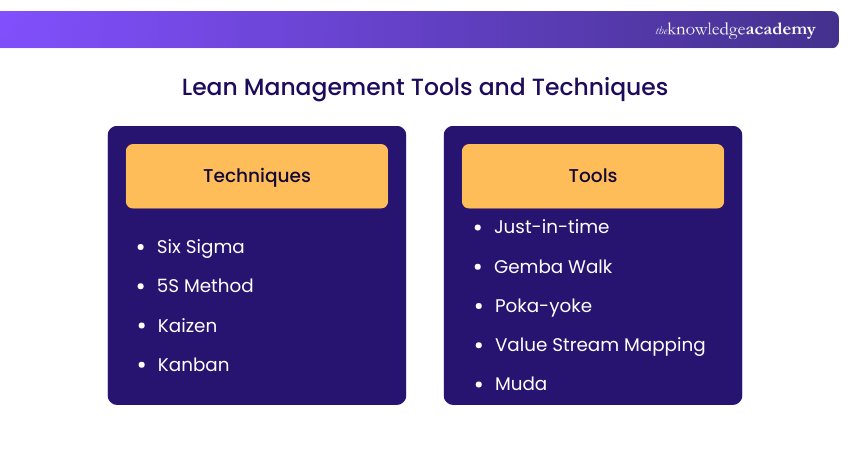
1) Six Sigma
Six Sigma is a data-driven method used to improve processes and reduce defects. It uses statistical analysis to identify problems and improve performance. When combined with Lean practices, it focuses on reducing waste and process variation. This approach helps organisations achieve consistent quality and make data-based decisions.
2) 5S Method
The 5S method is useful for organising the workplace to improve efficiency and safety. It includes five steps: Sort, Straighten, Scrub, Standardise, and Sustain. These steps help create a clean and organised environment that supports better productivity. Also, a well-organised workspace reduces errors and helps teams work more efficiently.
3) Kaizen
Kaizen means continuous improvement. It encourages everyone in the organisation to suggest small improvements regularly. With time, these small changes lead to significant improvements in efficiency and quality. This builds a culture where employees actively participate in improving processes.
4) Kanban
Kanban is a visual workflow management system that uses boards or cards to track workflow processes. It helps teams control work in progress, avoid overproduction, and ensure tasks move smoothly through different stages. By visualising tasks clearly, teams can quickly identify delays and improve workflow efficiency.
5) Lean Management Tools
a) Just-in-time (JIT): Produces and delivers items only when they are needed, reducing excess inventory.
b) Gemba Walk: Managers visit the workplace to observe processes and identify improvement opportunities.
c) Poka-yoke: An error prevention method that helps avoid mistakes during production.
d) Value Stream Mapping (VSM): Visualises the flow of materials and information to identify waste in processes.
e) Muda: A Japanese term for waste. It refers to activities that do not add value to the customer. Lean identifies seven common types of waste that organisations look to eliminate.
Learn to visualise workflows and eliminate process waste with Value Stream Mapping Training now!
Benefits of Lean Management
Lean Management helps organisations improve efficiency, reduce waste, and deliver greater value to customers. By focusing on better processes and continuous improvement, it enables teams to work smarter and achieve stronger results. Let’s look at some key benefits organisations gain by adopting this method:
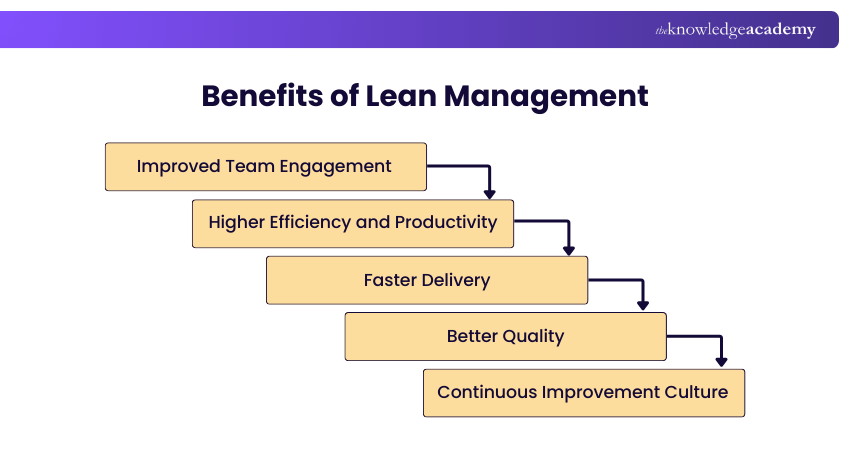
1) Improved Team Engagement
Lean Management encourages employees to take ownership of solving problems in their work processes. This involvement increases motivation, improves morale, and helps teams focus on activities that truly add business value. When employees actively participate in improvements, teams become more collaborative and accountable.
2) Higher Efficiency and Productivity
By eliminating waste and simplifying workflows, Lean Management helps organisations produce more with the same or fewer resources. This improves productivity without increasing workload or pressure on teams. Also, with clear processes, delays are reduced and teams can complete tasks more smoothly.
3) Faster Delivery
Lean Management practices, such as pull systems, keep work aligned with actual demand. This helps organisations deliver products and services faster while maintaining smooth and balanced workflows. Also, faster delivery helps businesses respond quickly to changing or evolving customer needs.
4) Better Quality
Lean Management highlights defects and inefficiencies early in the process. Fixing issues proactively reduces rework, improves product quality, and prevents problems from spreading through later stages. This results in more reliable products and greater customer satisfaction.
5) Continuous Improvement Culture
Lean Management promotes regular reflection and small improvements in everyday work. These changes create a culture where teams consistently look for better ways to improve processes and performance. This culture encourages learning, innovation, and supports long-term organisational growth.
Become an expert of Lean Management with our Certified Lean Practitioner Course - Register now!
What are the Challenges to Lean Implementation?
While Lean Management offers many benefits, organisations can face several challenges when implementing it. Let’s look at them below:
1) Lack of Mindset Change: Without adopting a mindset focused on improvement and waste reduction, Lean practices may not deliver meaningful results.
2) Treating Lean as a One-time Project: Some organisations see Lean as a short-term initiative, but it requires continuous effort and regular improvement.
3) Overemphasis on Efficiency: Focusing only on efficiency can make teams overlook the real purpose of the work and the value delivered to customers.
4) Limited Team Involvement: Lean works best when employees participate in identifying problems and improving processes. Without team engagement, it leads to poor implementation.
5) Too Much Focus on Metrics: While performance metrics are useful, Lean also emphasises learning from processes and improving them over time.
Types of Organisations Benefit from Lean
Lean Management is used across many industries. Organisations apply Lean principles to reduce waste, improve efficiency, and deliver greater value to customers. Let's look at some sectors below:
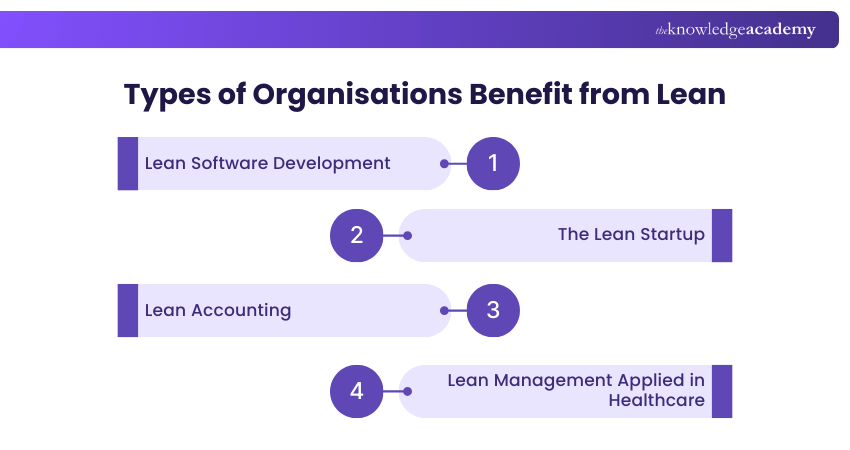
1) Lean Software Development
In 2003, Mary and Tom Poppendieck launched their book "Lean Software Development: An Agile Toolkit," which delves into implementing Lean principles in software development. With the introduction of Lean Tools, Lean Software Development was initially slow to catch on but has since become widely adopted in the industry based on seven fundamental principles.
2) The Lean Startup
Engineer and entrepreneur Eric Ries created a methodology using Lean principles to help startups succeed. In his 2011 book, "The Lean Startup," he presents five basic principles aimed at enhancing startups' adaptability and responsiveness. While not a central element, this method can be supported by Lean Kanban practices, which help reduce product development timelines and rapidly confirm business ideas—benefiting startups, government entities, marketing experts, and others.
3) Lean Accounting
Lean Accounting utilises Lean Management concepts such as prioritising customer value and minimising waste in financial operations. This method assists organisations in making their operations more efficient, aligning them with strategic objectives, and ensuring financial data is easily accessible and helpful for various teams and departments.
4) Lean Management Applied in Healthcare
Healthcare industries are increasingly adopting Lean Management principles to improve their services, boost worker satisfaction, and make services cost-effective. This approach also helps streamline processes, enhance patient care and reduce wait times.
Create organised workplaces and improve efficiency with 5S Training today!
What are the 7 Wastes of Lean?
The 7 Wastes of Lean, commonly remembered using the acronym TIMWOOD, represent activities that consume time, effort, or resources without adding customer value. Originating from the Toyota Production System, these wastes help organisations identify inefficiencies and drive continuous improvement (Kaizen) across industries such as manufacturing, healthcare, and software.
Here’s a clear breakdown of each waste:
a) Transportation: Unnecessary movement of materials or products between processes, increasing delays and handling costs.
b) Inventory: Excess raw materials, work-in-progress, or finished goods that tie up capital and storage space.
c) Motion: Unnecessary physical movements by people, such as walking or reaching, that reduce efficiency.
d) Waiting: Idle time when employees or machines wait for inputs, information, or approvals.
e) Overproduction: Producing more than required or too early, leading to surplus inventory.
f) Over-processing: Doing more work than the customer needs, such as extra features or redundant checks.
g) Defects: Errors or flaws that cause rework, waste materials, or reduce customer satisfaction.
Identifying and reducing these wastes helps streamline operations, improve quality, and enhance overall performance.
What Software Supports Lean Management?
Various software support Lean Management, but the choice depends on team size, complexity of work, and organisational needs. Let’s look at some below:
a) Businessmap: Businessmap helps teams visualise workflows, control work progress, and improve collaboration to support strategic alignment of daily tasks with broader organisational goals.
b) ClickUp and Trello: ClickUp and Trello are simple task management tools that help teams organise tasks, track progress, and manage workflows effectively. They are widely used by smaller teams and projects.
c) KaiNexus: KaiNexus is designed for continuous improvement initiatives. It helps organisations track improvement ideas, measure results, and support Lean culture.
d) LeanKit: LeanKit is an enterprise-level Kanban tool. It helps organisations visualise work, optimise processes, and manage complex workflows.
Conclusion
Lean Management gives organisations a practical way to improve efficiency, reduce waste, and deliver greater value to customers. Focusing on clear processes, continuous improvement, and team involvement, businesses can build smarter and more productive workflows. This helps organisations adapt to change, improve performance, and create long-term operational success.
Kickstart your Lean Management journey with our Certified Lean Foundation Course - Join today!
Frequently Asked Questions
What are the 5 C's of Lean?

The 5 C’s of Lean are Clear out, Configure, Clean and check, Conformity, and Custom and practice. Together, they help organisations organise workplaces, standardise processes, maintain discipline, and continuously improve efficiency, quality, and overall operational performance.
Can Lean Management be Applied in Small Businesses?
Yes, small businesses can use Lean Management to save time and resources while improving customer service. Simple changes, like organising workspace better or reducing unnecessary steps, can make a big difference in efficiency.
What are the Other Resources and Offers Provided by The Knowledge Academy?
The Knowledge Academy takes global learning to new heights, offering over 3,000+ online courses across 490+ locations in 190+ countries. This expansive reach ensures accessibility and convenience for learners worldwide.
Alongside our diverse Online Course Catalogue, encompassing 17 major categories, we go the extra mile by providing a plethora of free educational Online Resources like Blogs, eBooks, Interview Questions and Videos. Tailoring learning experiences further, professionals can unlock greater value through a wide range of special discounts, seasonal deals, and Exclusive Offers.
What is The Knowledge Pass, and How Does it Work?
The Knowledge Academy’s Knowledge Pass, a prepaid voucher, adds another layer of flexibility, allowing course bookings over a 12-month period. Join us on a journey where education knows no bounds.
What are the Related Courses and Blogs Provided by The Knowledge Academy?
The Knowledge Academy offers various Lean Training, including the Introduction to Lean Course, Certified Lean Foundation Course, and Certified Lean Practitioner Course. These courses cater to different skill levels and provide comprehensive insights into Lean Principles.
Our Business Improvement Blogs cover a range of topics related to Business Improvement, offering valuable resources, best practices, and industry insights. Whether you are a beginner or looking to advance your Lean Management skills. The Knowledge Academy's diverse courses and informative blogs have got you covered.

The Knowledge Academy


Global Training Provider
The Knowledge Academy is a world-leading provider of professional training courses, offering globally recognised qualifications across a wide range of subjects. With expert trainers, up-to-date course material, and flexible learning options, we aim to empower professionals and organisations to achieve their goals through continuous learning.

Upcoming Business Improvement Resources Batches & Dates
Date
 Introduction to Lean
Introduction to Lean
Fri 28th Aug 2026
Introduction to Lean
Fri 11th Dec 2026

 If you wish to make any changes to your course, please


