


 Top Rated Course

We may not have the course you’re looking for. If you enquire or give us a call on +33 805638382 and speak to our training experts, we may still be able to help with your training requirements.
Product Management Metrics: Essential KPIs for Success
The Knowledge Academy 17 April 2026Product management metrics track product success using data like MRR, DAU/MAU, churn rate, and NPS, helping teams make better decisions and improve performance. These insights help teams understand user behaviour, identify risks early, and prioritise features effectively. Strong metrics support sustainable growth and continuous improvement.

Training Outcomes Within Your Budget!
We ensure quality, budget-alignment, and timely delivery by our expert instructors.
Table of Contents

Clear measurement, not assumptions, is the foundation of successful products. Knowing what to measure ensures that teams remain engaged and united in terms of the desired results. The blog introduces the Product Management Metrics that make up the basis for clever decision-making and then proceeds to the essential KPIs that every manager must be aware of.
Table of Contents
1) What are Product Management Metrics?
2) Why Should you Track Product Management Metrics?
3) Top 16 Product Management Metrics and KPIs
a) Customer Acquisition Cost (CAC)
b) Customer Lifetime Value (CLV)
c) Monthly Recurring Revenue (MRR) and Annual Recurring Revenue (ARR)
d) Average Revenue Per User (ARPU):
e) Daily Active Users (DAU)
f) Feature adoption rate
g) Session Duration
h) Customer satisfaction score (CSAT)
i) Churn rate
j) Conversion rate
4) How to Choose the Right Product Metrics
5) What Common Mistakes Should Teams avoid when tracking metrics?
Conclusion
What is Product Management Metrics?
Product Management Metrics refer to the Key Performance Indicators (KPIs) and measurable data points used to assess and examine the success of a product or a product portfolio. This allows product managers to gather essential information about overall product performance.
Covering various stages of the product lifecycle from development and launch to ongoing usage and customer satisfaction—these insights assist Product Managers in making data-driven decisions, prioritising tasks, and, along with understanding how to become a product manager, identifying areas for improvement to enhance product performance.

Why Should you Track Product Management Metrics?
Tracking Product Management Metrics is essential for steering products towards success and ensuring they meet market demands and customer needs. Here is why they are important.
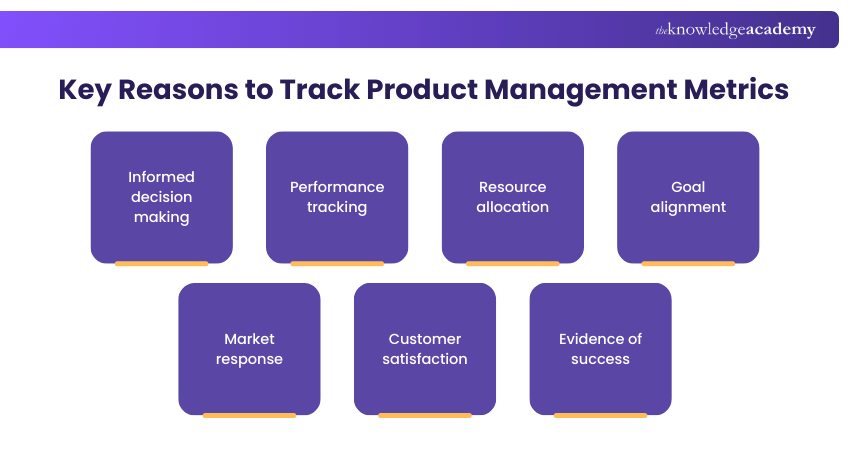
a) Informed decision making: Metrics provide tangible data that can guide decision-making processes. Instead of depending on gut feelings or assumptions, metrics offer concrete evidence that can help in making more strategic choices.
b) Performance tracking: By measuring various aspects of a product’s performance, such as user engagement or feature adoption, teams can identify what’s working well and what needs improvement. This ongoing evaluation helps maintain a product’s health and competitiveness.
c) Resource allocation: Metrics help determine where to allocate resources most effectively. Understanding which areas of a product are generating the most value can lead to more efficient use of time, money, and manpower.
d) Goal alignment: They ensure that everyone in the team—from development to marketing—is aligned with the overall product goals. Metrics acts as a common language that can help keep all team members on the same page.
e) Market response: They provide insights into how the market reacts to a product. This can be crucial for adapting to changes in market conditions and consumer preferences, thus avoiding costly missteps.
f) Customer satisfaction: Regular monitoring of satisfaction metrics can alert teams to potential issues before they escalate, allowing for proactive management and better customer retention.
g) Evidence of success: Finally, metrics can showcase the success of a product to stakeholders. Quantifiable achievements can bolster confidence among investors and within the team, encouraging continued support and investment.
Top 16 Product Management Metrics and KPIs
Top Product Management Metrics are as follows:
1) Customer Acquisition Cost (CAC)
Customer Acquisition Cost (CAC) is an indicator of the efficiency of marketing and sales in the process of acquiring customers. Monitoring CAC simultaneously with Customer Lifetime Value can assist in optimising expenditure, increasing ROI, and enabling the sustainable growth of the product.
2) Customer Lifetime Value (CLV)
Customer Lifetime Value (CLV) indicates the total profits that a customer is likely to bring to a company during their relationship. Monitoring CLV assists product leaders in spotting the most valuable customers, directing personalised interactions, and measuring ROI through the comparison of CLV and acquisition expenses.
3) Monthly Recurring Revenue (MRR) and Annual Recurring Revenue (ARR)
The Monthly Recurring Revenue (MRR) and Annual Recurring Revenue (ARR) are indicators of the predictable income from subscriptions. MRR is an indicator of the financial health of the company in the short term, while ARR is an indicator in the longer term and is used to support forecasting of growth and planning of stability.
4) Average Revenue Per User (ARPU)
Average Revenue Per User (ARPU) indicates the average revenue produced per user or account and is also applicable to customer types or product lines as segments. This metric enables the teams to gauge how monetarily effective their acquisition and retention methods are and to evaluate the revenue impact of their pricing and engagement initiatives.
Take the leap towards a successful supply chain career. Join our Supply Chain Management Course today!
5) Daily Active Users (DAU)
The Daily Active Users (DAU) value is an indicator of the daily interaction of a user with a product, and a high DAU confirms a product's success, showing that the product has a strong value, is relevant, and its usage is consistent. Monitoring DAU trends allows product managers to spot engagement declines precociously and apply corrective measures.
6) Feature Adoption Rate
The feature adoption rate is a way to measure how effectively users take up new product features. It provides product managers with a tool for evaluating the worth, giving priority to the areas for improvement, distributing the resources, and making the user engagement and retention stronger.
7) Session Duration
Session Duration is the metric that reflects the average time every single user of the product spends during each visit. Usually, longer sessions show that users are more engaged and interested in the overall experience. This metric is utilised by product teams to evaluate how attractive and addictive the product is to users.
8) Customer Satisfaction Score (CSAT)
Customer Satisfaction Score (CSAT) measures users' happiness with particular processes or features. CSAT is different from broader loyalty metrics in that it measures the immediate satisfaction of a user with a specific interaction. The data for CSAT is usually collected through short surveys that follow important actions taken by the users.
9) Churn Rate
Churn rate is the metric that indicates the portion of customers who cease using a product within a time frame. A significant churn rate denotes problems associated with the product's worth or user's enjoyment, while lowering churn leads to better retention, consistent revenue, and ultimately happier customers over time.
10) Conversion Rate
The conversion rate represents the percentage of visitors who take a specific action, e.g. subscribing or buying a product. A high conversion rate indicates that users, product, and marketing are in sync, while low rates point to the need for enhancing the user experience and conversion processes.
11) Bounce Rate
The bounce rate indicates the fraction of people who quit after an initial interaction. An elevated bounce rate pinpoints user unfriendliness or lack of interest, whereas a lower one signals greater user curiosity and easier browsing.
12) Net Promoter Score (NPS)
Net Promoter Score (NPS) is a customer loyalty measurement instrument that queries customers on the likelihood of recommending a specific product. A high NPS indicates a high level of satisfaction and support, while a low score points to the areas of customer discontent.
13) Monthly Active Users (MAU)
The Monthly Active Users (MAU) metric is a way to measure the number of different users that interact with a product on a monthly basis. An increase in MAU signifies good retention and high interest, while a drop in MAU points to possible product concerns. Besides, MAU is helpful for evaluating marketing and user growth strategies.
14) User Retention Rate
The user retention rate indicates the portion of users who keep on using a product during a given period of time. A high retention rate means that the users see the product as very valuable, they are satisfied with it, and they are loyal to it, whereas a low retention rate points out the user experience (UX) or feature shortcomings. Monitoring this key performance indicator (KPI) encourages long-term growth and increased Customer Lifetime Value (CLV).
15) Time-to-market
The time to market indicates the period between the conception of a product and its availability for sale. Businesses are able to react to demand, remain in competition, and satisfy customers with shorter timelines. By monitoring this metric, it is possible to identify the process inefficiencies and support the delivery of products that are faster and more profitable.
Learn essential logistics principles and strategies with our Logistics Management Training – Join today!
16) Escalation Rate
The escalation rate records the proportion of customer problems that are forwarded to superior levels of support or management. A high escalation rate can be a sign of complicated products, still existing bugs, or a lack of efficiency at the frontline support level. The teams observe this metric to discover hidden product or service issues and to make the support resolution process better.
How to Choose the Right Product Metrics?
The process of selecting appropriate Product Management Metrics begins with establishing prominent business and product objectives. Concentrate on indicators that show actual users' actions and results instead of mere numbers on the surface. Assess and improve metrics frequently to keep them aligned with the product's changes over time.
What Common Mistakes Should Teams Avoid When Tracking Metrics?
Here are common mistakes teams should avoid when tracking Product Management Metrics, based on insights from Calibre’s analysis of performance tracking pitfalls:
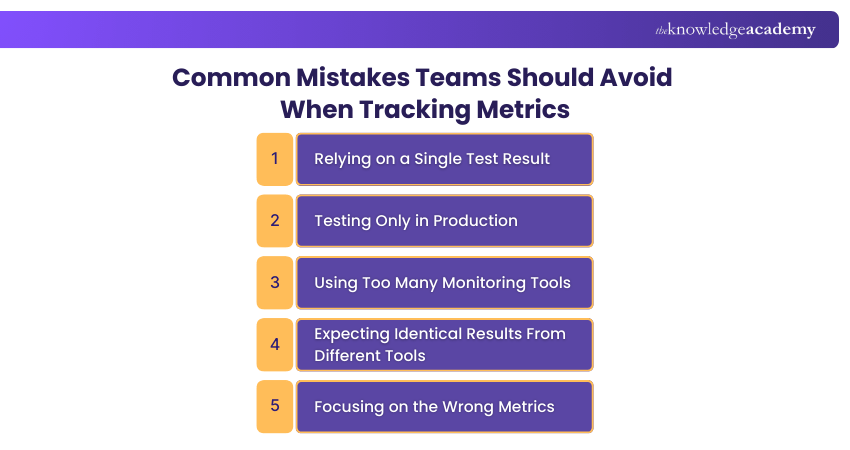
a) Relying on a Single Test Result: Trends and short-lived changes might be the main cause of false tipping and waste of effort, instead of switching over to real changes over time when reacting to one data point without trend context.
b) Testing Only in Production: By the time a change becomes visible to users, the testing process already has issues that can result in a negative experience before the problem is discovered.
c) Using Too Many Monitoring Tools: Having different tools showing various numbers causes confusion, and unless there is a very clear and single source of truth, trust in the data is already undermined.
d) Expecting Identical Results From Different Tools: Different tools can take different approaches and use different setups; hence, expecting results to correlate can lead to frustration and misunderstanding.
e) Focusing on the Wrong Metrics: Measuring every possible metric or using old ones distracts from the really important indicators, which can be a true reflection of the performance and the goals.
Conclusion
The appropriate metrics convert the usual data into significant guidance. Product Management Metrics enable teams to measure their achievements, find new areas for progress, and keep in touch with what users want. If these metrics are monitored uniformly, they will support intelligent decision-making process, and a product that enjoys success in the long run.
Understand current trends and technologies with our Industry Training – Join today!
Frequently Asked Questions
What Does Cohort Analysis Mean in Product Management?

Cohort analysis is the process of categorising users based on their common traits or actions and monitoring their activities over an extended period of time. It helps product managers analyse retention, engagement, and conversions across user groups to make better product and experience decisions.
How do PMs Track Product Adoption Rates?
Product managers keep an eye on adoption through calculation of percentage of users who are utilizing the key features actively. Observing activation, usage frequency, and time to value assists in recognizing adoption of trends and friction points.
What are the Other Resources and Offers Provided by The Knowledge Academy?
The Knowledge Academy takes global learning to new heights, offering over 3,000+ online courses across 490+ locations in 190+ countries. This expansive reach ensures accessibility and convenience for learners worldwide.
Alongside our diverse Online Course Catalogue, encompassing 17 major categories, we go the extra mile by providing a plethora of free educational Online Resources like Blogs, eBooks, Interview Questions and Videos. Tailoring learning experiences further, professionals can unlock greater value through a wide range of special discounts, seasonal deals, and Exclusive Offers.
What is The Knowledge Pass, and How Does it Work?
The Knowledge Academy’s Knowledge Pass, a prepaid voucher, adds another layer of flexibility, allowing course bookings over a 12-month period. Join us on a journey where education knows no bounds.
What are the Related Courses and Blogs Provided by The Knowledge Academy?
The Knowledge Academy offers various Industry Courses, including the Facilitation Skills Training, Basic Barista Course, and Reliability Engineering Training. These courses cater to different skill levels, providing comprehensive insights into Product Management Tools.
Our Business Skills Blogs cover a range of topics related to Product Management Metrics, offering valuable resources, best practices, and industry insights. Whether you are a beginner or looking to advance your Business skills, The Knowledge Academy's diverse courses and informative blogs have got you covered.

The Knowledge Academy


Global Training Provider
The Knowledge Academy is a world-leading provider of professional training courses, offering globally recognised qualifications across a wide range of subjects. With expert trainers, up-to-date course material, and flexible learning options, we aim to empower professionals and organisations to achieve their goals through continuous learning.

Upcoming Business Skills Resources Batches & Dates
Date
 Facilitation Skills Training
Facilitation Skills Training
Fri 24th Jul 2026
Facilitation Skills Training
Fri 25th Sep 2026
Facilitation Skills Training
Fri 20th Nov 2026

 If you wish to make any changes to your course, please


