


 Top Rated Course


We may not have the course you’re looking for. If you enquire or give us a call on 0800 446148 and speak to our training experts, we may still be able to help with your training requirements.
Nominal Vs Ordinal Data: Key Differences and Similarities
The Knowledge Academy 11 February 2026Are you curious about differentiating between Nominal and Ordinal Data? Nominal Data organises information without a specific order, whereas Ordinal Data arranges items meaningfully. This blog examines Nominal vs Ordinal Data, applications, instances of these two data forms and their importance in Statistical and Data Analysis.

Training Outcomes Within Your Budget!
We ensure quality, budget-alignment, and timely delivery by our expert instructors.
Table of Contents
Have you ever questioned how data is classified and analysed in Statistics? Understanding the distinction between Nominal Data vs Ordinal Data is crucial for Data Analysis. Nominal Data organises information without sequence, like gender, colour, or animal categories. It revolves around categories. Ordinal Data presents a hierarchy or sequence, such as education levels, satisfaction ratings, or competition rankings.
Each form of data has a distinct role in structuring and evaluating information. Grasping the difference between Nominal vs Ordinal Data can greatly improve your analytical abilities. Thus, helping you interpret datasets accurately and make informed decisions. Ready to enhance your Data Analysis skills? Let’s begin!
Table of Contents
1) What is Nominal Data?
2) What is Ordinal Data?
3) Key Differences Between Nominal and Ordinal Data
4) Similarities Between Nominal and Ordinal Data
5) Conclusion
What is Nominal Data?
Nominal Data, also known as categorical data, plays a crucial role in research, statistics, and Data Analysis. It consists of groupings or tags that categorise and sort information. Categorical data is characterised by the absence of a predefined order or hierarchy among its categories. These categories are separate and do not overlap.
Nominal Data organises data into distinct labels or categories with no inherent ranking. These labels are shown through names or terms without any hierarchy. Nominal Data is valuable for qualitative categorisation, enabling researchers to categorise data points by specific characteristics without suggesting any numerical connections.
"Blue" or "green" eye colour falls under the category of Nominal Data, as an illustration.
Every category is unique, without any specific arrangement or hierarchy. Brands of smartphones such as "iPhone" and "Samsung" are considered Nominal Data. There is no ranking system among brands. Modes of transportation such as "car" or "bicycle" are considered Nominal Data. They are distinct classifications with no intrinsic ranking.

Characteristics of Nominal Data
Nominal Data comprises different, descriptive categories that can’t be ordered or ranked hierarchically. Let’s explore some of the characteristics of Nominal Data here:

1) Different Groups
Nominal Data is made up of unique and unrelated groups. Every category is distinct and does not intersect with any other. This distinct separation enables easy categorisation and organisation of data points according to certain attributes or characteristics.
2) Labels That Give Detailed Descriptions
Descriptive labels, not numeric or quantitative values, are used to identify Nominal Data. These tags assign significant titles to groupings, which helps simplify the comprehension and analysis of the information. Instances include titles, tags, or phrases that characterise the group, like "green" for eye tint or "Samsung" for phone manufacturer.
3) Absence of a Hierarchical Structure
Nominal Data cannot be organised in a ranking or hierarchical order. No category is inherently better or worse than another, as no defined order or hierarchy exists among them. This feature sets Nominal Data apart from Ordinal Data, which does possess a logical order.
4) Categorical Sorting
Nominal Data is utilised to categorise qualitative data, allowing for the organization of data based on attributes that are not numerical. This data is important for categorising data points based on specific traits without suggesting numerical connections, which is crucial for qualitative research and analysis.
Unlock your potential in Data Analysis with our comprehensive Statistics Course- Join today!
Examples of Nominal Data
Below are some examples of how Nominal Data is applied to group and organise data into separate and unordered categories:
a) Eye Colours: Eye colours such as "blue," "green," and "brown" are categorised as Nominal Data. Every colour is a separate group without any natural sequence or hierarchy.
b) Types of Pets: Types such as "dog," "cat," and "bird" are examples of Nominal Data. Every kind of pet belongs to its distinct group with no ranking.
c) Beverage Brands: Labels of drinks like "Coca-Cola," "Pepsi," and "Sprite" are considered Nominal Data. These groups are distinct and do not have any numerical or sequential connection.
d) Countries: Countries such as "France," "Japan," and "Brazil" are examples of Nominal Data. Every country is unique, and no ranking is assigned to them.
e) Marital Status: Labels such as "single," "married," "divorced," and "widowed" are considered Nominal Data. They categorise people without suggesting any ranking or sequence.
What is Ordinal Data?
Ordinal Data is a form of qualitative data that sorts variables into descriptive categories in a meaningful sequence. These categories are arranged in a hierarchy, ranging from top to bottom. Ordinal Data is more intricate than Nominal Data because it has a built-in order but is still straightforward.
Ordinal Data allows for the comparison and ranking of accomplishments, positions, or performance despite varying intervals between them. This data type is beneficial for comprehending ranked selections or preferences and evaluating relative variances.
Characteristics of Ordinal Data
Ordinal Data is characterised by its ability to rank categories in a meaningful order while maintaining qualitative distinctions.
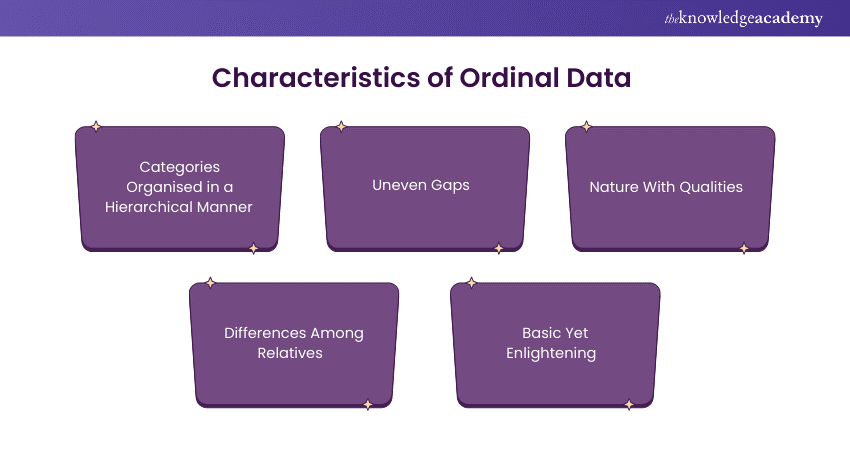
1) Categories Organised in a Hierarchical Manner
Ordinal Data consists of categories with a distinct and meaningful sequence or ranking. Categories can be compared to one another, for instance, in terms of satisfaction levels or levels of education achieved. This arrangement assists in comparing and grasping relative positions in the dataset.
2) Uneven Gaps
Although ordinal data order categories, the gaps between them may not be uniform, and the distinction between a 'good' and 'excellent' rating may not be as similar as between 'poor' and 'average.' This feature sets Ordinal Data apart from interval or ratio data.
3) Nature With Qualities
Although it has a ranking system, Ordinal Data remains qualitative. It explains qualities and features that are not numerical. This is beneficial for recording preferences, rankings, and ordered choices without needing exact numerical values.
4) Differences Among Relatives
Ordinal Data is perfect for evaluating the comparative distinctions among categories. It permits comparisons like superior, inferior, increased, or decreased. This is especially beneficial in sectors such as education, market research, and performance assessment, where grasping the hierarchy of categories holds more significance than quantifying precise disparities.
5) Basic yet Enlightening
Ordinal Data finds a middle ground between being straightforward and informative. Although it contains more information than Nominal Data because of its natural sequence, it is still simpler when compared to interval and ratio data. This feature allows it to be a flexible instrument for different analytical situations.
Examples of Ordinal Data
Below are some instances showcasing the application of Ordinal Data across different fields and sectors:
a) Levels of Education: Ordinal Data is frequently utilised to portray educational attainment levels, including "high school," "bachelor's degree," "master's degree," and "Ph.D." These levels have a specific sequence.
b) Customer Satisfaction Ratings: In surveys on customer satisfaction, people typically rate their experience on a scale ranging from "poor" to "excellent." These ratings represent data in a specific order with a well-defined ranking.
c) Economic Classes: Social classes based on ranking, such as "lower class," "middle class," and "upper class", are categorised as Ordinal Data. Every class holds a unique rank in the hierarchy.
d) Employee Performance Ratings: Ratings such as "needs improvement," "satisfactory," "good," and "excellent" are considered Ordinal Data. These ratings establish a ranking of performance levels.
e) Levels of Pain Intensity: Within healthcare, pain levels are commonly assessed using a range from "no pain" to "severe pain." These levels have a specific sequence but varying intervals, classifying them as Ordinal Data.
These instances show how Ordinal Data is used in different fields and areas to classify information into specific, organised categories.
Jumpstart your career in data with our Introduction to Business Analytics Training - Sign up now!
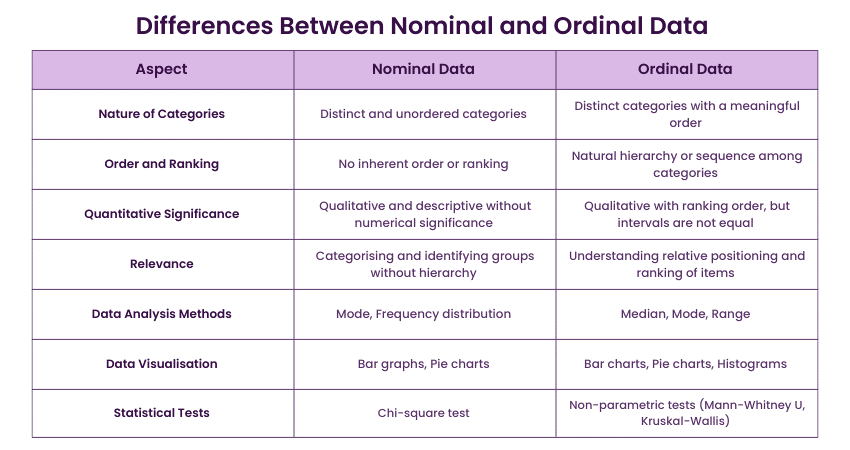
Key Differences Between Nominal and Ordinal Data
Understanding the main distinctions between nominal and Ordinal Data is crucial for individuals involved in Data Analysis, research, or statistics. Both kinds of data are vital for structuring and understanding information, although they have distinct functions and necessitate distinct methodologies. Let's explore their meanings, traits, uses, and distinctions thoroughly.
Similarities Between Nominal and Ordinal Data
Nominal and Ordinal Data are crucial types of qualitative data used in statistics, research, and analysis. They have multiple similarities, which are helpful in categorising and analysing non-numeric data. Comprehending these likenesses aids researchers and analysts in efficiently utilising both forms of data in their tasks.
1) Qualitative Nature
Nominal and Ordinal Data are qualitative data types that describe attributes that cannot be measured using numerical values. They record qualitative data like groups, descriptors, and orders. Categorical data categorises various animals, whereas Ordinal Data orders levels of satisfaction. Both offer an understanding of characteristics and choices.
2) Utilise for Classification
Both nominal and Ordinal Data classify information into separate categories. This aids in structuring data, simplifying the process of analysing and interpreting it. Each data point is only assigned to a single category, as categories do not overlap. This distinct classification enables easy comparison and assessment of diverse groups.
3) Data Collection Methods
Nominal or ordinal data is gathered using comparable techniques, including surveys, questionnaires, interviews, and observations. Surveys could inquire about favourite pet choices (nominal) or satisfaction levels (ordinal). Both data categories require individuals to provide details on what they like, their qualities, or their past encounters.
4) Visual Representation
Nominal and Ordinal Data are displayed through comparable charts and graphs. Both categories frequently utilise bar graphs and pie charts to display the distribution of categories. These visuals differentiate categories without suggesting an order for Nominal Data, whereas Ordinal Data charts showcase a hierarchical structure.
5) Statistical Analysis
Non-parametric methods can be used to analyse both nominal and Ordinal Data. Non-parametric tests are appropriate for qualitative data because they do not make assumptions about data distribution. The chi-square test is utilised for Nominal Data, whereas the Mann-Whitney U and Kruskal-Wallis tests examine Ordinal Data ranks.
6) Flexibility in Application
Nominal and Ordinal Data provide versatility in different fields and domains. They are used to capture and evaluate qualitative data in fields such as social sciences, marketing, healthcare, and education. For instance, in marketing, Nominal Data is used to classify preferences, while Ordinal Data is used to determine satisfaction levels.
7) Ease of Understanding
Nominal and Ordinal Data are simple to comprehend and interpret, making them understandable for many people. Descriptive labels and categories assist researchers, analysts, and stakeholders in quickly understanding the meaning of data, enabling better communication and collaboration and improving the effectiveness of Data Analysis overall.
8) Support for Descriptive Statistics
Descriptive statistics can be used to outline and describe dataset features for both nominal and Ordinal Data. Nominal Data relies on frequency counts and mode, whereas Ordinal Data relies on median and range to emphasise central tendency and variability. Descriptive statistics aid researchers in recognising essential patterns and trends.
9) Complementary Use in Research
Both nominal and Ordinal Data can be combined in research to gain a thorough understanding of a topic. For instance, research on customer likes could use Nominal Data for types of products and Ordinal Data for levels of satisfaction. The melding of both data types enriches and deepens qualitative research.
Conclusion
Categorising and examining qualitative information is essential for nominal and ordinal data. Nominal Data categorises specific, unordered groups, whereas Ordinal Data organises categories in a meaningful sequence. Both categories facilitate qualitative analysis and visualisation, assisting various research disciplines. Enhancing data interpretation and decision-making comes from understanding Nominal vs Ordinal Data and where they are applied. By utilising both effectively, researchers can gain a thorough understanding and make educated decisions.
Learn and master the BA skills with our Business Analyst Fundamentals Training – Register now!
Frequently Asked Questions
How This Nominal and Ordinal Data Collected?

They are gathered via questionnaires, observations, surveys, and interviews. Nominal Data involves picking various categories, whereas Ordinal Data involves rating items and ranking.
Why is This Nominal and Ordinal Data Used?
They are used to categorise and analyse non-numeric data. Nominal Data sets out distinct categories, whereas Ordinal Data ranks categories. Thus, aiding in analysis in various fields.
What are the Other Resources and Offers Provided by The Knowledge Academy?
The Knowledge Academy takes global learning to new heights, offering over 3,000+ online courses across 490+ locations in 190+ countries. This expansive reach ensures accessibility and convenience for learners worldwide.
Alongside our diverse Online Course Catalogue, encompassing 19 major categories, we go the extra mile by providing a plethora of free educational Online Resources like Blogs, eBooks, Interview Questions and Videos. Tailoring learning experiences further, professionals can unlock greater value through a wide range of special discounts, seasonal deals, and Exclusive Offers.
What is The Knowledge Pass, and How Does it Work?
The Knowledge Academy’s Knowledge Pass, a prepaid voucher, adds another layer of flexibility, allowing course bookings over a 12-month period. Join us on a journey where education knows no bounds.
What are the Related Courses and Blogs Provided by The Knowledge Academy?
The Knowledge Academy offers various Business Analyst Course, including the Statistics Course, Business Analyst Fundamentals Training, and Introduction To Business Analytics Training. These courses cater to different skill levels and provide comprehensive insights into What is Data Collection.
Our Business Analysis Blogs cover a range of topics related to Business Analysis, offering valuable resources, best practices, and industry insights. Whether you are a beginner or looking to advance your Business Analysis Skills. The Knowledge Academy's diverse courses and informative blogs have got you covered.

The Knowledge Academy


Global Training Provider
The Knowledge Academy is a world-leading provider of professional training courses, offering globally recognised qualifications across a wide range of subjects. With expert trainers, up-to-date course material, and flexible learning options, we aim to empower professionals and organisations to achieve their goals through continuous learning.


 If you wish to make any changes to your course, please


