


 Top Rated Course

We may not have the course you’re looking for. If you enquire or give us a call on 0800 446148 and speak to our training experts, we may still be able to help with your training requirements.
Delegation Skills: A Complete Guide for Leaders
Benjamin Walker 09 March 2026Delegation Skills help leaders assign tasks effectively, boost productivity, build trust, develop team and focus on high-value work through clear communication. By aligning tasks with team strengths, they reduce errors and delays. As a result, Delegation strengthens accountability and supports consistent performance.
Training Outcomes Within Your Budget!
We ensure quality, budget-alignment, and timely delivery by our expert instructors.
Table of Contents
Related Courses

Have you ever felt like there are not enough hours in the day to complete everything on your to-do list? Many leaders and professionals face constant pressure to deliver results while managing multiple responsibilities at once. The difference between feeling overwhelmed and leading with confidence often lies in strong Delegation Skills, which help distribute tasks effectively while maintaining quality and accountability.
In this blog, we will explain what Delegation Skills are, explore their types, and share practical ways to improve them at work. We will also highlight their key benefits and how they drive productivity, trust, and long-term team success. Let’s get started!
Table of Contents
1) What are Delegation Skills?
2) Different Types of Delegation Skills
3) How to Improve Delegation Skills?
4) Why is Learning How to Delegate Responsibilities Important?
5) Benefits of Effective Delegation
6) What is a Good Example of Delegation?
7) What are the Three Pillars of Delegation?
8) Conclusion
What are Delegation Skills?
Delegation Skills involve assigning tasks to the right team members, clearly communicating expectations, and offering necessary support. Key skills include identifying tasks suitable for Delegation, choosing the right person based on their strengths, and trusting them to complete the work.
Effective Delegation also involves monitoring progress, offering feedback, and recognising team members' efforts. These skills help create a more efficient and motivated team, leading to better organisational outcomes. By mastering Delegation, leaders empower their teams and foster a collaborative work environment, much like Delegated Legislation, which fosters efficient decision-making within set parameters. which is key to Delegating Effectively.
Different Types of Delegation Skills
Here are the key types of Delegation Skills that can help you distribute tasks effectively while ensuring efficiency and accountability. Understanding these will enable you to delegate with clarity and confidence, fostering a more productive team environment.
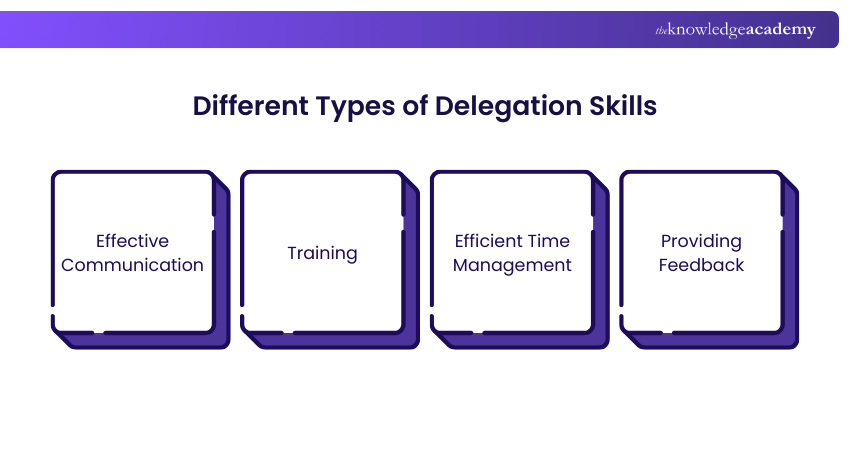
1) Effective Communication
Effective Communication style is of utmost importance in Delegation. Managers need to make sure that they are effectively communicating the task objectives, deadlines, and priorities so that workers understand the expectations and their role in the team. Effective communication needs Active Listening, as team leaders with this skill can solve any problems or questions that team members have at once.
2) Training
The Delegation, more often than not, calls for leaders to ensure that their team members are well-trained and well-equipped with the required skills and expertise. This is executed by training the workers to perform various functions and delegate tasks effectively. Training may be workshops, seminars, on-the-job training, or one-on-one mentorship programs based on the needs of the team's members.
3) Efficient Time Management
To delegate is to manage time so that all important tasks can be assigned priority and executed in the most efficient manner. This is the ability to prioritise the tasks, considering the urgency and importance, and delegating accordingly to the given deadlines without compromising the quality. Ensuring proper Time Management helps leaders focus on their strategic mission by delegating routine tasks to their teammates.
4) Providing Feedback
Top leaders are proud of giving their subordinates proper evaluation of their work. It entails sharing knowledge, congratulating workers, and picking out weak points of synergy. By providing feedback, leaders help their teammates live up to their potential and create a learning environment where improvement never ends.
Enhance your Delegation Skills by registering for Leadership Courses now!
How to Improve Delegation Skills?
Here are the different ways to improve Delegation Skills:
1) Self-evaluate
a) Evaluate your current Delegation Skills to identify areas for improvement.
b) Determine which qualities you excel at, such as communication.
c) Identify areas that need enhancement, like providing constructive feedback.
d) Seek feedback from friends, colleagues, or mentors to gain a comprehensive understanding of your abilities.
2) Engage in Learning and Training
a) Register in online courses and training programs that focus on effective Delegation strategies.
b) These programs often offer flexible learning schedules and practical strategies.
c) Encourage your team to take courses that provide insights into completing delegated tasks.
d) For instance, consider programs like the Authority Delegation Training offered by the federal government.
3) Observe Successful Leaders
a) Observe how effective leaders in your workplace delegate tasks.
b) Improve your skills by watching HR managers conduct onboarding sessions, for example.
c) Find a mentor who excels in Delegation and has a successful career to guide you.
d) Learn their techniques and apply them to your own Delegation practices.
4) Adopt a Delegative Leadership Style
a) Assess your team’s unique talents and assign responsibilities accordingly.
b) Adopting this leadership style helps create a positive work environment.
c) Identify strengths within your team and delegate tasks based on those strengths.
d) Foster collaboration and effective leadership by leveraging your team’s abilities.
Why is Learning How to Delegate Responsibilities Important?
Understanding how to delegate tasks is essential for several reasons:
1) Creates Learning Opportunities: Delegating tasks to team members can help them acquire new skills and gain experience, especially when the activities fall outside their typical responsibilities. This exposure to challenges can build resilience within the team.
2) Relieves Workload: Assigning tasks can help you manage your work more effectively and achieve a healthier work-life balance. This is particularly important when working with strict deadlines.
3) Increases Responsibility: Delegating tasks to teammates can foster a sense of responsibility, improving team morale. This increased responsibility can boost their confidence and sense of ownership.
4) Empowers Team Members: Successfully completing tasks can provide team members with a sense of accomplishment, inspiring them to perform better and increasing overall productivity.
Learn innovative problem-solving techniques that foster creativity and collaboration with our Design Thinking Course – Join now!
Benefits of Effective Delegation
Effective Delegation strengthens leadership and empowers teams. By sharing responsibilities wisely, organisations gain lasting benefits without overload. Key benefits include:
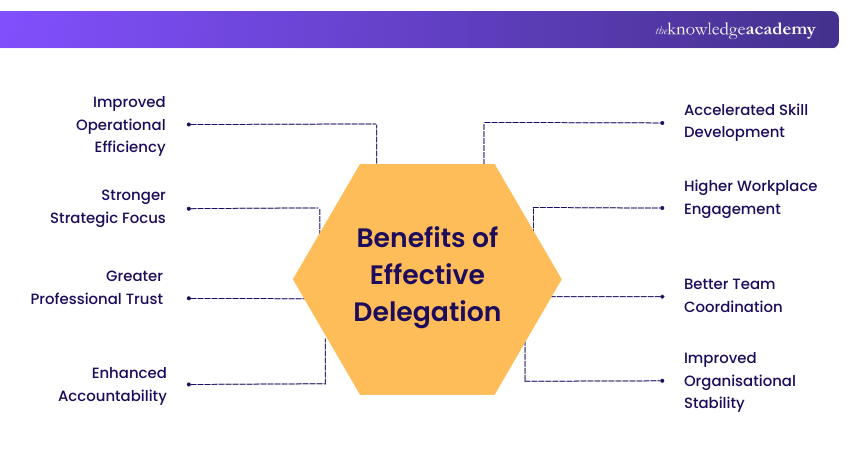
1) Improved Operational Efficiency:
Assigning tasks according to expertise ensures work is completed accurately and on time, increasing overall efficiency.
2) Stronger Strategic Focus:
Delegation allows leaders to concentrate on long-term planning, innovation, and critical decision-making instead of routine execution.
3) Greater Professional Trust:
Sharing responsibilities demonstrates confidence in employees, strengthening mutual respect and workplace relationships.
4) Enhanced Accountability:
Clear ownership of tasks encourages individuals to take responsibility and deliver high-quality outcomes.
5) Accelerated Skill Development:
New challenges help employees gain experience, expand their capabilities, and prepare for future leadership roles.
6) Higher Workplace Engagement:
Meaningful involvement in important tasks increases motivation, enthusiasm, and commitment to organisational goals.
7) Better Team Coordination:
A clear distribution of responsibilities reduces confusion and promotes smoother collaboration and communication.
8) Improved Organisational Stability:
Delegation reduces reliance on a single individual, ensuring continuity during absences or transitions.
9) Healthier Work Balance:
Balanced workloads minimise stress and support sustainable performance for both leaders and team members.
What is a Good Example of Delegation?
A Manager assigns a team member to lead a project meeting, ensuring an organized and productive Project Kickoff Meeting. This empowers the team members, leverages their strengths, and allows the manager to focus on more strategic tasks, fostering overall team efficiency and growth.
What are the Three Pillars of Delegation?
Here are the three pillars of Delegation in points:
a) Trust: Have confidence in your team's abilities to handle tasks
b) Communication: Clearly convey expectations and objectives
c) Support: Provide necessary resources and assistance to ensure task completion
Conclusion
Mastering Delegation Skills enhances productivity, builds trust, and fosters team growth. Understanding its types and applying effective strategies ensures efficiency while empowering others. Embrace Delegation as a leadership tool to drive success and collaboration. Done right, it’s not just task-sharing - it’s unlocking potential and inspiring excellence.
Improve your Leadership presence through our Executive Leadership Presence Training – sign up today!
Frequently Asked Questions
What are the Four Cs of Delegation?

The four Cs of Delegation are:
1) Clarity: Clearly define tasks and expectations.
2) Competence: Ensure the delegate has the necessary skills.
3) Commitment: Gain commitment from the delegate.
4) Control: Maintain control by monitoring progress.
What are the Four Phases of Delegation?
Here are the four phases of Delegation:
1) Assignment: Assign the task.
2) Instruction: Provide clear instructions.
3) Support: Offer necessary support and resources.
4) Evaluation: Evaluate performance and provide feedback.
What are the Other Resources and Offers Provided by The Knowledge Academy?
The Knowledge Academy takes global learning to new heights, offering over 3,000 online courses across 490+ locations in 190+ countries. This expansive reach ensures accessibility and convenience for learners worldwide.
Alongside our diverse Online Course Catalogue, encompassing 19 major categories, we go the extra mile by providing a plethora of free educational Online Resources like Blogs, eBooks, Interview Questions and Videos. Tailoring learning experiences further, professionals can unlock greater value through a wide range of special discounts, seasonal deals, and Exclusive Offers.
What is The Knowledge Pass, and How Does it Work?
The Knowledge Academy’s Knowledge Pass, a prepaid voucher, adds another layer of flexibility, allowing course bookings over a 12-month period. Join us on a journey where education knows no bounds.
What are the Related Courses and Blogs Provided by The Knowledge Academy?
The Knowledge Academy offers various Leadership Courses, including the Delegation Training, Agile Leadership Training, and the Practical Thinking Course. These courses cater to different skill levels, providing comprehensive insights into How to Set Goals.
Our Business Skills Blogs cover a range of topics related to Delegation Skills, offering valuable resources, best practices, and industry insights. Whether you are a beginner or looking to advance your Business skills, The Knowledge Academy's diverse courses and informative blogs have got you covered.

Benjamin Walker


Leadership Development Coach and Management Consultant
Benjamin Walker is a leadership coach and business consultant with over 18 years of experience in guiding organisations through strategic growth and transformation. He specialises in developing leadership capabilities at all levels, from emerging managers to executive teams. Benjamin’s work focuses on practical leadership, team dynamics, and performance management.
View Detail
Upcoming Batches & Dates
Date


 If you wish to make any changes to your course, please


